
About
Vena — Son of Anga and Sunitha, Wicked King, Father of Prithu
Vena · Anga-putra · Sunitha-putra · Prithu-pita · Mrityu-dauhitra · Dharma-drohi
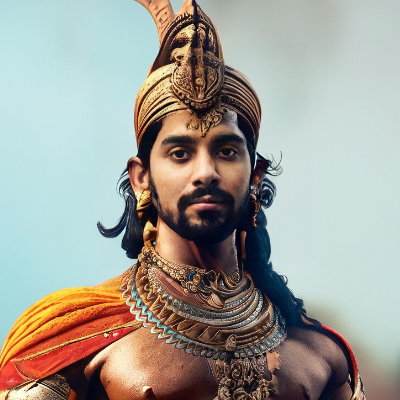
Vena is a king of the primordial lineage descending from Chakshusha Manu through Uru and Anga, and is one of the most dramatically narrated royal figures in the entire Bhagavata Purana. He is the son of King Anga — a righteous sovereign — and his wife Sunitha, who is identified as the daughter of Mrityu, the personification of Death. The Bhagavata Purana presents Vena as a being of mixed inheritance — born of a righteous father but fatally marked by the influence of his maternal grandfather Mrityu — whose initial promise as a king quickly gives way to a profound and destructive irreligion. He forbids all sacrifice and worship of the gods, declares himself the supreme deity deserving of all offerings, and oppresses the sages and the people with his arrogance and misrule. When his wickedness becomes irredeemable and the world falls into disorder and drought, the great sages kill him with their sacred grass blades charged with mantric power. His body is then churned by the sages — first producing a dark sinful dwarf-like being that represents the concentrated sinfulness of Vena's nature, and then producing the radiant and perfect sovereign Prithu, who is identified in the Vaishnava tradition as a partial avatara of Vishnu and regarded as the first true king of the earth, from whose name the earth herself receives the name Prithvi. Vena appears in the Bhagavata Purana, the Vishnu Purana, the Vayu Purana, the Matsya Purana, and the Mahabharata.
✦ The Name
The name Vena is ancient Sanskrit, connected to the root ven or related forms carrying associations with longing, desire, and love — the same root that gives the Sanskrit word for the veena, the stringed instrument whose name encodes the idea of vibration and the resonance of longing. In the Rigveda, vena appears as a name or epithet associated with a visionary seer or with the sun, and certain Vedic passages use the word in contexts of cosmic vision and illumination. As the name of this particular king in the Puranic tradition, however, the associations are almost entirely overshadowed by the narrative of his wickedness — Vena has become in the tradition synonymous with the perversion of royal power and the abuse of the sacred authority that kingship confers. The name's earlier Vedic associations with vision and longing give it a dimension of tragic irony in the Puranic context — Vena, whose name might encode the highest forms of aspiration and perception, becomes the exemplar of their most catastrophic inversion.
✦ Lineage
- Father: Anga, the righteous king and eponymous ancestor of the Anga kingdom, son of Uru and Agneyi, who performed his dharmic obligations with full conscientiousness, who was unable to correct his son's wickedness despite sustained effort, and who ultimately abandoned his kingdom in grief and disappeared into the forest as a renunciant.
- Mother: Sunitha, daughter of Mrityu — the divine personification of Death — whose parentage is identified in the Bhagavata Purana as the source of the fatal quality in Vena's nature. The text presents Vena's maternal inheritance from the lord of Death as the explanation for why a son born of a righteous father could develop such a destructive character — the darkness comes not from Anga's line but from Sunitha's.
- Maternal grandfather: Mrityu, the divine personification of Death in the Puranic tradition — not a demon or an asura but a cosmic principle given divine form, the inevitable end of all embodied existence.
- Paternal grandfather: Uru, son of Chakshusha Manu and Agneyi.
- Paternal great-grandfather: Chakshusha Manu, the sixth Manu, presiding sovereign of the sixth manvantara.
- Son: Prithu, produced by the churning of Vena's body after Vena's death at the hands of the sages — born not through normal biological generation but through a cosmic act of purification and creative power. Prithu is identified in the Vaishnava tradition as a partial avatara of Vishnu, the first true sovereign of the earth, whose name is given to the earth herself as Prithvi, and whose narrative occupies several of the most celebrated chapters of the Bhagavata Purana's fourth skandha.
✦ The Nature of Vena — Mixed Inheritance and Initial Promise
The Bhagavata Purana is careful to establish that Vena is not simply a villain of uncomplicated wickedness but a figure of tragic mixed nature. His birth is described as an event perceived with foreboding by the seers — they observe in him at birth both great qualities inherited from his father Anga's righteous line and a dark and destructive quality inherited from his maternal grandfather Mrityu. This dual inheritance is the Bhagavata Purana's theological framing for the tragedy that follows — Vena's destruction is not arbitrary but is the working out of karmic inheritance that his birth already carries.
In his early years as king, Vena showed some of the qualities of his better inheritance. He was powerful, effective in governance, and capable of maintaining order. The Bhagavata Purana notes that during the period of his early reign the world was free from certain dangers — robbers and thieves were suppressed, and there was a degree of order in the kingdom. But the darker qualities of his nature progressively asserted themselves, and as they did the better qualities were overwhelmed. His pride inflated, his sense of his own divinity grew, and his contempt for all authority — human, brahminical, and divine — deepened until it became the defining characteristic of his kingship.
✦ The Declaration of Supreme Divinity and the Suppression of Sacrifice
The central act of Vena's misrule — the act that renders him irredeemable in the eyes of the sages and precipitates his destruction — is his declaration that he alone is the supreme deity and his consequent prohibition of all sacrifice and worship directed toward the gods. The Bhagavata Purana narrates that Vena issued a royal proclamation throughout his kingdom forbidding all yajna, all sacrifice, all giving of gifts to brahmins, and all worship of the gods. He declared that there was no deity superior to the king, that the gods existed only because of the king's grace and will, and that all offerings and all forms of devotion should henceforth be directed to him alone.
The great sages — led by figures including Atri, Bhrigu, and other Maharishis — came to Vena and attempted to reason with him, remonstrating gently at first and then with increasing directness. They pointed out that a king's prosperity, power, and authority derive entirely from the divine order — from the gods, the Vedas, and the sacrificial system — and that a king who suppresses sacrifice undermines the very source of his own power. They offered him instruction in the proper relationship between kingship and dharma. Vena, inflated beyond the reach of counsel, dismissed them contemptuously and refused to modify his position. The sages returned repeatedly, each time receiving the same contemptuous dismissal. With each repetition of his arrogance, Vena's sinfulness accumulated further and his body began to display the signs of advanced spiritual degradation.
✦ The Death of Vena
When all attempts at instruction and remonstrance had failed and Vena's misrule had progressed to the point where the world was falling into disorder — the Bhagavata Purana describes clouds ceasing to rain, the earth withholding her crops, and cosmic disruption spreading through the natural order as a consequence of the suppression of sacrifice — the great sages convened and reached a momentous decision. They resolved that Vena must be killed. The Bhagavata Purana narrates that the sages raised their sacred grass blades — the kusha grass used in Vedic ritual, which when charged with mantric power becomes a lethal weapon — and struck Vena with them, uttering the mantric syllables that carried the accumulated power of their austerities. Vena fell dead.
The Bhagavata Purana presents the sages' killing of Vena as a dharmic act — not murder but the righteous removal of a king who had forfeited all claim to sovereignty by his destruction of the sacrificial order and his oppression of the righteous. The king's authority in the Hindu tradition derives from his adherence to dharma and his protection of the sacrificial and social order — a king who actively destroys these is no longer a king in any meaningful sense and his removal becomes not merely permissible but necessary for the restoration of cosmic order.
✦ The Churning of Vena's Body and the Birth of Prithu
After Vena's death the kingdom was without a king. The sages, aware that the absence of a king creates its own disorder — robbers multiplied, the unprotected were preyed upon, the natural order deteriorated further — recognised that a new sovereign must be produced. They looked at Vena's body lying before them and decided to churn it, as the gods and demons had churned the cosmic ocean in the Samudra Manthan, to extract from it whatever good might remain within the concentrated sinfulness of the dead king.
The sages first churned the thigh of Vena's body. From the thigh emerged a dark, short, and sinister figure — described as resembling a charred post, dark-skinned and malformed, with flat features and short limbs. This figure is the concentrated sinfulness of Vena's accumulated wickedness, extracted and given form by the churning. The sages addressed this figure and told him to sit — nishida, sit down — and he sat, and in sitting he became a Nishada, the ancestor of the hunter and forest-dwelling peoples. The negative karmic inheritance of Vena was thus extracted and deposited in a separate lineage rather than being allowed to contaminate whatever positive residue remained in the body.
The sages then churned the arms of Vena's body. From the arms emerged a being of extraordinary radiance and perfection — a man of magnificent physique, resplendent with divine marks, bearing the weapons and ornaments of supreme sovereignty, glowing with the lustre of ten thousand suns. This being was Prithu — born from the residual goodness of Vena's lineage, purified and concentrated by the extraction of the sinfulness in the earlier churning, and identified by the Vaishnava tradition as a partial avatara of Vishnu who had chosen to descend into the world through this extraordinary mode of birth. Prithu's birth from Vena's body rather than through normal biological generation is the Bhagavata Purana's most dramatic illustration of the principle that divine grace can produce the highest good even from the most corrupt material — that the vessel of Vena's wickedness, once cleansed, can become the vehicle for a manifestation of the supreme deity.
✦ Textual Variants
The story of Vena appears in the Bhagavata Purana, the Vishnu Purana, the Vayu Purana, the Matsya Purana, and the Mahabharata, with varying degrees of detail and certain narrative differences. The Vishnu Purana's account of Vena is broadly consistent with the Bhagavata Purana's but is less narratively elaborate. The Vayu Purana and Matsya Purana include Vena in their genealogical and narrative registers with further variations. The Mahabharata references Vena in its sections on royal dharma as an exemplary case of a king who abused his authority — using the story as a cautionary illustration rather than narrating it in full. The specific details of the churning episode — the order in which different parts of the body are churned, the precise description of the beings that emerge — vary somewhat across the sources, but the core narrative of Vena's wickedness, his death at the hands of the sages, and the birth of Prithu from his churned body is consistent across all of them.
✦ Theological and Philosophical Significance
Vena's story is one of the Bhagavata Purana's most sustained theological meditations on the nature of kingship, dharma, and the relationship between royal authority and divine order. Several distinct theological teachings are embedded in the narrative. The first concerns the source and limits of royal authority — Vena's fundamental error is his claim that the king is the supreme deity, that all worship is owed to him, and that the sacrificial order exists to serve the king rather than the king existing to serve the sacrificial order. The Bhagavata Purana presents this as the most profound possible inversion of the proper dharmic relationship between kingship and the divine — the king who claims divinity for himself has misunderstood the nature of the power he has been entrusted with and has transformed a sacred trust into an instrument of ego and oppression.
The second teaching concerns the relationship between karma, heredity, and individual nature. The Bhagavata Purana's presentation of Vena as a being of mixed inheritance — good from Anga's righteous line, dark from Mrityu's — and the subsequent separation of this mixed inheritance in the churning episode into a sinful being and a divine sovereign, illustrates the text's understanding of how karmic tendencies can be concentrated, separated, and redirected through the power of dharmic action and divine grace. Vena himself cannot be saved — his darkness is too deeply constitutive of his being — but the goodness within him is not lost; it is extracted and given its highest possible expression in Prithu.
The third teaching concerns the sages' authority to remove a wicked king. The Bhagavata Purana presents the killing of Vena as entirely justified — necessary, dharmic, and ultimately generative of the highest good. This teaching has significant implications for the tradition's understanding of the relationship between brahminical authority and royal power — the sages who kill Vena are not rebels or criminals but the guardians of the cosmic order whose authority supersedes that of even a crowned king when that king has forfeited his dharmic standing through his own actions.
✦ References
Primary Sources
- Bhagavata Purana, Skandha 4, Chapters 14–15: The principal and most detailed source for Vena's narrative; covers his birth and mixed nature, his early kingship, his declaration of supreme divinity and suppression of sacrifice, the sages' remonstrance, his death at the hands of the sages, the churning of his body, the emergence of the Nishada ancestor, and the birth of Prithu from his arms.
- Vishnu Purana, Book 1, sections on Anga's lineage: Provides a parallel account of the Vena narrative with some variation in detail; broadly consistent with the Bhagavata Purana's version.
- Vayu Purana, sections on the descendants of Chakshusha Manu: Includes Vena in the genealogical and narrative register with its own account of the episode.
- Matsya Purana, sections on primordial kings: References Vena and the episode of the birth of Prithu.
- Mahabharata, Shanti Parva, sections on rajadharma: References Vena as a cautionary example of a king who abused royal authority and suppressed the sacrificial order; uses the story as an illustration in the context of the broader discussion of the duties and limits of kingship.
Modern Reference Works
- Vettam Mani, Puranic Encyclopaedia (Motilal Banarsidass, 1975), entries on Vena and Prithu: Synthesises the Puranic and epic material on Vena's story and the birth of Prithu; addresses the theological significance of the churning episode and the Nishada origin narrative.
- Ganesh Vasudeo Tagare (trans.), Bhagavata Purana, Part 2 (Motilal Banarsidass, 1976): Critical translation of the fourth skandha including the complete Vena and Prithu narrative; the notes address the theological significance of Vena's wickedness, his death, and the churning episode in the context of the Bhagavata Purana's devotional theology.
- Alf Hiltebeitel, Dharma: Its Early History in Law, Religion, and Narrative (Oxford University Press, 2011): Addresses the Vena episode in the context of the Hindu tradition's understanding of dharmic kingship and the relationship between royal authority and brahminical power.
- Wendy Doniger O'Flaherty, The Origins of Evil in Hindu Mythology (University of California Press, 1976): Addresses the Vena episode as one of the Puranic tradition's most significant narratives of the origin and nature of evil, the mixed inheritance of sinfulness and goodness, and the creative potential of destruction.
- F. E. Pargiter, Ancient Indian Historical Tradition (Oxford University Press, 1922): Analyses the Puranic genealogical lists for the descendants of Chakshusha Manu and addresses the Vena episode in the comparative context of the major Puranic sources.