
About
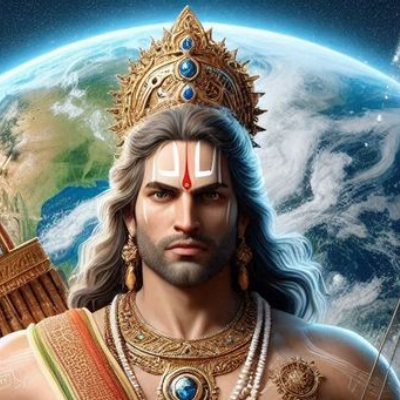
Prithu — The First True King, Partial Avatara of Vishnu, Son of Vena, Namer of the Earth
Prithu · Prithu Vainya · Vena-putra · Prithvi-data · Chakravarti · Vishnu-amsha-avatara · Archi-pati
Prithu is one of the most celebrated and extensively narrated royal figures in the entire Puranic tradition, regarded as the first true sovereign of the earth and identified in the Vaishnava tradition as a partial avatara of Vishnu. He is born not through biological generation but through the extraordinary act of the sages churning the arms of the dead wicked king Vena — his father by the conventions of dynastic descent but not his biological progenitor in the normal sense — after Vena's misrule and death had left the world without a king and plunged it into disorder. From Vena's arms Prithu emerges in full royal splendour, bearing the divine marks of sovereignty and the lustre of ten thousand suns. His name is given to the earth herself — the earth is called Prithvi, meaning the earth of Prithu or the wide earth, because Prithu was the first to make the earth yield her produce through his act of milking her in the form of a cow when she withheld her bounty from the world. He is described in the Bhagavata Purana, the Vishnu Purana, the Vayu Purana, the Matsya Purana, the Markandeya Purana, and the Mahabharata. His narrative in the Bhagavata Purana's fourth skandha is the most extensive treatment of any single royal figure in that skandha, encompassing his birth, coronation, conflict with the earth-goddess, the milking of the earth, his hundred horse sacrifices, philosophical discourses received from Sanatkumara and Brahma, his encounter with the four Kumaras, and his final liberation. He is married to Archi, whose devotion is so absolute that she immolates herself on his funeral pyre and is celebrated as one of the tradition's paradigmatic devoted wives.
✦ The Name
The name Prithu is Sanskrit, derived from the root prith or prath meaning to be wide, to spread, to expand, or to become great. Prithu means the wide one, the broad one, the great one, or the one who spreads in all directions — encoding both physical expansiveness and the greatness of sovereign power that extends across the entire earth. The derivation is directly connected to the name Prithvi — the earth — which means the wide one or the broad one, and the Bhagavata Purana's explanation that the earth received this name from Prithu because he was the first to cultivate and develop her connects the king's name to the earth's name in an aetiological relationship of the most fundamental kind. Prithu is thus not merely a king who rules the earth but the figure through whose action and name the earth herself receives her identity and her fertility. The epithet Vainya — meaning son of Vena — is applied to Prithu throughout the Bhagavata Purana as a patronymic, a usage that carries a certain theological weight since Vena was one of the tradition's most notorious wicked kings, and the patronymic reminds the reader of the extraordinary creative reversal by which the greatest of kings was born from the body of one of the worst.
✦ Lineage
- Born of: Vena, the wicked king whose misrule prompted the great sages to kill him with their mantric power and whose body was subsequently churned to produce first a sinful Nishada ancestor and then Prithu from the arms. Vena is Prithu's father in the dynastic sense — Prithu is the legitimate heir of Vena's royal lineage — but his birth was not through normal biological generation.
- Dynastic lineage through Vena: Anga, son of Uru; Uru, son of Chakshusha Manu; Chakshusha Manu, son of Ripu; Ripu, son of Shilisti; Shilisti, son of Dhruva; Dhruva, son of Uttanapada; Uttanapada, son of Svayambhuva Manu Prajapati; Svayambhuva Manu Prajapati, mind-born son of Brahma.
- Divine identity: Identified in the Bhagavata Purana as an amsha — a partial manifestation or avatara — of Vishnu, the supreme deity of the Vaishnava tradition. His birth from Vena's churned arms is presented in the text as a deliberate divine descent — Vishnu entering the world through this extraordinary mode of incarnation to restore the dharmic order that Vena's misrule had destroyed. The Bhagavata Purana states explicitly that Prithu bore the marks of Vishnu on his body — the Shrivatsa mark on his chest, the lotus footprint on his feet, and the divine lustre that identifies an avatara.
- Wife: Archi, a woman of extraordinary devotion described in the Bhagavata Purana as completely absorbed in the service of her husband. Archi immolates herself on Prithu's funeral pyre after his death — not out of grief or social pressure but out of the completeness of her devotion and her desire to follow her husband into whatever realm he has entered. The Bhagavata Purana narrates her immolation with great beauty and presents her as one of the tradition's supreme exemplars of pativrata — devoted wifeliness — whose liberation is the direct consequence of her total absorption in her husband's service.
- Sons: The Bhagavata Purana and Vishnu Purana name five sons of Prithu and Archi — Vijitashva, Haryaksha, Dhumraksha, Vrika, and Dravina in certain lists, though the names vary somewhat across different Puranic recensions.
✦ The Birth and Coronation
The Bhagavata Purana narrates Prithu's emergence from the churning of Vena's arms with considerable dramatic power. As the sages churned the arms, first a dark sinful being emerged from the right thigh — the Nishada ancestor, in whom the concentrated sinfulness of Vena was deposited and removed. Then from the arms emerged Prithu, radiant and perfect, bearing in his right hand a bow and in his left a bow, and already wearing the divine marks that identified him as a being of supreme spiritual and royal stature. The gods rained flowers upon him. Celestial musicians played. The sages offered praises. Every divine being recognised in him the partial descent of Vishnu — his lustre, his marks, his very presence communicated that this was no ordinary king but the divine itself taking royal form.
The coronation of Prithu is described as an event of universal cosmic significance. All the beings of the three worlds participated in some way — the gods brought gifts, the sages offered blessings and instruction, the Gandharvas sang, the Apsaras danced, the great serpents and the celestial beings each contributed to the celebration. Brahma himself presided and gave Prithu the title of chakravarti — universal sovereign — and the instruments of sovereignty. The earth-goddess, recognising the new king's divine nature, is described as trembling with both awe and relief — but this relief would be short-lived, as Prithu and the earth were soon to be in conflict.
✦ The Conflict with the Earth and the Milking
After Vena's misrule and death and during the period without a king, the earth had withdrawn her produce — crops failed, plants withheld their fruits, the cows gave no milk, and the world faced famine. When Prithu was crowned and the world rejoiced, the people came to him hungry and asked him to command the earth to give her produce. Prithu turned to the earth-goddess — Prithvi, or Bhumi — and asked her to release her bounty. The earth, in the form of a cow, refused and fled. The Bhagavata Purana narrates a remarkable episode in which Prithu pursued the earth-goddess across the cosmos, his bow raised, threatening to kill her if she did not yield. The earth-goddess, unable to escape the first true sovereign, finally turned and spoke to him — explaining that she had withheld her produce because the wicked Vena's misrule had made it impossible to maintain the sacred relationship between the earth and her inhabitants, and that the seeds and plants and minerals had been absorbed into her body for their own protection.
Prithu and the earth then negotiated — the Bhagavata Purana presents this as a genuine dialogue between the sovereign and the earth, a negotiation of the terms of the relationship between the ruler and the land he rules. Prithu promised to protect the earth and her inhabitants, to level her surface where it was uneven, to dig channels for water, to establish cities and villages in ordered patterns, and to maintain the conditions under which the earth could give her produce generously. The earth agreed, and the milking ceremony took place — a cosmic milking in which various beings used various calves and vessels to receive the earth's different forms of produce. The gods milked amrita and other divine substances. The sages milked the power of the Vedic mantras. The ancestors milked their offerings. The humans milked grain and other foods. Each category of being milked from the earth cow exactly the produce appropriate to their nature and needs, and from this act the earth's productivity was restored and the ordered relationship between the sovereign and the land was established for the first time.
The Bhagavata Purana draws from this episode one of its most important teachings about the nature of kingship — the relationship between a king and his kingdom is not one of simple ownership or domination but a covenant of mutual obligation. The earth gives her produce because the king promises protection, order, and the maintenance of the conditions under which life can flourish. When either party fails — as Vena had failed — the covenant breaks down and the earth withholds. Prithu's restoration of the covenant is presented as his most fundamental act of kingship, the one from which all other aspects of his sovereignty derive their legitimacy.
✦ The Hundred Horse Sacrifices and Indra's Interference
Prithu performed ninety-nine horse sacrifices — the Ashvamedha, the royal sacrifice of a horse that asserts the universal sovereignty of the performing king and whose completion in a full hundred gives the performer a status rivalling that of Indra, the king of the gods. As Prithu approached the completion of his hundredth sacrifice, Indra became alarmed — a king who completes a hundred Ashvamedhas acquires the right to Indra's throne in the heavens, and Indra perceived this as a threat to his sovereignty. He therefore intervened, stealing the sacrificial horse on three occasions to prevent the completion of the hundredth sacrifice. Each time the horse was stolen, Prithu's son Vijitashva — also known as Antarddhana in certain accounts — pursued Indra and attempted to recover it. The Bhagavata Purana narrates these three episodes with increasing dramatic intensity.
On the third occasion, Brahma intervened and counselled Prithu to desist from the pursuit of the hundredth sacrifice, explaining that ninety-nine completed Ashvamedhas already constituted a supreme achievement and that the rivalry with Indra served no dharmic purpose. Prithu, in an act of profound equanimity and spiritual wisdom, accepted Brahma's counsel without resentment and abandoned the plan to complete the hundredth sacrifice. The Bhagavata Purana presents this acceptance — this willingness to release attachment to an achievement at the moment of its near-completion, at the counsel of a teacher — as itself a mark of Prithu's spiritual greatness, a demonstration that he was not pursuing the horse sacrifices out of personal ambition but out of dharmic duty, and that the moment a higher dharmic consideration supervened he could release the attachment without inner conflict.
✦ The Discourse of Sanatkumara and the Encounter with the Kumaras
The Bhagavata Purana devotes considerable space to the philosophical and devotional instruction that Prithu receives during his life. The sage Sanatkumara — one of the four Kumaras, the eternal celibate sons of Brahma who appear throughout the Puranic tradition as teachers of the highest philosophical wisdom — delivers to Prithu a discourse on the nature of the self, the binding power of the gunas, and the path to liberation through devotion to Vishnu. This discourse is one of the Bhagavata Purana's major philosophical passages in the fourth skandha and is presented as the culminating spiritual instruction of Prithu's life as a householder-king — the knowledge that prepares him for the renunciation that follows.
Prithu also encounters all four Kumaras — Sanaka, Sanandana, Sanatana, and Sanatkumara — at his court, and the encounter is described with great reverence. The Kumaras are eternal children in appearance, perpetually five years old, of unimaginable spiritual accomplishment — beings who chose celibacy and renunciation from the very beginning of creation and who have never been bound by worldly attachment. Their presence at Prithu's court is an act of grace toward the king, and Prithu's reception of them and his complete absorption in their teaching is presented as the final stage of his transition from a householder-king to a being ready for liberation.
✦ Renunciation, Liberation, and Archi's Immolation
After completing his duties as a king — establishing order, restoring the earth's productivity, performing the great sacrifices, receiving the highest philosophical instruction — Prithu installed his sons as heirs and departed with his wife Archi for the forest to undertake the vanaprastha stage of life, the forest-dwelling retirement of a householder who has completed his worldly obligations. In the forest he progressively reduced his food, his activities, and his engagement with the world, entering the path of complete renunciation. The Bhagavata Purana narrates his final austerities with great intensity — he gradually ceased to eat, ceased to drink, stood on one leg as Dhruva his ancestor had done, and absorbed his consciousness entirely in the meditation on Vishnu. At the culmination of this practice he attained liberation — his individual consciousness merged into or was united with the supreme — and his body fell.
Archi, witnessing her husband's liberation, did not grieve. The Bhagavata Purana describes her as recognising that her husband had attained the highest goal, and that her own purpose in this life — her dharma as his devoted wife — had been completely fulfilled through his liberation. She gathered wood, built a funeral pyre, bathed, adorned herself, offered worship, and circumambulated her husband's body with deep reverence before ascending the pyre herself and immolating herself in the flames. The Bhagavata Purana describes celestial flowers raining on her as she burned, the gods and sages celebrating her extraordinary devotion, and her ascent to the realm where Prithu had gone — following her husband into the highest state through the completeness of her devotion. Her immolation is presented not as a sacrifice of her life but as the natural completion of a devotion so total that her continued existence without its object had no meaning.
✦ Prithu as the First King — The Establishment of Civilisation
The Bhagavata Purana's presentation of Prithu as the first true king encodes a broader claim about the origin of civilisation itself. Before Prithu, the text implies, the earth was unorganised — there were no towns or villages, no roads, no fields, no distinctions between cultivated and wild land. It was Prithu who first levelled the earth, established towns and villages in ordered patterns, dug roads and channels, organised the distribution of land, and created the infrastructure of settled civilisation. The milking of the earth is not merely a mythological episode but an aetiological account of the first act of agriculture — the first systematic extraction of the earth's produce through organised human effort under the direction of a sovereign.
This dimension of Prithu's narrative makes him one of the tradition's foundational culture-heroes — alongside figures like Manu, who establishes the social and ritual order, and Vyasa, who compiles and organises the Vedic and Puranic knowledge. Prithu's specific contribution is the organisation of the relationship between humanity and the earth — the first sovereignty, the first agriculture, the first systematic settlement of the land. That this act is encoded in the image of milking — a deeply domestic and nurturing act — rather than in the image of conquest or dominion, gives the Puranic conception of the relationship between sovereignty and the earth a quality of covenant and care rather than of ownership and exploitation.
✦ Theological and Philosophical Significance
Prithu's theological significance operates simultaneously on the avataric, the political, and the soteriological levels. As a partial avatara of Vishnu he demonstrates the Bhagavata Purana's teaching that Vishnu descends into the world whenever the dharmic order is threatened — Vena's misrule had created exactly the conditions that necessitate divine intervention, and Prithu's birth from Vena's churned body is the most dramatic illustration in the entire text of the principle that divine grace can extract the highest good even from the most corrupt material. As the first true king he establishes the model of righteous sovereignty that all subsequent kings in the tradition are measured against — his covenant with the earth, his performance of the great sacrifices, his acceptance of instruction from teachers, his equanimity in releasing the hundredth sacrifice, and his final renunciation constitute the complete portrait of the ideal dharmic king. As a liberated soul he demonstrates that the householder-king path — the path of active engagement with the world, the performance of duty, the completion of obligations — can lead to liberation when pursued with the right orientation, the right teachers, and ultimately the willingness to release everything at the appropriate time.
✦ Textual Variants
The story of Prithu is one of the most widely distributed narratives in the Puranic tradition and appears in the Bhagavata Purana, Vishnu Purana, Vayu Purana, Matsya Purana, Markandeya Purana, and Mahabharata with varying degrees of detail and certain narrative differences. The Bhagavata Purana's account is the most philosophically and narratively elaborate, devoting the most chapters to the story and giving the fullest treatment of the discourses Prithu receives. The Vishnu Purana's account is substantial but less narratively expansive. The Vayu Purana and Matsya Purana include the story in their genealogical and narrative registers with their own variations. The Mahabharata's references to Prithu are primarily in the context of discussions of dharmic kingship rather than as a full narrative. The names of Prithu's sons, the specific details of the milking episode, and certain elements of the discourse sections vary across the sources, but the core narrative — birth from Vena's arms, milking of the earth, hundred sacrifices, instruction by sages, renunciation, and liberation — is consistent across all the major sources.
✦ Connection to the Wider Genealogy
Through his dynastic lineage Prithu is connected upward to the entire primordial genealogy of the current cosmic cycle — through Vena to Anga, through Anga to Uru, through Uru to Chakshusha Manu, through Chakshusha to Ripu and Shilisti and Dhruva, through Dhruva to Uttanapada and Svayambhuva Manu Prajapati, and ultimately to Brahma himself. Through his sons the lineage continues downward into the further generations of the primordial Solar tradition. Through the earth's naming — Prithvi — Prithu is connected to the most fundamental geographical and cosmological vocabulary of the entire tradition, his name embedded in the Sanskrit word for the earth itself. And through his identification as a Vishnu avatara he is connected to the entire avataric theology of the Vaishnava tradition, standing in the sequence of divine descents that includes figures from the Fish avatara and the Tortoise through Narasimha, Vamana, Parashurama, Rama, Krishna, and beyond.
✦ References
Primary Sources
- Bhagavata Purana, Skandha 4, Chapters 15–23: The principal and most detailed source for Prithu's complete narrative; covers his birth from Vena's churned arms, his coronation, his conflict with the earth-goddess and the milking, the hundred horse sacrifices and Indra's interference, the discourses of Sanatkumara and Brahma, the encounter with the four Kumaras, his renunciation, his liberation, and Archi's immolation.
- Vishnu Purana, Book 1, sections on the lineage of Chakshusha Manu: Provides a substantial parallel account of Prithu's narrative with some variation in detail; broadly consistent with the Bhagavata Purana's version.
- Vayu Purana, sections on primordial kings: Includes the Prithu narrative in its genealogical and narrative registers.
- Matsya Purana, sections on primordial sovereigns: References Prithu and the milking episode as part of its genealogical and narrative material.
- Markandeya Purana, sections on righteous kings: Includes material on Prithu in the context of its discussions of dharmic sovereignty.
- Mahabharata, Shanti Parva, sections on rajadharma: References Prithu as the paradigmatic righteous king and the establisher of the proper relationship between sovereignty and the earth; uses his story as a touchstone in the broader discussion of the duties and ideals of kingship.
Modern Reference Works
- Vettam Mani, Puranic Encyclopaedia (Motilal Banarsidass, 1975), entries on Prithu and Archi: Synthesises the Puranic and epic material on Prithu's identity, narrative, theological significance, and genealogical connections; addresses the avatara identification and the naming of the earth.
- Ganesh Vasudeo Tagare (trans.), Bhagavata Purana, Part 2 (Motilal Banarsidass, 1976): Critical translation of the fourth skandha including the complete Prithu narrative; the notes address the theological significance of each major episode — the birth, the milking, the sacrifices, the discourses, and the renunciation — in the context of the Bhagavata Purana's devotional theology.
- Wendy Doniger O'Flaherty, The Origins of Evil in Hindu Mythology (University of California Press, 1976): Addresses the Vena-Prithu episode as one of the Puranic tradition's most significant narratives of the creative potential of destruction and the extraction of the highest good from the most corrupt source.
- Alf Hiltebeitel, Dharma: Its Early History in Law, Religion, and Narrative (Oxford University Press, 2011): Addresses the Prithu episode in the context of the Hindu tradition's understanding of dharmic kingship, the covenant between the sovereign and the earth, and the relationship between royal authority and cosmic order.
- F. E. Pargiter, Ancient Indian Historical Tradition (Oxford University Press, 1922): Analyses the Puranic genealogical lists for the descendants of Chakshusha Manu and addresses the Prithu narrative in the comparative context of the major Puranic sources.
- Edwin Bryant, Krishna: A Sourcebook (Oxford University Press, 2007): Addresses the Bhagavata Purana's avatara theology within which Prithu's identification as a partial descent of Vishnu is situated and provides relevant comparative context for understanding the avataric significance of his birth and kingship.