
About
Markandeya — Immortal Sage of the Bhrigu Lineage, Conqueror of Death
Markandeya · Mrityunjaya · Chiranjeevi · Markandeyamuni · Bhargava
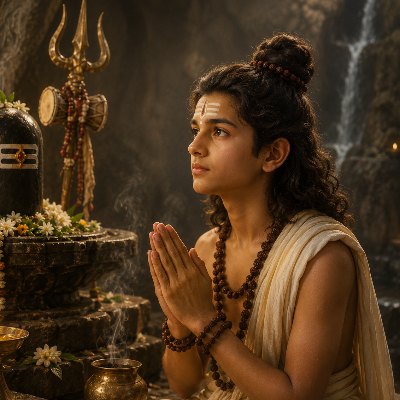
Markandeya is one of the most celebrated sages in the entire Hindu Puranic and epic tradition — a Brahmarshi of the Bhrigu lineage, devotee of both Shiva and Vishnu, and the eighth of the Ashta-Chiranjeevis, the eight immortal beings of the tradition who are held to persist through the ages until the end of the present cosmic cycle. He is the son of the sage Mrikandu — himself a son of Vidhata and Niyati, and a descendant of Bhrigu — and his mother is named Manasvini in the Markandeya Purana and Marudvati or Marudmati in other Puranic and narrative sources. He is the father of the sage Vedasiras, through whom the Bhrigu lineage continued. Markandeya appears prominently in the Markandeya Purana — one of the eighteen Mahapuranas, which bears his name — in the Mahabharata, in the Bhagavata Purana, in the Siva Purana, in the Skanda Purana, and in the Vishnu Purana. His narrative spans the themes of predestined death overcome through devotion, direct vision of cosmic dissolution, and the transmission of theological and cosmological knowledge across multiple traditions.
✦ The Name
The name Markandeya is a patronymic derived from Mrikandu — his father's name — with the suffix eya indicating descent or belonging. The name therefore means he who is of Mrikandu, or descendant of Mrikandu. This is a standard Sanskrit patronymic formation and places the sage's identity directly in his lineage. He is also referred to by the epithet Mrityunjaya, meaning conqueror of death or one who has overcome Mrityu — death personified — a title that directly commemorates the defining event of his life. As a descendant of Bhrigu, he carries the clan designation Bhargava, which is used across the Puranic tradition to identify members of Bhrigu's lineage. The term Chiranjeevi, meaning long-lived or one who lives for an immense span of time, is applied to him as one of the eight such beings recognised in the tradition.
✦ Lineage
- Great-great-grandfather: Brahma, the creator deity and source of the primordial sage lineages.
- Great-grandfather: Bhrigu, a mind-born son of Brahma, one of the Saptarishis, and the founding patriarch of the Bhrigu gotra — one of the most distinguished sage-clans of the Puranic world. His wife was Khyati, daughter of Daksha the Prajapati.
- Paternal grandfather: Vidhata (also Vidhatri), son of Bhrigu and Khyati. His name means the ordainer or disposer of destiny. He married Niyati, a daughter of Mount Meru — the cosmic mountain at the centre of the Puranic universe. Niyati's name means fate or fixed law.
- Father: Mrikandu (also Mrikanda or Mrukandu), son of Vidhata and Niyati, a Brahmarshi celebrated for his devotion to Shiva and for his choice — when offered a boon — of a brilliant but short-lived son over a long-lived but inferior one.
- Mother: Named Manasvini in the Markandeya Purana, and Marudvati or Marudmati in most other Puranic and narrative sources. She is a full participant in the austerities through which Markandeya's birth was obtained.
- Son: Vedasiras, recorded in the Vishnu Purana as the son of Markandeya, through whom the Bhrigu lineage descended further. The Brahmanda Purana records that Vedasiras's sons, born through his wife Pivari, were known collectively as the Markandeyas — descendants of Mrikandu — and were masters of the Vedas. The Bhagavata Purana in one passage places Vedasiras as the son of Prana rather than of Markandeya, which constitutes a variant that is addressed in the section on textual inconsistencies below.
✦ Birth and Predestined Death
Mrikandu and Marudvati were childless for a long time and performed sustained austerities directed toward Shiva. Shiva, pleased with their devotion, offered Mrikandu a choice between two sons: one of dull intellect and base character who would live a long life, and one of exceptional wisdom, virtue, and spiritual brilliance who would live only sixteen years. Mrikandu chose the second. The son born of this boon was Markandeya. He grew up in the forest hermitage of his parents and mastered the Vedas and sacred learning at a young age, fulfilling entirely the description under which he had been granted.
✦ The Conquest of Death — Shiva as Kalantaka
As Markandeya's sixteenth year drew to its close and his parents fell into profound grief, the boy pressed them for the cause of their sorrow. When they revealed to him the terms of the boon and the fate that had been ordained for him, Markandeya consoled them and resolved to seek Shiva's protection absolutely. He placed himself before a Shivalinga in unwavering devotion and worship.
At the appointed moment, Yama — the god of death and cosmic justice, son of the sun god Surya — arrived to claim Markandeya's life. The messengers of Yama are described in several accounts as unable to approach the sage on account of his spiritual intensity, after which Yama came personally. Yama threw his noose, but it fell around both the sage and the Shivalinga he was embracing. Shiva erupted from the Shivalinga in his terrible form as Kalantaka — the conqueror of time and death — and struck Yama down, defeating him. Upon the entreaty of the assembled gods, Shiva restored Yama to life and granted Markandeya the boon of immortality at the age of sixteen. This narrative is the central account in the Siva Purana, the Skanda Purana, and related Shaiva texts, and a version of it also appears in the Mahabharata.
From this episode derives the Mahamrityunjaya Mantra — the great mantra for the conquest of death, dedicated to Shiva — which the tradition closely associates with Markandeya as its recipient and master. The mantra is found in the Rigveda attributed to the sage Vasishtha in the Vedic context, but in the Puranic and popular tradition it is Markandeya who is most consistently identified as the sage through whom it was transmitted and made known.
✦ The Chiranjeevi Status
Markandeya is listed as the eighth of the Ashta-Chiranjeevis — the eight long-lived or immortal beings of the Hindu tradition. The traditional verse enumerating them names seven first — Ashwatthama, Bali, Vyasa, Hanuman, Vibhishana, Kripacharya, and Parashurama — and then names Markandeya as the eighth. The verse is widely known across traditions as a daily recitation believed to confer longevity. Markandeya's immortality is the direct result of Shiva's boon at the moment of his would-be death, and unlike some of the other Chiranjeevis whose immortality carries conditions or constitutes a form of divine punishment, his is an unambiguous reward for devotion. He is described across Puranic texts as appearing in the form of a youth of approximately sixteen years regardless of the ages through which he passes.
✦ The Vision of Cosmic Dissolution
One of the most theologically significant episodes associated with Markandeya in the Puranic corpus is his vision of the pralaya — cosmic dissolution — and his encounter with Vishnu in the form of a divine infant. The account is preserved in the Mahabharata's Vana Parva and elaborated in the Bhagavata Purana. Wandering alone during a period of cosmic dissolution when the universe had been submerged in a boundless ocean of darkness, Markandeya beheld a luminous infant floating on a large banyan leaf amid the waters. The infant — understood in the tradition as a manifestation of Vishnu or Narayana in the form known as Vatapatrasayi or Bala Mukunda — drew Markandeya into his mouth as he inhaled. Inside the body of the divine child, the sage beheld the entire universe intact — stars, mountains, oceans, rivers, and his own hermitage — undisturbed within the being who outwardly appeared as an infant floating on a leaf above the waters of dissolution. The child then exhaled the sage back into the flooded world. The episode teaches that the entire universe subsists within the Supreme Being and that what appears as cosmic annihilation is in fact contained within the divine.
The Mahabharata account of this vision is situated in the Vana Parva during the period when the Pandavas — the five sons of Pandu who are the heroes of the epic — were living in forest exile after the disastrous dice game orchestrated by their Kaurava cousins. In this account, the cosmic vision takes the form of Markandeya narrating or recounting the experience rather than experiencing it in the narrative present.
✦ Markandeya in the Mahabharata
Markandeya plays a substantial role in the Mahabharata, appearing most extensively in the Vana Parva — specifically the sub-section known as the Markandeya-Samasya Parva, spanning approximately chapters 182 through 232 of that book. He visits the Pandavas at their forest camp in the Kamyaka forest along with Krishna — the divine hero and eighth avatar of Vishnu, son of Vasudeva and Devaki — and the sage Narada. His function in this section of the epic is as a sage whose immense longevity across multiple cosmic cycles gives him a perspective inaccessible to ordinary beings. He addresses Yudhishthira — the eldest of the five Pandava brothers, son of Pandu and Kunti, devoted to dharma — who is suffering moral and existential anguish following the loss of his kingdom. Markandeya narrates stories of the Yugas, the description of the Kali age, the vision of cosmic dissolution, and the appearance of Bala Mukunda on the banyan leaf. His narrative presence in the epic is that of the cosmic witness whose testimony restores perspective in the face of suffering.
The Mahabharata describes him at his appearance in the Vana Parva as appearing to be no more than twenty-five years of age despite having witnessed many thousands of years of existence — a detail that directly reflects his immortal and eternally youthful state. He also appears briefly in the Udyoga Parva of the Mahabharata in related contexts.
✦ The Markandeya Purana
The Markandeya Purana is one of the eighteen Mahapuranas of Hinduism and is named for this sage. In its extant form of 137 chapters, the text opens with the Mimamsa philosopher Jaimini — a disciple of the sage Vyasa — approaching Markandeya with unresolved questions arising from the Mahabharata. Markandeya, pleading prior ritual obligations, directs Jaimini to four wise birds dwelling in the Vindhya range who repeat his teachings. The birds address Jaimini's questions through chapters four to forty-five. In later chapters, the sage himself resumes as the primary speaker. The Purana covers cosmology, the theory of the Yugas, genealogies of royal dynasties, dharma, karma, and devotional teachings that encompass Shaiva, Vaishnava, and Shakta traditions in a syncretic framework.
Chapters 81 through 93 of the Markandeya Purana constitute the Devi Mahatmya — also known as the Durga Saptashati or Chandi — the most important scriptural text of the Shakta tradition, celebrating the goddess Durga's victories over the demons Mahishasura, Shumbha, and Nishumbha, and establishing the goddess as the supreme power underlying all creation. Scholarly dating of the text, including work by Wendy Doniger and as noted by Thomas Coburn, places the Devi Mahatmya section as a later interpolation into the Markandeya Purana, composed between approximately the fourth and sixth centuries CE and added to a Purana whose earlier core is dated somewhat earlier. The Devi Mahatmya is not attributed to Markandeya as its author within the text itself — the narrator of its central sections is identified as the sage Medha — but its placement within the Markandeya Purana has caused it to be associated with him in the tradition. This distinction is recorded here as it is relevant to any attribution question.
✦ Textual Variants and Inconsistencies
The Vishnu Purana states clearly that Markandeya was the son of Mrikanda (Mrikandu) and that Vedasiras was the son of Markandeya. The Bhagavata Purana in Canto 4, however, places Vedasiras as the son of Prana — who is the son of Dhata and Ayati, the parallel branch of the Bhrigu lineage — rather than as the son of Markandeya. This is a genuine contradiction between two Mahapuranas: under the Vishnu Purana genealogy, Vedasiras descends through Vidhata's line via Mrikandu and Markandeya; under the Bhagavata Purana account, Vedasiras belongs to Dhata's line via Prana. The Brahmanda Purana further records that the sons of Vedasiras born through Pivari were called the Markandeyas collectively as descendants of Mrikandu, which suggests the Vishnu Purana line. The inconsistency across the Bhagavata and Vishnu Puranas on this point is unresolved in the primary sources.
A further variant concerns the mother's name. The Markandeya Purana names her Manasvini; the majority of other narrative Puranic sources call her Marudvati or Marudmati. These are treated as referring to the same person, but the discrepancy in name across primary sources is real.
Several versions of the boon narrative describe the choice as being between one hundred long-lived but foolish sons and one short-lived but virtuous son, while others present only a binary choice between two types of son without specifying the number one hundred. Both variants are found within the broader Puranic transmission.
✦ Theological Significance
Markandeya occupies a unique position in Hindu theology as a figure who is venerated across the three major devotional traditions — Shaiva, Vaishnava, and Shakta — without contradiction. His conquest of death establishes him as the supreme exemplar of Shaiva bhakti: the principle that absolute devotion to Shiva overcomes even cosmic fate. His vision of Bala Mukunda on the banyan leaf is one of the most iconic representations of Vaishnava cosmological theology: the universe dissolving into and subsisting within the Supreme Being who rests on the leaf of a banyan tree above the waters of dissolution. And the Devi Mahatmya, embedded in the Purana that bears his name, is the foundational text of Shakta goddess theology.
His function as a cosmic witness — a being who has persisted through the dissolution and renewal of the universe across multiple cycles — gives him a theological role that is rare even among the most elevated sages of the tradition. He does not merely teach about the cosmic order; he has witnessed it directly and personally, from within the body of the divine.
✦ Connection to the Wider Genealogy
Markandeya stands in the fifth generation from Brahma in the Bhrigu line: Brahma begat Bhrigu, Bhrigu begat Vidhata, Vidhata begat Mrikandu, and Mrikandu begat Markandeya. Through his son Vedasiras — per the Vishnu Purana — the Bhrigu lineage continued. His cousin in the parallel branch of the same family is Prana, son of Dhata and Ayati, through whom the line descended via Dyutiman and Rajavan. The two branches — Vidhata's through Mrikandu and Markandeya, and Dhata's through Prana — together constitute the primary continuation of the Bhrigu Vamsha from this generation as recorded in the Vishnu Purana.
✦ References
- Primary Sources:
- Vishnu Purana, Book I, Chapter 10: Establishes the genealogical line from Bhrigu through Vidhata and Mrikandu to Markandeya and Vedasiras; the primary genealogical source for this lineage.
- Markandeya Purana, all chapters: The Mahapurana bearing his name; the principal text associated with him, presenting him as the primary narrator in dialogue with Jaimini and containing the Devi Mahatmya (chapters 81–93) as an embedded section.
- Siva Purana, Rudra Samhita and Kotirudra Samhita: Principal Shaiva source for the narrative of the boon, Markandeya's birth, Yama's arrival, and Shiva's intervention as Kalantaka; the primary theological source for the conquest-of-death episode.
- Skanda Purana: Contains additional versions of the Markandeya birth and death-conquest narrative.
- Mahabharata, Vana Parva, Markandeya-Samasya Parva (Chapters 182–232): The most sustained appearance of Markandeya in the epic; his dialogues with Yudhishthira, his narration of the cosmic dissolution, and the vision of Bala Mukunda on the banyan leaf.
- Bhagavata Purana, Canto 4, verse 1.45; and Canto 12: Contains the genealogical reference placing Vedasiras as son of Prana (variant from Vishnu Purana); also contains elaborated accounts of the pralaya vision and Markandeya's cosmic encounters.
- Brahmanda Purana, Chapter 11: Records the sons of Vedasiras born through Pivari as collectively known as the Markandeyas, masters of the Vedas; corroborates the Vishnu Purana line of descent.
- Saura Purana: Corroborates the Bhrigu lineage genealogy placing Mrikandu as son of Vidhata and Markandeya as son of Mrikandu.
- Secondary and Reference Sources:
- Vettam Mani, Puranic Encyclopaedia (1975), entry on Markandeya: Summarises the genealogical data from multiple Puranas and the principal narrative episodes; records the descent from Bhrigu through Vidhata, Mrikandu, and Markandeya to Vedasiras.
- Wikipedia, article on Markandeya: Identifies Manasvini as the mother per the Markandeya Purana; summarises the Chiranjeevi classification and the Mahabharata appearances.
- Wikipedia, article on Markandeya Purana: Describes the structure of the Purana, the Jaimini dialogue, and the scholarly dating of the Devi Mahatmya section.
- Wikipedia, article on Devi Mahatmya: Provides scholarly dating of the Devi Mahatmya between approximately 400 and 600 CE as a later addition to the Markandeya Purana; notes Thomas Coburn's translation work and the Dadhimati Mata inscription evidence.
- Wisdomlib, definition entry for Markandeya: Aggregates Puranic references to Markandeya's lineage and principal narratives across multiple sources including the Saura Purana.
- Exotic India Art, article on Sage Markandeya: Discusses the theological significance of the pralaya vision in relation to Shaiva, Vaishnava, and Shakta traditions.
- Indica Today, article on Markandeya in the Mahabharata: Analyses Markandeya's role in the Vana Parva as a cosmic witness providing Yudhishthira with a timeless perspective.