
About
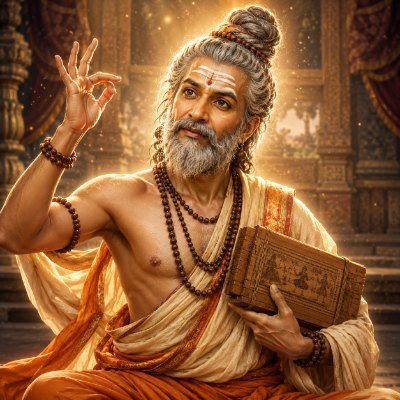
Bharata Muni — Sage and Author of the Natyashastra
Bharata · Bharata Muni · Bharatamuni · Natyacharya
Bharata Muni is the sage to whom the Hindu tradition attributes the authorship of the Natyashastra, the foundational Sanskrit treatise on the performing arts encompassing drama, dance, music, stagecraft, aesthetics, poetics, and theatrical architecture. The Natyashastra is composed in thirty-six chapters — thirty-seven in some recensions — and contains approximately six thousand verses. It is the earliest surviving systematic treatment of the performing arts in any tradition, and its influence on classical Indian dance, music, and dramatic literature has been sustained and pervasive across more than two millennia. Within the text itself, Bharata is presented as a sage who received the Natyaveda — the knowledge of the performing arts — directly from Brahma, the creator deity, and who taught it to his hundred sons and transmitted it to a gathered assembly of sages. The Matsya Purana is noted in the commentary tradition as the primary Puranic text that refers to this Bharata, while most other major Puranas are silent on him. His historical identity, parentage, dates, and precise biographical circumstances are not recorded in any primary text and remain a subject of scholarly uncertainty.
✦ The Name
The name Bharata is among the most polysemous proper names in Sanskrit literature and requires careful disambiguation. As a personal name it derives from a root meaning one who is maintained or nourished, or one who nourishes others. In the context of performing arts the name carries an additional significance: the closing portion of the Natyashastra itself offers the interpretation that the name Bharata designates the leader of a performance who takes on many roles. A further and widely cited interpretation treats Bharata as an acronym formed from three syllables: bha from bhava, meaning mood or emotional state; ra from raga, meaning melodic framework; and ta from tala, meaning rhythmic cycle. This acronymic reading, while not endorsed within the primary text itself as a formal derivation, has become a standard pedagogical formulation in the Indian performing arts tradition and encapsulates the three foundational elements that the Natyashastra systematises. The title Muni designates a sage, one possessed of wisdom and contemplative insight, and together with Bharata forms the compound Bharatamuni by which the author is most commonly identified in later tradition. The title Natyacharya — master or preceptor of drama — is also applied to him in later literature.
It must be noted explicitly that Bharata Muni the author of the Natyashastra is a distinct figure from: the emperor Bharata, son of King Dushyanta and the sage-born woman Shakuntala, who is the founding king of the Bharata dynasty in the Mahabharata and Puranas; King Bharata, son of the great king Rishabha and his wife Jayanti, after whom the Indian subcontinent is named Bharata-varsha in the Puranic cosmological tradition; and other figures named Bharata in the Sanskrit literary corpus.
✦ Lineage
- Parentage: No primary text records the parentage of Bharata Muni. The Natyashastra itself opens without any genealogical introduction for its author. The Matsya Purana, which is the one major Purana noted in the scholarly commentary tradition as referring to this Bharata, does not supply a father or mother for him. His lineage in the Vedic gotra or lineage sense is not established in any source consulted.
- Sons: The Natyashastra states that Brahma taught the Natyaveda to Bharata and that Bharata in turn taught it to his hundred sons, assigning each a role in the performance and propagation of the art. The names of these hundred sons are listed in the text, among the most prominent being Kohala, who is cited as an authority on dramatic matters by several later commentators including the Agni Purana. The sons of Bharata are presented in the Natyashastra's final chapter as having been cursed by a group of sages for displaying arrogance — having mocked other sages after the success of their first performance — and as having subsequently been sent to the earth by King Nahusha, who held the position of Indra at that time, to perform the Natya among human beings, thereby working off the residual effects of the curse. Scholarly commentary on the Natyashastra suggests that these named sons may represent actual authors or lineages of practitioners who contributed to the text's compilation rather than biological descendants of a single individual.
✦ The Origin of the Natyaveda — The Mythological Account
The first chapter of the Natyashastra contains the text's own account of the origin of the performing arts. The narrative situates the creation of the Natyaveda at the juncture between the Krita Yuga — the first and most perfect of the four cosmic ages — and the Treta Yuga that followed it. At this time, the gods approached Brahma and petitioned him to create a form of knowledge and entertainment that would be accessible to all people regardless of their knowledge of the Vedas, since the four existing Vedas were restricted in their comprehension and use. Brahma, in response, composed the Natyaveda by drawing upon elements from each of the four Vedas: the recitation of text from the Rigveda, the element of song from the Samaveda, the element of gesture and action from the Yajurveda, and the element of rasa and aesthetic sentiment from the Atharvaveda.
Brahma then instructed Bharata — whom he selected as the appropriate recipient among the sages — in the Natyaveda. Indra, king of the gods, was asked to arrange for the art's practice, but the gods declared themselves incapable of fully assimilating and performing it, and proposed instead that the sages — who were learned in the Vedas and disciplines of the mind — were better suited. Brahma then formally transmitted the Natyaveda to Bharata, who taught it to his hundred sons and set them to practising and performing the art. Brahma also created Apsaras — celestial nymphs — and gave them to Bharata for the purpose of performing in the dramatic works. The first public performance, according to the Natyashastra's account, was presented at the festival of Indradhvaja — the flag of Indra — and depicted the victory of the gods over the demons. The demons, displeased, disrupted the performance through their powers of illusion.
✦ The Curse on Bharata's Sons and the Descent of Drama to Earth
The Natyashastra's final chapter — the thirty-sixth, titled Natyashastra — narrates the episode of the curse that led to the art of drama descending from the divine to the human realm. After the success of their performances in the celestial regions, the sons of Bharata grew proud and began to mock and ridicule the sages who came to witness their art. The sages, angered by this disrespect, pronounced a curse upon the sons of Bharata. When the gods and Bharata himself interceded, the sages moderated the curse: the art of the Natya itself would not perish, but the sons would be affected by a residual portion of the imprecation.
Subsequently, when Nahusha — a king of the Puru dynasty who had temporarily attained the position of Indra through his accumulated merit — held that divine office, he invited Bharata's sons to bring the drama to the earth so that the art could be practised among human beings. The sons of Bharata accordingly came down to the earth, married women of human birth, and performed the Natya in the world of men. Through this performance the residual curse was discharged and they returned to the heavenly realm. The narrative thus explains both the sacred origin of performing arts in the Natyashastra's own cosmology and the mechanism by which it entered the human world.
✦ Contents and Scope of the Natyashastra
The Natyashastra is an encyclopaedic treatment of the performing arts with a scope that extends well beyond what a modern reader might expect of a treatise on theatre. Its thirty-six chapters address the origin of drama; the construction and layout of the theatre or playhouse; the categories of dramatic composition and their structure; the classification of dramatic styles into four vrittis — Bharati, Sattvati, Araabhati, and Kaisiki; the theory of rasa, or aesthetic sentiment; the theory of bhava, or emotional states and their classification into permanent, transitory, and physical expressions; the technique of bodily movement and gesture including detailed systems of hand gestures or mudras and eye movements; the use of the voice; the classification and structure of musical scales, notes, and melodic frameworks; the classification of musical instruments into four groups; the principles of dance as a distinct art; stage conventions, costumes, and makeup; the structure of Sanskrit dramatic compositions; and the duties and qualities of the various participants in a production including the director, the playwright, and the performers. The text asserts that the performing arts are spiritually equivalent in power and benefit to the study of the Vedas and that participation in music and drama is a path of merit and liberation.
✦ The Theory of Rasa
The most philosophically influential contribution of the Natyashastra to the Indian intellectual tradition is the theory of rasa — the doctrine that the purpose of a dramatic performance is to produce in a cultivated audience member a specific aesthetic experience of one of eight fundamental emotional states. These eight rasas as enumerated in the Natyashastra are: shringara, the sentiment of love and beauty; hasya, of comic pleasure; karuna, of compassion and sorrow; raudra, of fury; vira, of heroism and courage; bhayanaka, of terror; bibhatsa, of disgust; and adbhuta, of wonder. A ninth rasa, shanta — the sentiment of tranquillity — was added in the post-Natyashastra commentary tradition, most influentially by Abhinavagupta in his commentary Abhinavabharati, though its status was debated. Each rasa is associated with a corresponding permanent emotional state, or sthayi bhava, which the actor does not directly display but evokes in the audience through a systematic use of determinants, responses, and transitory emotional indicators. The theory of rasa became the central framework for all subsequent Indian aesthetic philosophy and literary criticism, and was elaborated and debated by thinkers across the Sanskrit literary tradition for more than a thousand years.
✦ Questions of Authorship and Date
The question of whether the Natyashastra was composed by a single individual named Bharata or represents the accumulated work of multiple authors over an extended period is a matter of ongoing scholarly discussion and cannot be resolved with the available evidence. The traditional attribution to Bharata Muni as a single sage is strong within the Indian performative and pedagogical tradition, and scholars such as Bharat Gupt and Kapila Vatsyayan have argued that the existing text shows characteristics consistent with a single compiler. Other scholars regard the text as a compilation assembled over several generations. The great commentator Abhinavagupta, who wrote the Abhinavabharati — the most important and detailed commentary on the Natyashastra, composed around the tenth to eleventh century CE — treats Bharata as a single authoritative figure while acknowledging textual variants and interpolations.
Estimates for the date of the text's composition in its extant form range from approximately 500 BCE to 500 CE, with the most widely cited scholarly range being between 200 BCE and 200 CE. The text predates several sections of the Ramayana in the musical and aesthetic terminology it employs, and references in the grammarian Panini's Ashtadhyayi to earlier dramatic schools suggest that some form of systematic treatment of the performing arts existed before the Natyashastra's compilation in its surviving form. The text is cited by name and attributed to Bharata by the poet Kalidasa, which places Bharata before the Gupta period in the scholarly consensus.
✦ Theological and Cultural Significance
The Natyashastra is described within its own text as a fifth Veda — the Natyaveda — intended to be accessible to all human beings without restriction of caste or learning, unlike the four canonical Vedas whose study was formally restricted. This positioning of the performing arts as a form of sacred knowledge with salvific potential is one of the text's most theologically distinctive claims. The text asserts that drama, properly performed and received, can guide the audience toward an experience of their own inner states, and ultimately toward a recognition of the spiritual values embedded in the human situation. The arts of drama, dance, and music are treated not as entertainment in a trivial sense but as vehicles of dharma — righteous order — and as paths of spiritual cultivation. This framing has shaped the self-understanding of the classical Indian performing arts tradition to the present day.
The 108 dance positions described in the Natyashastra influenced the iconographic programme of Hindu temple sculpture, particularly the Tandava form of Shiva as lord of dance, and the Nataraja image — Shiva as the cosmic dancer — reflects the categories of movement systematised in the Natyashastra. The text's influence thus extends beyond the performing arts into visual art, architecture, philosophy, and religious practice.
✦ References
- Natyashastra of Bharata Muni, Chapters I and XXXVI (primary source): Chapter I narrates the mythological origin of the Natyaveda, Brahma's instruction to Bharata, and the first performance at the Indradhvaja festival. Chapter XXXVI narrates the curse on Bharata's sons, Nahusha's invitation, and the descent of drama to the human world.
- Matsya Purana, Chapter 34: Noted in the scholarly commentary tradition as the primary Puranic text that refers to Bharata Muni; most other major Puranas do not mention him.
- Agni Purana: Includes chapters on dramatic arts and poetics following the Natyashastra's framework, and cites the authority of Kohala — identified as one of Bharata's named sons — on matters of dramatic theory.
- Abhinavagupta, Abhinavabharati (commentary on the Natyashastra, c. 10th–11th century CE): The most detailed and authoritative commentary on the Natyashastra; treats Bharata as the single authoritative source of the tradition while noting variant readings and interpolations. Abhinavagupta's elaboration of the rasa theory in this commentary became the dominant framework for subsequent Indian aesthetic philosophy.
- Kalidasa, Vikramorvashiya and Kumarasambhava (c. Gupta period): Cites the Natyashastra and attributes it to Bharata by name, establishing that the text and its attributed authorship predate the Gupta period.
- Manomohan Ghosh (trans.), The Natyashastra of Bharatamuni (Asiatic Society of Bengal, 1951): Standard modern English translation; used for chapter references and for the mythological narrative of the text's first chapter.
- Kapila Vatsyayan, Bharata: The Natyashastra (Sahitya Akademi, 1996): Authoritative modern study of the text, its authorship question, its aesthetic theory, and its influence on the Indian performing arts and visual traditions.
- Emmie te Nijenhuis, Indian Music: History and Structure (Brill, 1974): Used for contextualising the Natyashastra's contribution to the theory of Indian music within the broader history of the tradition.
- Vettam Mani, Puranic Encyclopaedia (Motilal Banarsidass, 1975): Identifies Bharata Muni and the Matsya Purana reference and distinguishes him from other figures named Bharata in the tradition.
- Wikipedia, Natya Shastra article: Used for cross-referencing scholarly opinions on authorship, dating, and the extent and structure of the text.