
About
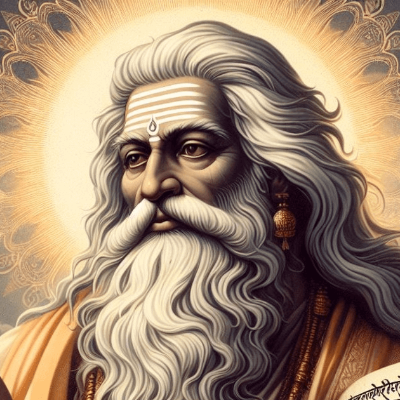
Kautsa — Disciple of Bharata Muni and Debater on the Purpose of the Vedas
Kautsa · Kautsya
Kautsa is a sage and intellectual figure who appears in the Vedic and post-Vedic tradition primarily as a thinker who advanced the controversial position that the Vedic hymns are meaningless — that they bear no intelligible relationship to the rituals they accompany and serve no instructive purpose. He is identified in the Nirukta, the ancient text on Vedic etymology and philology composed by the grammarian Yaska, as one of the foremost proponents of this nihilistic view of Vedic language. A figure of the same name also appears in the Natya Shastra tradition as a disciple of Bharata Muni, the legendary sage credited with composing the Natya Shastra, the foundational Sanskrit treatise on dramaturgy, dance, and music. Whether the Kautsa of the Nirukta and the Kautsa of the Natya Shastra tradition are one and the same individual cannot be established with certainty from the primary sources; the name is shared and the textual contexts differ. This profile addresses both associations as they appear in their respective sources.
✦ The Name
The name Kautsa is a patronymic or gotra-derived name, formed from the root name Kutsa, an ancient Vedic sage and poet to whom several hymns in the Rigveda are attributed. The suffix indicates descent from or affiliation with the lineage of Kutsa. The form Kautsya is a variant of the same patronymic. The name thus carries no independent etymological meaning beyond its identification with the Kutsa lineage.
✦ Lineage
- Ancestral affiliation: The Kutsa lineage, tracing descent from the Vedic rishi Kutsa, a sage credited with authorship of hymns in the Rigveda and regarded as a companion of Indra, the king of the gods, in Vedic mythology.
- Teacher (in the Natya Shastra tradition): Bharata Muni, the legendary sage held to be the author of the Natya Shastra, the encyclopaedic Sanskrit work on the performing arts. Bharata Muni is regarded in this tradition as having received the knowledge of drama directly from Brahma, the creator deity, and as having transmitted it to his disciples, among whom Kautsa is named.
✦ Kautsa in the Natya Shastra Tradition
The Natya Shastra, attributed to Bharata Muni, opens with an account of how the science of dramatic performance came into being. According to this account, Bharata Muni received the Natyaveda — the knowledge of drama as a fifth Veda — from Brahma and transmitted it to his sons and disciples. Kautsa is named among those disciples or associates in the lineage of transmission connected to Bharata Muni. In this context, Kautsa functions as a student and inheritor of the performing arts tradition rather than as a protagonist of any specific narrative episode. The Natya Shastra itself does not assign Kautsa any individual dramatic episode or doctrine; his mention situates him within the circle of Bharata's school.
✦ Kautsa in the Nirukta — The Debate on Vedic Meaning
The Nirukta of Yaska, a systematic work on Vedic etymology and interpretation dating to approximately the fifth or sixth century BCE, records and engages at length with the philosophical position attributed to Kautsa. Kautsa argued that the Vedic hymns are without meaning — specifically, that the words of the Vedas do not bear a coherent semantic relationship to the rites they are used in, and that the hymns therefore cannot be understood as conveying instruction or knowledge. He is said to have supported this view with several observations: that certain Vedic words appear to contradict known meanings, that some passages seem to praise deities in terms that are logically inconsistent, and that if the hymns had genuine communicative content, their meaning would be self-evident without requiring the elaborate explanatory apparatus of the Nirukta itself.
Yaska devoted considerable effort to refuting Kautsa's position. He argued that the difficulty of Vedic language does not render it meaningless, that the obscurity arises from the antiquity and compressed style of the compositions, and that the etymological method of the Nirukta itself is the proper tool for recovering the meaning that Kautsa claimed was absent. The debate preserved in the Nirukta is one of the earliest recorded intellectual disputes about the nature of scriptural language in the Sanskrit tradition, and Kautsa's position — though presented by Yaska as mistaken — was evidently influential enough to require systematic rebuttal.
✦ Textual Variants and Inconsistencies
The primary inconsistency surrounding Kautsa is the question of whether the figure named in the Natya Shastra tradition as a disciple of Bharata Muni is the same person as the philosophical dissenter recorded in the Nirukta. The two texts operate in entirely different intellectual domains — one in dramaturgy and the performing arts, the other in Vedic philology and hermeneutics — and neither text references the other in connection with Kautsa. It is possible that the name Kautsa, being a common gotra designation derived from the lineage of the Vedic rishi Kutsa, was shared by more than one individual in the tradition. The Puranic Encyclopaedia and modern scholars treat these as likely distinct figures, though the evidence for a definitive separation is itself indirect. This profile records both associations as they appear in the sources without asserting their identity or their separation as established fact.
✦ Philosophical Significance
The position attributed to Kautsa in the Nirukta anticipates debates that would recur throughout the history of Indian philosophical and grammatical thought — debates about whether sacred language is inherently meaningful, whether meaning is conventional or eternal, and what authority scriptural texts possess if their linguistic content cannot be straightforwardly interpreted. The Mimamsa school of philosophy, which holds that the Vedic injunctions are eternally valid and inherently meaningful, can be understood in part as a sustained philosophical response to the kind of scepticism that Kautsa represented. In this sense, Kautsa occupies a significant, if adversarial, position in the intellectual history of Vedic interpretation: his challenge helped sharpen the arguments of those who defended the meaningfulness and authority of the Vedic corpus.
✦ Connection to the Wider Genealogy
Kautsa belongs genealogically to the lineage of the Vedic rishi Kutsa, who is himself associated in Rigvedic mythology with Indra and is counted among the ancient seer-poets. Through his affiliation with Bharata Muni in the Natya Shastra tradition, Kautsa is connected to the broader lineage of performers and theorists who transmitted the knowledge of the dramatic arts. Bharata Muni is regarded in that tradition as a son or emanation of Brahma in terms of spiritual transmission, making Kautsa part of a chain of knowledge-lineage that traces ultimately to the creator deity, though this relationship is one of disciplic succession rather than biological descent.
✦ References
- Primary Sources:
- Nirukta of Yaska, Chapter 1 — The principal source for Kautsa's philosophical position on the meaninglessness of Vedic hymns and for Yaska's extended rebuttal of that view.
- Natya Shastra of Bharata Muni, Chapter 1 — The source situating Kautsa as a disciple or associate within the lineage of Bharata Muni's school of dramatic arts.
- Rigveda, Hymns attributed to the Kutsa lineage — The foundational source establishing the ancestral rishi Kutsa, from whose name the patronymic Kautsa derives.
- Secondary Sources:
- Puranic Encyclopaedia by Vettam Mani — Provides a brief identifying entry for Kautsa and notes the distinction between the figure in the Nirukta and the figure associated with Bharata Muni.
- A History of Indian Literature by Jan Gonda — Discusses the Nirukta, Yaska's method, and the significance of Kautsa's challenge to Vedic interpretation within the broader history of Sanskrit philology.
- The Natyasastra: A Treatise on Hindu Dramaturgy and Histrionics, translated by Manomohan Ghosh — Provides context for the transmission lineage described in the opening chapter of the Natya Shastra and the naming of Bharata's disciples.