
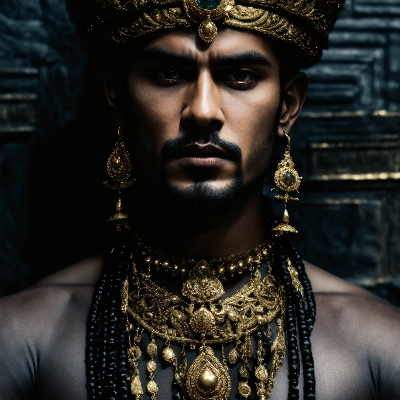
About
Naabhaaga — Son of Nabhaga, Father of Ambarisha, and Recipient of the Angirasa Sacrifice Wealth
Naabhaaga · Nabhaga · Nabhaga-putra · Ambarisha-pita · Suryavanshi
Naabhaaga is a figure of the solar dynasty, recorded in the Bhagavata Purana as the son of Nabhaga — himself a direct son of Vaivasvata Manu, the seventh Manu and progenitor of the current human race — and as the father of Ambarisha, one of the most celebrated devotee-kings of the entire Puranic tradition. Vaivasvata Manu was the son of Vivasvan the sun-god and his wife Saranyu. Naabhaaga is the subject of a narrative of genuine theological significance in Bhagavata Purana Skandha IX, Chapter 4, which describes his prolonged residence at his preceptor's hermitage, his exclusion from his brothers' division of the ancestral estate, his father Nabhaga's counsel directing him to the sacrifice of the descendants of Angira, his receipt of the sacrificial wealth, and his encounter with Shiva. He appears also in the Brahmanda Purana and the Bahvrca Brahmana, the latter being identified by the commentator Bhavarartha Dipika as the earliest stratum in which this episode is recorded. His principal significance in the tradition is twofold — as the immediate progenitor of Ambarisha, the supreme devotee, and as the figure through whom the sacred wealth of the Angirasa sacrifice was rightly claimed, an episode that illustrates the principles of Vedic learning, rightful inheritance, and divine testing.
✦ The Name and the Nomenclature Problem
The name Naabhaaga shares the same Sanskrit root as his father's name Nabhaga, both deriving from nabha meaning sky, atmosphere, or navel, conveying a sense of centrality, eminence, or celestial origin. The distinction between the two names lies in the lengthening of the second vowel — Nabhaga versus Naabhaaga — a subtle difference in Sanskrit nominal form that is not always consistently maintained across manuscript traditions. Modern critical editions of the Bhagavata Purana attempt to preserve this distinction, using Nabhaga for the father who is a direct son of Manu and Naabhaaga for the son who is the subject of the Chapter 4 narrative, but the reader encounters both forms used loosely in different recensions and secondary compilations. The Wisdomlib Puranic encyclopaedia, drawing on the Bhagavata Purana's own internal markers, confirms the four-way disambiguation: Nabhaga as a direct son of Manu at IX.1.11–12; a separate Naabhaaga also listed as a son of Manu at VIII.13.2–3 representing a different enumeration tradition; Naabhaaga son of Dishta at IX.2.23–24 who adopted vaishya occupational duties; and Naabhaaga son of Nabhaga at IX.4.1 who is the present figure. The Bhagavata Purana's own opening verse of Chapter 4 resolves the immediate ambiguity by stating explicitly that Naabhaaga was the son of Nabhaga, anchoring the relationship before proceeding to the narrative.
✦ Lineage
- Paternal great-grandfather: Vivasvan — the sun-god, also known as Surya and Aditya, son of the sage Kashyapa and his wife Aditi; divine progenitor of the entire solar dynasty.
- Paternal grandfather: Vaivasvata Manu — the seventh Manu, also called Shraddhadeva and Satyavrata, son of Vivasvan and his wife Saranyu; progenitor of the current human race and founding ancestor of all solar dynastic lines of the present age.
- Father: Nabhaga — a direct son of Vaivasvata Manu, brother of Ikshvaku the founder of the Ayodhya royal line, celebrated in the Mahabharata as a king of exemplary dharmic conduct who gifted the entire earth to brahmanas at the close of his reign, whereupon Bhumidevi assumed physical form rather than leave his presence. Nabhaga is the figure who directed Naabhaaga to the sacrifice of the Angirasa descendants and thereby guided his son toward his rightful inheritance through knowledge rather than through material property.
- Brothers: The Bhagavata Purana records that Naabhaaga was the youngest of Nabhaga's sons and that his brothers, presuming he would remain a lifelong celibate student at his preceptor's hermitage, divided the ancestral estate among themselves without reserving a share for him. Their individual names are not recorded in the primary sources.
- Son: Ambarisha — described in the Bhagavata Purana as the most exalted devotee born from Naabhaaga; emperor of the entire earth consisting of seven islands; the central figure of the celebrated episode in which the sage Durvasa pronounced a curse upon him and the Sudarshana Chakra of Vishnu pursued Durvasa across the three worlds until the sage was compelled to return and seek Ambarisha's intercession. Ambarisha had three sons named Virupa, Ketuman, and Shambhu.
✦ The Long Residence at the Preceptor's Hermitage
The Bhagavata Purana describes Naabhaaga as the youngest of his brothers and as the most learned and wise among them, qualities he acquired through an exceptionally prolonged period of brahmacarya — celibate studentship — at his preceptor's hermitage. While his brothers completed their education and returned home within the expected time, Naabhaaga remained at the hermitage in pursuit of complete mastery of the scriptures. His brothers, having waited for a long time and concluding that Naabhaaga would never return to claim his share of the ancestral wealth, divided their father Nabhaga's estate entirely among themselves. When Naabhaaga finally returned and approached his brothers to ask for his portion, they informed him that his inheritance was their father himself — that is, the duty and privilege of caring for the aged Nabhaga in his final years. The brothers' action is described by Nabhaga himself, when Naabhaaga reported it to him, as an act of cheating, indicating that the division had not been conducted in good faith toward the absent youngest son.
✦ The Angirasa Sacrifice and the Receipt of Wealth
When Naabhaaga went to his father Nabhaga and reported that his brothers had divided the estate without leaving him a share, Nabhaga acknowledged the injustice and counselled his son on how to obtain a livelihood through his own learning. Nabhaga directed Naabhaaga to go to the sacrificial arena where the descendants of Angira were conducting a long sacrificial session. On every sixth day of this session, the Angirasa sages became confounded about the correct procedure to be followed, and the sacrifice was unable to proceed as ordained. Nabhaga instructed Naabhaaga to recite to the Angirasa sages two specific suktas from the Rigveda — identified in the commentary tradition as belonging to the Bahvrca recension — that would resolve their ritual confusion and enable them to complete the sacrifice correctly. Naabhaaga went to the sacrificial arena, recited the two Vedic compositions to the Angirasa sages as instructed, and resolved their procedural difficulty. In gratitude, the Angirasa sages offered Naabhaaga all the remaining wealth accumulated at the sacrifice — land, kingdom, gold, grain, wealth, and vehicles — as the rightful reward for his knowledge and service. The Bhavarartha Dipika commentary on this passage identifies the story of Naabhaaga as one preserved in an earlier stratum in the Bahvrca Brahmana, indicating that the episode has roots in Vedic literature antedating the Puranic compilation.
✦ The Encounter with Shiva
As Naabhaaga was about to receive the accumulated wealth from the Angirasa sages, a dark, short, and fearsome figure appeared and challenged his claim to the sacrificial remainder, asserting that the residual wealth of a sacrifice belongs by right to Rudra, the divine lord of such remnants. This figure, whose appearance is described in the Kamakoti tradition's retelling as dark-complexioned and offensive in manner, was Shiva himself, testing Naabhaaga. Naabhaaga, uncertain of how to respond, returned to his father Nabhaga and reported the challenge. Nabhaga confirmed to his son that the dark figure was indeed Shiva, directed Naabhaaga to acknowledge Shiva as the supreme lord, and instructed him to offer worship and seek his grace rather than contesting the claim. Naabhaaga returned to the sacrificial arena, acknowledged Shiva's lordship, and approached him with reverence. Shiva, satisfied by Naabhaaga's conduct — his learning, his humility, and his willingness to recognise divine authority over material wealth — declared himself pleased, acknowledged Naabhaaga's right to the wealth, and granted him all the riches of the sacrifice. The episode is understood in the tradition as a test not merely of Naabhaaga's knowledge but of his spiritual disposition — his ability to subordinate material acquisition to divine acknowledgment.
✦ Textual Variants and Inconsistencies
The principal textual complexity associated with Naabhaaga is the four-way naming overlap described above, which causes his story to be conflated in some sources with those of other figures bearing closely related names. The Bhagavata Purana's Chapter 4 of Skandha IX is the most explicit and unambiguous primary source, opening with the statement that Naabhaaga was the son of Nabhaga and closing the episode by confirming that from Naabhaaga was born Ambarisha the great devotee. The Bhavarartha Dipika commentary's note that the story is preserved in the Bahvrca Brahmana provides an earlier textual anchor. The Brahmanda Purana III.63.5 confirms Naabhaaga's position in the genealogical succession. A further complexity noted in the received document submitted by the user — that some sources associate the Angirasa sacrifice episode with the early Nabhaga son of Manu rather than with his son Naabhaaga — reflects a genuine ambiguity in certain Puranic passages where the distinction between father and son is blurred by the near-identical names. The Bhagavata Purana Skandha IX, Chapter 4 is unambiguous in attributing the episode to Naabhaaga the son rather than to Nabhaga the father, and this attribution is followed in the present profile as it represents the most detailed and internally consistent primary account.
✦ Connection to the Wider Genealogy
Naabhaaga stands in the third generation of the solar dynasty as constituted in the present age, counting from Vivasvan. He is the grandson of Vaivasvata Manu and a nephew of Ikshvaku, the founder of the main Ayodhya royal line. Through his son Ambarisha, and Ambarisha's three sons Virupa, Ketuman, and Shambhu, the line continues. The arc from Nabhaga through Naabhaaga to Ambarisha is presented in the Bhagavata Purana as a progressive deepening of spiritual orientation within the same family — Nabhaga the righteous king who gifts the earth and resides in Brahmaloka; Naabhaaga who acquires wealth not through inheritance but through sacred learning and the grace of Shiva; and Ambarisha the supreme devotee whose entire being is absorbed in the service of Vishnu and who is protected by the Sudarshana Chakra. Naabhaaga's episode is thus not merely a genealogical interlude but a narrative of transition, establishing through his son's career the devotional lineage that reaches its fullest expression in Ambarisha.
✦ References
- Bhagavata Purana, Skandha IX, Chapter 4, verses 1–13: The primary and most detailed source for the entire Naabhaaga episode; establishes his identity as the son of Nabhaga and the father of Ambarisha, narrates the long studentship, the brothers' division of the estate, Nabhaga's counsel, the Angirasa sacrifice, the receipt of wealth, the challenge by Shiva, Nabhaga's further guidance, and the resolution in Naabhaaga's favour.
- Brahmanda Purana, III.63.5: Confirms Naabhaaga's position in the solar genealogical succession as son of Nabhaga and progenitor of Ambarisha.
- Bahvrca Brahmana: Earliest textual stratum in which the Naabhaaga episode is attested, as identified by the Bhavarartha Dipika commentary on Bhagavata Purana IX.4; provides the Vedic foundation for the Puranic narrative.
- Bhavarartha Dipika (commentary of Shridhara Svami) on Bhagavata Purana IX.4: Notes the Bahvrca Brahmana as the source tradition for the Naabhaaga episode; provides interpretive context for the encounter with Shiva and the nature of the sacrificial remainder.
- Mahabharata, Vana Parva, Chapter 25, verse 12: Records Ambarisha as the famous son of Naabhaaga, providing the Itihasa attestation for the genealogical connection between the two figures.
- Vettam Mani, Puranic Encyclopaedia: Secondary reference compiling the multiple entries on figures named Nabhaga and Naabhaaga across the Puranic and Vedic corpus; essential for navigating the four-way naming overlap and confirming the present figure's distinct identity.
- F. E. Pargiter, Ancient Indian Historical Tradition (Oxford University Press, 1922): Analyses the Puranic solar dynasty lists comparatively and addresses the naming complexity in this portion of the succession with particular attention to the father-son Nabhaga-Naabhaaga pair.
- A. A. Macdonell and A. B. Keith, Vedic Index of Names and Subjects (1912), entry on Nabhaga: Provides the Vedic and Brahmana stratum evidence for the Nabhaga-Naabhaaga episode, establishing the Bahvrca Brahmana as the earliest attestation of the sacrificial narrative.