
About
Krodha — Son of Lobha and Personification of Anger
Krodha · Krodhan · not to be confused with other figures named Krodha in the Puranic tradition
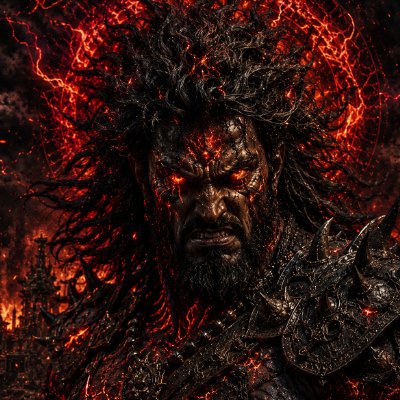
Krodha, in this genealogical context, is a cosmological being in the Hindu Puranic tradition, conceived as the personification of anger, wrath, and rage. He is identified in the Bhagavata Purana as the son of Lobha — the personification of greed, himself a third-generation descendant of Adharma the primordial Prajapati of unrighteousness — and of Nikrti, the personification of baseness and moral degradation. Krodha is paired with his sister Himsa — the personification of violence — and their union produces Kali, the male personification of strife and the presiding spirit of the Kali Yuga, and Durukti, the personification of abusive and harsh speech. Krodha thus stands as a fourth-generation figure in the lineage of Adharma, representing a marked escalation in the destructive character of the lineage as it moves from the social and acquisitive vices of the preceding generations into the domain of active aggression and harm. The name Krodha is widely distributed across Hindu scripture as both a common noun denoting anger and as the name of various distinct figures; careful disambiguation is necessary in any reference context.
✦ The Name
The name Krodha derives from the Sanskrit root krudh, meaning to be angry or enraged. Across Sanskrit literature, krodha denotes anger in a morally culpable sense — not the righteous indignation that may at times be warranted by circumstance, but the uncontrolled, destructive rage that clouds judgment and drives a being to harm others and violate dharma. The Bhagavad Gita identifies krodha as arising from frustrated desire and as one of the three principal enemies of the human being alongside kama (desire) and lobha (greed), noting that it leads through a chain of consequences to the complete destruction of a person's moral and rational capacity. In the Puranic genealogical context, the name functions as a personal name designating the being who embodies and propagates this quality. As the son of Lobha (greed) and Nikrti (baseness), the genealogical Krodha represents the anger that arises when greedy desire is frustrated and when the degradation of character removes all ethical restraint upon its expression.
✦ Lineage
- Father: Lobha — the personification of greed and covetousness; son of Dambha, the personification of hypocrisy, and Maya, the personification of deception; third-generation descendant of Adharma the primordial Prajapati of unrighteousness.
- Mother: Nikrti — the personification of baseness, vileness, and moral degradation; daughter of Dambha and Maya, and sister and consort of Lobha.
- Sister: Himsa — the personification of violence, injury, and harm; born of the same parents.
- Consort: Himsa — his own sister, in the account of the Bhagavata Purana; the union of Krodha and Himsa producing the next generation of personified vices.
- Son: Kali — the male personification of strife, discord, and the Kali Yuga; born of Krodha and Himsa. This Kali is the presiding spirit of the degenerate age and is entirely distinct from the goddess Kali.
- Daughter: Durukti — the personification of harsh, abusive, and morally destructive speech; born of Krodha and Himsa.
✦ Cosmological Role
Within the Puranic genealogical taxonomy of vice, Krodha represents the fourth generation and a qualitative shift in the nature of the lineage. The first three generations — Adharma and Mithya, Dambha and Maya, Lobha and Nikrti — embody vices that are primarily internal or social in character: unrighteousness, falsehood, hypocrisy, deception, greed, and baseness are qualities that corrupt the individual and distort social relations but do not in themselves directly inflict physical harm. With the arrival of Krodha and his sister Himsa in the fourth generation, the lineage crosses into the domain of direct aggression and injury. Anger and violence are the natural expression of greed and baseness when those qualities have fully matured; Krodha thus represents the point at which the accumulated internal corruption of the preceding generations erupts outward in destructive action. The pairing of Krodha with Himsa — anger with violence — to produce Kali and Durukti then represents the social and cosmic consequences of unchecked anger and violence: strife, discord, and the degradation of speech and communication.
✦ Disambiguation
The name Krodha is borne by several distinct figures in the Puranic tradition and must be carefully distinguished from the genealogical Krodha treated in this profile. The Mahabharata and certain Puranas refer to a Krodha among the mind-born sons or attendants of various cosmic figures. The Vishnu Purana and other texts list Krodha as one of the beings produced in the earliest phases of creation, sometimes in a different genealogical context from the lineage of Adharma. The genealogical Krodha of this profile is specifically the fourth-generation descendant of Adharma through Dambha, Maya, Lobha, and Nikrti, as attested in the Bhagavata Purana's account of the lineage of vice.
✦ Textual Variants and Inconsistencies
The Bhagavata Purana is the most detailed source for Krodha's position within the lineage of Adharma. The Vishnu Purana provides a broadly consistent account of this lineage but with less granular detail for the fourth-generation figures. No significant inconsistency specific to Krodha's identity or parentage within this lineage has been identified across the principal primary sources.
✦ Connection to the Wider Genealogy
Krodha is the fourth-generation descendant of the primordial Adharma, tracing his lineage through Dambha, Maya, Lobha, and Nikrti. Through his son Kali and daughter Durukti, he is the direct ancestor of Bhaya (fear) and Mrityu (death in this genealogical context), the fifth-generation terminal figures of the lineage. Krodha thus stands two generations above the culminating figures of the lineage of Adharma.
✦ References
Primary Sources
- Bhagavata Purana, Skandha 4, Chapters 7–8 — the principal source naming Krodha as the son of Lobha and Nikrti, identifying his consort as Himsa, and specifying Kali and Durukti as their offspring.
- Vishnu Purana, Book 1, Chapter 7 — provides a broadly consistent genealogy for the lineage of Adharma within which Krodha appears as a fourth-generation figure.
- Bhagavad Gita, Chapter 2 and Chapter 16 — identifies krodha as a primary destroyer of moral and rational capacity and enumerates it among the qualities of the demonic nature, providing the broader scriptural context for the Puranic personification.
- Mahabharata, Shanti Parva — contains extensive ethical discussion of krodha as a root cause of conflict, injustice, and the destruction of individuals and kingdoms.
Modern Reference Works
- Vettam Mani, Puranic Encyclopaedia (1975), entry on Adharma — collates the Puranic genealogy within which Krodha is positioned and notes the disambiguation issues arising from the wide distribution of this name.
- Wendy Doniger O'Flaherty, The Origins of Evil in Hindu Mythology (1976) — analyses the escalating destructive character of the lineage of Adharma as it passes through the fourth generation.
- Wisdom Library (wisdomlib.org), entries on Krodha and the lineage of Adharma — provides verse-level references to the relevant Bhagavata Purana passages.