
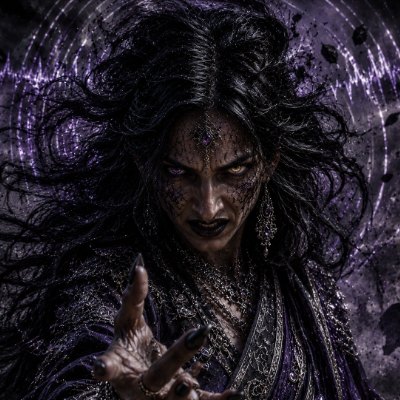
About
Durukti — Daughter of Krodha and Personification of Abusive Speech
Durukti · Duruktih · Durukta (in certain secondary readings)
Durukti is a cosmological being in the Hindu Puranic tradition, conceived as the personification of harsh, abusive, and morally destructive speech. She is identified in the Bhagavata Purana as the daughter of Krodha — the personification of anger, himself a fourth-generation descendant of Adharma the primordial Prajapati of unrighteousness — and of Himsa, the personification of violence. Durukti is the sister of Kali — the male personification of strife and the presiding spirit of the Kali Yuga — and is taken as his consort in the account of the Bhagavata Purana, their union producing Bhaya, the personification of fear, and Mrityu, the personification of death in this genealogical context. As the female generative principle of the fifth generation in the lineage of Adharma, Durukti serves as the necessary complement to Kali in the propagation of the terminal generation of the lineage. The significance of destructive speech as a vehicle of moral disorder is widely attested across Hindu scriptural literature, and the personification of abusive speech as the consort of strife and the mother of fear and death reflects a coherent Puranic understanding of the relationship between harmful language and its consequences.
✦ The Name
The name Durukti is a Sanskrit compound formed from the prefix dur-, denoting badness, difficulty, or moral deficiency, and ukti, meaning speech, utterance, or expression, derived from the root vac or vak meaning to speak. Durukti therefore denotes bad or evil speech — speech that is harsh, abusive, false, or morally harmful. In Sanskrit ethical literature, the category of evil speech encompasses several distinct types: speech that is false, speech that is cruel or harsh, speech that creates discord between persons, speech that is obscene or degrading, and speech that wounds the hearer unjustly. All of these fall under the broad designation of durukti or its synonyms. As the daughter of Krodha (anger) and Himsa (violence), and the sister and consort of Kali (strife), Durukti represents the expression of anger and violence through the medium of language — the destructive power of words wielded as instruments of harm.
✦ Lineage
- Father: Krodha — the personification of anger and wrath in this genealogical context; son of Lobha, the personification of greed, and Nikrti, the personification of baseness; fourth-generation descendant of Adharma the primordial Prajapati of unrighteousness.
- Mother: Himsa — the personification of violence, injury, and the wilful infliction of harm; daughter of Lobha and Nikrti, and sister and consort of Krodha.
- Brother: Kali — the male personification of strife, discord, and the presiding spirit of the Kali Yuga; born of the same parents. This Kali is entirely distinct from the goddess Kali.
- Consort: Kali — her own brother, in the account of the Bhagavata Purana; the union of Durukti and Kali producing the terminal generation of the lineage.
- Son: Bhaya — the personification of fear; born of Durukti and Kali.
- Daughter: Mrityu — the personification of death in this genealogical context; born of Durukti and Kali. This Mrityu is to be distinguished from other figures of the same name appearing elsewhere in the Puranic tradition.
✦ Cosmological Role
Within the Puranic genealogical taxonomy of vice, Durukti occupies the fifth generation as the female counterpart to Kali, together constituting the penultimate generative pair of the lineage. Her role as the personification of abusive speech paired with Kali as the personification of strife reflects the Puranic understanding that strife and destructive speech are twin expressions of the same underlying disorder — anger expressed through violence on the one hand and through language on the other. Their union producing Bhaya and Mrityu — fear and death — encodes the moral reasoning that strife and harmful speech, left unchecked, generate fear and ultimately lead to death, whether of individuals, relationships, or social order. Durukti thus completes the moral arc of the lineage, which moves from the abstract unrighteousness of Adharma through successive generations of increasingly concrete and destructive vices to the existential realities of fear and death.
✦ Textual Variants and Inconsistencies
The Bhagavata Purana is the clearest and most detailed source for Durukti's position within the lineage of Adharma. The Vishnu Purana presents a broadly consistent genealogy but with less granular detail for the fifth-generation figures. No significant inconsistency specific to Durukti's identity or parentage within this lineage has been identified across the principal primary sources.
✦ Connection to the Wider Genealogy
Durukti is the fifth-generation descendant of the primordial Adharma, tracing her lineage through Dambha, Maya, Lobha, Nikrti, Krodha, and Himsa. Through her son Bhaya and daughter Mrityu, she is the mother of the terminal generation of the lineage of Adharma. Together with her brother and consort Kali, she completes the penultimate generation and gives rise to the two final personifications — fear and death — that represent the ultimate consequences of the accumulated moral disorder originating in the primordial Adharma.
✦ References
Primary Sources
- Bhagavata Purana, Skandha 4, Chapters 7–8 — the principal source naming Durukti as the daughter of Krodha and Himsa, identifying her consort as Kali, and specifying Bhaya and Mrityu as their offspring.
- Vishnu Purana, Book 1, Chapter 7 — provides a broadly consistent genealogy for the lineage of Adharma within which Durukti appears as a fifth-generation figure.
- Mahabharata, Anushasana Parva — contains extensive discussion of the ethics of speech, including the harmful consequences of abusive and harsh speech, providing the broader scriptural context for the personification of Durukti.
Modern Reference Works
- Vettam Mani, Puranic Encyclopaedia (1975), entry on Adharma — collates the Puranic genealogy within which Durukti is positioned.
- Wendy Doniger O'Flaherty, The Origins of Evil in Hindu Mythology (1976) — analyses the fifth generation of the lineage of Adharma and the moral logic of Durukti's pairing with Kali.
- Wisdom Library (wisdomlib.org), entries on Durukti and the lineage of Adharma — provides verse-level references to the relevant Bhagavata Purana passages.