
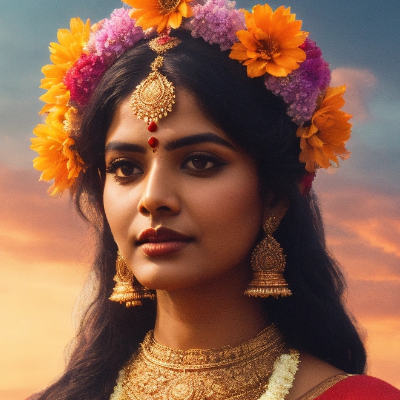
About
Khyati — Daughter of Kardama, Wife of Bhrigu, Mother of Lakshmi and Shukracharya
Khyati · Kardama-putri · Devahuti-putri · Bhrigu-patni · Lakshmi-mata
Khyati is one of the nine daughters of the Prajapati Kardama and his wife Devahuti, named in the Bhagavata Purana's third skandha among the daughters given in marriage to nine great sages of the primordial tradition. She is given in marriage to the sage Bhrigu — one of the ten mind-born sons of Brahma, one of the seven great rishis of the first creation, and among the most significant and extensively narrated sages in the entire Puranic tradition. Through her marriage to Bhrigu, Khyati becomes the mother of figures of the highest theological and genealogical consequence. In certain Puranic accounts she is named as the mother of the goddess Lakshmi — the consort of Vishnu and the goddess of prosperity, beauty, and auspiciousness — making her one of the very few figures in the tradition to be identified as the human or semi-divine mother of a supreme goddess. She is also named in Puranic sources as the mother of Dhata and Vidhata, two cosmic figures associated with the ordering of fate and creation, and in some accounts as the mother of Shukracharya — the great sage and preceptor of the asuras — though this last attribution is subject to textual variation as described below. Of all the nine daughters of Kardama, Khyati receives the most theologically significant treatment through her children, and her profile is correspondingly the most substantial of the group after Arundhati.
✦ The Name
The name Khyati is Sanskrit, derived from the root khya, meaning to be known, to be famous, to be celebrated, or to make known. Khyati means fame, renown, celebrity, or the state of being widely known and recognised — it carries the sense of a reputation so established that it spreads beyond any single community or context and becomes a general fact of the world. In the philosophical vocabulary of the tradition, khyati also carries an epistemological sense — it denotes a mode of knowing or cognition, the recognition of a thing for what it is. The name for a daughter of Kardama thus encodes both social renown and a quality of cognitive clarity or recognition — appropriate for a figure through whom the goddess of auspiciousness herself enters the world, since Lakshmi is precisely the being whose presence is universally recognised and whose fame pervades every realm of existence.
✦ Lineage
- Father: Kardama, Prajapati and mind-born son of Brahma, who performed long austerities at Bindu-sarovara on the Sarasvati river, received from Vishnu the promise of the avatara birth, married Devahuti, fathered nine daughters and the sage Kapila — identified as a Vishnu avatara — and thereafter renounced household life.
- Mother: Devahuti, daughter of Manu Svayambhuva — the first Manu and primordial sovereign of humanity — and of Shatarupa. After Kardama's departure Devahuti received the Samkhya philosophical teaching from her son Kapila and attained liberation.
- Brother: Kapila, the sage and Vishnu avatara, teacher of the Samkhya system of philosophy, whose burning gaze destroyed the sixty thousand sons of King Sagara and thereby initiated the events leading to the descent of the Ganga from heaven to earth.
- Sisters: Eight other daughters of Kardama and Devahuti — Kala, Anasuya, Shraddha, Havirbhu, Gati, Kriya, Arundhati, and Shanti — given in marriage respectively to the sages Marichi, Atri, Angiras, Pulastya, Pulaha, Kratu, Vasishtha, and Atharvan.
- Husband: Bhrigu, one of the ten mind-born sons of Brahma and one of the seven great rishis of the primordial creation, a sage of enormous power and consequence in the Puranic tradition. Bhrigu is the progenitor of the Bhrigu lineage — the Bhargavas — one of the most celebrated brahmin lineages in the entire tradition, and a figure who appears in major narrative episodes across the Mahabharata, the Vishnu Purana, the Bhagavata Purana, and other Mahapuranas. He is particularly associated with the testing of the three great gods — Brahma, Vishnu, and Shiva — in the celebrated Bhrigu-test episode of the Mahabharata, in which he kicks Vishnu on the chest and Vishnu responds with patient humility, confirming Vishnu's supremacy among the three.
- Daughter (principal account): Lakshmi, the goddess of prosperity, beauty, fortune, and auspiciousness, the eternal consort of Vishnu — named in the Vishnu Purana as the daughter of Bhrigu and Khyati born before the great churning of the ocean, the Samudra Manthan. This birth of Lakshmi as Khyati's daughter is the Vishnu Purana's account and represents one of the tradition's explanations of Lakshmi's origin. It is distinct from the account of Lakshmi's birth from the churning of the cosmic ocean, which is the more widely known version and which is not incompatible with the Vishnu Purana's account in the tradition's own theological framework, since Lakshmi as an eternal goddess may have multiple manifestations and points of emergence.
- Sons (principal account): Dhata and Vidhata, two cosmic figures named in the Vishnu Purana and Bhagavata Purana as sons of Bhrigu and Khyati. Dhata means one who establishes, sustains, or ordains, and Vidhata means one who prescribes, determines, or apportions — both names encoding functions related to the cosmic ordering of existence, the allotment of destinies, and the maintenance of the created order. They are associated in the tradition with the regulation of fate and the sustaining of cosmic law.
- Son (variant account): Shukracharya — also known as Shukra, Ushanas, and Kavya — the great sage and preceptor of the asuras, the teacher of the Mritasanjivani vidya by which the dead can be restored to life, and one of the most powerful and complex figures in the Puranic tradition. Some Puranic sources name Shukracharya as the son of Bhrigu, but the identity of his mother varies — certain sources name Khyati, others name a different wife of Bhrigu, and still others do not specify. This variant is addressed in the section on textual inconsistencies below.
✦ Khyati as the Mother of Lakshmi
The identification of Khyati as the mother of Lakshmi is one of the most theologically striking facts of her profile and requires careful contextualisation. The Vishnu Purana, in its account of the primordial sages and their wives, states that Bhrigu and Khyati had a daughter named Lakshmi — the Shri who is the eternal companion of Vishnu. This statement places Lakshmi's birth within a genealogical framework in which she is the granddaughter of the Prajapati Kardama and the great-granddaughter of Brahma, born into the world through the marriage of a primordial sage and a daughter of another primordial sage.
This account sits alongside — and in the tradition is not regarded as contradicting — the much more widely narrated account of Lakshmi's emergence from the churning of the cosmic ocean, the Samudra Manthan, in which the gods and demons churn the primordial waters and Lakshmi arises from the foam as one of the treasures produced by the churning. The Puranic tradition accommodates both accounts through the understanding that Lakshmi as an eternal goddess associated with Vishnu transcends any single moment of birth or emergence — her appearance as Khyati's daughter and her emergence from the Samudra Manthan are understood in the devotional tradition as two different manifestations or descents of the same eternal being rather than as contradictory claims about a single historical event. The Bhagavata Purana, which is the most theologically developed of the Puranas on the subject of Vishnu and his associated figures, does not always foreground the Khyati-as-Lakshmi's-mother account as prominently as the Vishnu Purana does, but it does not contradict it either.
The consequence for Khyati's genealogical profile is significant. If the Vishnu Purana's account is accepted, Khyati is one of the very few named mortal or semi-divine women in the entire tradition to be identified as the mother of a supreme goddess — a distinction she shares with only a small number of figures. Through this daughter she is connected to Vishnu himself as the mother-in-law of the supreme deity, a relationship of extraordinary theological weight that the Puranic tradition does not always make explicit but which is structurally present in the genealogical framework.
✦ Dhata and Vidhata
The Vishnu Purana and the Bhagavata Purana both name Dhata and Vidhata as sons of Bhrigu and Khyati. These two figures are cosmic rather than narrative in their significance — they are not the subjects of extended stories but are structural elements of the Puranic cosmological order, associated with the ordaining and sustaining of cosmic law, the allotment of destinies to beings, and the maintenance of the dharmic structure of existence. Their names — the establisher and the prescriber — encode complementary aspects of the cosmic ordering function. Through these sons Khyati's lineage extends into the abstract architecture of the Puranic universe as well as into its narrative and devotional dimensions.
✦ Textual Variants and Inconsistencies
The most significant textual variation concerning Khyati's children involves Shukracharya. Shukracharya — the sage Shukra, preceptor of the asuras and possessor of the Mritasanjivani vidya — is consistently named across the Puranas as the son of Bhrigu. However the identity of his mother is not uniformly given. Some Puranic passages name Khyati as his mother, which would make him the brother of Lakshmi and Dhata and Vidhata — a genealogical configuration with considerable theological implications given that Shukracharya serves the asuras while Lakshmi is eternally associated with the supreme deity Vishnu. Other passages do not specify Khyati as Shukracharya's mother and leave the question open. Still other accounts suggest Bhrigu had more than one wife, and that Shukracharya may have been born of a different mother. The Bhagavata Purana, the Vishnu Purana, and the Matsya Purana do not speak with one voice on this point, and the ambiguity is genuine. This profile records Shukracharya as a son of Bhrigu whose mother may be Khyati according to certain Puranic passages, while being transparent that this attribution is not universally or unambiguously established across all the primary sources.
A further variation concerns the account of Lakshmi's birth. As noted above, the Vishnu Purana names Khyati as Lakshmi's mother, while the Samudra Manthan account of Lakshmi's emergence from the churning of the cosmic ocean — present in the Bhagavata Purana, the Vishnu Purana itself in a different section, and many other texts — does not name a mother in the biological sense. The tradition has generally accommodated both accounts rather than choosing between them, but the reader of a genealogical reference work should be aware that the identification of Khyati as Lakshmi's mother is specifically grounded in the Vishnu Purana's genealogical section and is not the universal or exclusive account of Lakshmi's origin across all Puranic sources.
A third variation concerns Khyati's own parentage. The Bhagavata Purana, which is the primary source for this profile, identifies Khyati as a daughter of the Prajapati Kardama and his wife Devahuti, and names her explicitly among the nine daughters given by Kardama to the sages. The Vishnu Purana, however, in its genealogical enumeration of Daksha and Prasuti's daughters, lists a Khyati among the eleven daughters of Daksha and Prasuti given to the sages, and records this Khyati as the wife of Bhrigu and mother of Lakshmi, Dhata, and Vidhata — the identical set of children attributed to Khyati in this profile. Since the children are the same in both accounts and only the parentage differs, the most economical reading is that the two texts are giving variant parentage for the same figure rather than describing two distinct women of the same name married to the same sage with the same offspring. This genealogical system follows the Bhagavata Purana's account, placing Khyati as Kardama's daughter.
✦ Theological and Philosophical Significance
Khyati's theological significance is inseparable from her role as the mother of Lakshmi in the Vishnu Purana's genealogical framework. In the Vaishnava tradition, Lakshmi and Vishnu are the eternal divine couple — Shri and her lord are inseparable, and Lakshmi's presence is the mark of auspiciousness, prosperity, and divine grace in every realm of existence. That this eternal goddess enters the genealogical world through Khyati — the daughter of a Prajapati, herself born of a mind-born son of Brahma — places Khyati at the intersection of the primordial human lineage and the divine order. Her name, meaning fame or renown, acquires its fullest meaning through this connection: she is made eternally famous through the daughter born of her body.
The pairing of Khyati with Bhrigu is itself theologically resonant. Bhrigu is the sage most associated in the Mahabharata with the testing and confirmation of Vishnu's supremacy — he kicks Vishnu on the chest in the celebrated test episode, and Vishnu's patient and humble response confirms his greatness. That the wife of this sage who tested and confirmed Vishnu's supremacy should be the mother of Vishnu's eternal consort Lakshmi creates a deep structural coherence within the Puranic theological imagination — the sage who recognised Vishnu's greatness through his test and the woman through whom Vishnu's partner entered the genealogical world are husband and wife.
✦ Connection to the Wider Genealogy
Through her father Kardama, Khyati is connected to the primordial Prajapati lineage and through her mother Devahuti to the line of Manu Svayambhuva. Through her husband Bhrigu she is connected to one of the most significant brahmin lineages of the tradition — the Bhargavas — whose descendants include Parashurama, the sixth avatara of Vishnu, in a separate branch of Bhrigu's line. Through her daughter Lakshmi she is connected to Vishnu himself and to the entire Vaishnava theological universe. Through her sons Dhata and Vidhata she is connected to the cosmic ordering principles of the Puranic world. And through her possible son Shukracharya — if that attribution is accepted — she is connected to the entire lineage of the asuras and to the dramatic narratives of the wars between gods and demons that occupy so much of the Puranic narrative imagination. No other daughter of Kardama generates genealogical connections of comparable breadth and theological weight.
✦ References
Primary Sources
- Bhagavata Purana, Skandha 3, Chapters 24 and 33: Names Khyati as one of the nine daughters of Kardama and Devahuti and identifies Bhrigu as her husband; the primary source for her naming and marital placement within the series of nine daughters.
- Vishnu Purana, Book 1, sections on the primordial sages and their wives: The principal source for the identification of Lakshmi, Dhata, and Vidhata as the children of Bhrigu and Khyati; the most explicit primary text attestation of Khyati as Lakshmi's mother; also the source for the variant parentage placing Khyati as a daughter of Daksha and Prasuti rather than Kardama and Devahuti.
- Bhagavata Purana, Skandha 8, Samudra Manthan section: Narrates the emergence of Lakshmi from the churning of the cosmic ocean; does not name Khyati in this context but provides the alternative account of Lakshmi's origin that must be read alongside the Vishnu Purana's genealogical account.
- Matsya Purana, sections on the Prajapatis and their descendants: Includes the marriages of Kardama's daughters among its genealogical registers and provides additional material on Bhrigu's lineage.
- Mahabharata, Shanti Parva, Bhrigu-test episode: Narrates the episode in which Bhrigu tests the three great gods and confirms Vishnu's supremacy; provides essential context for understanding Bhrigu as Khyati's husband and his relationship to Vishnu.
Modern Reference Works
- Vettam Mani, Puranic Encyclopaedia (Motilal Banarsidass, 1975), entries on Khyati, Bhrigu, and Lakshmi: Synthesises the Puranic material on Khyati's children and addresses the textual variation regarding Shukracharya's mother and the dual account of Lakshmi's birth.
- Ganesh Vasudeo Tagare (trans.), Bhagavata Purana, Parts 2 and 4 (Motilal Banarsidass, 1976–1978): Critical translation of the third and eighth skandhas; the notes address the genealogical account of Lakshmi's birth through Khyati and its relationship to the Samudra Manthan account.
- H. H. Wilson (trans.), Vishnu Purana (Trubner and Co., 1864, reprinted Motilal Banarsidass): The translation of the Vishnu Purana's genealogical sections that includes the naming of Lakshmi, Dhata, and Vidhata as children of Bhrigu and Khyati; Wilson's notes address the variant parentage placing Khyati as a daughter of Daksha and Prasuti and the significance of this genealogical discrepancy across the Puranas.
- F. E. Pargiter, Ancient Indian Historical Tradition (Oxford University Press, 1922): Addresses the comparative Puranic genealogical lists for the daughters of Kardama and the children of Bhrigu across the major Puranas.