
About
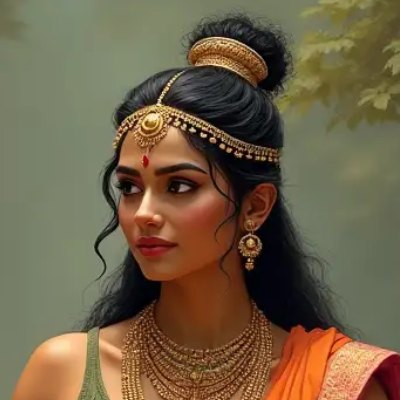
Shraddha — Queen Consort of Vaivasvata Manu, Mother of the Solar and Lunar Dynasties
Shraddha · Shraddha Vaivasvati · Shraddhadevi
Shraddha is recorded across the major Puranas and the Mahabharata as the wife of Vaivasvata Manu — the seventh Manu, also called Shraddhadeva and Satyavrata — son of Vivasvan the Sun-god and his wife Saranyu, and the presiding sovereign of the current Manvantara, the seventh world-age. She is the mother of his ten principal children, most significantly Ikshvaku, the founder of the Solar dynasty, and Ila, who through her union with Budha became the progenitor of the Lunar dynasty. Through her, therefore, nearly all the great royal lineages of ancient India — the Suryavamsha and the Chandravamsha alike — trace their origin. Her principal narrative role beyond genealogical enumeration is her intervention in the sacrifice performed to obtain offspring, which resulted in the birth of a daughter rather than a son. She appears in the Bhagavata Purana, the Vishnu Purana, the Matsya Purana, and the Mahabharata.
✦ The Name and Disambiguation
The name Shraddha is a Sanskrit abstract noun meaning faith, reverence, trust, or devoted belief — particularly the devotional disposition directed toward the divine, toward elders, and toward ancestral rites. It is one of the most significant virtue-words in Sanskrit religious literature. The name is borne by several distinct figures in the Puranic tradition and these must be distinguished clearly. First, a Shraddha who is the daughter of Daksha Prajapati by his wife Prasuti and who became one of the wives of Dharma, bearing him a son named Kama — this figure is attested in the Vishnu Purana (1.7), the Bhagavata Purana (4.1), the Brahmanda Purana, and the Vayu Purana. Second, a Shraddha who is the daughter of the patriarch Kardama by his wife Devahuti and who became the wife of the sage Angirasa, mother of Utathya, Brihaspati, and four daughters named Sinivali, Kuhu, Raka, and Anumati — attested in the Bhagavata Purana (3.24). Third, the Shraddha who is the wife of Vaivasvata Manu and the subject of this profile. These three figures are entirely separate in the Puranic genealogical system and their narratives do not overlap.
✦ Lineage
- Husband: Vaivasvata Manu, also called Shraddhadeva and Satyavrata, son of the Sun-god Vivasvan and his wife Saranyu, seventh of the fourteen Manus of the current cosmic cycle, progenitor of the present human race, presider over the current Manvantara, and the king who survived the great flood with the aid of the Matsya avatar of Vishnu.
- Son — Ikshvaku: eldest son, founder of the Ikshvaku dynasty and the Solar lineage, first king of Ayodhya, ancestor of the great solar kings including Harishchandra, Sagara, Dilipa, Raghu, and ultimately Rama.
- Son — Dhrishta: second son; founded a Kshatriya clan known by his name according to the Vishnu Purana.
- Son — Narishyanta: third son; progenitor of a separate dynastic line.
- Son — Dishta (also Nabhaga or Nabhagadishta in variant texts): fourth son in the Vishnu Purana sequence.
- Son — Nriga: fifth son; known in later tradition for the curse he received for giving away a cow belonging to a Brahmin.
- Son — Karusha: sixth son; founder of the Karushaka people according to the Vishnu Purana.
- Son — Saryati: seventh son; father of the princess Sukanya who married the sage Chyavana.
- Son — Nabhaga: eighth son in some enumerations.
- Son — Pranshu: ninth son.
- Son — Prisadhra: tenth son; the Bhagavata Purana records that he accidentally slew his guru's cow and was cursed to become a Shudra.
- Child — Ila (also known as Sudyumna): born as a daughter as a result of the altered sacrifice; through divine intervention transformed into the male Sudyumna, and later cursed to alternate between male and female forms; as a woman, Ila married Budha, son of the Moon-god Chandra, and gave birth to Pururavas, the ancestor of the entire Chandravamsha, the Lunar dynasty of Indian kings.
✦ The Flood Narrative
The flood narrative is primarily the account of Vaivasvata Manu rather than of Shraddha individually, but she is present within it as his queen. According to the Matsya Purana and the Bhagavata Purana, Manu was warned by the Matsya avatar of Vishnu — appearing first as a small fish and growing progressively larger until it became enormous — of an impending catastrophic deluge that would destroy all life. Following the divine instruction, Manu constructed a great vessel. When the floods came, the boat carried his family, the seven sages known as the Saptarishis, and the seeds of all living beings. The divine fish drew the ark through the rising waters until it came to rest on a mountain — identified as the Himalayas or the Malaya mountains in different textual versions. After the waters receded, Manu and his household, including Shraddha, became the progenitors of repopulated humanity. Shraddha's participation in the ark is implied by her being the mother of Manu's children, who were born after the flood.
✦ The Sacrifice and the Birth of Ila
The birth of Ila is the principal narrative in which Shraddha's own agency is foregrounded. The Bhagavata Purana (Skandha 9) records that Vaivasvata Manu and Shraddha, wishing for offspring, had the sage Vasishtha perform a great sacrifice on their behalf. Shraddha observed the vow of payovrata — subsisting on milk alone — in connection with this sacrifice, directing her devotion toward Mitra and Varuna and desiring a daughter rather than a son. As a result of this, the child born was a daughter, Ila, rather than the son Manu had intended. Manu, dissatisfied, requested Vasishtha to alter what had been produced. The sage performed further rites and the daughter was transformed into the male form, thereafter named Sudyumna. This child subsequently entered a sacred forest where Shiva and Parvati were in seclusion and was cursed to alternate between male and female forms for successive months. As the female Ila, she met Budha, the planet-deity and son of Chandra, and bore him Pururavas; as the male Sudyumna, he fathered three sons — Utkala, Gaya, and Vinatashva — and later ruled as king before renouncing the throne. The Vishnu Purana gives a somewhat compressed account of the same events; the Valmiki Ramayana's Bala Kanda also mentions Ila in passing.
✦ Textual Variants and Inconsistencies
Significant variations exist across the primary texts regarding the children of Shraddha and Vaivasvata Manu. The Vishnu Purana names the sons as Ikshvaku, Nriga, Saryati, Dishta, Dhrishta, Karusha, Narishyanta, Nabhaga, Pranshu, and Prisadhra. The Mahabharata (Anushasana Parva) gives a partially different list including Vena, Dhrishnu, Narishyan, Nabhaga, Ikshvaku, Karusha, Saryati, Prishadhra, and Nabhagarishta, noting also that Manu had fifty additional sons on earth who perished in mutual conflict. The Bhagavata Purana in its ninth skandha provides yet another enumeration. The total is consistently given as ten principal children across the texts, but the individual names, their sequence, and the distinction between Nabhaga and Nabhagarishta — treated as one figure in some texts and two in others — vary across sources.
On the sacrifice episode, the Bhagavata Purana specifies that it was Shraddha's own observance of payovrata and her particular intent in the rite that produced Ila; this version thus attributes the outcome to Shraddha's devotional act rather than to a private request she made to the officiating priest. The Vishnu Purana's account does not describe Shraddha's personal role in the ritual in the same detail. These are distinct narrative emphases rather than a single flat contradiction, but they result in meaningfully different characterizations of Shraddha's agency.
Regarding Ila's status among the children: some texts treat Ila as the eleventh child born separately from the ten sons, while others count Ila among the ten in place of one of the male names. The Vishnu Purana and the Bhagavata Purana include Ila in the account of Manu's children but differ in whether she is counted alongside or apart from the ten sons.
✦ Significance in the Wider Genealogy
Shraddha's position in the Puranic genealogical system is uniquely comprehensive. As the wife of the seventh Manu, she stands at the foundation of the current human age. Through her son Ikshvaku, she is the ancestral mother of the entire Suryavamsha — the Solar dynasty — from which descended the kings of Ayodhya including Sagara, Dilipa, Raghu, Dasharatha, and Rama. Through her child Ila, who as the female Ila bore Pururavas to the Moon-god's son Budha, she is also the matrilineal origin of the Chandravamsha — the Lunar dynasty — from which descended Yayati, the Yadavas, the Kurus, the Pandavas, and Krishna. Her husband Vaivasvata Manu is himself a son of Vivasvan, the Sun-god, and a half-brother of Yama, Yami, the Ashvini twins, Revanta, Shani, Tapati, and Savarni Manu. The Puranic tradition thus treats Shraddha as the co-progenitor, alongside her husband, of virtually all the human lineages recorded in the epics and the Puranas.
✦ References
- Bhagavata Purana, Skandha 9, chapters 1–2: Primary source. The most detailed Puranic account of Shraddha's role in the sacrifice, her payovrata observance, and the birth and transformation of Ila; also enumerates the ten sons of Vaivasvata Manu.
- Vishnu Purana, Amsha 4, Chapter 1: Primary source. Names Shraddha as the wife of Vaivasvata Manu and lists the ten sons; provides the compressed account of the birth of Ila and the subsequent transformation by Vasishtha.
- Matsya Purana: Primary source. Contains the flood narrative in which Shraddha is present as Manu's queen; the most detailed account of the Matsya avatar episode.
- Mahabharata, Anushasana Parva: Primary source. Provides a variant enumeration of the sons of Vaivasvata Manu, noting fifty additional sons who perished; names differ partially from the Vishnu Purana list.
- Valmiki Ramayana, Bala Kanda: Primary source. Traces the Solar dynasty from Brahma through Vivasvan and Manu to Ikshvaku; implies Shraddha's position without naming her explicitly.
- Vishnu Purana, Amsha 1, Chapter 7; Bhagavata Purana, Skandha 4, Chapter 1: Primary sources establishing the distinct figure of Shraddha daughter of Daksha who married Dharma — separate from the Shraddha of this profile.
- Dharmawiki — Shraddha entry: Modern secondary resource. Provides a careful disambiguation of the multiple figures named Shraddha in Puranic literature with primary text citations for each; confirms the three main distinct Shraddha figures.
- Wisdomlib — Shraddha (Purana glossary) and Vaivasvata Manu entries: Modern secondary resource. Aggregates references across the Bhagavata Purana, Vishnu Purana, Brahmanda Purana, and Vayu Purana for the various Shraddha figures and for the sons of Vaivasvata Manu.
- Wikipedia — Ila (Hinduism) and Vaivasvata Manu articles: Modern secondary resources. Provide cross-referenced genealogical data on the children of Shraddha and Manu with primary source citations.