
About
Sinivali — Goddess of the Fourteenth Day Before the New Moon, Daughter of Angiras and Shraddha
Sinivali · Sinivali Angirasi · Subahu
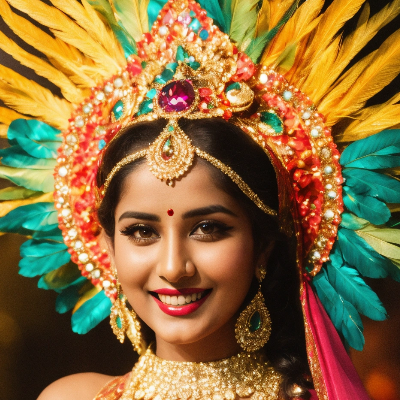
Sinivali is a Vedic goddess and the personification of the fourteenth lunar day preceding the new moon — the last visible sliver of the waning moon before it disappears entirely. She is one of four daughters born of the union of the primordial rishi Angiras and Shraddha, herself a daughter of the Prajapati Kardama Muni and his wife Devahuti. As a daughter of Angiras, Sinivali belongs to the Angirasa lineage, one of the foundational clans of Vedic priestly and cosmological tradition. She is invoked in the Atharva Veda as a goddess of procreation, of the safe establishment of the embryo in the womb, and of the fertile power associated with the lunar cycle at the moment of its greatest darkness and impending renewal. In the Puranic tradition, she is recorded as one of four wives of Dhata, the seventh son of Aditi, by whom she bore the son Darsha — the personification of the new moon sacrifice. Her significance spans both genealogical and cosmological registers: she is at once a member of the family of Angiras and a living embodiment of a specific phase of sacred time that governs the ritual calendar. She appears primarily in the Atharva Veda, the Nirukta of Yaska, and the Bhagavata Purana.
✦ The Name
The name Sinivali is interpreted in the Nirukta of Yaska as referring to the day before the new moon when the last crescent remains faintly visible — the liminal phase between the waning moon and its complete disappearance. Yaska's analysis connects the name to the concept of a cord or thread and a row or series, suggesting the final thin arc of the moon as a thread stretched across the sky before it is extinguished. In the Atharva Veda she is described with epithets meaning broad-hipped and wearing braided hair — physical qualities associating her with fertile womanhood and with the readiness to bear and nurture life. The designation Angirasi, used in some sources, identifies her as a daughter of Angiras.
✦ Lineage
- Maternal grandfather: Kardama Muni — one of the Prajapatis, the progenitor-sages appointed by Brahma the creator to populate the world; the father of nine daughters given in marriage to nine great sages as recorded in the Bhagavata Purana (Canto 4, Chapter 1); his wife was Devahuti, daughter of Manu Svayambhuva.
- Mother: Shraddha — one of the nine daughters of Kardama Muni and Devahuti; her name means faith or reverential trust in Sanskrit; given in marriage to the sage Angiras by the instruction of Brahma as recorded in the Bhagavata Purana (Canto 4, Chapter 1); to be distinguished from other figures named Shraddha in the tradition, including the daughter of Daksha.
- Father: Angiras — one of the primordial saptarshis, the seven great seers of Vedic tradition, regarded as a mind-born son of Brahma the creator; the founding ancestor of the Angirasa clan of seers; closely associated with fire ritual, the priestly office, and the Atharvaveda.
- Sisters: Kuhu — goddess of the new moon day; Raka — goddess of the full moon; Anumati — goddess of the fourteenth day before the full moon; all three are daughters of Angiras and Shraddha and sisters of Sinivali.
- Brothers (principal): Brihaspati — the preceptor of the gods, one of the most prominent sons of Angiras, identified in Vedic and Puranic tradition as the divine teacher of the devas and the lord of sacred speech and wisdom; Utathya — a renowned sage and son of Angiras; Ghora — a sage of the Angirasa lineage identified in the Rigveda Anukramanis as the father of Kanva, the founding seer of the Kanva family of Rigvedic seers, and recorded in the Chandogya Upanishad as the teacher of Krishna Devakiputra; his name signifying the terrible or awe-inspiring aspect of ascetic discipline places him alongside the auspicious lunar goddesses as a complementary expression of the Angirasa tradition's range.
- Husband: Dhata — the seventh son of Aditi, the mother of the gods, and one of the twelve Adityas; a solar deity of the Vedic and Puranic tradition. The Bhagavata Purana (Canto 6, Chapter 18) records that Dhata had four wives — Kuhu, Sinivali, Raka, and Anumati — each of whom bore him one son.
- Son: Darsha — the personification of the Darsha sacrifice, the new moon fortnightly rite which is one of the two primary sacrificial observances of the Vedic ritual calendar; his name derives directly from the word for the new moon day, and through him Sinivali becomes the mother of one of the foundational institutions of Vedic sacrificial practice.
✦ Cosmological Identity and Lunar Role
Sinivali presides over the fourteenth tithi — the lunar day — of the waning fortnight, the krishna paksha, which is the last day on which the moon remains even faintly visible before the new moon darkness. This phase of the lunar cycle, poised at the threshold between the visible and the invisible moon, is understood in the Vedic ritual calendar as a moment of particular potency for rites connected with fertility, conception, and the generation of new life. The thinness of the remaining lunar crescent, about to be extinguished and then renewed, makes this day simultaneously an ending and a preparation for beginning — qualities that align naturally with Sinivali's role as a goddess of the placement of the embryo and the initiation of new life within the womb. That her son Darsha is the personification of the new moon sacrifice — the ritual performed precisely at the moment of lunar disappearance and renewal — establishes a coherent cosmological logic within the family: the goddess of the threshold day before the new moon is the mother of the sacrificial act performed on the new moon itself.
✦ Ritual Significance and Invocation
In the Atharva Veda, Sinivali is invoked specifically in rites concerned with procreation and the safe establishment of the embryo in the womb. She is addressed as a goddess who places the germ of new life and who ensures the proper seating of the foetus — a function making her the presiding deity of the moment of conception understood as a sacred and ritually significant event. Her physical description in the Atharva Veda — broad-hipped and wearing braided hair — employs the conventional iconographic language of fertile womanhood in Vedic literature, grounding her cosmic function in the imagery of embodied maternal power. She is described in conjunction with her sister Raka as one of the pair of lunar goddesses most directly associated with the granting of progeny to worshippers who invoke them at the correct lunar moment. The Nirukta of Yaska discusses Sinivali among the lunar deity figures in the context of explaining the meaning of the tithi names and their associated ritual invocations.
✦ Theological Significance
The identification of Sinivali and her sisters as daughters of Angiras and Shraddha — Faith — carries a specific theological significance in the Vedic understanding. The daughters of Faith and of the primordial priestly sage are not merely biological offspring but are the very phases of sacred time that make ritual life possible. The lunar tithis govern the calendar of sacrifice, and these goddesses, as personified tithis, are understood to be the living regulatory forces of the ritual order. Sinivali in particular, as the goddess of the liminal pre-new-moon day, embodies the creative potential latent in darkness and endings — the threshold quality that makes her the appropriate presiding deity of conception, itself a hidden beginning within apparent completion. Her union with Dhata, the Aditya associated with cosmic establishment and ordering, and the birth of Darsha — the sacrificial act of the new moon — extends this theological logic into the Puranic framework: the daughter of Faith, presiding over the threshold of darkness, becomes through her marriage to a solar deity the mother of the ritual that governs the renewal of the sacred calendar.
✦ Connection to the Wider Genealogy
Sinivali belongs to the Angirasa-Kardami branch of the Angirasa lineage — the family produced by the union of Angiras with Shraddha, daughter of Kardama Muni. Through her father Angiras, Sinivali is connected to the entire Angirasa genealogical tradition, including Brihaspati the divine preceptor, Utathya, Ghora, and the Kanva family of Rigvedic seers. Through her mother Shraddha, she is connected to the family of Kardama Muni, whose nine daughters became the mothers of some of the most significant lineages in the Vedic and Puranic traditions. Through her marriage to Dhata and the birth of her son Darsha, she is further connected to the Aditya lineage — the twelve solar deities born of Aditi — bridging the Angirasa priestly tradition and the solar divine order.
✦ References
- Primary Sources:
- Atharva Veda: The principal Vedic source for Sinivali's ritual identity and invocation; describes her physical attributes and her role as the goddess of the pre-new-moon tithi invoked for procreation and the safe establishment of the embryo.
- Bhagavata Purana, Canto 4, Chapter 1: Records the genealogical identity of Shraddha as a daughter of Kardama Muni and her marriage to Angiras by Brahma's instruction; anchors the parentage of Sinivali and her sisters within the Puranic tradition.
- Bhagavata Purana, Canto 6, Chapter 18: Records that Dhata, the seventh son of Aditi, had four wives — Kuhu, Sinivali, Raka, and Anumati — and that Sinivali bore him the son Darsha, the personification of the new moon sacrifice.
- Nirukta of Yaska: Provides etymological and exegetical discussion of Sinivali among the lunar deity figures and the ritual significance of the tithi designations.
- Secondary Sources:
- Vettam Mani, Puranic Encyclopaedia (1975): Entry on Sinivali noting her identity as a daughter of Angiras, her marriage to Dhata, and her lunar and ritual associations.
- A. A. Macdonell and A. B. Keith, Vedic Index of Names and Subjects (1912): Contains entries on Sinivali, the lunar goddesses, and the Angirasa lineage establishing the textual and genealogical background.
- Wisdom Library, Sinivali: Aggregates Vedic and Puranic references to Sinivali and her sisters within the Angirasa family tradition, including the Bhagavata Purana account of her marriage to Dhata.