
About
Atharva — Mind-Born Sage, Husband of Shanti
Atharva · Atharvan
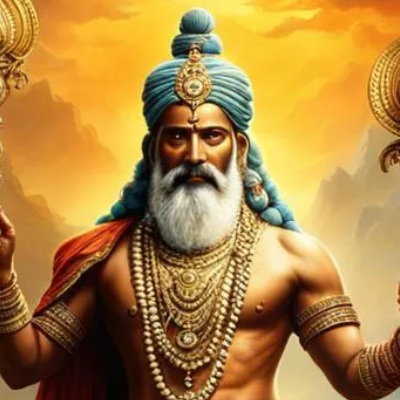
Atharva, also rendered Atharvan, is a primordial sage counted among the mind-born sons of Brahma and, in certain Puranic enumerations, among the Saptarishis, the seven great seers of the Vedic and Puranic tradition. He is recorded in the Bhagavata Purana as the husband of Shanti, one of the nine daughters born to the sage Kardama Prajapati and his wife Devahuti, daughter of Svayambhuva Manu. Atharva's marriage to Shanti was one of nine such unions arranged by Kardama, in which each of his nine daughters was given in marriage to a different eminent sage, an event recorded as part of the wider narrative of Kardama and Devahuti's household in the Bhagavata Purana's third book. Atharva's name is closely associated with the Atharvaveda, the fourth of the four Vedas, traditionally connected with this sage and his lineage as its foundational source.
✦ The Name
The name Atharva, also given as Atharvan, is closely connected in Vedic and Puranic tradition with the fourth Veda, the Atharvaveda, which is traditionally associated with this sage as its foundational seer and which contains hymns, charms, and ritual formulae distinct in character from the other three Vedas. The precise Sanskrit etymology of the name itself is not settled within the tradition, though its strong association with this body of Vedic literature situates Atharva among the small number of primordial sages whose names are directly bound up with the origin of a specific portion of the Vedic corpus.
✦ Lineage
- Spouse: Shanti — one of the nine daughters of the sage Kardama Prajapati and his wife Devahuti, daughter of Svayambhuva Manu. Shanti's eight sisters were Kala, Anasuya, Shraddha, Havirbhu, Gati, Kriya, Khyati, and Arundhati, each likewise given in marriage to a different eminent sage: Kala to Marichi, Anasuya to Atri, Shraddha to Angiras, Havirbhu to Pulastya, Gati to Pulaha, Kriya to Kratu, Khyati to Bhrigu, and Arundhati to Vasishtha.
- Father-in-law: Kardama Prajapati — a mind-born son of Brahma and one of the ten Prajapatis, the progenitors of creation in the Puranic tradition. Kardama undertook a sacrifice of ten thousand years' duration in devotion to Vishnu, who appeared before him and promised him marriage to Devahuti, daughter of Svayambhuva Manu, along with the future birth of a son who would be a portion of Vishnu himself.
- Mother-in-law: Devahuti — daughter of Svayambhuva Manu and his wife Shatarupa, and wife of Kardama Prajapati. Devahuti bore Kardama nine daughters, including Shanti, and one son, the sage Kapila.
- Brother-in-law: Kapila — the only son of Kardama and Devahuti, revered in the Bhagavata Purana as a partial incarnation of Vishnu and credited as the founder of the Sankhya school of philosophy.
- Brothers-in-law (through Shanti's sisters): Marichi, Atri, Angiras, Pulastya, Pulaha, Kratu, Bhrigu, and Vasishtha — the eight sages who married Shanti's eight sisters, themselves among the most celebrated of the primordial seers of the Vedic and Puranic tradition, several of whom, together with Atharva, are variously counted among the Saptarishis in different recensions of that list.
✦ The Marriages of Kardama's Daughters
The Bhagavata Purana's third book recounts that, following the birth of his nine daughters by Devahuti, Kardama Prajapati arranged their marriages to nine of the most eminent sages of the age, acting in accordance with instructions received from Brahma. This sequence of marriages is presented in the Puranic tradition as a significant act in the ongoing work of populating and structuring the cosmos through the union of Kardama's progeny with the foremost seers of the time, each of whom would, through these unions, father further lineages of sages, priests, and lawgivers. Atharva's marriage to Shanti was one of these nine unions, placing him within this same act of cosmological organisation, alongside Marichi, Atri, Angiras, Pulastya, Pulaha, Kratu, Bhrigu, and Vasishtha, each of whom received one of Shanti's eight sisters in marriage.
✦ Connection to the Wider Genealogy
Through his marriage to Shanti, Atharva is connected to the household of Kardama Prajapati and Devahuti, and through Devahuti to the lineage of Svayambhuva Manu, the first Manu of the Puranic cosmological scheme and the progenitor of the earliest human dynasties. Through his brother-in-law Kapila, regarded as a partial incarnation of Vishnu and the founder of the Sankhya school of philosophy, Atharva's household is connected to one of the most influential currents of Puranic and philosophical thought. Through his fellow sons-in-law Marichi, Atri, Angiras, Pulastya, Pulaha, Kratu, Bhrigu, and Vasishtha, Atharva stands among a cluster of primordial sages whose marriages to the daughters of Kardama collectively gave rise to many of the great priestly and ascetic lineages, or gotras, that structure the genealogical tradition of the Vedic and Puranic corpus.
✦ References
- Primary Sources
- Bhagavata Purana, Book 3, Chapters 21–33 — Primary source for the narrative of Kardama and Devahuti's household, the birth of their nine daughters and one son, and the marriages of the nine daughters to nine eminent sages, including Atharva's marriage to Shanti.
- Secondary Sources
- Wilson, Horace Hayman (trans.), The Vishnu Purana: A System of Hindu Mythology and Tradition — Secondary translation and commentary consulted for cross-verification of the Kardama-Devahuti genealogy and the marriages of their daughters.
- Manidvipa, "Consorts, Daughters, and Female Characters" — Secondary compilation consolidating the genealogical record of Kardama and Devahuti's nine daughters and their respective husbands, including Atharva's marriage to Shanti.
- Grokipedia, entry on Kardama — Secondary reference consulted for cross-verification of the sequence of marriages arranged by Kardama for his nine daughters.