
About
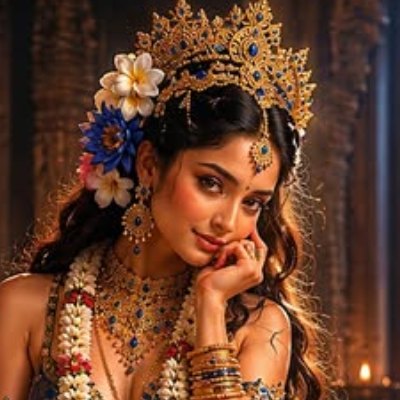
Satya — Princess of Kosala, Fifth Queen of Krishna
Satya · Nagnajiti · Nagnajitei · Kausalya · Nappinai
Satya, also known by her patronymic Nagnajiti, was the daughter of King Nagnajit of Kosala and the fifth of the Ashtabharya — the eight principal queen-consorts of Krishna at Dwarka. Her marriage to Krishna is narrated in the Bhagavata Purana (Canto 10, Chapter 58) as one of the most celebrated episodes of divine valour in the Ashtabharya narrative, centring on Krishna's simultaneous subduing of seven ferocious bulls that no other suitor had been able to tame. She is attested in the Bhagavata Purana, the Vishnu Purana, the Harivamsha, the Mahabharata, and in the South Indian Vaishnava devotional tradition through the identification with Nappinai in the works of the Tamil poet-saint Andal. In Sri Vaishnava theology she is identified as an incarnation of Niladevi, the third aspect of the goddess Lakshmi.
✦ The Names
The name Satya derives from the Sanskrit root sat meaning being, truth, or the real — yielding the sense of one who is truthful, virtuous, or aligned with ultimate reality. It is the personal name by which she is most consistently identified across the Bhagavata Purana, the Vishnu Purana, and the Harivamsha. The patronymic Nagnajiti means daughter of Nagnajit, formed from her father's name with the standard feminine suffix. The epithet Kausalya — used in the Bhagavata Purana (10.58.32) — means she who belongs to Kosala, identifying her as a princess of that kingdom; the Bhagavata Purana uses the related masculine form Kaushalya to describe her father Nagnajit as the ruler of Kosala. In South Indian Vaishnava tradition she is identified with Nappinai, a beloved figure in the Tamil devotional literature of Andal, in which the bull-taming episode is presented in a regional narrative framework.
✦ Lineage
- Father: Nagnajit, also known as Kumbagan in certain variant traditions, a pious king of Kosala described in the Bhagavata Purana as exceedingly righteous and devoted to Vedic dharma; the text describes him as ati-dharmikas — supremely righteous
- Dynasty: The Suryavamsha — Solar Dynasty — through her father's kingdom of Kosala; though the Bhagavata Purana does not explicitly equate Nagnajit's Kosala with the Solar dynasty's Ayodhya-centred Kosala, the epithet Kausalya and the kingdom's identification with the region associated with the Solar line is consistent across secondary sources
- Husband: Krishna, the eighth avatar of Vishnu, son of Vasudeva and Devaki, king of Dwarka; who won her at her father's challenge by taming the seven bulls simultaneously
- Sons: Ten sons named in the Bhagavata Purana (10.61.13) — Vira (the eldest according to BhP), Chandra, Ashvasena, Chitragu, Vegavan, Vrisha, Ama, Shanku, Vasu, and Kunti (the youngest); the Vishnu Purana names Bhadravinda as the prominent or eldest son in its account, representing a minor textual variant in the ordering
✦ The Marriage Challenge and the Seven Bulls
The Bhagavata Purana (10.58.33–45) narrates the circumstances of Satya's marriage in detail. King Nagnajit had set a singular condition for any man who sought his daughter's hand: the suitor must simultaneously subdue seven ferocious bulls, described as large, sharp-horned, and utterly untamable, whose noses had never been pierced for a rope. The condition had defeated every king and hero who attempted it before Krishna's arrival. When Krishna came to Kosala, Nagnajit received him with great honour, freely acknowledging his desire to have Krishna as a son-in-law but bound by his sworn condition. The Bhagavata Purana records that as Krishna entered the arena to face the bulls, Satya prayed fervently to the sacred fire, asking that this supreme being might become her husband. Krishna then multiplied himself into seven simultaneous divine forms and cast a separate noose around the neck of each bull, subduing all seven at once with total ease. The assembled onlookers were overwhelmed with wonder and joy.
Nagnajit gave his daughter to Krishna in marriage and sent with her a royal dowry described in the Bhagavata Purana as consisting of ten thousand cows, nine thousand elephants, nine hundred thousand horses, and a vast number of male and female servants — a dowry of a scale befitting the marriage of a princess to a divine king. As Krishna departed with Satya, the assembled suitors who had previously failed the challenge attacked out of rage and humiliation. Krishna's forces defeated them, and the couple proceeded to Dwarka.
✦ Position Among the Ashtabharya
Satya is counted as the fifth of the eight principal queens of Krishna. The canonical list in the Bhagavata Purana (Canto 10) names them as Rukmini, Satyabhama, Jambavati, Kalindi, Mitravinda, Nagnajiti, Bhadra, and Lakshmana — placing Satya in the sixth position in this specific enumeration, though she is widely described as the fifth in secondary and popular sources reflecting alternate orderings in the Vishnu Purana and Harivamsha. The Bhagavata Purana (3.3.4) provides an earlier reference to Nagnajiti among Krishna's consorts, confirming her standing in the primary textual tradition independent of the detailed marriage narrative in Canto 10. The Mahabharata also refers to a wife of Krishna named Satya in the context of the Ashtabharya.
✦ The South Indian Identification with Nappinai
In the South Indian Vaishnava tradition, Satya is identified with Nappinai, a figure celebrated in the devotional poetry of Andal — the eighth-century Tamil poet-saint revered as a goddess in the Sri Vaishnava tradition. In Andal's Tiruppavai and Nachiyar Tirumoli, Nappinai is described as a beautiful maiden of exceptional grace, the daughter of a Nagnajita who is identified in the South Indian tradition as the brother of Yashoda, Krishna's foster mother. The bull-taming episode is explicitly referenced in Andal's poetry and has been linked to the ancient Tamil martial tradition of Eru Thazhuvuthal — the practice of a hero embracing or subduing bulls to demonstrate worthiness for a bride — which is the cultural ancestor of the modern festival of Jallikattu. This South Indian Nappinai identification represents a significant regional elaboration of the Nagnajiti narrative with deep devotional and cultural roots, though the precise relationship between the Puranic Nagnajit of Kosala and the South Indian tradition's Nagnajita as Yashoda's brother is not established in the Sanskrit primary sources themselves.
✦ Theological Significance
In Sri Vaishnava theology, Satya is identified as an earthly manifestation of Niladevi — the third aspect of the supreme goddess Lakshmi, alongside Sridevi and Bhudevi. In this theological framework, the three aspects of the goddess are present in the world through specific divine consorts: Sridevi through Rukmini, Bhudevi through Satyabhama, and Niladevi through Satya-Nagnajiti. This identification places Satya within the broader Vaishnava metaphysics of the divine feminine as not merely a human queen but a manifestation of cosmic goddess-energy taking birth to accompany Vishnu's avatar.
✦ Textual Variants and Inconsistencies
The principal variant concerns the name of her eldest son. The Bhagavata Purana (10.61.13) gives Vira as the eldest of her ten sons. The Vishnu Purana names Bhadravinda as the prominent or leading son in its account without explicitly designating him eldest. The Wisdomlib Purana Index entry for Nagnajiti notes that she had two sons specifically named in the Vishnu Purana, of whom Bhadravinda is named — suggesting the Vishnu Purana provides a shorter or differently ordered list rather than a full enumeration of ten. These two accounts are complementary rather than strictly contradictory but cannot be fully harmonised on the question of primogeniture.
A second point concerns the submitted identification of Kosala's capital as Ayodhya. The Bhagavata Purana (10.58.32) uses the epithet Kaushalya for Nagnajit — meaning ruler of Kosala — but does not specify Ayodhya as his capital. Ayodhya is the well-established capital of the Solar dynasty's Kosala kingdom in the Ramayana tradition. Whether Nagnajit's Kosala and the Solar dynasty's Kosala are the same political entity is not confirmed in the primary text, and the identification should be treated as probable but not explicitly attested.
✦ Connection to the Wider Genealogy
Satya connects the Kosala royal line — whether of the Solar dynasty or a distinct eastern Kosala kingdom — to the Yadava dynasty of Krishna through her marriage at Dwarka. Her ten sons were princes of Dwarka and members of the Yadava order through their paternal lineage. Her identification as an incarnation of Niladevi places her within the threefold theological structure of the divine feminine that the Sri Vaishnava tradition sees as fully manifest in Krishna's principal consorts at Dwarka.
✦ References
- Bhagavata Purana, Canto 10, Chapter 58, verses 32–45: Primary source for the marriage narrative; identifies Nagnajit as the pious king of Kosala; describes the seven bulls, Krishna's multiplication into seven forms, Satya's prayer at the sacred fire, and the royal dowry
- Bhagavata Purana, Canto 10, Chapter 61, verse 13: Names the ten sons of Satya and Krishna — Vira, Chandra, Ashvasena, Chitragu, Vegavan, Vrisha, Ama, Shanku, Vasu, and Kunti
- Bhagavata Purana, Canto 3, Chapter 3, verse 4: Earlier reference confirming Nagnajiti among Krishna's principal consorts independent of the Canto 10 narrative
- Vishnu Purana, Book 5, Chapter 32, verse 3: Corroborates Satya Nagnajiti as one of Krishna's eight queens; names Bhadravinda as a prominent son
- Matsya Purana, Chapter 47, verses 13 and 19: Corroborates Nagnajiti's position among Krishna's consorts
- Harivamsha: One of the earliest textual attestations of Nagnajiti among Krishna's principal consorts; corroborates the name Satya Nagnajiti
- Mahabharata: References a wife of Krishna named Satya in connection with the Ashtabharya
- Andal, Tiruppavai and Nachiyar Tirumoli (8th century CE): South Indian devotional primary source identifying Nappinai with Nagnajiti; describes the bull-taming episode and Nappinai's beauty; foundational text for the South Indian Vaishnava tradition of this identification
- Wikipedia, "Nagnajiti" article: Secondary source confirming attestation across Bhagavata Purana, Vishnu Purana, Harivamsha, and Mahabharata; records the Niladevi identification and the Nappinai connection in South Indian tradition
- Wisdomlib, "Nagnajiti" definition entry: Secondary source citing Bhagavata Purana 3.3.4, 10.58.32, and 10.61.13; Matsya Purana 47.13 and 47.19; and Vishnu Purana 5.32.3 as the principal primary attestations
- Puranic Encyclopaedia (Vettam Mani), "Nagnajiti" entry: Secondary source providing consolidated narrative and genealogical details across the Puranic tradition