
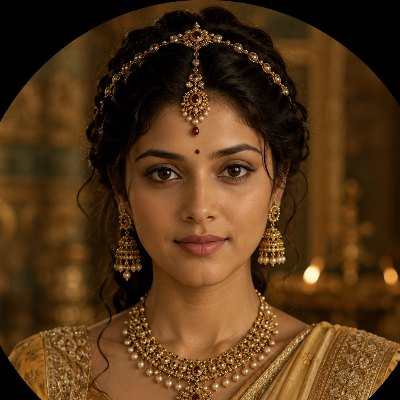
About
Bhadra — Princess of Kekeya, Eighth Queen of Krishna, Daughter of Dhrishtaketu
Bhadra · Kaikeyi · Princess of Kekeya
Bhadra is a princess of the Kekeya royal house and the eighth among the Ashtabharya — the eight principal queens of Krishna as enumerated in the Bhagavata Purana. She is the daughter of Dhrishtaketu, king of Kekeya, and Shrutakirti — a daughter of Shurasena the Yadava chieftain of Mathura and a sister of Vasudeva the father of Krishna — making Bhadra a first cousin of Krishna through their mothers being sisters. The Bhagavata Purana (Canto X, chapter 58) gives her the epithet Kaikeyi, meaning princess of the Kaikeya realm. The Vishnu Purana and Harivamsha do not name her directly, referring to her only as the daughter of Dhrishtaketu or the princess of Kekeya. She is attested also in the Mahabharata, where a brief mention of Bhadra among the queens of Krishna at Hastinapura occurs in the context of their visit to Kunti and the Pandavas. She bore Krishna ten sons. The Mausala Parva of the Mahabharata records Bhadra among the queens who performed sati at Krishna's funeral.
✦ The Name
The name Bhadra is a Sanskrit adjective-noun meaning auspicious, fortunate, good, or blessed — one of the most broadly positive epithets in the Sanskrit tradition, used across numerous contexts in Vedic, Puranic, and epic literature. The epithet Kaikeyi, used for her in the Bhagavata Purana, means she who is of the Kaikaya lineage or the princess of Kekeya, and follows the standard patronymic formation common in Sanskrit nomenclature. The name Bhadra is shared by numerous other figures in the tradition — gods, apsaras, and mortal women alike — making the qualifier princess of Kekeya or daughter of Dhrishtaketu essential for identifying this specific individual.
✦ Lineage
- Father: Dhrishtaketu — king of Kekeya, vassal of Yudhishthira, Pandava ally
- Mother: Shrutakirti — daughter of Shurasena the Yadava chieftain, sister of Vasudeva the father of Krishna
- Brothers: Santardana — eldest brother who headed the family delegation that gave Bhadra in marriage to Krishna; Vrihatkshatra, Sukumara, Nila, Suryadatta, and Shankha — further brothers, Pandava allies at Kurukshetra
- Husband: Krishna — son of Vasudeva and Devaki, pre-eminent figure of the Vrishni clan, avatara of Vishnu; her first cousin through Vasudeva being her mother's brother
- Sons (Bhagavata Purana, Canto X, chapter 61): Sangramajit, Brihatsena, Shura, Praharana, Arijit, Jaya, Subhadra, Vama, Ayur, and Satyaka — ten sons born to Bhadra by Krishna
✦ Marriage to Krishna
The Bhagavata Purana (Canto X, chapter 58, verse 56) records that Bhadra's brothers, headed by Santardana, brought her to Krishna and gave her to him in marriage — an arranged marriage conducted by her own brothers with full familial consent, in direct contrast to the circumstances of Mitravinda's marriage to Krishna, which involved an abduction against her brothers' wishes. An alternative account in some secondary sources describes Bhadra as having chosen Krishna at a svayamvara, but the Bhagavata Purana's primary statement is the brothers' arrangement. The union was cordial and freely given, reflecting the bond of maternal kinship and political sympathy that already connected the Kekeya house to the Pandava-Yadava alliance.
✦ At Hastinapura and the Conversation with Draupadi
The Mahabharata records that Krishna and his queens, including Bhadra, visited Hastinapura and were received by Kunti and the Pandavas. As directed by Kunti, Draupadi worshipped and honoured Bhadra and the other queens with gifts. Bhadra narrated to Draupadi the account of her own marriage to Krishna. This episode, while brief, is one of the few passages in the primary literature that gives Bhadra a speaking presence rather than a purely genealogical one.
✦ Death and Sati
The Mausala Parva of the Mahabharata, describing the end of the Vrishni line and the death of Krishna, records that Bhadra was among the queens who immolated themselves on Krishna's funeral pyre. The Mahabharata names four of the eight principal queens as performing sati; Bhadra is among those specifically named. The Bhagavata Purana states more broadly that all eight queens committed sati, without naming them individually in that passage.
✦ Textual Variants
The Bhagavata Purana names Bhadra eighth among the Ashtabharya; some sources give her seventh position, a minor ordering discrepancy. The Vishnu Purana and Harivamsha do not use the name Bhadra at all for this queen, referring to her only by the periphrasis daughter of Dhrishtaketu or princess of Kekeya — making the Bhagavata Purana the sole primary source for her personal name. The sons' list from the Bhagavata Purana is reproduced consistently across secondary sources; no variant list for her children appears in any primary source consulted.
✦ Connection to the Wider Genealogy
Bhadra unites two branches of the wider Yadava lineage through her parentage and her marriage: through her mother Shrutakirti she descends from Shurasena son of Devamidhusha son of Vrishni son of Satvata; through her husband Krishna she is connected to that same line by a different path. Her cousin relationship to Krishna and her sister Mitravinda's parallel situation through their mothers being Shurasena's daughters creates a doubled marital connection between the Kekeya house and the Vrishni royal household at Dvaraka.
✦ References
Primary Sources
- Bhagavata Purana, Canto X, chapter 58, verse 56 — The principal source naming Bhadra and recording her marriage to Krishna through her brothers headed by Santardana; gives her the epithet Kaikeyi.
- Bhagavata Purana, Canto X, chapter 61 — Lists Bhadra's ten sons by Krishna: Sangramajit, Brihatsena, Shura, Praharana, Arijit, Jaya, Subhadra, Vama, Ayur, and Satyaka.
- Vishnu Purana, Book IV, chapter 15 — Refers to Bhadra as the daughter of Dhrishtaketu or princess of Kekeya without giving her personal name; includes her among Krishna's principal queens.
- Harivamsha — Refers to the same figure as princess of Kekeya; does not use the name Bhadra.
- Mahabharata, Mausala Parva — Names Bhadra among the queens who performed sati at Krishna's funeral.
Secondary Sources
- Wikipedia, "Bhadra (Krishna's wife)" article — Collates all primary references; distinguishes the Bhagavata Purana naming from the Vishnu Purana and Harivamsha periphrases; records the sons list and the sati episode.
- Wisdomlib.org, "Shrutakirti" entry — Cites Bhagavata Purana IX.24.29 and X.58.56 confirming Shrutakirti as Bhadra's mother and the marriage context.
- Puranic Encyclopaedia, Vettam Mani, entry "Bhadra" — Distinguishes the Kekeya princess from other figures named Bhadra in the tradition; records the primary chapter references.