
About
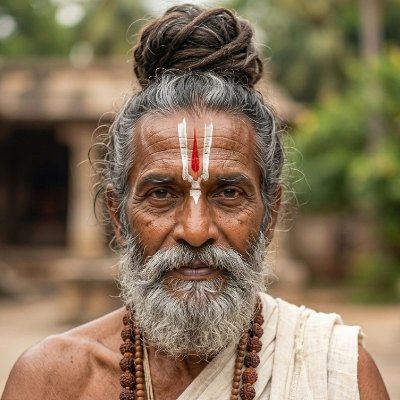
Upamanyu — Vedic Sage, Disciple of Ayodha Dhaumya, and Supreme Devotee of Shiva
Upamanyu · Aupamanyava (patronymic) · elder brother of Dhaumya
Upamanyu is a Vedic sage who appears in several primary texts of the Hindu canonical tradition, most extensively in the Shiva Purana (Vayaviya Samhita and the parallel account in the Linga Purana), the Mahabharata (Adi Parva, adhyaya 3, and Anushasana Parva, adhyayas 14–17), and the Kurma Purana. He is the son of Vyaghrapada, the tiger-footed sage celebrated for his flower-gathering devotion to Shiva at Chidambaram, and the elder brother of Dhaumya. In the Shiva Purana he is the boy who performs intense penance in the Himalayas and is granted a cosmic ocean of milk by Shiva. In the Mahabharata Adi Parva he appears as the model disciple of the teacher Ayodha Dhaumya, subjected to a progressive sequence of deprivations and restored to wholeness through the Ashvin Kumaras. In the Anushasana Parva he reappears as an elderly sage in the Himalayas who initiates Krishna into Shaiva practice and transmits the Shiva Sahasranama. He is identified in the Vamsa Brahmana of the Sama Veda as the father or ancestor of Kamboja Aupamanyava.
✦ The Name
The Sanskrit name Upamanyu is generally understood to carry the sense of "zealous" or "fervent," derived from a compound that suggests intense eagerness or desire directed toward something. The patronymic Aupamanyava, meaning "descendant of Upamanyu," is the form in which his name appears in the Vamsa Brahmana of the Sama Veda (1.18), where his son or descendant Kamboja Aupamanyava is listed. No further etymology specific to this figure is offered in the primary sources.
✦ Lineage
- Father: Vyaghrapada — a sage whose name means "tiger-footed," celebrated in the Shaiva tradition for his intense devotion to Shiva at Chidambaram; he prayed for the limbs of a tiger so that he could climb trees at dawn to gather unblemished flowers for Shiva's worship without injury from thorns or darkness, and Shiva granted this boon. He is an ancestor within the Vasishtha lineage tradition, though the precise generational connection varies by source.
- Younger brother: Dhaumya — identified as Upamanyu's younger brother in the Shiva Purana (chapter 35, verse 15) and the Linga Purana (chapter 107, verse 32), where Shiva disguised as Indra addresses Upamanyu directly as "elder brother of Dhaumya." Dhaumya is the same figure who appears in the Mahabharata as Ayodha Dhaumya, the teacher of three celebrated disciples — Aruni, Upamanyu, and Veda — and who later becomes the purohita of the Pandavas. The connection between Ayodha Dhaumya and the Dhaumya who serves the Pandavas is noted as unclear in the epic itself.
- Son or descendant: Kamboja Aupamanyava — named in the Vamsa Brahmana of the Sama Veda (1.18) as the father or ancestor bearing Upamanyu's patronymic; no further genealogical details are recorded.
✦ The Shiva Purana Account: The Penance for an Ocean of Milk
The Shiva Purana, in its Vayaviya Samhita section (mirrored in condensed form in the Linga Purana, chapter 107), narrates the origin of Upamanyu's Shiva devotion in a childhood episode. While visiting another hermitage, the young Upamanyu drank his fill of fresh cow's milk. Returning home and longing for the same, he asked his mother for milk. Unable to provide it on account of the family's poverty, she offered him a substitute of water mixed with powdered rice. He rejected this immediately, recognising it as a falsification, and wept for real milk. His mother, grieved at her inability to fulfil his wish, told him that only Shiva could change their circumstances, declaring that without Shiva's grace no one receives wealth, the heavenly realm, or an abundance of good things.
The boy resolved to perform penance. He travelled to the Himalayas, fashioned a clay Parthiva Linga, and began the continuous recitation of the Panchakshara mantra — the five-syllable formula sacred to Shiva. The intensity of his austerity generated such heat that it disturbed the gods in their realms. Shiva, wishing to test and ultimately bless him, arrived at his hermitage in the disguise of Indra, accompanied by a retinue imitating the divine court. The false Indra praised Upamanyu's austerity and offered him great worldly boons, and then began to speak disparagingly of Shiva, describing him as unworthy of devotion in contrast to Indra himself.
Upamanyu was immediately enraged. He refused all offered boons and declared that he would not tolerate any insult to Shiva in his presence. He fashioned a weapon from ash with the intention of using it against the false Indra, declaring that he would sooner perish than hear his lord defamed. At this moment Shiva revealed his true form together with Parvati and his divine retinue. He addressed Upamanyu as the elder brother of Dhaumya — the phrase appears verbatim in the Linga Purana text (chapter 107, verse 32) and in the parallel Shiva Purana chapter 35 — declared himself Upamanyu's eternal father, and granted him the boon of the Ksheera Sagara, an ocean of milk, to draw upon whenever he desired. Additional boons of spiritual knowledge and liberation were granted in the same encounter.
✦ The Mahabharata Account: The Disciple of Ayodha Dhaumya
The Mahabharata (Adi Parva, adhyaya 3, verses 34–77) presents Upamanyu in an entirely different narrative context — as one of three disciples tested by the sage Ayodha Dhaumya, the other two being Aruni of Panchala and Veda. Each disciple is tested for a different quality of studentship. Upamanyu's test is stated explicitly: whether he will maintain his teacher's instruction even when it becomes a matter of life or death. Dhaumya assigns Upamanyu to take the ashram cattle to pasture each day. Some days later, observing that Upamanyu appears well-nourished despite receiving no food from the ashram, Dhaumya asks how he sustains himself. Upamanyu replies that he begs alms in the village. Dhaumya forbids this on the grounds that what a disciple receives belongs first to the teacher. Upamanyu obeys.
Finding himself still hungry, Upamanyu begins begging a second round of alms for himself after giving the first to his teacher. Dhaumya forbids this too, declaring it greedy. Upamanyu then begins drinking milk directly from the cows he tends. Dhaumya forbids this as taking what belongs to the teacher without permission. Upamanyu resorts to licking the froth that flows from the calves' mouths after they nurse. Dhaumya forbids even this, on the grounds that the calves, out of compassion for Upamanyu, produce more froth than they otherwise would, and that this deprives them of nourishment. Upamanyu now has no means of sustaining himself at all.
Wandering the forest one day in extreme hunger, he chews the leaves of the Arka plant, which is described in the text as both bitter and poisonous in its properties. The leaves blind him. Unable to see, he stumbles and falls into a dry open well. When he fails to return to the ashram at sunset, Dhaumya and the other disciples search for him. Finding him inside the well, Dhaumya asks what happened. Upamanyu explains without complaint or reproach. Dhaumya instructs him to chant hymns in praise of the Ashvin Kumaras, the twin divine physicians of the Vedic tradition. Upamanyu recites hymns from the Rigveda addressed to the Ashvins from within the well. The Ashvins appear and offer him a divine cake. Upamanyu declines to consume anything without first offering it to his teacher. The Ashvins argue that their teacher Dhaumya had in a former time accepted such a cake without consulting his own preceptor — therefore Upamanyu need not hesitate. Upamanyu refuses still. The Ashvins, recognising this as the mark of a perfected student, restore his eyesight without requiring him to eat the cake. He returns to the ashram. Dhaumya receives him with praise and bestows upon him instantaneous mastery of the Vedas and Shastras.
✦ The Anushasana Parva: Guru to Krishna and the Shiva Sahasranama
The Mahabharata's Anushasana Parva (adhyayas 14–17) presents Upamanyu in his mature form as a venerable ascetic residing in a Himalayan hermitage, engaged in profound Shaiva practice. Krishna, at the urging of his wife Jambavati — who was the only wife among his consorts who had not yet borne a son — seeks guidance on how to perform austerity to obtain a son from Shiva. Directed to Upamanyu's hermitage by Narada, Krishna arrives and finds it a place of extraordinary sanctity, populated by ascetics, pervaded by sacred sound, and suffused with the atmosphere of Shiva's presence.
Upamanyu narrates to Krishna the same story of his childhood penance and the granting of the ocean of milk — presented in the Anushasana Parva as Upamanyu's own account of his devotional history — and then instructs Krishna in the correct method of Shaiva austerity. Under Upamanyu's direction, Krishna performs rigorous penance for six months in successive postures: holding a skull and a staff in the first month, standing on one leg in the second, subsisting on water alone in the third, standing on his toes in the fourth, living on air alone in the fifth and sixth. Shiva appears before Krishna in his Ardhanarishvara form — the composite half-male, half-female manifestation — and grants Krishna's boon of a son from Jambavati. The child born from this boon is named Samba, the name being derived from the form of Shiva as Samba-Sadashiva in which he appeared. The VedaPurana Hindu encyclopaedia records further that Upamanyu named this child and that Upamanyu composed the Shiva Sahasranama — the thousand names of Shiva — and transmitted it to Krishna, who later teaches it to Yudhishthira at Bhishma's request in the same Anushasana Parva.
✦ Textual Variants and Inconsistencies
The Wisdomlib compilation of the Puranic Index entry for Upamanyu, drawing on the Brahmanda Purana (II.33.3 and III.8.98) and Vayu Purana (70.89), records a different Upamanyu — described as a Shrutarshi and Madhyamadhvaryu, the son of Vasu — from whom descends a group of Aupamanyus. This may represent a homonymous figure in a separate lineage, or a variant genealogical tradition for the same sage; the Brahmanda and Vayu Purana do not identify this Upamanyu with the son of Vyaghrapada.
The Saurapurana (a tenth-century Upapurana) also identifies Upamanyu as the elder brother of Dhaumya, consistent with the Shiva Purana and Linga Purana. The Wisdomlib compilation notes the tradition preserved in learned opinion that Upamanyu son of Vyaghrapada and Upamanyu the disciple of Ayodha Dhaumya are the same person — a view that the primary texts themselves support, since the Anushasana Parva account explicitly has Upamanyu narrate his own childhood penance to Krishna, connecting both episodes in a single biographical arc.
The relationship between Ayodha Dhaumya as teacher in the Adi Parva and Dhaumya as priest of the Pandavas is noted by the Wikipedia Dhaumya article as unclear within the Mahabharata's own text. The Mahabharata identifies Dhaumya the Pandava priest as the brother of Devala — not as the brother of Upamanyu — while the Shaiva Puranic sources identify Dhaumya as Upamanyu's younger brother without any mention of Devala. These two statements about Dhaumya's siblings belong to different textual frameworks and are not reconcilable within a single genealogical line.
✦ Theological Significance
Upamanyu functions in the Shiva Purana tradition as one of the supreme exemplars of Bhakti — devotion that is exclusive, unconditional, and willing to face destruction rather than tolerate the slightest compromise of its object. The episode of the ash-weapon fashioned against the disguised Shiva-as-Indra is the narrative pivot: it demonstrates that Upamanyu's devotion operates even when it appears to be directed against the deity himself. In the Mahabharata tradition, the same absolute quality — the refusal to compromise even at the cost of his own life — is the defining characteristic of his studentship. The two traditions thus present the same essential quality of Upamanyu's character in complementary contexts: Bhakti toward Shiva, and obedience toward the Guru, each taken to its absolute limit.
His role as the source of the Shiva Sahasranama and as the guru who directs Krishna's Shaiva austerity places him in a position of exceptional theological authority: he is the human sage through whom the highest form of Shaiva knowledge passes both to the community of practitioners and to Vishnu's own avatar. The Shiva Purana in some traditions identifies Upamanyu as a divine incarnation — a manifestation of Shiva himself — which further elevates his status beyond that of an ordinary mortal sage.
✦ Connection to the Wider Genealogy
Upamanyu belongs to the lineage of Vyaghrapada, whose own ancestry connects through Vasishtha — Vyaghrapada's wife being a sister of Vasishtha in one tradition, and Vyaghrapada himself being counted among Vasishtha's descendants in secondary sources. Through his younger brother Dhaumya, Upamanyu is connected to the Pandava household, since Dhaumya serves as the Pandavas' purohita throughout the events of the Mahabharata. Through his descendant Kamboja Aupamanyava, he is placed within the Vedic teacher-lineage recorded in the Vamsa Brahmana of the Sama Veda. His intervention in the birth of Samba — Krishna's son by Jambavati — connects the Upamanyu lineage to the Yadava genealogy and, through Samba, to the events of the Mausala Parva in which the destruction of the Yadava clan is precipitated.
✦ References
Primary Sources
- Shiva Purana, Vayaviya Samhita, chapter 35 (and parallel Rudra Samhita chapter 34): The primary Shaiva narrative source; records the childhood episode of the milk substitute, the Himalayan penance, the test by Shiva disguised as Indra, the ash-weapon, and the granting of the ocean of milk; verse 15 addresses Upamanyu as the elder brother of Dhaumya.
- Linga Purana, chapter 107: A condensed parallel of the Shiva Purana Upamanyu narrative; verse 32 confirms the address to Upamanyu as elder brother of Dhaumya; the Wisdomlib note observes that the Linga Purana version appears to be an abridgement of the Shiva Purana account.
- Mahabharata, Adi Parva, adhyaya 3 (verses 34–77): The primary source for the discipleship narrative — Ayodha Dhaumya's three disciples, the progressive food bans, the blinding by Arka leaves, the dry well, the Ashvins, and the granting of Vedic mastery.
- Mahabharata, Anushasana Parva, adhyayas 14–17: The primary source for the mature Upamanyu's encounter with Krishna, the instruction in Shaiva austerity, the birth of Samba, and the transmission of the Shiva Sahasranama; the Vedapath Anushasana Parva summary confirms the detailed ashrama description and the Shiva Ardhanarishvara revelation.
- Vamsa Brahmana of the Sama Veda, 1.18: Records Kamboja Aupamanyava as son or descendant of Upamanyu in the Vedic teacher-lineage; the oldest textual stratum in which the name Upamanyu appears.
- Kurma Purana: Named alongside the Shiva Purana, Linga Purana, and Mahabharata as a primary source containing the Upamanyu narrative by the VedaPurana Hindu encyclopaedia.
- Saurapurana (Upapurana, approximately 10th century): Identifies Upamanyu as the elder brother of Dhaumya; cited in the Wisdomlib definition compilation.
- Brahmanda Purana, II.33.3 and III.8.98; Vayu Purana, 70.89: Record a distinct Upamanyu — son of Vasu, a Shrutarshi and Madhyamadhvaryu — from whom the Aupamanyus descend; the source of the alternate-parentage variant.
Secondary and Reference Works
- Wisdomlib — "Upamanyu: 14 definitions": Compiles Puranic Index entries, dictionary definitions, and cross-references across the Shiva Purana, Linga Purana, Mahabharata, Brahmanda Purana, and Vayu Purana; notes the learned opinion identifying the son of Vyaghrapada with the disciple of Ayodha Dhaumya as one person.
- Wisdomlib — Shiva Purana, chapter 35 translation ("The story of Upamanyu"): Source for the precise verse references and the address to Upamanyu as elder brother of Dhaumya at verse 15.
- Wisdomlib — Linga Purana, chapter 107 translation ("The story of Upamanyu"): Source for the parallel text and the verse 32 confirmation of the elder-brother designation; includes the editorial note on the Linga Purana as likely an abridgement of the Shiva Purana version.
- Wisdomlib — Puranic Encyclopaedia entry "Story of Ayodhadhaumya": Source for the Mahabharata Adi Parva 3 narrative of the three disciples; confirms chapter and verse references (verses 34–77 for the Upamanyu episode).
- Wikipedia — "Upamanyu": Provides the overview of the Shiva Purana account and confirms Vyaghrapada as father and Kamboja Aupamanyava as descendant.
- Wikipedia — "Dhaumya": Source for the note that the connection between Ayodha Dhaumya and Dhaumya the Pandava priest is unclear in the epic, and for the identification of Devala as Dhaumya's brother in the Mahabharata tradition.
- Wikipedia — "Samba (Krishna's son)": Source for the narrative of Krishna's visit to Upamanyu's hermitage, the six-month penance, the Ardhanarishvara appearance, and the granting of Samba's birth.
- VedaPurana Hindu Encyclopaedia — "Upamanyu": Source for the statement that Upamanyu composed the Shiva Sahasranama and gave it to Krishna, and that he named Samba; cites Shiva Purana, Linga Purana, Kurma Purana, Adi Parva, and Anushasana Parva as sources.
- Hindupedia — "Shiva Sahasranamam": Confirms the Anushasana Parva transmission sequence — Krishna learns the Sahasranama from Upamanyu and then teaches it to Yudhishthira at Bhishma's request — and identifies Upamanyu as the named Rishi for the hymn in the Nyasa recitation formula.
- Grokipedia — "Upamanyu": Source for the detail that the Ashvins granted Upamanyu golden teeth alongside the restoration of his sight; confirms the Vyaghrapada parentage and the elder-brother relationship to Dhaumya with citations to the Shiva Purana.