
About
Dhruva — The Vasu of Space, Son of Vasu and Dharma
Dhruva · Dhruva the Vasu · not to be confused with Dhruva the prince, son of King Uttanapada, who became the Pole Star
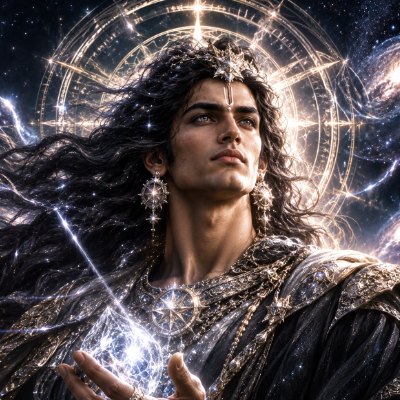
Dhruva is one of the eight Vasus — the group of elemental divine beings associated with fire and light who form part of the thirty-three principal gods of the Vedic and Puranic tradition. He is the son of Vasu, daughter of Daksha Prajapati and his wife Asikni, and of Dharma, the personification of cosmic righteousness. Among the eight Vasus, Dhruva is the most consistently named across all sources — appearing in the Mahabharata, Harivamsa, Vishnu Purana, Bhagavata Purana, Agni Purana, and Padma Purana under the same name without variant. He is associated in the Vedic and Puranic tradition with fixedness, constancy, and the pole — the Vishnu Purana identifying him with Akasha, the ether or space, as the fixed axis around which all phenomena revolve. His single recorded child in all primary sources is Kala — the destroyer of all beings, Time personified — a genealogical relationship of exceptional cosmological significance: the Vasu who embodies constancy and fixedness is the father of the force that destroys all things through the passage of time. Dhruva the Vasu must be carefully and emphatically distinguished from Dhruva the prince, one of the most celebrated devotional figures of the Bhagavata Purana and Vishnu Purana, who is an entirely separate being in an entirely separate narrative context.
✦ The Name
The name Dhruva derives from the Sanskrit root dhrv, related to dhr meaning to hold or to be firm, and denotes that which is fixed, immovable, constant, or certain. In the Vedic tradition, the pole star is called Dhruva — the fixed point of the celestial sphere around which all other stars appear to revolve — and the name thus carries strong cosmological associations with the axis of the universe, the unchanging centre around which all change revolves. The Vishnu Purana's identification of the Vasu Dhruva with Akasha — the fifth element, space or ether, which permeates and contains all other elements and phenomena — is consistent with this sense of Dhruva as the all-pervading, fixed, and foundational cosmic reality. As the father of Kala, the destroyer representing Time, Dhruva the Vasu embodies the paradox at the heart of existence: the fixed and the eternal give rise to the destructive force of time, just as space is the medium within which all temporal phenomena including destruction occur.
✦ Lineage
- Father: Dharma — the personification of cosmic righteousness and duty; one of the creations of Brahma; husband of ten daughters of Daksha and Asikni in Daksha's second birth.
- Mother: Vasu — daughter of Daksha Prajapati and Asikni; mother of all eight Vasus.
- Brothers: The seven other Vasus — Dhara, Apa, Soma, Anila, Anala, Pratyusha, and Prabhasa — born of the same parents.
- Mother in the Mahabharata's secondary genealogy: The Mahabharata, Adi Parva, Chapter 66, contains an alternate parentage for some of the Vasus, stating that Dhara and Dhruva were born of a figure named Dhumra. This represents a different genealogical tradition within the Mahabharata itself from the primary account that traces all eight Vasus to Dharma and Vasu daughter of Daksha. The two traditions cannot be harmonised and represent distinct genealogical strata within the epic.
- Son: Kala — the destroyer of all beings, Time personified as a cosmic force; described in the Mahabharata, Harivamsa, Puranic Encyclopaedia, Agni Purana, and Padma Purana as the son of the Vasu Dhruva. This Kala as the son of Dhruva is a distinct cosmological figure from the Kali who appears in the lineage of Adharma as a presiding spirit of strife; both figures are associated with destructive temporal forces but belong to entirely separate genealogical lineages and narrative contexts.
✦ Dhruva as Father of Kala
The genealogical relationship between Dhruva the Vasu and his son Kala is among the most cosmologically charged in the Vasu lineage. Kala — Time or the Destroyer — is described in the Mahabharata as the illustrious destroyer of worlds, a phrase that invests him with the full weight of the Hindu cosmological understanding of time as the ultimate leveller and dissolver of all created things. In the Bhagavad Gita, Krishna identifies himself as Kala, declaring himself the destroyer of worlds. In the Puranic cosmological framework, Kala is the force that brings each cosmic age to its close, dissolves creation at the end of each cycle, and ensures that nothing in the manifest universe persists permanently. That this supreme destructive force of time is the son of Dhruva — the Vasu of fixedness, constancy, and the immovable axis — reflects the Hindu cosmological teaching that the unchanging absolute (represented by the pole, the fixed point, the ether) is paradoxically the source of the changing and destructive temporal process. The eternal gives birth to time; the fixed gives rise to change; the immovable is the parent of the destroyer.
✦ Elemental and Cosmological Significance
The Vishnu Purana's identification of the Vasu Dhruva with Akasha — the fifth and subtlest of the five great elements, ether or space — gives Dhruva the broadest cosmological scope among the eight Vasus. While the other Vasus represent relatively specific natural phenomena or elements — earth, water, fire, wind, the sun, dawn — Dhruva as Akasha represents the all-pervading medium that contains and permeates all of them. Akasha in classical Indian cosmological and philosophical thought is not merely empty space but the subtle carrier of sound and the medium within which all other elements exist and operate. In the Vaisheshika school of philosophy, Akasha is eternal, all-pervasive, and one — qualities that align precisely with the name Dhruva's connotations of fixedness and constancy. Among the thirty-three gods of the Vedic tradition the Vasus represent the immanent divine presence in natural phenomena; Dhruva as Akasha represents that immanence in its most subtle and all-encompassing form.
✦ The Curse of Vasishtha
Dhruva the Vasu is one of the eight Vasus cursed by Vasishtha following the theft of the divine cow Nandini, as narrated in the Mahabharata. Like the other six non-culpable Vasus, Dhruva was born briefly as one of the sons of Ganga and Shantanu of the Kuru dynasty and immediately drowned by Ganga, spending only the briefest moment in mortal form before returning to the celestial realms. No specific narrative details distinguish Dhruva's participation in this episode from that of the other six peripheral Vasus in the primary texts.
✦ Disambiguation
The name Dhruva is shared by at least two major and entirely distinct figures in the Hindu Puranic tradition, and the disambiguation is of critical importance. The Vasu Dhruva treated in this profile — the son of Dharma and Vasu daughter of Daksha, one of the eight elemental divine beings, and father of Kala the destroyer — is an entirely separate figure from Dhruva the prince, the son of King Uttanapada and Queen Suniti, whose story of childhood rejection, determined austerity, and divine elevation is one of the most celebrated narratives in both the Vishnu Purana and the Bhagavata Purana. Dhruva the prince performed intense tapas at the age of five years at the forest of Madhuvana on the Yamuna, was granted the vision of Vishnu, and was elevated to the status of the Pole Star — Dhruva Nakshatra — where he is said to reside permanently as an eternal fixture of the celestial sphere. This prince Dhruva is a great-grandson of Svayambhuva Manu through the line of Uttanapada, and belongs to an entirely different genealogical lineage from the Vasu Dhruva who is the son of Dharma and Vasu daughter of Daksha. The two figures share only a name and its associated symbolism of fixedness and permanence; they have no other genealogical, narrative, or cosmological connection that is established in the primary texts.
✦ Textual Variants and Inconsistencies
Among the eight Vasus, Dhruva has the most consistent textual representation across sources: his name does not vary across the major texts, and his single recorded offspring — Kala — is confirmed consistently in the Mahabharata, Harivamsa, Puranic Encyclopaedia, Agni Purana, and Padma Purana. The one genuine inconsistency concerns his parentage: the Mahabharata, Adi Parva, Chapter 66, contains a passage stating that Dhara and Dhruva were born of a figure named Dhumra, which differs from the primary Puranic tradition tracing all eight Vasus to Dharma and Vasu daughter of Daksha. This internal inconsistency within the Mahabharata is not resolved across the text and likely reflects the incorporation of different genealogical traditions within the epic's composite composition.
✦ References
Primary Sources
- Mahabharata, Adi Parva, Chapter 66 — names Dhruva among the eight Vasus, records his son as the illustrious Kala the destroyer of worlds, and notes the secondary tradition of his birth from Dhumra.
- Vishnu Purana, Book 1, Chapter 15 — names Dhruva among the eight Vasus and identifies him with Akasha, space or ether, as his elemental domain.
- Bhagavata Purana, Skandha 6, Chapter 6 — names Dhruva among the eight Vasus under the same name, confirming his consistent inclusion across the Puranic tradition.
- Harivamsa, Book 1, Chapter 3 — names Dhruva among the eight Vasus and records his son as Kala the divine destroyer of creatures.
- Agni Purana, Chapter 18 — names Dhruva among the eight Vasus and records his son Kala the destroyer of the universe.
- Padma Purana, Srishti Khanda, Chapter 6 — names Dhruva among the eight Vasus.
- Vishnu Purana, Book 1, Chapters 11–12, and Bhagavata Purana, Skandha 4 — contain the narrative of Dhruva the prince, the figure from whom the Vasu Dhruva treated in this profile must be carefully distinguished.
Modern Reference Works
- Vettam Mani, Puranic Encyclopaedia (1975), entry on Ashtavasu — provides the most comprehensive secondary collation, confirms Kala as the son of Dhruva the Vasu across the principal sources, and addresses the disambiguation from Dhruva the prince.
- Wisdom Library (wisdomlib.org), entries on Dhruva (Vasu) and the Ashtavasus — provides verse-level references to the relevant Mahabharata, Harivamsa, and Puranic passages and assists in the disambiguation between the two Dhruvasa.