
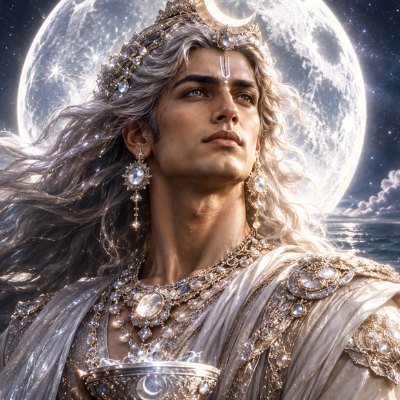
About
Soma — The Vasu of the Moon, Son of Vasu and Dharma
Soma · Soma the Vasu · Chandramas (in the Mahabharata's secondary parentage passage) · not to be confused with Soma the moon god, son of Atri and Anasuya
Soma is one of the eight Vasus — the group of elemental divine beings associated with fire and light who form part of the thirty-three principal gods of the Vedic and Puranic tradition. He is the son of Vasu, daughter of Daksha Prajapati and his wife Asikni, and of Dharma, the personification of cosmic righteousness. Among the eight Vasus, Soma is associated with the moon and with the sacrificial Soma plant and its juice — the two most sacred liquids in the Vedic cosmological and ritual scheme. He is named among the eight Vasus with complete consistency across the Mahabharata, Harivamsa, Vishnu Purana, Bhagavata Purana, Agni Purana, and Padma Purana, making him one of the most stably named of the eight. His son is Varchas — the resplendent one — attested in the Mahabharata, Harivamsa, Agni Purana, and the Puranic Encyclopaedia; Varchas in turn through his wife Manohara is the father of three sons named Shishira, Prana, and Ramana. Soma the Vasu must be carefully and emphatically distinguished from Soma the moon god, who is the son of the sage Atri and his wife Anasuya, a major deity in his own right with an independent narrative history across the Vedas, epics, and Puranas, and who is not a member of the group of eight Vasus.
✦ The Name
The name Soma derives from the Sanskrit root su, meaning to press or to extract, and denotes the sacred ritual juice pressed from the Soma plant in Vedic sacrifice, as well as the moon itself — the cosmic vessel of Soma liquid in the Vedic cosmological understanding. In Vedic thought, the moon is the repository of the Soma that nourishes the gods; as the moon waxes the divine nectar accumulates, and as it wanes the gods drink it down, leaving the moon empty before it fills again. The Soma plant whose juice was pressed in the Vedic sacrifice was understood as the earthly counterpart of this celestial lunar Soma. The Mahabharata's secondary parentage passage identifies this Vasu by the name Chandramas — the Sanskrit word for the moon — alongside the identification of Anila as Svasana (the wind), and Anala as Hutasana (the fire consumer), suggesting that at least within one textual tradition, these were understood as straightforward elemental personifications. As the Vasu Soma, this divine being personifies the elemental lunar and sacrificial qualities of the Soma complex as a component of the eight elemental divine beings who together constitute a taxonomy of the natural world.
✦ Lineage
- Father: Dharma — the personification of cosmic righteousness and duty; one of the creations of Brahma; husband of ten daughters of Daksha and Asikni in Daksha's second birth.
- Mother: Vasu — daughter of Daksha Prajapati and Asikni; mother of all eight Vasus.
- Brothers: The seven other Vasus — Dhara, Apa, Dhruva, Anila, Anala, Pratyusha, and Prabhasa — born of the same parents.
- Secondary parentage tradition: The Mahabharata, Adi Parva, Chapter 66, contains a passage giving secondary parentages for some Vasus: Soma and Anila are said to have been born of the intelligent Svasa. This represents a different genealogical tradition within the epic from the primary account that traces all eight to Dharma and Vasu daughter of Daksha, and likely reflects older traditions of multiple cosmic births or different maternal lines within the group.
- Son: Varchas — the resplendent one; his name means splendour, brilliance, or effulgence, a fitting name for the son of the Vasu of the moon. He is consistently recorded as Soma the Vasu's only son across all sources that treat his offspring.
- Daughter-in-law: Manohara — the wife of Varchas; her name means one who captivates or steals the heart.
- Grandsons through Varchas and Manohara: Shishira — the cold season or the cool and dewy period of the year; Prana — the vital breath or life force; and Ramana — the pleasing or delightful one. The Mahabharata names three sons of Varchas but the translation of the sacred texts passage appears to record only two names clearly — Shishira and Ramana — with Prana sometimes added from parallel sources. The Agni Purana records Varchas's son as Varchasvi, suggesting a continuation of the luminous lineage.
✦ Elemental and Ritual Significance
As one of the eight Vasus, Soma the Vasu embodies the elemental divine presence in the moon and in the sacred Soma liquid. In the Vedic ritual system, Soma occupies a position of supreme importance as the drink of the gods pressed in sacrifice, the divine ambrosia that sustains the celestial beings, and the liquid medium through which the sacrificer achieves communion with the divine. The three Vedic fires, the Soma pressing, and the chanting of the Samaveda hymns together constitute the structural core of the classical Vedic sacrifice, making Soma the pivotal ritual element around which much of the entire sacrificial system revolves. The identification of one of the eight Vasus with this element places the cosmic significance of Soma within the elemental framework of the thirty-three gods: just as fire, water, earth, wind, and space are represented among the eight, so too is the lunar and sacrificial Soma. The name of Soma's son Varchas — splendour or effulgence — perpetuates this lunar luminous quality into the next generation.
✦ The Curse of Vasishtha
Soma is one of the eight Vasus who were cursed by the sage Vasishtha to take mortal birth following the theft of the divine cow Nandini. Like the other six Vasus who played only a peripheral role in the actual theft, Soma was born briefly as one of the sons of Ganga and Shantanu of the Kuru dynasty and was immediately drowned by Ganga at birth, spending only moments in mortal form before returning to the celestial realms.
✦ Disambiguation
The name Soma is one of the most widely distributed in the Hindu scriptural tradition and designates several entirely distinct figures and concepts. Three require particular separation in this genealogical context. First, Soma the Vasu treated in this profile: the son of Dharma and Vasu daughter of Daksha, one of the eight elemental divine beings, and father of Varchas. Second, Soma the moon god: the son of the sage Atri and his wife Anasuya, born from Atri's penance as an avatar of Brahma in certain accounts; husband of the twenty-seven Nakshatras who are daughters of Daksha; a major deity associated with the moon, the mind, and vegetation; the father of Budha the planet Mercury through his illicit union with Tara, wife of Brihaspati — this episode, the Tarakamaya war, is one of the most significant narrative episodes in the Bhagavata Purana and Vishnu Purana. This moon-god Soma is entirely distinct from the Vasu Soma. Third, Soma as the sacred plant and its pressed juice: the ritual substance central to Vedic sacrifice, attested from the earliest Rigvedic hymns and forming the subject of the entire ninth Mandala of the Rigveda; this is the cosmic referent that the Vasu Soma personifies as a divine being but is distinct from him as a personal figure.
✦ Textual Variants and Inconsistencies
Among the eight Vasus, Soma has the most consistent name across all primary sources. The principal textual variation concerns the number and names of Varchas's sons: the Mahabharata's primary passage names Shishira and Ramana clearly, and may intend a third son; the Agni Purana records Varchasvi as Varchas's son rather than a group of sons; and the Puranic Encyclopaedia's collation of sources gives a slightly different set of names. Additionally, the Mahabharata's secondary parentage tradition attributing Soma and Anila to a figure named Svasa represents a variant lineage tradition that cannot be harmonised with the primary account tracing all eight Vasus to Dharma and Vasu daughter of Daksha.
✦ References
Primary Sources
- Mahabharata, Adi Parva, Chapter 66 — names Soma among the eight Vasus, records his son as Varchas and Varchas's son as born of Manohara, and contains the secondary parentage tradition attributing Soma and Anila to Svasa.
- Harivamsa, Book 1, Chapter 3 — names Soma among the eight Vasus and records his son as the divine Varchas who begot Varchasvi.
- Bhagavata Purana, Skandha 6, Chapter 6 — includes Soma among the eight Vasus and records his son Varchas.
- Vishnu Purana, Book 1, Chapter 15 — names Soma among the eight Vasus.
- Agni Purana, Chapter 18 — names Soma among the eight Vasus and records Varca as his son and Varchasvi as his grandson.
- Rigveda, Mandala 9 — the principal Vedic source for Soma as a sacred cosmic entity, providing the deep Vedic background for the personification of Soma as a Vasu.
Modern Reference Works
- Vettam Mani, Puranic Encyclopaedia (1975), entry on Ashtavasu — records Soma's son Varchas and the subsequent generation through Manohara, and addresses the disambiguation from Soma the moon god.
- Wisdom Library (wisdomlib.org), entry on Soma (Vasu) — provides verse-level references to the relevant Mahabharata and Puranic passages and assists in the disambiguation between the Vasu Soma and the deity Soma.