
About
Pratyusha — The Vasu of Dawn, Son of Vasu and Dharma
Pratyusha · Pratyusa · the Vasu of the dawn · father of the sage Devala
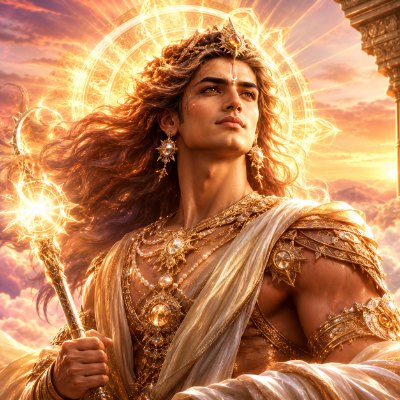
Pratyusha is one of the eight Vasus — the group of elemental divine beings associated with fire and light who form part of the thirty-three principal gods of the Vedic and Puranic tradition. He is the son of Vasu, daughter of Daksha Prajapati and his wife Asikni, and of Dharma, the personification of cosmic righteousness. Among the eight Vasus, Pratyusha is associated with the dawn — his name meaning daybreak or the first light of morning — and he represents the elemental divine presence in the moment of transition from night to day, the instant at which darkness yields to light. He is among the most consistently named of all eight Vasus, appearing under the same name in the Mahabharata, Harivamsa, Vishnu Purana, Bhagavata Purana, Agni Purana, Padma Purana, Brahmanda Purana, Matsya Purana, Vayu Purana, and Saurapurana. His sole recorded child is the sage Devala — a figure of some prominence in the Puranic tradition as a philosopher and ascetic — and through Devala he is the grandfather of two further sons described as exceedingly forgiving and of great mental power, whose names are not recorded in the primary texts. As the Vasu of dawn, Pratyusha stands in natural cosmological symmetry with Dosha the Vasu of evening — together the two bracket the daily cycle of darkness at its two liminal boundaries — and both are paired in the Mahabharata's secondary parentage tradition as sons of a figure named Prabhasa with Prabhata.
✦ The Name
The name Pratyusha derives from the Sanskrit prefix prati — meaning towards, against, or in the direction of — and usha or ushas — meaning dawn, the rosy light of morning, or the goddess of the dawn who is one of the most celebrated figures of the Rigveda. The compound thus means the approach of dawn, the dawn itself, or the period immediately before and at the moment of sunrise. In classical Sanskrit literature, pratyusha appears as a standard noun for the early morning hour, the pre-dawn period, or daybreak; it is used in this ordinary temporal sense in numerous passages across the epics, Puranas, and Kavya literature. As the name of a Vasu it is simultaneously the common noun and the proper name, the elemental phenomenon and the divine being who embodies and presides over it. The goddess Ushas in the Rigveda is hymned across an entire series of verses as the most beautiful and auspicious of divine figures, the one who awakens all creatures, drives away darkness, and inaugurates the sacred ritual day. As Pratyusha — the approach of that Ushas — this Vasu personifies not the goddess herself but the cosmic moment of her arrival: the brightening of the eastern sky just before the sun appears, when night has ended and day has not yet fully begun.
✦ Lineage
- Father: Dharma — the personification of cosmic righteousness and duty; one of the creations of Brahma; husband of ten daughters of Daksha and Asikni in Daksha's second birth.
- Mother: Vasu — daughter of Daksha Prajapati and Asikni; mother of all eight Vasus.
- Brothers: The seven other Vasus — Dhara, Apa, Dhruva, Soma, Anila, Anala, and Prabhasa — born of the same parents in the primary tradition.
- Secondary parentage tradition: The Mahabharata, Adi Parva, Chapter 66, contains the statement that Pratyusha and Prabhasa were the sons of Prabhata — meaning the morning or the pre-dawn period. This secondary parentage tradition cannot be harmonised with the primary genealogy tracing all eight Vasus to Dharma and Vasu daughter of Daksha. It likely reflects an older stratum of tradition in which Pratyusha and Prabhasa — dawn and radiant light — were understood as children of the morning period itself, personifying a natural temporal kinship. The pairing of Pratyusha and Prabhasa as brothers of the same secondary mother Prabhata is cosmologically coherent: the pre-dawn hour gives rise to both the first light of dawn and the full radiance of daylight.
- Son: Devala — the sage; consistently recorded across all primary sources as the sole offspring of Pratyusha. Devala is a figure of independent significance in the Puranic tradition, known as a philosopher, ascetic, and dharmashastra authority; he is sometimes listed among the great sages invoked at the beginning of Puranic recitations, and in the Mahabharata he appears as an advisor and interlocutor in several contexts. His descent from the Vasu Pratyusha gives him a divine genealogy that places him within the cosmic lineage of the eight elemental beings.
- Grandsons through Devala: Two sons, unnamed in the primary texts, described in the Mahabharata, Adi Parva, Chapter 66 as both exceedingly forgiving and of great mental power. Their anonymity in the surviving primary passages is genuine: no primary source consulted names them individually.
✦ The Sage Devala
The most significant aspect of Pratyusha's genealogical profile beyond his own identity is the figure of his son Devala. The Mahabharata's genealogical passage calls him simply the sage Devala and notes that his two sons were both exceedingly forgiving and of great mental power — qualities suggestive of highly developed ascetic and philosophical attainment. Devala appears in several other contexts within the epic and Puranic literature. In the Mahabharata he is invoked as a dharmashastra authority alongside figures such as Manu, Yajnavalkya, and Brihaspati; in the Puranas he is listed as a composer of legal and philosophical texts. He is sometimes identified with one of the great early philosophers of the Samkhya tradition. He appears in the Mahabharata's Shanti Parva and Udyoga Parva in discursive contexts. The Puranic Encyclopaedia of Vettam Mani notes his descent from Pratyusha and records that his two sons were of great intelligence and forbearance. His prominence as a named and independent figure in the tradition gives Pratyusha's lineage a significance beyond what Pratyusha's own sparse direct attestation might suggest: through Devala, the Vasu of dawn is the progenitor of a lineage associated with philosophical wisdom, asceticism, and the dharmashastra tradition.
✦ Elemental and Cosmological Significance
As the Vasu of dawn, Pratyusha represents one of the two liminal moments of the daily cycle — the turning from night to day — complementing Dosha the evening, who represents the turning from day to night. In the Vedic cosmological and ritual framework, the dawn holds a position of exceptional sacredness. The Rigvedic hymns to Ushas comprise one of the most celebrated sections of the oldest Veda, celebrating the dawn as the most visible manifestation of the cosmic order, the moment when the eternal rhythm of day and night reasserts itself and all creatures are awakened to their duties. The dawn is also the hour prescribed for the most important Vedic rites — the agnihotra fire offering must be performed at dawn and dusk — so Pratyusha as the divine being of the dawn is specifically the presiding deity of the cosmic moment at which one of the foundational Vedic sacrifices takes place. This gives him a ritual significance complementary to that of Anala the fire Vasu, whose element is the medium of that same sacrifice. As the approach of light, Pratyusha also carries the symbolism of the triumph of illumination over darkness — a theme that runs through the entire Vedic and Puranic tradition from the earliest Rigvedic hymns to the eschatological passages of the later Puranas.
✦ Pratyusha and Dosha as Complementary Vasus
The pairing of Pratyusha and Dosha as dawn and dusk within the eight Vasus reflects the tradition's habit of representing natural phenomena in complementary pairs — light and darkness, day and night, expansion and contraction — as constituent elements of the cosmic order. Dosha is attested only in the Bhagavata Purana; Pratyusha is attested universally across the principal sources. The asymmetry of their textual profiles is notable: Pratyusha as the dawn is one of the most consistent names across all Vasu lists, while Dosha as the evening is the most restricted in attestation. This may reflect the greater liturgical prominence of the dawn in the Vedic tradition, where Ushas and the dawn ritual receive disproportionate emphasis relative to the evening, or it may simply reflect the fact that the Bhagavata Purana's list of eight is distinctively different in vocabulary from the other traditions and that Dosha is a name specific to that tradition's way of framing the temporal Vasu. What is shared across all sources — the consistent inclusion of Pratyusha — testifies to the antiquity and cross-traditional stability of the dawn as a member of the eight elemental divine beings.
✦ The Curse of Vasishtha
Pratyusha is one of the eight Vasus cursed by the sage Vasishtha to take mortal birth following the theft of the divine cow Nandini. The narrative is recorded in the Mahabharata, Adi Parva. Like the other six relatively innocent Vasus who aided or acquiesced in the theft without being the principal offender, Pratyusha was born briefly as one of the sons of Ganga and King Shantanu of the Kuru dynasty and was immediately drowned by Ganga at birth, spending only the briefest period in mortal form before returning to the celestial realms. No specific narrative detail distinguishes Pratyusha's participation in the episode or his mortal birth from that of the other six peripheral Vasus.
✦ Textual Variants and Inconsistencies
The principal textual variant concerning Pratyusha is the secondary parentage tradition in the Mahabharata attributing him and Prabhasa to Prabhata, which cannot be reconciled with the primary Puranic genealogy tracing all eight Vasus to Dharma and Vasu daughter of Daksha. The Bhagavata Purana's Skandha 6 list places the equivalent seventh Vasu under the name Vasu rather than Pratyusha; whether this Vasu in the Bhagavata's list is understood as the same being as Pratyusha in the other sources, or as a different Vasu in a different scheme, is not resolved in the primary texts and cannot be determined with certainty from the passages available. The name Pratyusha itself is stable and consistent — it does not appear in variant forms across sources — and the identification of Devala as his son is confirmed across the Mahabharata, Harivamsa, and the Puranic Encyclopaedia without contradiction.
✦ References
Primary Sources
- Mahabharata, Adi Parva, Chapter 66 — the principal primary source: names Pratyusha among the eight Vasus, records his son as the sage Devala and Devala's two unnamed sons as exceedingly forgiving and of great mental power, and contains the secondary parentage tradition attributing Pratyusha and Prabhasa to Prabhata.
- Harivamsa, Book 1, Chapter 3 — names Pratyusha among the eight Vasus; records his genealogical position consistently with the Mahabharata account.
- Vishnu Purana, Book 1, Chapter 15 — names Pratyusha among the eight Vasus.
- Bhagavata Purana, Skandha 6, Chapter 6 — includes the seventh Vasu as Vasu rather than Pratyusha; relevant for the discussion of equivalents.
- Brahmanda Purana, Section 3, Chapter 3 — names Pratyusha among the eight Vasus; cited in the Wisdomlib definition alongside the Matsya Purana and Vayu Purana as additional sources.
- Matsya Purana, Chapters 5 and 203 — names Pratyusha among the eight Vasus.
- Vayu Purana, Chapters 61 and 66 — names Pratyusha among the eight Vasus.
- Agni Purana, Chapter 18 — names Pratyusha among the eight Vasus.
- Rigveda, hymns to Ushas throughout — the foundational Vedic source for the sacred significance of the dawn whose approach Pratyusha personifies, providing the deep cosmological background for his elemental identity.
Modern Reference Works
- Vettam Mani, Puranic Encyclopaedia (1975), entry on Ashtavasu — records Pratyusha's son as Devala and Devala's two sons as of great intelligence and forbearance; confirms the Mahabharata as the primary attestation.
- Wisdom Library (wisdomlib.org), entry on Pratyusha — provides the most comprehensive cross-source definition, citing the Mahabharata, Brahmanda Purana, Matsya Purana, Vayu Purana, and Vishnu Purana as sources confirming Pratyusha's position among the eight Vasus, and noting the meaning of his name as daybreak or the morning sun.
- Monier-Williams, A Sanskrit-English Dictionary (1899), entry on pratyusha — confirms the primary meaning of the word as daybreak or the early morning, situating the name in its full Sanskrit semantic context.