
About
Anala — The Vasu of Fire, Son of Vasu and Dharma
Anala · Hutasana (in the Mahabharata's secondary parentage passage) · Agni (in the Vishnu Purana and Bhagavata Purana enumerations) · not to be confused with the full divine identity of Agni as the Vedic fire god
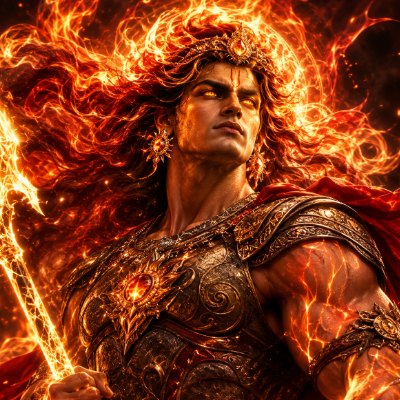
Anala is one of the eight Vasus — the group of elemental divine beings associated with fire and light who form part of the thirty-three principal gods of the Vedic and Puranic tradition. He is the son of Vasu, daughter of Daksha Prajapati and his wife Asikni, and of Dharma, the personification of cosmic righteousness. Among the eight Vasus, Anala is the personification of fire — his name meaning one who is without measure or limit, or simply the fire itself — and he is identified in the Vishnu Purana and Bhagavata Purana directly as Agni, the Vedic fire deity, in his aspect as an elemental member of the group of eight. He is attested under the name Anala in the Mahabharata and Harivamsa, and under the name Agni in the Vishnu Purana, Bhagavata Purana, Agni Purana, and Padma Purana. The most significant aspect of Anala's genealogical profile is the attribution to him, through the combination of various wife-traditions, of fatherhood over Kumara — the divine commander of the celestial army, known also as Kartikeya, Skanda, and Murugan — and of three further sons named Shakha, Vishakha, and Naigameya. The birth narratives of Kumara across the tradition are numerous and significantly variant, and Anala's role as father is one of several competing accounts; this complexity is addressed below.
✦ The Name
The name Anala derives from the Sanskrit privative prefix an- and ala, meaning sufficient, enough, or limited, giving the compound the sense of that which is without limit or that which can never be satisfied — fire in its quality of insatiability, since fire consumes without ever being sated. The name thus designates the fundamental quality of fire as an endless consumer. The alternate name Hutasana, used in the Mahabharata's secondary parentage passage, means the eater of oblations — one who consumes the ritual offerings — and explicitly associates this Vasu with the sacrificial fire that receives the huta (poured or oblated) offerings. The Vishnu Purana and Bhagavata Purana use the name Agni directly for this Vasu, identifying him fully with the principal Vedic fire deity. This identification is cosmologically coherent — among the eight elemental Vasus, the fire element is naturally associated with Agni — but creates a complex relationship between the Vasu's identity and the far broader identity of the Agni deity across the Vedic and Puranic tradition.
✦ Lineage
- Father: Dharma — the personification of cosmic righteousness and duty; one of the creations of Brahma; husband of ten daughters of Daksha and Asikni in Daksha's second birth.
- Mother: Vasu — daughter of Daksha Prajapati and Asikni; mother of all eight Vasus.
- Brothers: The seven other Vasus — Dhara, Apa, Dhruva, Soma, Anila, Pratyusha, and Prabhasa — born of the same parents.
- Secondary parentage tradition: The Mahabharata, Adi Parva, Chapter 66, states that Hutasana (Anala) was born of Sandilya. This represents a secondary genealogical tradition within the epic that cannot be harmonised with the primary account tracing all eight Vasus to Dharma and Vasu.
- Wife (Bhagavata Purana, Skandha 6): Dhara — meaning that which holds or sustains, or a stream; through her he produced sons including Dravinaka and others.
- Wife (additional tradition — Krittika): The Bhagavata Purana, Skandha 6, Chapter 6, verse 14, states that Skanda was the son of Krittika and the Vasu Agni (Anala). The Krittikas are the six divine nymphs associated with the Pleiades who are traditionally said to have nursed the infant Skanda, giving him the name Kartikeya. The Bhagavata Purana here attributes Skanda's parentage through the Vasu Agni specifically to Krittika as a wife or mother-figure, while other accounts give different parentages.
- Son: Kumara — also known as Kartikeya, Skanda, Shanmukha, and Murugan; the divine commander of the celestial army, the slayer of the demon Taraka, and one of the most prominent divine figures in the Puranas and in South Indian devotional tradition. His birth is ascribed to different parents across different primary sources; the Mahabharata's genealogical passage attributes him to Agni the Vasu, the Bhagavata Purana attributes him to Agni through Krittika, and other accounts describe him as the son of Shiva and Parvati. These are discussed below.
- Sons: Shakha, Vishakha, and Naigameya — described in the Puranic Encyclopaedia as the three brothers of Kumara, born of the Krittikas; named alongside Kumara and described as companions in the divine army.
✦ Anala as Father of Kumara — Textual Complexity
The attribution of Kumara's parentage to the Vasu Anala or Agni is one of several competing genealogical traditions for this important divine figure, and must be understood carefully in its textual context. The Mahabharata, Adi Parva, Chapter 66, states simply: the son of Agni is the handsome Kumara born in a forest of reeds. The Bhagavata Purana, Skandha 6, Chapter 6, verse 14, states that Skanda was born from Krittika and Agni (the Vasu). These passages place Kumara's origin firmly within the Vasu Anala's lineage in the genealogical scheme of Dharma's progeny.
However, the Puranic and epic tradition contains multiple other and quite different accounts of Kumara's birth. The Shiva Purana and large portions of the Mahabharata describe Kumara as the son of Shiva and Parvati, his birth necessitated by the cosmic need for a warrior capable of defeating the demon Taraka. The Vana Parva and Anushasana Parva of the Mahabharata describe his birth from the union of the fire god Agni and the goddess Svaha — Svaha having taken the forms of six of the Saptarishi's wives to seduce Agni, and depositing the resultant semen in the reed bed of the Ganga. In this account, the six-headed Skanda is born from the reed bed and nursed by the six Krittikas. The Ramayana contains yet another account. The Valmiki Ramayana attributes his birth to Rudra and Parvati with involvement from Agni and the Ganga. These variant traditions cannot be reconciled into a single genealogy; each represents a distinct mythological stream for the origin of this important deity. The attribution in the Mahabharata's genealogical passage and the Bhagavata Purana's Skandha 6 genealogy to the Vasu Agni/Anala is the specific tradition relevant to this lineage series and should be understood as one strand within this larger and irresolvably variant narrative complex.
✦ Anala as a Vasu and as the Fire Deity
The Vasu Anala and the Vedic deity Agni exist in a complex relationship across the primary sources. In the Vishnu Purana and Bhagavata Purana they are treated as the same being — Agni is listed as the fifth of the eight Vasus in the Vishnu Purana's enumeration — while in the Mahabharata and Harivamsa the Vasu is called Anala and Agni the deity has a separate and vast mythology of his own. The Puranic Encyclopaedia confirms that Agni is one of the Ashtavasus according to the Vishnu Purana. The resolution lies in recognising that Agni the fire deity encompasses multiple genealogical and cosmological identities across the tradition: as a Prajapati-born deity, as a Vasu, as the son of Angiras, as the descendant of Brahma through various lineages, as the mouth of all gods, and as the medium of all sacrifice. The Vasu aspect of Agni — Anala — represents his membership in the group of eight elemental divine beings as the personification of the fire element, without displacing or subsuming the totality of Agni's identity and mythology.
✦ The Curse of Vasishtha
Anala is one of the eight Vasus who were cursed by the sage Vasishtha to take mortal birth following the theft of Nandini. Like the other six relatively innocent Vasus, he was born briefly as one of the sons of Ganga and Shantanu and immediately drowned by Ganga, spending only the briefest moment in mortal form before returning to the celestial realms.
✦ Textual Variants and Inconsistencies
The principal textual variants concerning Anala are his name — Anala in the Mahabharata and Harivamsa, Hutasana in one Mahabharata passage, Agni in the Vishnu Purana and Bhagavata Purana — and the complex genealogical situation around Kumara discussed above. The Bhagavata Purana's Skandha 6 genealogy records his wife as Dhara, while the attribution of Skanda's birth to Anala and Krittika reflects a distinct but related tradition. The Mahabharata's secondary parentage tradition recording Anala as the son of Sandilya cannot be reconciled with the primary tradition of descent from Dharma and Vasu. As noted for the other Vasus, the Bhagavata Purana's Skandha 6 enumeration uses names that differ from the Mahabharata tradition: its fifth Vasu in the list is named Agni rather than Anala, while elsewhere in the Bhagavata Purana Agni has his own extensive independent mythology.
✦ References
Primary Sources
- Mahabharata, Adi Parva, Chapter 66 — names Anala among the eight Vasus, records his son as Kumara born in a forest of reeds, and contains the secondary parentage tradition attributing Anala to Sandilya.
- Bhagavata Purana, Skandha 6, Chapter 6, verses 13–14 — names Agni (Anala) among the eight Vasus, records his wife Dhara and sons including Dravinaka and others from her, and records Skanda as born of Krittika and Agni.
- Vishnu Purana, Book 1, Chapter 15 — identifies Agni as one of the eight Vasus, equating Anala directly with the fire deity.
- Harivamsa, Book 1, Chapter 3 — names Anala among the eight Vasus.
- Agni Purana, Chapter 18 — names Anala or Agni among the eight Vasus and records his son Kumara and Kumara's brothers Shakha, Vishakha, and Naigameya.
- Mahabharata, Vana Parva — contains the narrative of Agni's desire for the Saptarishi wives, Svaha's deception, and the birth of Skanda from the reed bed, providing the principal epic alternative to the Vasu-based parentage of Kumara.
- Rigveda, Mandala 1, hymn 1 and throughout — the principal Vedic source for Agni as the most invoked deity of the Vedic tradition, providing the deep background for the identification of the Vasu Anala with Agni.
Modern Reference Works
- Vettam Mani, Puranic Encyclopaedia (1975), entries on Ashtavasu and Agni — provides the most comprehensive collation of the Vasu Anala's identity, confirming his identification with Agni in the Vishnu Purana, recording his sons Kumara, Shakha, Vishakha, and Naigameya, and noting the multiple birth traditions for Kumara.
- Wendy Doniger O'Flaherty, Asceticism and Eroticism in the Mythology of Shiva (1973) — analyses the multiple competing birth narratives of Skanda/Kumara and the roles of fire, Agni, and Shiva in those accounts, providing essential scholarly context for the Vasu Anala's role as one of Kumara's attributed fathers.
- Wisdom Library (wisdomlib.org), entries on Anala, Agni (Vasu), and Ashtavasu — provides verse-level references to the Mahabharata and Bhagavata Purana passages and the Puranic Encyclopaedia's collation.