
About
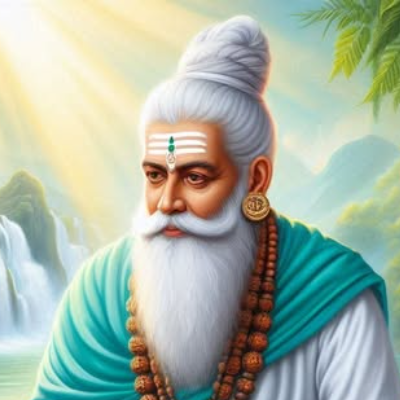
Sushruta — Son of Vishvamitra, Physician and Author of the Sushruta Samhita
Sushruta · Susruta · Vriddha Sushruta (a distinct figure in some traditions)
Sushruta is the ancient Indian physician and surgeon to whom the Sushruta Samhita — one of the foundational texts of Ayurveda and the oldest surviving systematic treatise on surgery in the world — is attributed. The Mahabharata's Anushashana Parva names him as a son of Vishvamitra, the great Brahmarishi and former king who appears extensively in the Rigveda, the Ramayana, the Mahabharata, and the Puranas as one of the most celebrated and spiritually powerful sages of the Vedic tradition. The Garuda Purana likewise identifies Sushruta as a son of Vishvamitra. The Sushruta Samhita itself presents Sushruta as a student who received his knowledge of medicine and surgery from Divodasa Dhanvantari — a sage-king of Kashi regarded in the tradition as an incarnation of Dhanvantari, the divine physician of the gods. Sushruta is regarded in the Indian tradition as the father of surgery and the father of plastic surgery, and the Sushruta Samhita remains one of the most significant medical texts produced in the ancient world.
✦ The Name
The name Sushruta is a Sanskrit compound of su, meaning well or good, and shruta, meaning heard or renowned. The compound thus denotes one who is well heard or widely renowned. The name is an adjective used as a proper name and was likely an honorific designation attached to the figure rather than a birth name in the ordinary sense. One scholarly tradition, advanced by the translator Kunja Lal Bhishagratna in 1907, holds that Sushruta was not only a personal name but the name of the clan or gotra to which Vishvamitra belonged — an interpretation that would make Sushruta a clan designation indicating Vishvamitra's lineage rather than the personal name of his individual son. This reading has not been universally accepted but remains a noted variant in the scholarly literature on the text's authorship.
✦ Lineage
- Father: Vishvamitra — one of the Brahmarishis, the highest class of sages in the Vedic tradition, and a figure of extraordinary significance across the Vedic, epic, and Puranic literature. Vishvamitra was originally a Kshatriya king known as Vishvaratha, son of Gadhi of the Kushika lineage, who through sustained and fierce austerities attained the status of Brahmarishi. He is credited with composing the greater part of the third Mandala of the Rigveda, including the Gayatri Mantra. He appears as Rama's teacher and protector in the Ramayana, and his encounters with the sage Vasishtha are among the most celebrated narrative sequences in the Puranic corpus. Vishvamitra had many children from different mothers: Shakuntala, who became the mother of the emperor Bharata through King Dushyanta, was born from the Apsara Menaka; Ashtaka was born from Madhavi, daughter of King Yayati; and Madhuchhanda was a son who composed hymns in the Rigveda. Sushruta is named in the Mahabharata among Vishvamitra's descendants.
- Teacher: Divodasa Dhanvantari — described in the Sushruta Samhita as the king of Kashi who maintained an ashrama and taught surgery and medicine to a group of students. He is identified in the tradition as an incarnation of Dhanvantari, the divine physician who emerged from the churning of the cosmic ocean bearing the nectar of immortality, and who is regarded as the presiding deity of Ayurveda. The Bhavaprakasha states that Vishvamitra and other sages, perceiving through divine vision that King Divodasa of Kashi was an incarnation of Dhanvantari, sent Sushruta to Kashi to receive instruction from him. The Charaka Samhita and early Buddhist Jatakas both mention a Divodasa as a physician associated with ancient Kashi.
- Fellow students: The Sushruta Samhita records that alongside Sushruta, the following students also studied under Divodasa Dhanvantari: Aupadhenava, Vaitarana, Aurabhra, and Pauskalavata. Each of these students is said to have composed a treatise on surgery, but only the Sushruta Samhita has survived.
✦ The Sushruta Samhita — Contents and Scope
The Sushruta Samhita is one of the three great classical texts of Ayurveda — the Brihat Trayi — alongside the Charaka Samhita and the Ashtanga Hridayam. It is the primary surviving text on the branch of Ayurveda known as Shalya Tantra, or surgery, and also addresses Shalakyatantra, which concerns treatment of the head, eyes, and ears. In its extant form the text is divided into two principal parts: the Purva-tantra, or original text, comprising five sections — Sutra Sthana, Nidana Sthana, Sharira Sthana, Chikitsa Sthana, and Kalpa Sthana — and the Uttara-tantra, a supplementary section added at a later stage of the text's compilation.
The text's contents are extraordinarily broad. Sushruta enumerates eight fundamental categories of surgical procedure: Chedya or excision, Lekhya or scarification, Vedhya or puncturing, Esya or exploration, Ahrya or extraction, Vsraya or evacuation, and Sivya or suturing. He describes the anatomy of the human body through the study of cadavers, providing a systematic account of bones, muscles, nerves, blood vessels, and organs. He enumerates one hundred and one instruments used in surgical procedures, classifying them according to their use and construction, and notes that their design was informed by observation of the forms of bird beaks and the jaws and paws of animals.
Among the surgical procedures described, two are of particular historical significance. The Sushruta Samhita contains the earliest known detailed written account of rhinoplasty — the reconstruction of the nose — using a flap of skin taken from the cheek. This technique, described in the Sutra Sthana and the Chikitsa Sthana, is widely regarded as the origin of what later became known as the Indian method of rhinoplasty and is considered the foundational text for plastic surgery as a discipline. The Sushruta Samhita also contains early accounts of cataract surgery, the extraction of urinary stones, the setting of fractures, Caesarean section, the repair of cut earlobes, and skin grafting. The text addresses medical ethics, the training and qualities required of a physician, and the relationship between physician and student.
✦ Transmission of Knowledge from Divodasa
The Sushruta Samhita presents its teaching as deriving from a chain of divine transmission. The text states that the god Indra received knowledge of Ayurveda from the divine Ashvins — the twin physician-gods of the Rigvedic tradition — and that Indra in turn transmitted this knowledge to Dhanvantari. Dhanvantari, incarnated as Divodasa the king of Kashi, then transmitted it to his students including Sushruta. This framing locates Sushruta within a sacred lineage of medical knowledge that extends from the divine realm through Dhanvantari to the human sphere, providing theological authority for the treatise's content. The Bhavaprakasha adds that it was Vishvamitra's counsel that directed Sushruta specifically to Kashi to seek out Divodasa, perceiving through his own spiritual insight that Divodasa was the divine Dhanvantari in human form.
✦ The Question of Multiple Authors and Redactors
It is now broadly accepted in modern scholarship that the Sushruta Samhita in its extant form is not the work of a single author but the result of multiple layers of composition, redaction, and supplementation spanning several centuries. The tenth-century commentator Dalhana, whose Nibandhasangraha is the principal surviving commentary on the Sushruta Samhita, records that the text was redacted by the philosopher and alchemist Nagarjuna — a figure dated to approximately the second to third century CE — and that a later emendation or textual correction was carried out by Chandrata, son of the scholar Tisata. Some commentators and later writers mention a figure called Vriddha Sushruta — Sushruta the Elder — as the author of an earlier and larger version of the text, though this name does not appear in the Sushruta Samhita itself and is regarded by most modern scholars as a scholarly construct rather than a distinct historical individual. The physician-scholar Gerrit Jan Meulenbeld, in his comprehensive five-volume History of Indian Medical Literature published between 1999 and 2002, provides the most thorough modern survey of all theories relating to Sushruta's identity, the text's dating, and its compositional history.
✦ Textual Variants and Inconsistencies
The primary source for Sushruta's parentage as a son of Vishvamitra is the Mahabharata's Anushashana Parva, which names him in a genealogical list that includes Vishvamitra, Madhuchhanda, Devarata, and Sushruta. The Garuda Purana independently confirms the identification. However, the Shalihotra Samhita — a text on equine medicine — names Sushruta as the son of the sage Shalihotra rather than Vishvamitra, which represents a divergent genealogical tradition. The Bower Manuscript — a birch-bark manuscript dated to the fourth or fifth century CE that contains the earliest externally dated reference to Sushruta's name — lists him simply as one of ten sages residing in the Himalayas, without reference to any parentage. These variant traditions cannot be harmonised and are honestly recorded here as parallel accounts in different textual streams.
A further interpretive complexity arises from the Bhishagratna hypothesis that Sushruta designates not an individual son of Vishvamitra but the name of Vishvamitra's entire clan or gotra. If this reading is accepted, the figure of Sushruta becomes a lineage designation rather than a personal genealogical entry, and the Mahabharata's reference would indicate that the Sushruta tradition belonged to Vishvamitra's school rather than recording a specific father-son relationship. This reading has not been definitively refuted but has not been widely adopted in subsequent scholarship.
✦ Historical Influence and Later Reception
The Sushruta Samhita's reach extended well beyond the Indian subcontinent. In the early eighth century the text was translated into Arabic under the title Kitab Shah Shun al-Hindi, a translation carried out by the Indian medical practitioner Mankah on the orders of Yahya ibn Barmak, the Barmakid minister of the Abbasid caliph. This Arabic translation made Sushruta's surgical knowledge available to the Islamic medical tradition, through which it influenced the development of medicine in the medieval West. The Charaka Samhita, the other great classical Ayurvedic text, cites Sushruta as an authoritative source on surgical matters, establishing that his reputation was established across the major branches of classical Indian medicine. By the ninth and tenth centuries Sushruta's fame had spread to Cambodia in the east and Arabia in the west. In modern times the Royal Australasian College of Surgeons erected a statue of Sushruta on its campus in Australia in 2018, acknowledging his place in the global history of surgery.
✦ References
- Mahabharata, Anushashana Parva, Chapter 4, verses 49–58: Names Sushruta in a genealogical list that includes Vishvamitra; the primary epic source establishing the father-son relationship between Vishvamitra and Sushruta.
- Garuda Purana: Independently names Sushruta as a son of Vishvamitra; a secondary Puranic confirmation of the Mahabharata's genealogical statement.
- Sushruta Samhita (primary source): The text attributed to Sushruta itself; presents him as the student of Divodasa Dhanvantari, king of Kashi, and records the chain of divine transmission from Dhanvantari through Indra and the Ashvins. The principal source for Sushruta's medical and surgical teaching and his identity as author-compiler of the treatise.
- Bhavaprakasha: States that Vishvamitra and other sages, perceiving Divodasa of Kashi to be an incarnation of Dhanvantari, sent Sushruta to study under him; provides the narrative connecting Sushruta's parentage to his discipleship at Kashi.
- Shalihotra Samhita: Names Sushruta as a son of the sage Shalihotra rather than Vishvamitra; represents a divergent genealogical tradition and is recorded here as a textual variant.
- Bower Manuscript (4th–5th century CE): The earliest externally dated reference associating Sushruta's name with the medical tradition; lists him as one of ten Himalayan sages without reference to parentage.
- Dalhana, Nibandhasangraha (c. 10th century CE): The principal surviving commentary on the Sushruta Samhita; records Nagarjuna's redaction of the text and Chandrata's later emendation; the primary source for the compositional history of the Sushruta Samhita.
- Gerrit Jan Meulenbeld, History of Indian Medical Literature, Volume IA (Egbert Forsten, Groningen, 1999): The most comprehensive modern scholarly survey of all theories relating to Sushruta's identity, the Sushruta Samhita's dating, its authorship, and its compositional history.
- Kunja Lal Bhishagratna (trans.), The Sushruta Samhita (Calcutta, 1907): The influential early English translation whose introduction advanced the argument that Sushruta was Vishvamitra's son and proposed the clan-name hypothesis; used for the genealogical discussion in this profile.
- Wikipedia, Sushruta and Sushruta Samhita articles: Used for cross-referencing the range of primary and secondary sources on Sushruta's identity, the Bower Manuscript reference, and the history of the text's modern scholarship.