
About
Varaha — The Boar Avatar of Vishnu
Varaha · Adi Varaha · Yajnavaraha · Ekashringa Varaha · Shvetavaraha · Prithivyuddhara · Dharavaraha
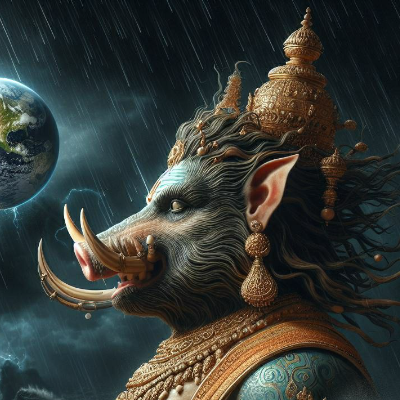
Varaha is the third of the principal avatars of Vishnu, the preserver deity of the Vaishnava theological tradition, manifesting in the form of a great boar — either entirely theriomorphic or, in the more widely attested iconographic tradition, combining a boar's head with a powerfully built human body. His defining mythological act is the rescue of the earth goddess Bhudevi, also known as Prithivi, who had been seized by the demon Hiranyaksha and dragged to the floor of the cosmic ocean. By killing Hiranyaksha and raising the earth aloft on his tusks, Varaha restores the conditions necessary for creation and life to continue. He appears across a vast range of primary Hindu texts: the Shatapatha Brahmana, the Taittiriya Samhita, the Mahabharata, the Harivamsa, the Valmiki Ramayana, the Vishnu Purana, the Bhagavata Purana, the Vayu Purana, the Matsya Purana, the Agni Purana, the Brahmanda Purana, and most extensively in the Varaha Purana, which bears his name as its principal subject.
✦ The Name
The Sanskrit word varaha means boar or wild boar, and it is the primary designation of this avatar in virtually all textual sources. The epithet Adi Varaha, meaning the primordial or original boar, emphasises the cosmogonic antiquity of this form and distinguishes the cosmic boar from the minor boar figure of the Vedic tradition. Yajnavaraha, the boar of sacrifice, is an epithet found in Puranic texts that identifies Varaha with the sacrificial order and with Yajna, the principle of sacred rite, his body in several accounts being described as composed of the Vedas and sacrificial implements. Ekashringa Varaha, meaning the single-horned or single-tusked boar, is a regional designation that in some contexts conflates or associates the Varaha form with the Hayagriva or Ekashringa traditions. Shvetavaraha, the white boar, appears in certain Puranic passages and is associated with the current cosmic age, the Shveta Varaha Kalpa. Prithivyuddhara means the one who lifted Prithivi, the earth, and functions as a straightforward descriptive epithet for his cosmic deed. Dharavaraha similarly denotes the boar who bears or holds the earth.
✦ Lineage
- Identity: Varaha is a direct manifestation of Vishnu, one of the principal gods of the Hindu Vaishnava tradition, responsible for preservation and cosmic order. As an avatar, Varaha is not a separate being but Vishnu himself descending into embodied form to accomplish a specific cosmic purpose.
- Origin in the Vedic tradition: In the Shatapatha Brahmana and the Taittiriya Samhita, a cosmic boar emerges from Prajapati, the lord of creatures and progenitor deity, either as a transformation of Prajapati himself or as an emanation from his nostrils. This Vedic boar is not yet identified with Vishnu and carries a distinct cosmogonic function.
- Spouse: Bhudevi (also called Prithivi, Vasudha, and Dharitri), the goddess of the earth, is the principal consort associated with Varaha. In several Puranic accounts she is rescued by Varaha and thereafter remains closely associated with him as his shakti or consort in this form. In the Vaishnavite tradition more broadly, Bhudevi is one of the two principal consorts of Vishnu, the other being Lakshmi.
- Children: The Bhagavata Purana and the Varaha Purana record that Varaha and Bhudevi produced a son named Narakasura (also called Bhauma), a powerful demon king who in later narrative cycles is slain by Krishna, himself a later avatar of Vishnu. This creates a striking intra-Vaishnava narrative arc in which one avatar's offspring is slain by another.
✦ The Vedic Boar — Earliest Attestations
The figure of a cosmic boar who lifts or stabilises the earth appears in Vedic literature prior to its absorption into the Vaishnava avatar framework. In the Taittiriya Samhita, a boar with a single tusk raises the earth from the primordial waters. In the Shatapatha Brahmana, the boar is identified as Prajapati, the generative lord of all creatures, who dives into the waters and retrieves the earth. The boar in these passages is a cosmogonic agent associated with the establishment of stable ground at the beginning of a cosmic cycle. The name Emusha is given to this boar in some Vedic contexts. These passages do not associate the boar with Vishnu. The identification of the cosmogonic boar with Vishnu as an avatar becomes established through the epic and early Puranic literature, representing a theological reprocessing of older Vedic material within the developing Vaishnava framework.
✦ The Rescue of the Earth — Principal Narrative
The narrative that forms the core of Varaha's significance across Puranic literature runs as follows. During one of the great cosmic dissolutions, the demon Hiranyaksha — son of the sage Kashyapa and his wife Diti, and twin brother of Hiranyakashipu — assailed the earth goddess Bhudevi and dragged her down into the depths of the primordial cosmic ocean, the Garbhodaka or the universal waters depending on the specific Puranic account. The earth, submerged and helpless, cried out for rescue. Vishnu, perceiving her distress, manifested in the form of a boar. In the Bhagavata Purana's account, this manifestation occurred from the nostril of Brahma, the creator god, having begun as a form no larger than a thumb before expanding to a massive cosmic size. Varaha plunged into the waters, confronted Hiranyaksha, and engaged him in a prolonged and fierce battle that lasted, according to some Puranic reckonings, many thousands of divine years. At the conclusion of this combat, Varaha killed Hiranyaksha. He then raised the earth on his tusks, carrying her upward through the cosmic waters and restoring her to her proper position in the universe. In several Puranic versions, Varaha also sports with the earth in the waters before lifting her, and the episode carries an erotic as well as cosmogonic dimension, with the earth goddess acknowledging Varaha as both rescuer and consort.
The Valmiki Ramayana contains a celebrated passage in which Rama, the seventh avatar of Vishnu, is compared to Varaha lifting the earth, identifying the cosmogonic act as the supreme exemplar of world-rescue and an image resonant enough to be invoked in the context of a later avatar's own deed of liberation.
✦ The Body of Varaha as Sacred Cosmos
A distinctive theological elaboration found in several Puranas, most fully in the Vishnu Purana and the Bhagavata Purana, identifies each part of Varaha's body with a component of the Vedic sacrificial and cosmic order. His snout is said to be the fire altar, his hooves the sacred hymns, his back the sacrificial post, his breath the oblations, his body hair the sacred kusha grass, his eyes the day and night, and so forth through an extended homology that transforms the boar form into a complete map of the Vedic yajna. This identification grounds the epithet Yajnavaraha and establishes the avatar's cosmic rescue as simultaneously a restoration of the sacrificial order upon which the maintenance of the universe depends. The implication is that the sinking of the earth is also the sinking of dharma and of yajna, and that Varaha's deed restores all of these together.
✦ The Varaha Purana
The Varaha Purana, one of the eighteen Mahapuranas in most canonical enumerations, presents Varaha not merely as an avatar who performs a single cosmogonic deed but as a teacher and revealer of religious knowledge. The text is structured largely as a dialogue between Varaha and the earth goddess Bhudevi, in which the boar deity expounds on topics including cosmology, dharma, pilgrimage sites, the proper observance of vratas or sacred vows, the nature of the self, and the paths to liberation. This framing positions Varaha within the broader Vaishnava tradition of the deity as the source of revealed knowledge, a function more typically associated in other contexts with Vishnu's forms as Narayana or Krishna. The Varaha Purana also contains geographical material relating to sacred sites, particularly in and around the region of Mathura, and hymns of praise to Varaha that were employed in liturgical contexts.
✦ Textual Variants and Inconsistencies
The Varaha narrative exists in meaningfully different versions across the primary sources, and the differences are significant enough to warrant careful note.
Regarding the origin of the boar form: the Shatapatha Brahmana identifies the boar as a form of Prajapati with no Vaishnava connection. The Mahabharata and the Harivamsa attribute the boar form to Vishnu directly as a deliberate descent. The Bhagavata Purana specifies that the boar emerged from the nostril of Brahma and was initially tiny before expanding. The Vishnu Purana presents the form as a direct voluntary manifestation of Vishnu. These are not fully reconcilable accounts and represent different stages in the textual development of the narrative.
Regarding the position of Varaha in the avatar sequence: the Bhagavata Purana's widely cited list of ten principal avatars places Varaha third, after Matsya (the fish) and Kurma (the tortoise). The Mahabharata and some earlier texts present less systematised avatar lists in which the relative ordering differs or in which Varaha appears without a fixed numerical position. The Agni Purana and certain other Puranas include avatars not listed in the Bhagavata Purana's canonical ten, and the position of Varaha within those extended lists varies accordingly.
Regarding the adversary: virtually all Puranic sources identify the demon opponent as Hiranyaksha. The Vedic boar narratives do not name a demonic opponent at all, the act of earth-lifting being presented as cosmogonic rather than combative. This difference reflects the epic-Puranic tendency to reframe cosmogonic acts as martial victories over demonic forces.
Regarding the cosmic ocean: the Bhagavata Purana specifies the Garbhodaka Ocean, a particular body of water associated with the space between cosmic shells in its cosmological scheme. Other texts refer more generically to the primordial waters or the cosmic flood without this specific identification.
✦ Theological and Philosophical Significance
Varaha's theological significance operates on several levels. At the cosmogonic level, the avatar embodies the Vaishnava principle that the preserver god intervenes at moments of cosmic crisis to restore the conditions necessary for ordered existence. The earth is not merely a physical mass but the ground of dharmic life, and its rescue is therefore simultaneously the rescue of the moral and sacrificial order. The intimate connection drawn between Varaha's body and the Vedic sacrifice deepens this: the boar does not merely save the earth by brute force but by embodying the very structure of sacred order.
At the cosmological level, the Varaha avatar is associated with the current world-age. The present cosmic cycle in the Puranic reckoning is named the Shveta Varaha Kalpa, the aeon of the white boar, marking the entire current day of Brahma as standing under the protecting sign of this avatar's primordial act. This is an unusual feature: Varaha is not merely an avatar who acted at some point within the current cycle but the defining event from which the entire cycle takes its name.
The relationship between Varaha and Bhudevi also carries theological weight. The earth goddess is not merely a passive recipient of rescue. In the Varaha Purana, she is an interlocutor and co-participant in the transmission of sacred knowledge. In Vaishnava Agamic and Pancharatra traditions, Bhudevi as the earth is one of the two primary shaktis of Vishnu, and the Varaha episode is understood as establishing or commemorating the intimate bond between the lord and the earth as his consort.
✦ Iconography and Worship
Varaha is depicted in two principal iconographic types. The first is the fully theriomorphic form, in which the deity is shown entirely as a great boar, often with the earth goddess balanced on one tusk. This form is relatively rare in surviving temple sculpture but is described in early textual sources. The second and far more common type is the anthropomorphic form with a boar's head: Varaha stands or strides with a powerful human body, four arms in most canonical representations, holding the earth goddess — shown as a small female figure — on one tusk or cradling her in one arm. The remaining hands may hold the Sudarshana Chakra, the discus weapon of Vishnu, the Panchajanya conch, and the Kaumodaki mace, connecting the avatar visually to the broader iconographic vocabulary of Vishnu.
Among the most celebrated surviving sculptural representations is the enormous rock-cut relief at Udayagiri in Madhya Pradesh, dated to the early fifth century CE and associated with the Gupta period, which shows a massive Varaha striding through the cosmic waters while the earth goddess clings to his arm and ranked celestial beings witness the event from either side. The Varaha cave temple at Mahabalipuram, dated to the seventh century CE Pallava period, provides a further notable example, with Varaha shown in a standing posture alongside Bhudevi.
Varaha has dedicated temple traditions in several parts of India. The Shri Varaha Swami temple at Tirumala in Andhra Pradesh is among the most significant, where Varaha is venerated as the presiding deity of the sacred hill prior to, and in association with, the principal Venkateswara (Vishnu) shrine. Regional variants of the Varaha icon, including standing, seated, and dancing forms, are attested across the subcontinent.
✦ Connection to the Wider Genealogy
Varaha's genealogical connections within the Puranic framework are several. His adversary Hiranyaksha belongs to the Daitya lineage: Hiranyaksha is the son of the great sage Kashyapa — one of the seven primordial sages — and of Diti, one of Kashyapa's wives and daughter of the progenitor Daksha. Hiranyaksha is thus the brother of Hiranyakashipu, the demon king who is in turn the adversary of the Narasimha avatar of Vishnu, the fourth avatar in the canonical sequence. This means that two consecutive avatars of Vishnu — Varaha and Narasimha — contend with the two sons of the same mother, establishing a sustained family conflict between Diti's Daitya lineage and Vishnu across several avatar episodes.
Varaha's son Narakasura, born of Bhudevi, becomes a great demon king in later Puranic cycles and is ultimately slain by Krishna, the eighth or tenth avatar of Vishnu depending on the enumeration scheme employed. This creates a lineage thread in which Varaha's own offspring becomes the adversary that a subsequent avatar must overcome, a narrative pattern without precise parallel elsewhere in the avatar sequence.
Bhudevi, as Varaha's consort in this context, is also counted as one of the two principal wives of Vishnu in the Vaishnava tradition as a whole, the other being Lakshmi, the goddess of prosperity. Both are understood as eternal consorts who accompany Vishnu across his various forms and descents.
✦ References
Primary Sources
- Shatapatha Brahmana, XIV.1.2: Contains the early Vedic account of the cosmogonic boar identified with Prajapati who retrieves the earth from the waters, providing the pre-Vaishnava stratum of the myth.
- Taittiriya Samhita, VII.1.5: Records the single-tusked boar lifting the earth as a cosmogonic act, an early Vedic source for the earth-rescue motif independent of the Vaishnava avatar framework.
- Mahabharata, Shanti Parva and Vana Parva (various passages): Contains references to Vishnu's boar form and the rescue of the earth, representing the transitional stage in which the Vedic cosmogonic boar is integrated into a Vaishnava avatar context.
- Harivamsa (Supplement to the Mahabharata), chapters dealing with Vishnu's avatars: Elaborates the Varaha story as a Vaishnava avatar narrative, developing the identification with Vishnu more fully than the main epic body.
- Valmiki Ramayana, Bala Kanda, I.1: Contains the celebrated simile comparing Rama to Varaha lifting the earth, establishing the cosmogonic rescue as a touchstone image for the later avatar tradition.
- Vishnu Purana, Book I, chapters 4–5: Gives a detailed account of the Varaha avatar, the demon Hiranyaksha, the combat, and the earth-rescue, and includes the homology between Varaha's body and the Vedic sacrificial apparatus.
- Bhagavata Purana, Third Skandha, chapters 13–19: The most extensively elaborated Puranic account of the Varaha avatar, including the emergence from Brahma's nostril, the expansion of the form, the combat with Hiranyaksha, and the identification of Varaha's body with the cosmic sacrifice. Also records the birth of Narakasura.
- Varaha Purana (complete text): The principal dedicated source, structured as a dialogue between Varaha and Bhudevi, covering cosmology, sacred geography, dharma, vratas, and hymns of praise to the boar avatar.
- Matsya Purana, chapters on avatars: Provides variant accounts of the Varaha narrative and lists of Vishnu's avatars situating Varaha within the canonical sequence.
- Vayu Purana, chapters on cosmogony: Contributes to the tradition of the Shveta Varaha Kalpa, the naming of the current cosmic age after the white boar, and associated cosmological material.
- Agni Purana, chapters on Vishnu's avatars: Supplies iconographic prescriptions for Varaha worship and additional narrative material on the avatar sequence.
- Brahmanda Purana, cosmological sections: Contributes to Puranic material on the cosmic waters, the earth, and the Varaha episode in its broader cosmological framing.
- Padma Purana, sections on Vishnu's forms: Provides hymns and devotional material related to the Varaha form and his relationship with Bhudevi.
Modern Reference Works
- Vettam Mani, Puranic Encyclopaedia (1975): Provides a consolidated summary of Varaha's appearances across Puranic texts and cross-references key narrative variants.
- A. D. Pusalker and others, in the History and Culture of the Indian People series (Bharatiya Vidya Bhavan): Discusses the historical development of the Varaha myth from Vedic to Puranic sources and its place within the avatar doctrine.
- Wendy Doniger O'Flaherty, Hindu Myths (Penguin Classics, 1975): Translates and contextualises key Varaha passages from the Shatapatha Brahmana and the Bhagavata Purana, with comparative discussion of the cosmogonic boar motif.
- T. A. Gopinatha Rao, Elements of Hindu Iconography (1914): Provides the classical Agamic and Puranic prescriptions for Varaha iconography including the two principal types and their textual sources.
- Joanna Williams, The Art of Gupta India (1982): Discusses the Udayagiri Varaha relief and situates it within the Gupta-period development of Vaishnava monumental sculpture.