
About
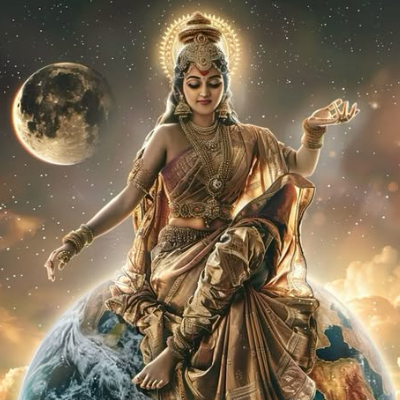
Bhudevi — The Earth Goddess and Consort of Vishnu
Bhudevi · Bhu · Prithivi · Vasudha · Vasundhara · Dharitri · Dharani · Mahidevi · Avni · Medini · Bhumi · Kashyapi · Vishhnupatni
Bhudevi is the goddess of the earth in the Hindu tradition, venerated as the personification of the physical earth itself and as one of the two principal consorts of Vishnu, the preserver deity of the Vaishnava tradition. Her other primary consort is Lakshmi, the goddess of prosperity and fortune. Bhudevi appears across a wide range of Hindu scriptural texts: the Rigveda and the Atharvaveda contain hymns addressed to the earth goddess under the name Prithivi; the Mahabharata, the Harivamsa, and the Valmiki Ramayana include her in significant narrative roles; and the Puranic corpus — most fully the Bhagavata Purana, the Vishnu Purana, the Varaha Purana, the Devi Bhagavata Purana, the Matsya Purana, and the Brahmanda Purana — develops her character, genealogy, and theological significance in considerable detail. In the Pancharatra and Vaishnava Agamic traditions she is one of the two eternal shaktis or divine powers of Vishnu, understood as inseparable from him across all his manifestations and descents.
✦ The Name
The name Bhudevi is a compound of bhu, meaning earth or ground, and devi, meaning goddess. It is the most common designation in Puranic and Agamic literature for the earth in her personalised divine form. Bhu or Bhumi alone is used frequently in prose contexts. Prithivi, derived from the name of the legendary king Prithu who is said in the Vishnu Purana and Bhagavata Purana to have shaped the earth and drawn forth her abundance, is the oldest name in the textual record and the designation used in Vedic hymns. Vasudha and Vasundhara both mean the bearer or holder of wealth and treasure, referring to the earth as the sustainer of all living beings and the container of all mineral and agricultural abundance. Dharitri and Dharani derive from the root dhar, to hold or support, and denote the earth as the supporter and upholder of all existence. Mahidevi means the great goddess of the earth, mahi being another Sanskrit word for earth. Avni and Medini are further synonyms found in poetic and hymnic contexts. Kashyapi, meaning daughter of Kashyapa, is an epithet grounded in the Puranic genealogical tradition that makes the earth a daughter of the progenitor sage. Vishnupatni means wife of Vishnu and is used in devotional and Agamic contexts to foreground her status as divine consort.
✦ Lineage
- Parentage (principal Puranic account): The Vishnu Purana and the Bhagavata Purana identify Bhudevi as the daughter of the sage Kashyapa — one of the seven primordial sages and the progenitor of many classes of beings — and of Aditi, the mother of the Adityas or solar gods. This makes Bhudevi a sister of Indra, king of the gods, and of the Adityas. However, other Puranic passages give the earth no personal parentage at all but treat her as self-existent or as emerging from cosmogonic processes, and these accounts are not fully reconcilable with the Kashyapa lineage.
- Parentage (the Prithu episode): The Vishnu Purana and Bhagavata Purana also contain a separate narrative tradition in which the earth acquires the name Prithivi from the king Prithu, son of King Vena. In this account, Prithu subdues the earth goddess when she withholds her produce from living beings, and she thereafter becomes associated with him as a daughter is associated with a father. This is not a genealogical parentage in a biological sense but an aetiological bond that runs in parallel with, and cannot be straightforwardly harmonised with, the Kashyapa parentage tradition.
- Spouse: Vishnu, the preserver deity and supreme god of the Vaishnava tradition, is Bhudevi's principal consort. In the Vaishnava Agamic and Pancharatra traditions this relationship is eternal and cosmologically fundamental: Bhudevi as earth is the ground upon which all of Vishnu's creation rests. In the specific context of the Varaha avatar episode — in which Vishnu descends as a great boar to rescue the earth goddess from the demon Hiranyaksha who had dragged her to the bottom of the cosmic ocean — the relationship between Varaha and Bhudevi takes on an explicitly intimate dimension in several Puranic accounts.
- Co-wife: Lakshmi (also called Shri), the goddess of prosperity, beauty, and fortune, is Bhudevi's co-wife in Vishnu's divine household. In Sri Vaishnava theology and iconography, the two goddesses together constitute Vishnu's inseparable shaktis and are depicted flanking him in the standard representation of Vaikunthanatha.
- Son (Puranic account): The Bhagavata Purana and the Varaha Purana record that Bhudevi bore a son to Vishnu in his Varaha form. This son is Narakasura, also called Bhauma or Bhoumasura, meaning son of the earth. Narakasura becomes a powerful demon king who rules the city of Pragjyotisha. He is eventually slain by Krishna — himself an avatar of Vishnu — assisted by his wife Satyabhama, who in certain Puranic accounts is identified as a partial incarnation of Bhudevi. The episode thus closes a generational arc: the earth goddess's son by one Vishnu avatar is slain by a later Vishnu avatar, with the earth goddess's own incarnate form participating in the killing.
- Daughter (regional tradition): The Devi Bhagavata Purana and certain South Indian traditions identify Sita — the daughter of King Janaka of Mithila who becomes the wife of Rama, the seventh avatar of Vishnu — as a daughter of Bhudevi. In the Valmiki Ramayana, Sita is said to have been found in a furrow of the earth when Janaka was ploughing a field in preparation for a sacrifice, and she bears the name Sita meaning furrow. The identification of this earth-born child as Bhudevi's daughter is developed most explicitly in later Puranic and regional traditions rather than in the Valmiki Ramayana itself. At the conclusion of the Ramayana narrative, Sita returns into the earth, a detail that several traditions interpret as the daughter returning to her mother.
✦ The Vedic Earth Goddess — Earliest Attestations
The personification of the earth as a divine feminine presence is attested in some of the oldest layers of Hindu scripture. The Rigveda contains hymns in which the earth, designated Prithivi, is addressed alongside the sky, Dyaus, as one of the primordial parental pair — the great mother below and the great father above — a cosmogonic pairing of earth and heaven that recurs in several Vedic hymns. The earth in this context is the sustainer and nourisher of all beings, the broad and stable ground upon which the cosmic and human orders rest. The Atharvaveda contains the celebrated Prithivi Sukta, a lengthy hymn addressed entirely to the earth goddess, which praises her as the holder of mountains, forests, rivers, and all living beings, as the bearer of fire within herself, and as the ground of all that exists. This hymn is among the richest Vedic treatments of the earth as a divine personality. In Vedic literature the earth goddess does not yet carry the genealogical connections or the consort relationship with Vishnu that she acquires in the epic and Puranic tradition; her divinity in this earlier stratum is grounded in her cosmic function as support and nourisher rather than in her place within a divine family.
✦ The Episode of Prithu
One of the major narrative episodes in which Bhudevi plays a central role is the story of King Prithu, told in the Vishnu Purana and elaborated in the Bhagavata Purana. In this account, during the reign of the wicked King Vena, the earth withdrew her fertility and ceased to yield crops, trees, and medicinal plants. The sages, alarmed by the famine that resulted, churned the body of the dead king and produced from him a being of radiant qualities named Prithu. Prithu, in his role as the first righteous king and the archetype of sovereign power, pursued the earth goddess who had taken the form of a cow to flee his wrath. Cornered, the earth goddess engaged with Prithu and ultimately agreed to release her produce on condition that Prithu prepare the land for cultivation, level the mountains, and create the conditions for settled agricultural life. From this episode, the earth derives the name Prithivi, meaning she who belongs to Prithu or she who was shaped by Prithu, and the Puranic tradition frames the episode as the mythological origin of agriculture, settled civilisation, and the proper relationship between a righteous king and the land over which he rules.
✦ The Rescue by Varaha
The episode in which Bhudevi is rescued by Vishnu in his Varaha avatar is the narrative most directly associated with her in the Puranic tradition. The demon Hiranyaksha, son of the sage Kashyapa and his wife Diti, seized the earth goddess and carried her down to the floor of the cosmic ocean, submerging her entirely. Bhudevi, helpless, cried out for rescue. Vishnu, perceiving her distress, manifested in the form of a great boar — Varaha — plunged into the ocean, fought and killed Hiranyaksha after a prolonged combat, and raised the earth on his tusks, lifting her back to her proper place in the cosmos.
In several Puranic versions of this episode, particularly in the Bhagavata Purana, the earth goddess's gratitude and intimacy with Varaha are rendered in terms that establish her as his consort rather than merely his charge. The Varaha Purana develops this relationship most extensively, structuring much of its contents as a dialogue in which Bhudevi addresses questions to Varaha and receives teachings on dharma, cosmology, the nature of liberation, and the significance of sacred sites and pilgrimage. In this textual framework Bhudevi is not a passive figure but an active interlocutor whose queries occasion the transmission of religious knowledge.
✦ Bhudevi's Lament and the Descent of Krishna
A narrative that recurs across the Mahabharata, the Harivamsa, and the Bhagavata Purana positions Bhudevi as the catalyst for the descent of Krishna, the eighth avatar of Vishnu in most Vaishnava enumerations. In this account, the earth, burdened by the accumulated weight of wicked kings, demon-born rulers, and armies of Asuras who had incarnated in human form, found herself unable to bear the load of adharma — unrighteousness — pressing upon her. She approached Brahma, the creator god, in the form of a cow and presented her distress. Brahma led the assembled gods, with Bhudevi, to the cosmic ocean where they appealed to Vishnu. Vishnu, perceiving the crisis, announced his intention to descend to the earth in the form of Krishna to relieve her burden. This episode establishes Bhudevi's suffering as the direct occasion for one of the most significant divine descents in the Hindu tradition, positioning the earth goddess not merely as a setting for divine action but as its primary motivating figure.
✦ Satyabhama as a Form of Bhudevi
Several Puranic texts, including the Bhagavata Purana and the Devi Bhagavata Purana, identify Satyabhama — one of Krishna's principal wives among the Ashtabharya, the eight chief consorts — as a partial incarnation or earthly form of Bhudevi. This identification is theologically purposeful: it ensures that when Krishna slays Narakasura, the son born of Bhudevi's union with the Varaha avatar, Bhudevi herself is present and participating in the act through her own incarnate form. The Bhagavata Purana's account of the killing of Narakasura states explicitly that Satyabhama fought alongside Krishna in the battle and played a role in the demon's defeat, creating a narrative in which the earth goddess, through her human form, participates in the destruction of her own demonic offspring.
✦ Textual Variants and Inconsistencies
Several significant inconsistencies and variant traditions exist across the primary sources concerning Bhudevi.
Regarding her parentage: the Vishnu Purana and Bhagavata Purana name her parents as Kashyapa and Aditi, but the aetiological tradition connecting her to King Prithu presents a quite different account of her origin that functions independently of this genealogy. A number of Puranic passages treat the earth as self-existent or cosmogonically primordial, making any personal parentage secondary or metaphorical rather than literal.
Regarding Sita as her daughter: the Valmiki Ramayana identifies Sita as having emerged from the earth when Janaka ploughed a sacred field, but does not call Bhudevi her mother. The explicit identification of Sita as Bhudevi's daughter is developed in later Puranic and regional traditions, and certain texts instead treat Sita as an embodiment of Lakshmi rather than of Bhudevi. These two identifications — Sita as Bhudevi's daughter, and Sita as Lakshmi's incarnation — coexist in the tradition without full reconciliation.
Regarding Narakasura's paternity: the Bhagavata Purana and the Varaha Purana name Varaha as Narakasura's father. The Harivamsa gives a variant in which the circumstances of Narakasura's birth are presented differently. These accounts are not fully consistent with each other in their details.
Regarding the Prithivi of the Vedas and the Bhudevi of the Puranas: the Vedic Prithivi and the Puranic Bhudevi share a fundamental identity as earth goddess but differ considerably in their characterisation. The Vedic texts present Prithivi primarily as a cosmic force and maternal ground without detailed narrative or genealogical context. The Puranic Bhudevi is a fully personalised figure with specific parentage, consort relationships, children, narrative episodes, and theological functions. The extent to which these represent a continuous tradition versus distinct developments that were later merged is a matter of scholarly discussion.
✦ Theological and Philosophical Significance
In Vaishnava theology, Bhudevi holds a position of fundamental importance as one of the two eternal shaktis of Vishnu. Where Lakshmi represents divine grace, beauty, prosperity, and the principle of devotional favour, Bhudevi represents groundedness, sustenance, patience, forbearance, and the material substrate upon which all existence rests. The two goddesses are understood as complementary and together constitute the fullness of Vishnu's divine power in the world. In the Sri Vaishnava theological system elaborated by the acharya Ramanuja and his successors, Bhudevi's role as mediator and intercessor alongside Lakshmi is given explicit doctrinal weight: the devotee approaches Vishnu through the intercession of his consorts, and Bhudevi's infinite patience and compassionate nature make her a particularly accessible mediating presence.
Philosophically, Bhudevi as the earth represents the principle of kshama, patience or forbearance, a virtue frequently illustrated in didactic passages by reference to the earth's capacity to bear the weight of all beings and all actions without complaint. The Mahabharata contains several passages in which Bhudevi herself speaks, or is invoked in discussions of ethics, to exemplify the virtue of patient endurance as the highest quality of one who sustains others.
✦ Iconography and Worship
In temple iconography, Bhudevi is most commonly depicted as one of the two flanking consorts of Vishnu. She typically stands to Vishnu's left, while Lakshmi stands to his right, though this arrangement is not invariable across all regional traditions. She is generally shown as a graceful female figure, dark-complexioned or golden depending on regional convention, holding a blue lotus or a white lotus. She may be shown with two or four arms. Her association with the earth is sometimes indicated by her green complexion in certain South Indian representations or by attributes that reference vegetation and fertility.
In the context of the Varaha icon, Bhudevi is depicted as a small figure balanced on one of Varaha's tusks or held in the crook of his arm as he strides through the cosmic waters. This iconographic type, well attested from the Gupta period onward, visually encapsulates the relationship of rescue and intimacy that the Puranic narrative establishes between the earth goddess and her boar-formed consort.
Bhudevi receives dedicated worship in several South Indian Vaishnava temples, most notably in the Sri Vaishnava tradition where she is venerated as Sridevi alongside Lakshmi in the divine pair. The Tirumala temple complex in Andhra Pradesh includes a shrine to Bhudevi associated with the Varaha Swami temple on the sacred hill. She is also invoked in agricultural rituals, in ceremonies connected with land and its cultivation, and in the Bhu Puja performed before the commencement of construction on a new building or the breaking of new ground, in which the earth goddess is propitiated and her permission sought.
✦ Connection to the Wider Genealogy
Bhudevi's genealogical connections extend across several strands of the Puranic family tree. As the daughter of Kashyapa and Aditi in the principal Puranic account, she is a sibling of the twelve Adityas — the solar gods including Indra, Varuna, Mitra, and others — as well as a member of the broader progeny of Kashyapa, who is also the father of the Daityas through his wife Diti, of the Nagas through Kadru, and of other classes of beings through his various wives. This means that Bhudevi is, in the Puranic genealogical scheme, a half-sister of Hiranyaksha, the very demon whose act of abducting her occasions the Varaha avatar. The genealogical irony of a family member becoming her abductor is not explicitly commented upon in the texts but is implicit in the Puranic lineage structure.
Through her son Narakasura's eventual slaying by Krishna and the identification of Satyabhama as her own partial incarnation, Bhudevi is woven into the narrative arc of the Krishna avatar, making her a figure who spans multiple avatar cycles within the Puranic framework. Through Sita — identified in later traditions as her daughter who is simultaneously connected to Lakshmi — she is also linked to the Rama avatar, creating a presence across the three most narratively elaborate of Vishnu's descents: Varaha, Rama, and Krishna.
✦ References
Primary Sources
- Rigveda, hymns to Prithivi (especially I.22.15, V.84, VII.34): Among the earliest textual attestations of the earth as a divine feminine presence, addressed as a cosmic mother and sustainer alongside the sky god Dyaus.
- Atharvaveda, Prithivi Sukta (XII.1): The most extensive Vedic hymn dedicated entirely to the earth goddess, praising her sustaining and containing functions across many verses.
- Shatapatha Brahmana, cosmogonic passages: Contains early material on the earth's place in the sacrificial cosmos and the cosmogonic boar episode, providing the pre-Puranic stratum underlying later Bhudevi narratives.
- Valmiki Ramayana, Bala Kanda and Uttara Kanda: Records Sita's emergence from the earth at Janaka's ploughing and her return into the earth at the narrative's conclusion, the primary textual basis for identifying Sita as earth-born.
- Mahabharata, Shanti Parva and Udyoga Parva (various passages): Contains episodes in which Bhudevi laments the weight of adharma, didactic passages invoking her as the exemplar of forbearance, and narrative material on her relationship with the gods.
- Harivamsa (supplement to the Mahabharata), chapters on Krishna's birth and genealogy: Provides early versions of the episode in which Bhudevi approaches Brahma to seek relief from the burden of the earth, leading to Vishnu's decision to descend as Krishna.
- Vishnu Purana, Book I, chapters on cosmogony and Prithu; Book IV, genealogical sections: Gives Bhudevi's parentage as daughter of Kashyapa and Aditi, narrates the Prithu episode explaining the origin of the name Prithivi, and situates her within the Vaishnava theological framework.
- Bhagavata Purana, Third Skandha (Varaha episode); Fourth Skandha (Prithu episode); Tenth Skandha (Krishna avatar and Narakasura): The most extensive Puranic source for Bhudevi, covering her rescue by Varaha, the Prithu episode, the identification of Satyabhama as her form, the birth and death of Narakasura, and the lament that occasions Krishna's descent.
- Varaha Purana (complete text): Structures much of its content as a dialogue between Bhudevi and the Varaha avatar, making her an active interlocutor for the transmission of Vaishnava religious knowledge and sacred geography.
- Devi Bhagavata Purana, relevant chapters: Develops Bhudevi's identity as a great goddess within a Shakta-inflected framework and includes material on her relationship to Sita and Satyabhama.
- Matsya Purana and Brahmanda Purana, cosmological and genealogical sections: Contribute additional Puranic material on Bhudevi's lineage, her role in creation, and variant accounts of the episodes involving Prithu and Varaha.
- Padma Purana, sections on Vishnu's consorts: Provides hymns and devotional material situating Bhudevi within the Vaishnava divine household alongside Lakshmi.
Modern Reference Works
- Vettam Mani, Puranic Encyclopaedia (1975): Provides a consolidated reference for Bhudevi's appearances across Puranic texts, cross-referencing the principal narrative episodes and variant names.
- Wendy Doniger O'Flaherty, Hindu Myths (Penguin Classics, 1975): Translates and contextualises key passages relating to the earth goddess from Vedic and Puranic sources.
- David Kinsley, Hindu Goddesses: Visions of the Divine Feminine in the Hindu Religious Tradition (1986): Discusses Bhudevi and Prithivi within the broader study of Hindu goddess traditions, tracing the development from Vedic earth hymns to Puranic and Agamic goddess theology.
- T. A. Gopinatha Rao, Elements of Hindu Iconography (1914): Provides classical prescriptions for the iconographic representation of Bhudevi in temple sculpture, including her position in the Vishnu flanking-consort arrangement.
- R. N. Dandekar, in History of Dharmashastra and related Vedic studies: Discusses the Vedic Prithivi hymns and their relationship to the later Puranic earth goddess traditions.