
About
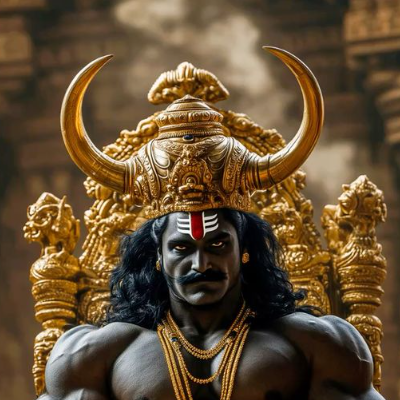
Narakasura — The Demon King of Pragjyotisha
Narakasura · Naraka · Bhauma · Bhoumasura · Mahi-putra · Dharanisuta · Bhumi-nandana · Pragjyotishapura-adhipati
Narakasura, also called Naraka or Bhauma, is a powerful demon king in the Hindu Puranic tradition whose birth, reign, and death form one of the major narrative cycles associated with Krishna, the eighth avatar of Vishnu in the most widely followed Vaishnava enumeration. He is the son of Vishnu in his Varaha form — the boar avatar who rescued the earth goddess from the demon Hiranyaksha — and of Bhudevi, the earth goddess herself, also known as Prithivi, Dharani, and Vasudha. As the son of the earth, Narakasura bears the patronymic Bhauma, meaning born of the earth, and Mahi-putra, meaning son of the earth. He rules the kingdom of Pragjyotisha, identified in several Puranic texts with a region in the far northeast of the Indian subcontinent, from his capital city also called Pragjyotishapura. His reign is characterised in the Puranas by extreme violence, abduction, and the accumulation of stolen divine weapons, treasures, and captive women on a vast scale. His death at the hands of Krishna, with the direct participation of Krishna's wife Satyabhama — identified in several Puranic accounts as a partial incarnation of Bhudevi herself — is the episode that gives rise to the festival of Naraka Chaturdashi, observed on the day preceding Diwali. Narakasura appears most fully in the Bhagavata Purana, the Vishnu Purana, the Harivamsa, the Brahmanda Purana, the Kalika Purana, and the Devi Bhagavata Purana, with the Kalika Purana providing the most geographically and genealogically detailed account of his lineage and kingdom.
✦ The Name
The name Naraka in Sanskrit means hell or the infernal region, and its application as a personal name to this demon king carries an obvious signifying weight: he is, in his conduct, an embodiment of hellish qualities and a source of hellish suffering for those under his power. The name functions simultaneously as a proper name and as a moral characterisation. Narakasura combines naraka with asura, the Sanskrit term for a class of powerful beings who stand in opposition to the cosmic and divine order, though the term asura in Puranic literature does not always denote simple evil but rather a being of great power whose orientation is toward worldly dominion rather than dharmic order.
Bhauma derives from bhumi, earth, and means born of the earth or son of the earth. It is the most commonly used alternative designation in the Puranas and the Harivamsa. Bhoumasura combines bhauma with asura and is used interchangeably with Narakasura in several texts. Mahi-putra and Dharanisuta are further patronymic forms meaning son of Mahi and son of Dharani respectively, both being names for the earth goddess Bhudevi. Bhumi-nandana means the beloved son or joy of the earth. Pragjyotishapura-adhipati is a descriptive title meaning the lord or overlord of Pragjyotishapura, identifying him by his kingdom rather than his parentage.
✦ Lineage
- Father (principal Puranic account): Vishnu in his Varaha avatar — the great boar form in which the preserver deity descended to rescue the earth goddess Bhudevi from the demon Hiranyaksha who had dragged her to the floor of the cosmic ocean. Vishnu is the supreme deity of the Vaishnava tradition, responsible for the preservation and restoration of cosmic order. The Bhagavata Purana and the Varaha Purana both record that the union of Varaha and Bhudevi, following the rescue, produced Narakasura. This makes Narakasura the direct son of a divine avatar, a paradox that several Puranic commentators have found theologically significant: the son of the preserver god himself becomes one of the great demonic adversaries of a later divine descent.
- Father (variant account): The Harivamsa, in certain passages, presents the circumstances of Narakasura's parentage with less specificity regarding the Varaha connection, and some regional and later textual traditions simply describe him as born of the earth without identifying a divine father. The Kalika Purana, a text with strong northeastern Indian provenance and significant attention to Pragjyotisha, develops the Bhauma lineage in considerable detail but with some variation from the Bhagavata Purana's account. These variants are noted where they diverge substantively.
- Mother: Bhudevi, the goddess of the earth, also called Prithivi, Dharani, Vasudha, Vasundhara, Dharitri, and Mahidevi. Bhudevi is one of the two principal consorts of Vishnu in the Vaishnava tradition, the other being Lakshmi. As the earth goddess, she is the ground and sustainer of all existence, the deity who holds all beings upon herself. Her son Narakasura's demonic character and eventual death at the hands of another avatar of his own divine father creates a narrative of profound complexity within the Puranic tradition.
- Son: The Bhagavata Purana records that Narakasura had a son named Bhagadatta, who rules Pragjyotisha after his father's death. Bhagadatta appears as a significant warrior king in the Mahabharata, fighting on the side of the Kauravas in the Kurukshetra war and deploying a great elephant named Supratika in battle. He is eventually slain by Arjuna, the third of the five Pandava brothers, when Arjuna uses the Gandiva bow and a divine weapon to cut the gem that Bhagadatta wears on his forehead. This makes Bhagadatta the grandson of both Vishnu in his Varaha form and of the earth goddess, and connects the Pragjyotisha lineage directly to the Mahabharata war narrative.
- Consorts: The Puranic texts do not extensively elaborate Narakasura's personal consorts, but the sixteen thousand one hundred women — in some accounts the number is given as sixteen thousand — whom he abducted and held captive in his palace at Pragjyotishapura became, after his death, the wives of Krishna. Their liberation and subsequent marriage to Krishna is a central element of the Narakasura episode in the Bhagavata Purana and the Vishnu Purana.
- Genealogical context of the kingdom: The Kalika Purana traces the lineage of the rulers of Pragjyotisha extensively, situating Narakasura within a royal succession and connecting the region's sacred geography to his story. According to this text, after Narakasura's death, the line continues through Bhagadatta and subsequently through a succession of kings who rule the region through the periods corresponding to the Mahabharata era and beyond.
✦ Birth and the Boon of Invincibility
The Bhagavata Purana's account of Narakasura's birth places it within the context of the Varaha avatar episode. After Vishnu in his Varaha form raised Bhudevi from the cosmic ocean, their union produced Narakasura. From birth, Narakasura possessed extraordinary power, as befitting the son of a divine avatar and a goddess. The Bhagavata Purana states that Vishnu himself installed Narakasura as the king of Pragjyotisha and conferred upon him lordship over that kingdom, acknowledging his son's dominion over the northeastern realm.
The Vishnu Purana and the Bhagavata Purana record that Narakasura obtained a boon — in some accounts from Brahma the creator, in others from Vishnu himself — that he could be slain only by his own mother. This boon was the foundation of his sense of invulnerability: since it seemed impossible that a mother would bring about the death of her own son, the condition appeared to guarantee his immortality in practical terms. The boon is theologically and narratively central to the resolution of the episode, since its fulfillment requires either that Bhudevi take a direct role in her son's death or that someone acting as or on behalf of the earth goddess deliver the killing blow.
✦ The Reign of Narakasura — Crimes and Transgressions
The Puranic texts characterise Narakasura's reign as a prolonged catastrophe for gods, sages, and human beings alike. The Bhagavata Purana, the Vishnu Purana, and the Harivamsa catalogue his transgressions in considerable detail, and the cumulative picture is of a king whose power, conferred by divine parentage and augmented by boons, was directed entirely toward aggression, plunder, and domination.
Among the offences attributed to him: he attacked and defeated Indra, the king of the gods and lord of the heavens, and stole from him the divine earrings belonging to Aditi — the mother of the gods and, in the principal Puranic genealogy, the grandmother of Narakasura himself through Bhudevi's parentage. The theft of Aditi's earrings is treated in the Bhagavata Purana as a particularly grave transgression because Aditi is the divine mother of the Adityas and the matriarch of the celestial order, and the violation of her property represents an attack on the cosmic maternal order. Narakasura also stole the divine white umbrella of Varuna, the lord of the waters and cosmic law, and seized an Indra's mountain, identified in some texts as Maniparvata, for his own capital.
Most extensively elaborated in the Puranic accounts is his practice of abducting women on a vast scale. The Bhagavata Purana states that Narakasura seized sixteen thousand one hundred women — daughters of gods, sages, kings, and other beings — and confined them in his palace at Pragjyotishapura. This act of mass abduction is presented in the text not merely as personal transgression but as a structural violation of the social and cosmic order: the women seized included daughters of divine beings, and their captivity represented an unresolved defilement that the universe could not accommodate indefinitely. The liberation of these women becomes one of the primary objectives of the campaign against Narakasura.
The Bhagavata Purana further records that Narakasura possessed a formidable array of divine weapons obtained through conquest and that he was protected by a demon named Mura — commander of his forces — who himself guarded Pragjyotishapura with five thousand nooses stretched across the approaches to the city. It is because of this association with Mura that Krishna acquires the epithet Murari — enemy or slayer of Mura — through the events of this campaign.
✦ The Fortress of Pragjyotishapura
The Bhagavata Purana's description of Pragjyotishapura presents it as an extraordinarily well-defended city whose fortifications were not merely physical but magical and cosmically layered. The city was encircled by mountains of fire; surrounded by a moat of water; protected by walls of wind; enclosed in a net of darkness; and, most importantly, guarded at its approaches by the five thousand nooses of the demon Mura. The description creates the impression of a citadel that had been made deliberately impregnable through the accumulation of every available form of defensive enchantment, reflecting Narakasura's confidence in his invulnerability.
The Kalika Purana, a text of particular importance for the northeastern Indian geographical tradition and for the sacred landscape of Kamakhya and the Brahmaputra valley, situates Pragjyotishapura with considerable geographical specificity in the region corresponding to present-day Assam. The Kalika Purana treats Narakasura as a founding figure of that region's sacred and political history, and provides a more sympathetic and complex portrait of him than the Bhagavata Purana does, emphasising his role as the establisher of the great Kamakhya temple on Nilachal hill and his deep devotion to the goddess. In the Kalika Purana's account, Narakasura is less straightforwardly villainous and more a tragic figure whose great piety toward the goddess coexists with his antagonistic relationship with Vishnu and Krishna.
✦ The Embassy of Indra and the Decision to Act
According to the Bhagavata Purana, Indra — the king of the gods, who had been defeated by Narakasura and robbed of the divine earrings of his mother Aditi — came to Dvaraka, the city of Krishna, to report Narakasura's crimes and appeal for intervention. Indra presented before Krishna the full account of the transgressions: the theft of Aditi's earrings, the seizure of Varuna's umbrella, the capture of the mountain, and the imprisonment of the sixteen thousand one hundred women. The appeal for relief from the burden of Narakasura's predations mirrors, in structure, the broader Puranic motif in which the gods appeal to Vishnu or to the supreme deity for rescue from a demonic oppressor, and which in the wider context echoes Bhudevi's own earlier lament that had occasioned the decision to descend as Krishna in the first instance.
Krishna resolved to proceed against Narakasura and set out for Pragjyotishapura riding Garuda, his divine eagle vehicle. Significantly, the Bhagavata Purana records that Krishna was accompanied on this campaign by his wife Satyabhama. The inclusion of Satyabhama is not incidental: she is the figure through whom the boon-condition governing Narakasura's death would be fulfilled, and her presence in the battle is the key that unlocks the otherwise impossible killing.
✦ The Battle and the Death of Narakasura
The Bhagavata Purana narrates the assault on Pragjyotishapura in considerable detail. Krishna used his Sudarshana Chakra, the divine discus weapon of Vishnu, to destroy the mountains of fire, the water defences, the wind walls, and the curtain of darkness surrounding the city. The demon Mura, who guarded the outer approaches with his five thousand nooses, attacked Krishna as he flew in on Garuda. Krishna destroyed the nooses and, when Mura pressed his attack, slew him and his seven sons. It is from this killing of Mura that Krishna is thereafter called Murari.
Narakasura himself then advanced to battle, riding an elephant and armed with a spear called Sataghni. The Bhagavata Purana describes an exchange of weapons between the two combatants, with Narakasura hurling the Sataghni at Garuda and deploying various divine weapons against Krishna. Krishna destroyed all of them. At the critical moment, Narakasura struck Krishna with his spear. The Bhagavata Purana records that although the blow did not harm Krishna, Satyabhama — witnessing the attack on her husband — was filled with fierce anger and took up her own bow to join the battle. The text states that Krishna, with the appearance of being briefly affected by the blow, encouraged Satyabhama to fight, thereby placing the decisive action in her hands.
The killing blow to Narakasura was delivered by Satyabhama. In the Bhagavata Purana's account, Satyabhama shot the arrow that killed Narakasura, fulfilling the condition of the boon: he could be slain only by his own mother, and Satyabhama, as a partial incarnation of Bhudevi the earth goddess who was Narakasura's mother, satisfied this condition. The Vishnu Purana presents a closely parallel account. In some variant tellings — including certain passages within the Bhagavata Purana's own subsequent narration — Krishna himself is said to have beheaded Narakasura with the Sudarshana Chakra, and Satyabhama's role is described somewhat differently or merged with Krishna's action. These variant emphases within and across the texts are discussed further in the section on textual inconsistencies below.
As Narakasura lay dying, the Bhagavata Purana records a moment of theological resolution: Narakasura, recognising Krishna as Vishnu, attained clarity and acknowledged his own destruction as liberation. His dying words, addressed to Krishna, express acceptance and a request that the day of his death be remembered as a day of joyful celebration rather than mourning. Krishna granted this request, and this moment is held in the tradition to be the origin of the festival of Naraka Chaturdashi.
✦ The Aftermath — Liberation of the Women and Restoration of Stolen Objects
Following Narakasura's death, the Bhagavata Purana describes a sequence of restorations and resolutions that complete the episode. Krishna entered the palace at Pragjyotishapura and released the sixteen thousand one hundred captive women. The women, who had been imprisoned for extended periods and whose prospects of return to their own families were compromised by their captivity, appealed to Krishna to accept them as his wives. Krishna agreed, and in one of the most discussed passages of the Bhagavata Purana's tenth book, he is said to have simultaneously multiplied himself into as many forms as there were women and married each of them in a separate household, so that each wife experienced Krishna as her sole husband attending personally to her. This episode is treated in Vaishnava theology as an expression of Krishna's omnipresence and his capacity to give himself fully to each devotee without division.
The stolen divine objects were also recovered and restored. The earrings of Aditi were returned to Indra for delivery to his mother. Varuna's umbrella was returned. The mountain seized for Narakasura's capital was dealt with according to various accounts. The Bhagavata Purana records that Krishna took the divine parijata tree — which Narakasura had also stolen from the heavens — and brought it to Dvaraka at Satyabhama's insistence, a detail that leads into a separate episode involving a dispute with Indra over the celestial tree.
After the battle, Krishna and Satyabhama visited the heaven of Indra to present Aditi with her recovered earrings. Aditi blessed Satyabhama. The Bhagavata Purana records Aditi's blessing and the reception of Krishna and Satyabhama in Indra's heaven, completing the narrative arc that had begun with Indra's embassy to Dvaraka.
✦ The Kalika Purana's Account — A Divergent Tradition
The Kalika Purana, a text of the Shakta tradition with deep roots in the northeastern Indian region corresponding to present-day Assam, presents a substantially different portrait of Narakasura that diverges in important respects from the Bhagavata Purana's treatment. In the Kalika Purana, Narakasura is a figure of complex religious significance who is credited with establishing the great Kamakhya temple on Nilachal hill above the Brahmaputra river. The Kamakhya temple is one of the most sacred sites in the Shakta tradition, associated with the goddess Kamakhya, a form of Kali or Devi, and considered one of the Shakta Pithas — the seats of the goddess's power distributed across the subcontinent.
In the Kalika Purana's narrative, Narakasura is deeply devoted to the goddess and exercises his authority over the Pragjyotisha region in ways that the text frames as religiously significant rather than purely demonic. His antagonism is directed specifically against Vishnu and the Vaishnava order rather than against dharma in general. The text describes his conflict with Vishnu's traditions and his eventual death at Krishna's hands, but the overall characterisation is more ambivalent: Narakasura is a great devotee of the goddess who is caught in a structural opposition to Vishnu that the tradition must ultimately resolve. The Kalika Purana's treatment reflects the complex theological negotiations between Shakta and Vaishnava traditions in the northeastern region, in which a figure demonised in Vaishnava texts is reclaimed and rehabilitated within a Shakta framework.
The Kalika Purana also provides different details regarding the succession in Pragjyotisha, treating Bhagadatta and subsequent rulers as part of a continuous sacred royal lineage connected both to the Kamakhya tradition and to the broader political and religious history of the region. This makes the Kalika Purana an indispensable source for understanding Narakasura's significance in eastern Indian regional religious traditions, even as its account diverges markedly from the mainstream Vaishnava Puranic presentation.
✦ Textual Variants and Inconsistencies
The Narakasura narrative exists across enough primary texts, and with enough variation in detail, that the inconsistencies merit systematic treatment.
Regarding who delivers the killing blow: the Bhagavata Purana's narrative of the battle presents Satyabhama as the one who kills Narakasura, fulfilling the boon-condition that only his mother could slay him, since Satyabhama is Bhudevi incarnate. However, the same text, in passages recounting the episode from a slightly different narrative angle or in summary form, attributes the killing to Krishna using the Sudarshana Chakra. The Vishnu Purana similarly attributes the killing primarily to Krishna while acknowledging Satyabhama's role. The Harivamsa's version emphasises Krishna's direct agency. These varying emphases likely reflect both the different theological priorities of different textual traditions and the editorial layering within the Puranas themselves. The boon-condition resolution, which requires Satyabhama's agency, is the theologically more complex and narratively more carefully motivated account; the simpler attribution to Krishna directly may represent an earlier or less theologically elaborated stratum.
Regarding the number of captive women: the Bhagavata Purana gives the number as sixteen thousand one hundred in its detailed narrative. Other passages in the same text and references in the Vishnu Purana give the round figure of sixteen thousand. The slight discrepancy of one hundred women appears to be an internal inconsistency within the tradition rather than a meaningful narrative distinction.
Regarding Narakasura's father: the Bhagavata Purana and the Varaha Purana identify Vishnu in his Varaha form as the father. The Harivamsa is less explicit on the Varaha connection in some of its passages. The Kalika Purana presents the birth traditions of the Pragjyotisha line with its own emphases and does not foreground the Varaha parentage in the same way.
Regarding Satyabhama's identity as Bhudevi: the identification of Satyabhama as a partial incarnation of Bhudevi is stated explicitly in the Bhagavata Purana and the Devi Bhagavata Purana. Not all Puranic texts that mention the Narakasura episode make this identification, and in those texts the fulfillment of the boon-condition is either left unexplained or attributed to a different mechanism. In some folk and regional traditions, Satyabhama's role is emphasised independently of the Bhudevi-incarnation identification.
Regarding Narakasura's religious character: the Bhagavata Purana and the Vishnu Purana present him as straightforwardly demonic with no redemptive religious qualities prior to his dying moment of recognition. The Kalika Purana presents him as a devoted worshipper of the goddess with a complex relationship to the divine order. These two characterisations cannot be harmonised and represent genuinely different theological orientations within the broader Hindu tradition.
Regarding the boon-granter: the Bhagavata Purana in some passages implies the boon was given by Vishnu himself; other passages and other texts attribute it to Brahma. This distinction matters theologically — a boon from Vishnu that only his own incarnate wife as the earth goddess can fulfill creates a tighter self-referential divine arrangement than a boon from Brahma — but the texts are not consistent on this point.
✦ The Festival of Naraka Chaturdashi
The death of Narakasura is commemorated by the festival of Naraka Chaturdashi, observed on the fourteenth day of the dark fortnight of the month of Kartika, the day immediately preceding the main night of Diwali. The Bhagavata Purana records that Narakasura himself, at the moment of his death, asked that the day be celebrated with joy and the lighting of lamps, and Krishna granted this request. The festival is therefore understood in the tradition not as a celebration of a villain's death but as the fulfillment of a dying request, and indeed as a moment of liberation: Narakasura's recognition of Krishna at his final moment is interpreted in Vaishnava theological commentary as equivalent to liberation, since to die with the divine name and form present in consciousness is, in Vaishnava soteriology, to attain release.
The festival involves ritual bathing before dawn — understood as a purification parallel to the cleansing of the world from Narakasura's oppressive presence — the lighting of lamps, the celebration of Krishna and Satyabhama's victory, and in some regional traditions the symbolic burning of an effigy of Narakasura. In South India, particularly in the states of Maharashtra, Karnataka, Andhra Pradesh, and Tamil Nadu, Naraka Chaturdashi is observed with considerable elaborateness and is in some respects more widely observed than the main Lakshmi Puja of Diwali night. In Assam and the northeastern region, given the Kalika Purana's strong identification of Narakasura with the founding of the Pragjyotisha sacred landscape, the festival carries additional layers of regional religious significance.
✦ Theological and Philosophical Significance
Narakasura's narrative raises several theological questions that Puranic and Vaishnava commentarial literature have engaged with seriously. The most obvious is the paradox of a divine avatar's son becoming a great demonic oppressor. In Vaishnava theology, this is addressed through the doctrine of the independence of individual beings: even beings of divine parentage possess their own volitional trajectories, and the greatness of one's origin does not predetermine the dharmic quality of one's choices. Narakasura's fall is attributed in this framework not to a flaw in his divine parentage but to the consequences of power accumulated without corresponding virtue, and to the effects of past karmic configurations that express themselves through successive births regardless of the excellence of one's parents.
The boon-structure of Narakasura's death is also theologically rich. That he could be slain only by his mother encodes a principle found in several Puranic boon narratives: the condition that appears to guarantee invulnerability contains within itself the mechanism of its own undoing, and divine providence arranges circumstances such that the loophole is precisely fulfilled. Bhudevi's identity as the earth goddess — patient, all-bearing, the ultimate mother of all beings — is the ground upon which the resolution turns. Her incarnation as Satyabhama makes the fulfillment possible without requiring Bhudevi herself to act against her son in a way that would violate the maternal bond, since Satyabhama, though Bhudevi's incarnate form, is experientially a separate person with no maternal relationship to Narakasura.
The dying recognition scene is given considerable weight in Vaishnava commentary. Several Vaishnava acharyas have cited it as an illustration of the principle that the divine compassion of Vishnu extends even to those who have spent their lives in opposition to dharma: the moment of sincere recognition at death is sufficient for liberation. This reading frames Narakasura not as a figure of unrelieved evil but as a being whose latent capacity for recognition was activated at the final moment by direct contact with the divine.
In Shakta theological readings informed by the Kalika Purana, Narakasura is understood as a devotee of the goddess who was caught in the structural opposition between Shakta and Vaishnava sacred orders. His death at Krishna's hands is in this reading less a moral resolution than a political and cosmic one: the Vaishnava order asserts its authority over the region through the defeat of a figure who embodied an alternative sacred orientation. The founding of Kamakhya as his lasting religious contribution ensures that his presence continues to shape the sacred landscape of the northeast even after his death.
✦ Connection to the Wider Genealogy
Narakasura occupies a node in the Puranic genealogical network that connects several of the tradition's major narrative threads. Through his father Vishnu in the Varaha form, he is directly descended from the supreme preserver deity and is therefore the son of the same being who appears across all avatar descents. Through his mother Bhudevi, he is the son of the earth goddess who is simultaneously one of Vishnu's eternal consorts and the ground of all created existence. His parentage thus makes him simultaneously the son of the cosmic preserver and the son of the earth — a combination that the Puranas treat as the source of his extraordinary power and the background of his eventual destruction.
His son Bhagadatta connects the Pragjyotisha lineage to the Mahabharata war, where Bhagadatta fights for the Kauravas and is slain by Arjuna. The Pandava Arjuna is himself the son of Indra, the king of the gods, whose divine mother Aditi's earrings Narakasura had stolen. The genealogical irony that Indra's son Arjuna slays the son of the being who robbed Indra's mother is implicit in the texts and reflects the Puranic tradition's tendency to arrange its genealogies in patterns of extended consequence and resolution.
Through the identification of Satyabhama as Bhudevi incarnate, Narakasura is connected to the circle of Krishna's principal wives — the Ashtabharya — and through them to the narrative architecture of the Bhagavata Purana's tenth book and the Harivamsa's account of Krishna's life at Dvaraka. Through the sixteen thousand one hundred women who become Krishna's wives after their liberation, the Narakasura episode contributes directly to the domestic and devotional narratives of the Krishna cycle.
Through his mother Bhudevi's parentage as daughter of Kashyapa and Aditi, Narakasura is a grandson of Kashyapa — the great progenitor sage who is also the father of Hiranyaksha, the demon slain by the Varaha avatar who is Narakasura's own father. This means that Narakasura's divine father and his demonic step-uncle — Hiranyaksha and Hiranyakashipu, the sons of Kashyapa and Diti — belong to opposing genealogical branches of the same progenitor, and that the Pragjyotisha lineage is genealogically descended from both sides of this cosmic opposition simultaneously.
✦ References
Primary Sources
- Bhagavata Purana, Tenth Skandha, chapters 59–60: The most detailed Puranic account of the Narakasura episode, covering Indra's embassy, the assault on Pragjyotishapura, the killing of Mura, the battle with Narakasura, Satyabhama's role in his death, the liberation of the captive women, the recovery of stolen objects, and the dying exchange between Narakasura and Krishna.
- Bhagavata Purana, Third Skandha, chapters 13–19: Narrates the Varaha avatar episode and the birth of Narakasura as its consequence, establishing the divine parentage that underlies the later narrative.
- Vishnu Purana, Book V, chapters on Krishna's exploits: Provides a parallel account of the Narakasura episode with some differences in emphasis regarding the agency of Krishna and Satyabhama, and connects the episode to the broader narrative of Krishna's campaigns.
- Harivamsa (supplement to the Mahabharata), Vishnu Parva, chapters on Krishna's battles: Contains an account of the Narakasura episode and contributes material on the genealogy of the Pragjyotisha line, including Bhagadatta's descent.
- Mahabharata, Drona Parva: Records the role of Bhagadatta, son of Narakasura, as a major Kaurava warrior in the Kurukshetra war, and his death at Arjuna's hands, connecting the Pragjyotisha lineage to the Mahabharata war narrative.
- Kalika Purana, chapters on Pragjyotisha and Kamakhya: The most important source for the northeastern Indian regional tradition of Narakasura, identifying him as the founder of the Kamakhya temple, characterising him as a devotee of the goddess, and providing a divergent account of his significance in the sacred geography of Assam.
- Varaha Purana, relevant chapters: Contributes material on Narakasura's birth from Varaha and Bhudevi and situates this within the broader theological framework of the Varaha avatar's significance.
- Devi Bhagavata Purana, relevant chapters: Develops the identification of Satyabhama as a form of Bhudevi and situates this within a Shakta theological framework that inflects the Narakasura episode differently from the mainstream Vaishnava Puranic tradition.
- Brahmanda Purana, sections on Vishnu's avatars and on genealogies: Contributes supplementary material on the Narakasura lineage and the Pragjyotisha kingdom.
- Agni Purana, chapters on avatars and sacred sites: Provides additional Puranic material on the Narakasura episode and associated ritual and iconographic traditions.
Modern Reference Works
- Vettam Mani, Puranic Encyclopaedia (1975): Consolidates Narakasura's appearances across the Puranic corpus with cross-references to the principal variant accounts and associated figures.
- Wendy Doniger O'Flaherty, Hindu Myths (Penguin Classics, 1975): Contextualises the structural features of the boon-narrative and the divine parentage paradox within broader comparative patterns in Hindu mythological literature.
- David Shulman, The Wisdom of Poets: Studies in Tamil, Telugu, and Sanskrit (2001): Discusses the theological significance of dying recognition scenes in Vaishnava narrative, with relevance to the Narakasura episode.
- Banikanta Kakati, The Mother Goddess Kamakhya (1948): The principal modern scholarly study of the Kamakhya tradition and the Kalika Purana's account of Narakasura's role in establishing the sacred geography of Assam.
- T. A. Gopinatha Rao, Elements of Hindu Iconography (1914): Provides relevant iconographic material for the Narakasura episode as depicted in temple art, including the representation of the battle scene and Satyabhama's role.
- Alf Hiltebeitel, The Ritual of Battle: Krishna in the Mahabharata (1976): Discusses the Bhagadatta episode in the Mahabharata and its connections to the Pragjyotisha lineage descending from Narakasura, situating the war narrative within the broader genealogical and cosmic framework.