
About
Devala — Son of Pratyusha, Brahmarishi, and Dharmashastra Authority
Devala · Asita-Devala · Daivala · son of Pratyusha the Vasu · not to be confused with the separate figure Ashtavakra, with whom he is conflated in some secondary narratives
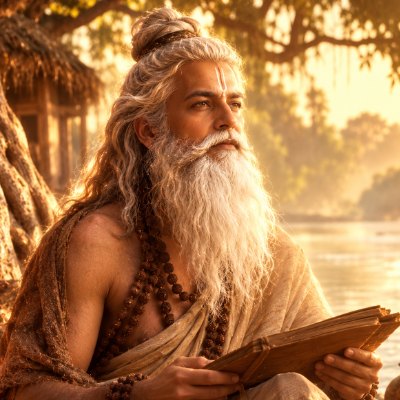
Devala is one of the celebrated brahmarishis of the Hindu Puranic and epic tradition — a Vedic seer, Sankhya philosopher, dharmashastra authority, and recurrent presence across the Mahabharata and the Bhagavata Purana. He is the son of Pratyusha, the seventh of the eight Vasus born to Vasu daughter of Daksha and Dharma, and through this lineage he carries a divine genealogy tracing back through the elemental gods to the progenitors of creation. His most celebrated appearance in the primary literature is the invocation of his name by Arjuna in the Bhagavad Gita, Chapter 10, verses 12–13, where Arjuna lists him alongside Narada, Asita, and Vyasa as among the great sages who have proclaimed Krishna to be the Supreme Brahman — a passage whose commentators from Shankaracharya onward have consistently treated as naming the most authoritative figures in the tradition of spiritual knowledge. He is attested in the Mahabharata across multiple Parvas, in numerous Puranas including the Bhagavata, Vishnu, Matsya, Brahmanda, Vayu, and Brahmavaivarta, and in the dharmashastra tradition through his Devala-smriti, a text no longer extant in complete form but so extensively quoted by later writers that modern scholarship has attempted its partial reconstruction. His association with the sage Asita — as son, father, or composite figure depending on the source — is one of the genuine unresolved problems of Puranic genealogy. The Mahabharata's genealogical passage at Adi Parva, Chapter 66 records his two sons as exceedingly forgiving and of great mental power; a secondary source within the Grokipedia article on Devala names them as Sudeva and Devesha, drawing on the Adi Parva.
✦ The Name
The name Devala derives from the Sanskrit root through deva — the shining one, a god or divine being — with the suffix -la, which in Sanskrit frequently forms agent nouns or descriptive adjectives. The name may thus mean one who relates to or belongs to the divine, one who tends toward the gods, or by some analyses, the sport or play of the gods. An alternative derivation treats the name through daivala — meaning divine or of the gods — which is indeed the adjectival form used in the gotra tradition, where Devala's lineage is called the Daivala pravara. The compound name Asita-Devala, which occurs frequently in the Mahabharata, combines the name of the sage Asita — meaning the dark one or the black one, from the root as associated with sitting or with darkness — with Devala; the composite form appears sometimes to designate a single sage of complex identity and sometimes two sages named together as a revered pair.
✦ Lineage
- Father (primary tradition): Pratyusha — the seventh of the eight Vasus, the elemental divine being of the dawn, son of Vasu daughter of Daksha and Dharma. Attested in the Mahabharata, Adi Parva, Chapter 66; Matsya Purana 5.27 and 203.7; Brahmanda Purana 3.3.27; Vishnu Purana 1.15.117; and the Puranic Encyclopaedia.
- Father (competing tradition): Asita — a Vedic seer of considerable antiquity, associated with the Kashyapa gotra, and the figure most frequently paired with Devala in compound references. The Brahmanda Purana, Vayu Purana, and Saurapurana record Devala as the son of Asita and his wife Ekaparna, daughter of Himavan — the mountain. The Brahmavaivarta Purana adds that this birth was granted to Asita through the grace of Shiva, who bestowed the child upon him as a boon. Both parentage traditions are attested in primary sources and cannot be reconciled; the Devala-smriti critical study concludes that Asita and Devala are likely distinct figures of different periods whose names became intertwined due to their frequent association and the tradition of compound naming.
- Wife: Ekaparna — daughter of Himavan, the mountain; recorded in the Harivamsa (Chapter 18) and certain Puranic accounts as Devala's wife. In other accounts Ekaparna is the wife of Asita rather than Devala, reflecting the same lineage ambiguity that marks the Asita-Devala parentage problem.
- Sons: Two sons described in the Mahabharata, Adi Parva, Chapter 66, as exceedingly forgiving and of great mental power. The Adi Parva passage at Chapter 182.2 (Critical Edition 1.174.2) names the younger brother of Devala — a figure who performs tapas at Utkochaka tirtha — as **Dhaumya**, who is identified in the epic as the chief priest and preceptor of the Pandavas. If this identification is accurate, Dhaumya is not Devala's son but his brother, which would make Devala himself the elder of two brothers, and his sons would be a further generation unnamed in the passage. The Grokipedia article on Devala, citing the Adi Parva, names the two sons of Devala as **Sudeva** and **Devesha**, both noted for their forgiving nature and mental prowess; this naming is not confirmed in the passages directly consulted for this profile and should be treated as a secondary-source attribution pending primary-text verification.
- Grandson (Saurapurana tradition): Shandilya — the founder of the Shandilya gotra; recorded in the Saurapurana as a son of Devala in the Kashyapa-Asita-Devala lineage.
✦ The Bhagavad Gita Invocation
The most widely known appearance of Devala's name in the entire primary tradition is in the Bhagavad Gita, Chapter 10, verses 12–13, where Arjuna, overwhelmed by Krishna's disclosure of his divine nature in the Vibhuti Yoga chapter, responds by affirming his belief and listing the authorities who had proclaimed the same truth before him. Arjuna says that all the sages as well as the divine sage Narada, and Asita, Devala, and Vyasa have declared Krishna to be the Supreme Brahman, the supreme Light, the eternal divine Person, the Primal God, unborn and all-pervading. This grouping of Narada, Asita, Devala, and Vyasa as the canonical list of authorities on divine knowledge gave Devala a place of permanent prominence in the Vaishnava theological tradition. Shankaracharya's commentary on this passage mentions Devala in the context of the dharmashastra authorities. The Gita Supersite's compilation of commentaries notes that Asita is the father of Devala, which reflects the alternative parentage tradition from the Puranas rather than the Mahabharata's genealogical chapter. The pairing of Asita and Devala in this verse is consistent with their frequent compound invocation elsewhere in the tradition.
✦ Appearances in the Mahabharata
Devala appears across multiple Parvas of the Mahabharata in substantively different contexts, attesting to the breadth of his authority in the epic tradition. In the Sabha Parva, he is among the sages present at the Rajasuya Yajna of Yudhishthira — a gathering that assembles the most important figures of the cosmic and human world. In the Adi Parva, his name appears in the genealogical passage identifying him as the son of Pratyusha and in the context of the selection of Dhaumya as the Pandavas' preceptor, where Dhaumya's elder brother who performs tapas in the forest is potentially Devala. In the Sabha Parva dice game episode, Yudhishthira invokes Devala's authority — his view that deceitful gambling is sinful and destructive of dharma — in his arguments against participating in the rigged game, establishing Devala's dharmashastra position on a specific ethical question within the epic's most consequential narrative moment. In the Shanti Parva, Devala or Asita-Devala appears in discourse on cosmic and ethical questions, and in the Shalya Parva Asita-Devala is depicted as a virtuous ascetic who traverses the domains of Yama, Soma, and Brahman in metaphysical enquiry, demonstrating expertise in yogic traversal of cosmic realms. The Mahabharata's Santi Parva (Chapter 66 in the Critical Edition numeration) cites a teaching attributed to Devala that three lights belong to a person — offspring, karma, and learning — which are the only things that accompany the individual when the body is abandoned, a teaching that reflects his Sankhya and dharmic philosophical outlook. Devala is also listed among the sages invited to the Sarpayajna snake sacrifice of King Janamejaya, the framing narrative of the entire Mahabharata.
✦ Devala as a Sankhya Authority
One of the most significant aspects of Devala's intellectual profile is his identification as a teacher in the Sankhya philosophical tradition. The Matharavrtti, a commentary on the Sankhyakarika, lists the paramapara — the lineage of teachers — of Sankhya philosophy and includes Devala as one of its early transmitters, in a line from Kapila through Pancasikha through figures including Devala to Ishvarakrishna the author of the Sankhyakarika. This identification places Devala as an ancient Sankhya authority predating the classical systematisation of the school. Shankaracharya's commentary on the Brahmasutra (2.1.4.12) refers to Devala among the dharmasutrakaras who accepted in their texts the Sankhya doctrine of Pradhana — the primordial matter — as the causal principle of the world, and notes this as a position that the Vedanta system rejects. The Devala-smriti critical study (Wisdomlib/Shodhganga) identifies Devala's concept of purushartha — the aims of human life — as distinctively Sankhya-influenced: he frames the aims of worldly prosperity and final liberation as two aspects of a single framework grounded in Dharma, rather than as the conventional four purusharthas, showing the influence of Sankhya categories on his dharmic thought.
✦ The Devala-smriti
Devala is the attributed author of a dharmasutra or smriti text known as the Devala-smriti or Devalasmriti. This text does not survive in complete form — no extant manuscript preserves it as an independent work — but it is so extensively quoted in later dharmashastra literature that modern scholarship has attempted a partial reconstruction from those quotations. The Brihaspatismriti cites Devala as one of the principal dharmashastra authorities; Shankaracharya in his commentary on the Bhagavad Gita introduction refers to him as a dharmasutrakara; and numerous medieval digests of Hindu law quote Devala's rulings on topics including the status of widows, purification rituals, the conduct of different varnas, and the ethics of gambling. The Devala-smriti's reconstructed text has been the subject of a full critical study submitted to Shodhganga and available through the Wisdomlib platform, which collects and analyses the surviving quotations and attempts to assess Devala's position on major dharmic questions. His view on gambling — that deceitful play with professional gamblers is sinful and destructive to the individual and society — is explicitly cited in the Mahabharata, making it one of the few dharmashastra positions attributed to Devala that is attested in a primary epic source rather than only in later digests.
✦ Appearances in the Bhagavata Purana
Devala is named in multiple passages of the Bhagavata Purana across several Skandhas, confirming his authority within the Vaishnava tradition that the Bhagavata Purana represents. Skandha 6, Chapter 15, verse 12 lists him alongside Kumara, Narada, and Angiras as a great sage. Skandha 2, Chapter 7, verse 45 lists him alongside Dvaipayana (Vyasa), Narada, Cyavana, and others as authorities who have heard or transmitted sacred knowledge. Skandha 8, Chapter 4, verse 3 records an episode in which a gandharva named Huhu was freed from a curse through an encounter with Devala — an episode not found in the surviving Mahabharata passages but recorded in the Bhagavata Purana's narrative of the elephant Gajendra's liberation. Skandha 9, Chapter 4, verse 57 contains a further reference. Skandha 6, Chapter 6, verse 20 records a parentage tradition different from both the Pratyusha-son and Asita-son accounts, attributing Devala to Dhisana — a further variant lineage not attested elsewhere in the same form. These scattered references confirm that Devala was understood in the Bhagavata Purana's tradition as a figure of universal authority, present at major narrative junctures across multiple cosmic periods.
✦ The Asita-Devala Problem
The relationship between Devala and the sage Asita is one of the genuine textual problems of the Puranic and epic tradition and requires honest acknowledgement rather than false resolution. The primary evidence presents contradictory positions: in some texts Devala is the son of Pratyusha and Asita is a separate figure; in others Devala is the son of Asita; in others Asita is recorded as the son of Devala; and in still others Asita-Devala appears as a compound name designating a single sage. The Srautasutras, the Mahabharata, and the Puranas all present different configurations. The Devala-smriti critical study, drawing on the full range of primary evidence, concludes that the most defensible position is that Asita and Devala are two distinct historical sages of the Kashyapa-Sandilya tradition who became closely associated through their shared gotra, similar philosophical outlook, and frequent compound invocation — and that the Puranic tendency to structure all sages into linear genealogies produced competing father-son attributions for figures who were originally contemporaneous or successive in a more lateral tradition. The Mahabharata's genealogical chapter in Adi Parva, which places Devala as the son of Pratyusha the Vasu, represents the framework within which this genealogical series operates; the alternative Asita-parentage is a competing and irreconcilable tradition from different textual strata.
✦ Devala's Gotra and Scholastic Affiliation
In the gotra tradition — the system by which Brahmin lineages trace their patrilineal descent to a founding sage — Devala is associated with the Sandilya subdivision of the Kashyapa school. The Srautasutras of Apastamba, Katyayana, and Asvalayana all record the Daivala pravara within the Sandilya gotra, placing Devala as one of the foundational ancestors of this lineage. The Matsya Purana confirms Devala's association with the Sandilya group of the Kashyapa school. The Brahmanda and Vayu Puranas place him instead in the Kausika group of Visvamitra's tradition — a discrepancy that the Devala-smriti critical study attributes to the same phenomenon of multiple sages sharing the Devala name across different lineages and periods. The composite figure Asita-Devala, identified by the Srautasutras as a pravara ancestor of the Sandilya gotra, appears to blend two figures from different periods into a single ancestral designation.
✦ Disambiguation
The name Devala designates multiple distinct figures across the tradition, and several require separation. First, Devala the son of Pratyusha the Vasu, treated in this profile as the principal figure within this genealogical series: the brahmarishi, Sankhya teacher, dharmashastra authority, and Bhagavad Gita-cited sage. Second, Devala as the son of Asita and Ekaparna: the same individual in a competing parentage tradition, or in some readings a different sage of the same name. Third, the Devala associated with the Ashtavakra narrative: the Vedic Library at ISVARA.org records a tradition in which Devala, son of Asita, was cursed by the apsara Rambha for rejecting her love, causing his body to become crooked and giving rise to the name Ashtavakra. This narrative, attested in the Harivamsa and Brahmavaivarta Purana traditions, conflates Devala with Ashtavakra — a figure more commonly identified as the son of Kahoda in the Mahabharata — and represents a distinct sectarian tradition not supported by the principal primary sources. Fourth, the Devala who is the progenitor of the Devanga community according to the Devanga Purana, emerging from the third eye of Shiva to create the first woven cloth: a tradition attested only in that sectarian Purana and not in the pan-Puranic primary literature. Fifth, Devala the Gandharva: the Bhagavata Purana's Skandha 8 episode of the liberation of Huhu the gandharva through Devala's curse and the subsequent encounter with the elephant Gajendra-Vishnu presents what may be a different figure sharing the name.
✦ References
Primary Sources
- Mahabharata, Adi Parva, Chapter 66 — the primary genealogical passage identifying Devala as the son of Pratyusha and recording his two sons as exceedingly forgiving and of great mental power.
- Mahabharata, Adi Parva, Chapter 182 — the selection of Dhaumya as the Pandavas' preceptor, where a sage performing tapas at Utkochaka tirtha is identified as the younger brother of Devala.
- Mahabharata, Sabha Parva — Devala's presence at the Rajasuya Yajna; Yudhishthira's invocation of Devala's authority against gambling in the dice game episode.
- Mahabharata, Shanti Parva — discourses citing Devala or Asita-Devala on cosmic and ethical questions; the teaching on three lights of a person.
- Mahabharata, Shalya Parva — Asita-Devala as a virtuous ascetic traversing the realms of Yama, Soma, and Brahman in metaphysical enquiry.
- Bhagavad Gita, Chapter 10, verses 12–13 — Arjuna's invocation of Narada, Asita, Devala, and Vyasa as the canonical authorities who have proclaimed Krishna's divine nature.
- Bhagavata Purana, Skandha 6, Chapter 15, verse 12; Skandha 2, Chapter 7, verse 45; Skandha 8, Chapter 4, verse 3; Skandha 9, Chapter 4, verse 57 — multiple appearances across the Bhagavata confirming Devala's authority within the Vaishnava tradition.
- Matsya Purana, Chapters 5 and 203 — records Devala as the son of Pratyusha and his gotra affiliation with the Kashyapa-Sandilya school.
- Brahmanda Purana, Section 3, Chapter 3, verse 27 — records Devala as the son of Pratyusha and notes his two sons.
- Vishnu Purana, Book 1, Chapter 15, verse 117 — records Devala as the son of Pratyusha.
- Harivamsa, Chapter 18 — records Ekaparna as the wife of Devala.
- Brahmavaivarta Purana — records the tradition of Devala's birth as a boon granted by Shiva to Asita, and the Sankhya paramapara.
Modern Reference Works
- Vettam Mani, Puranic Encyclopaedia (1975), entries on Ashtavasu and Devala — records the primary genealogical attribution and notes Devala's two sons.
- Mukund Lalji Wadekar, Devala-smriti: Reconstruction and Critical Study (Shodhganga/Wisdomlib) — the most comprehensive modern scholarly work on Devala, collecting all explicit references to him across the Vedas, epics, Puranas, and dharmashastra literature, reconstructing his smriti text from surviving quotations, and analysing his philosophical positions including his Sankhya affiliation and approach to purushartha.
- Wisdom Library (wisdomlib.org), entries on Devala, Asita-Devala, and Pratyusha — provides cross-source definitions, verse-level citations, and a comprehensive bibliography of relevant primary sources.
- Wikipedia, entries on Devala and Rishi Asita — summarises the principal traditions concerning Devala's identity and the Asita-Devala relationship, with citations to the Bhagavad Gita, Mahabharata, and Puranas.