
About
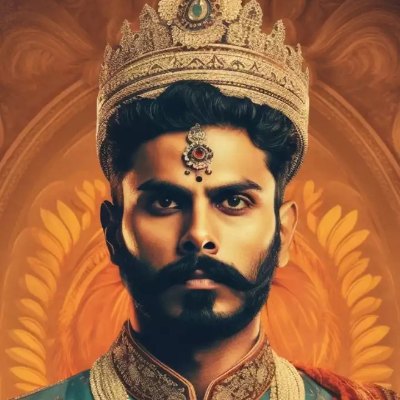
Nriga — King of the Solar Dynasty, Sovereign of Unrivalled Charity, and the Cursed Lizard Liberated by Krishna
Nriga · Son of Vaivasvata Manu · The Lizard King
Nriga is one of the primary sons of Vaivasvata Manu, the presiding Manu of the current cosmic epoch and the great progenitor-patriarch from whom all present human lineages descend according to the Puranic scheme. Vaivasvata Manu, also called Sraddhadeva, was himself the son of Vivasvat the sun god, placing Nriga within the Solar Dynasty, the Suryavamsha. Nriga is celebrated in the Puranic tradition as a king of extraordinary charitable disposition who donated cows, land, and wealth on a scale unsurpassed among mortal sovereigns. Despite this immense accumulation of merit, a single inadvertent error in the administration of his charity resulted in a curse by which he was transformed into a giant lizard and confined within a dry well near the city of Dvaraka for an entire cosmic age, until he was liberated by direct physical contact with Krishna. His story is preserved in rich narrative detail in the Bhagavata Purana and the Mahabharata, and is one of the most frequently cited Puranic illustrations of the principle that good and ill karma cannot cancel each other but must each be experienced separately and in full.
✦ The Name
The name Nriga appears in the Puranic genealogical lists as a straightforward proper name without significant variant forms. It occurs in the enumerations of Vaivasvata Manu's sons across the Bhagavata Purana, Vishnu Purana, and Harivamsha without elaboration on its etymological derivation in the primary texts themselves. In later tradition he is sometimes referred to by the epithet the Lizard King in retelling of his narrative, though this is a descriptive identification rather than a formal name found in the Sanskrit sources.
✦ Lineage
- Father: Vaivasvata Manu, also called Sraddhadeva, the seventh Manu in the Puranic cosmic scheme, son of Vivasvat the sun god, and the progenitor-patriarch of all human lineages in the present epoch.
- Mother: Sraddha, the wife of Vaivasvata Manu, named in the Bhagavata Purana and related genealogical accounts.
- Brothers: Ikshvaku, founder of the Ikshvaku dynasty and the royal line of Ayodhya from which the solar-lineage kings of the epics descend; Dhrishta, ancestor of the Dharstaka clan whose descendants attained Brahmana standing; Dishta, the seer associated with the Angiras episode and the ancestor of the Vaishali dynastic line; Narishyanta, whose line eventually produced the Agniveshya Brahmana gotra; Saryati, Pranshu, Nabhaga, Karusha, and Prishadhra, all sons of Vaivasvata Manu recorded in the Puranic genealogical lists.
- Son: Sumati, named in the Bhagavata Purana as Nriga's son and the next link in his dynastic succession.
- Later descendants: The Bhagavata Purana traces the succession from Sumati through Jyotis, then Vasu, then Pratika, after whom the line is not extended further in the surviving Puranic accounts consulted.
✦ Nriga as the Sovereign of Charity
Both the Bhagavata Purana and the Mahabharata establish Nriga at the outset of his narrative as a king of unparalleled generosity. He is described as having donated cows by the millions, each cow carefully selected and adorned before being given to Brahmanas. He also gave land, gold, and other wealth on a scale that the texts present as exceeding any other mortal sovereign of his age. This accumulated merit forms the essential backdrop against which his subsequent curse and its eventual resolution must be understood: the narrative depends on the reader grasping that Nriga was not a sinner or a negligent king but a sovereign whose entire life was devoted to righteous giving. The single flaw in his vast edifice of charity was therefore all the more theologically significant precisely because of how small it was relative to the whole.
✦ The Stray Cow: The Error and Its Consequences
The episode that defined Nriga's fate is recorded in nearly identical form in the Bhagavata Purana, tenth canto, sixty-fourth chapter, and in the Anushasana Parva of the Mahabharata. Among the millions of cows Nriga had donated over his lifetime, one cow that had been gifted to an elderly Brahmana strayed from that Brahmana's household and wandered back into the royal herds. The king's administrators, unaware of the cow's prior gifted status, included it in a subsequent donation, and Nriga unknowingly gave the same cow a second time to a different Brahmana.
When the two Brahmanas encountered one another and each recognised the cow as belonging to him, a dispute broke out between them. They brought their grievance before King Nriga, framing the matter in the gravest possible terms: to give away something previously donated to a holy man amounted to reclaiming a gift from a Brahmana, one of the most serious transgressions in the Dharmashastra framework. Nriga was deeply distressed. He acknowledged that the error, however unintentional, had occurred, and he offered each Brahmana one hundred thousand superior cows as compensation in exchange for their releasing their claim to the disputed one. Both Brahmanas refused. The texts record that they departed in anger without accepting the king's offer, leaving the matter unresolved and the transgression without remediation.
✦ The Judgment of Yamaraja and the Curse
When Nriga died and was brought before Yamaraja, the lord of dharmic retribution, he was asked a question that the Bhagavata Purana presents as central to the theological meaning of the entire episode. Yamaraja asked Nriga whether he wished to experience first the fruits of his vast accumulated merit, or first the consequence of his single unresolved sin. Nriga chose to exhaust the sin first. He was accordingly sent back to the mortal realm in the form of a colossal lizard, confined within a dry well in the region of Dvaraka, there to remain through an immense span of time until the accumulated weight of the transgression was expiated and a liberating force of sufficient potency arrived to release him.
The Bhagavata Purana is precise on the theological point that Yamaraja's question itself embodied: the merits and the sin were not set against each other for cancellation. They were treated as entirely separate accounts, each requiring its own complete experience. The mountain of good karma Nriga had accumulated across his reign remained entirely intact and awaiting him; it could not, however, absorb or neutralise the outstanding wrong. This principle, that pious and impious acts produce their respective results independently and cannot offset one another, is the explicit lesson the text draws from Nriga's fate.
✦ The Liberation by Krishna
The Bhagavata Purana places the liberation of Nriga in the Dvapara Yuga, during the period of Krishna's residence at Dvaraka. A group of young Yadava princes, including Samba and Pradyumna, came upon a large dry well in the course of their activities and discovered within it a gigantic lizard of unusual appearance. They attempted to lift the creature out with ropes but were unable to do so. The princes then went to Krishna and reported what they had found.
Krishna accompanied them to the well and reached down into it, extending his hand to the lizard. The moment the creature was touched by Krishna's hand, the curse was broken. The lizard's form dissolved and in its place stood a luminous celestial figure, identified as the liberated Nriga. The Bhagavata Purana records that Nriga, now restored to his divine form, offered praise to Krishna, recounted the circumstances of his transgression and his long confinement, and then ascended to the heavenly realms to enjoy the fruits of his accumulated merit, which had awaited him undisturbed throughout the entire duration of his punishment.
The Mahabharata version of this episode, found in the Anushasana Parva, presents the core narrative in consistent alignment with the Bhagavata Purana account, though the two texts differ in certain narrative details and in the degree of elaboration given to different elements of the story.
✦ Textual Variants and Inconsistencies
The two principal accounts of Nriga's episode, in the Bhagavata Purana and the Mahabharata, are in substantial agreement on the core facts: the unintentional double-donation of a cow, the refusal of both Brahmanas to accept compensation, the post-death judgment by Yamaraja, the choice to experience the sin first, the transformation into a lizard confined in a well, and the eventual liberation by Krishna. Minor differences exist between the two in narrative framing and in which Yadava princes are named as discovering the well, but these do not constitute contradictions on any theologically or genealogically significant point.
In the genealogical lists of Vaivasvata Manu's sons, Nriga appears consistently across the Bhagavata Purana, Vishnu Purana, and Harivamsha. The roster of Manu's sons varies modestly between texts in the names and number of brothers listed alongside Nriga, which is consistent with the general character of Puranic genealogical transmission and does not affect Nriga's own position as a son of Manu.
✦ Theological Significance
The story of Nriga is among the most explicitly didactic narratives in the Bhagavata Purana. The text itself, through the voice of Krishna addressing the assembled Yadavas after Nriga's liberation, draws out the lesson directly: that even a sovereign who gave away wealth equivalent to entire worlds cannot avoid the consequence of a single unresolved wrong done to a Brahmana or to the property of a Brahmana. The episode is positioned in the Bhagavata Purana not as a tale of divine punishment for wickedness but as a far more nuanced and therefore more unsettling warning: that the machinery of karma is precise, impartial, and entirely independent of the overall moral balance sheet of a lifetime. Nriga's incalculable merit was preserved in full; it merely could not protect him from the separate and complete experience of his single sin.
The narrative also functions within the Bhagavata Purana's broader theological framework as a demonstration of the unique liberating power of Krishna. The confinement that had persisted across an entire cosmic age was dissolved instantaneously by Krishna's direct physical touch. This contrast between the immovable weight of karmic consequence on the one hand and the immediate, effortless liberation conferred by divine contact on the other is a structurally important element of the Bhagavata Purana's devotional theology.
✦ Connection to the Wider Genealogy
Nriga belongs to the first post-flood generation of the Solar Dynasty, born of Vaivasvata Manu, the seventh and presiding Manu of the current Manvantara. His brother Ikshvaku founded the principal Ayodhya line of the Solar Dynasty, the branch most extensively narrated in the Ramayana and Mahabharata. Nriga's own dynastic line, running through Sumati, Jyotis, Vasu, and Pratika, constitutes a collateral branch of the Solar Dynasty that does not generate the great dynastic narratives of the epic tradition but is recorded as a legitimate continuation of Manu's descent in the Bhagavata Purana. Within the Solar Dynasty's first generation, Nriga stands alongside his brothers as one of the several founding ancestors of the various branches through which Vaivasvata Manu's line spread across the early world; his lasting prominence in the tradition, however, derives not from his dynastic descendants but from the narrative of his curse and liberation, which gave him a fame in the Puranic and devotional literature that far outlasted the memory of his royal line.
✦ References
Primary Sources
- Bhagavata Purana, Canto 10, Chapter 64: The fullest Puranic account of the Nriga episode; narrates the double donation of the cow, the dispute between the two Brahmanas, Nriga's offer of compensation and its refusal, the judgment of Yamaraja, the transformation into a lizard, the discovery by the Yadava princes, and the liberation by Krishna, followed by Krishna's address to the assembled Yadavas on the theological lesson of the episode.
- Mahabharata, Anushasana Parva, Chapter 6: The epic's parallel account of the Nriga narrative, consistent with the Bhagavata Purana on all major points and providing an independent corroboration of the episode within the Itihasa literature.
- Bhagavata Purana, Canto 9, Chapter 2: Genealogical source naming Nriga among the sons of Vaivasvata Manu and recording the dynastic succession through Sumati, Jyotis, Vasu, and Pratika.
- Vishnu Purana, Book 4, Chapter 1: Lists Nriga among the sons of Vaivasvata Manu and provides parallel genealogical context for his place in the Solar Dynasty's first generation.
- Harivamsha (appendix to the Mahabharata), genealogical sections: Records Nriga among the sons of Vaivasvata Manu, consistent with the Puranic accounts.
Modern Reference Works
- Mani, Vettam. Puranic Encyclopaedia. Motilal Banarsidass, 1975: Provides a concise entry for Nriga covering his genealogical position, the core narrative of the double donation and curse, and the liberation by Krishna.
- Wisdomlib, definition entry for Nriga: Aggregates references to Nriga across Puranic and epic sources and provides cross-references to the Bhagavata Purana and Mahabharata passages relevant to this figure.