
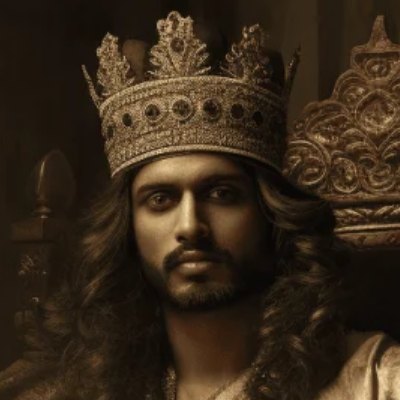
About
Dishta — Son of Vaivasvata Manu and Progenitor of the Nabhanedishta Line
Dishta · Drishta · Dishtа · Suryavanshi
Dishta is a king of the solar dynasty, recorded in the Puranic genealogical tradition as one of the ten sons of Vaivasvata Manu, the seventh Manu and progenitor of the current human race. Vaivasvata Manu, also known as Shraddhadeva and Satyavrata, was the son of Vivasvan the sun-god and his wife Saranyu, and is the founding ancestor of all the solar dynastic lines of the present age. Dishta appears in the genealogical lists of the Bhagavata Purana, the Vishnu Purana, the Markandeya Purana, and the Shiva Purana among the sons of Vaivasvata Manu, and is the progenitor of a distinct sub-branch of the solar line that descended through his son Nabhaga — known in the tradition as Nabhanedishta to distinguish him from his uncle of the same name, who was a separate son of Manu — and continued through several further generations before the Bhagavata Purana closes its account of the line at Vivimshati. Dishta's line is notable for the varna transition recorded at its second generation, his son Nabhaga having adopted the occupational duties of a vaishya rather than continuing in the kshatriya royal tradition of his father.
✦ The Name
The name Dishta is derived from a Sanskrit root conveying the sense of that which is directed, appointed, assigned, or fated. The name carries the implication of one who is destined or pointed toward a particular purpose, consistent with the broader Puranic convention of naming the sons of Manu with names of auspicious or fateful import. The name is also rendered as Drishta in some manuscript traditions, though Dishta is the form most consistently attested in the principal Puranic sources. The dynastic epithet Suryavanshi, meaning one of the solar race, applies to Dishta by virtue of his descent from Vivasvan the sun-god through Vaivasvata Manu.
✦ Lineage
- Paternal grandfather: Vivasvan — the sun-god, also known as Surya and Aditya, son of the sage Kashyapa and his wife Aditi; divine progenitor of the entire solar dynasty.
- Father: Vaivasvata Manu — the seventh Manu, also called Shraddhadeva and Satyavrata, son of Vivasvan and his wife Saranyu; progenitor of the current human race and founding ancestor of all solar dynastic lines of the present age. The Bhagavata Purana records that Manu, having first obtained a daughter named Ila through a sacrificial rite performed for Mitra and Varuna, subsequently performed a century of austerities on the bank of the Yamuna and worshipped Vishnu, from which worship ten sons were born to him, all described as resembling him in qualities.
- Brothers: Ikshvaku — eldest son of Manu and founder of the principal Ikshvaku solar line from which the kings of Ayodhya descended, including Rama; Nriga — son of Manu from whom a sub-line through Sumati, Bhutajyoti, and Vasu descended; Dhrishta — son of Manu from whom a kshatriya clan arose that subsequently became brahminical; Sharyati — son of Manu of independent narrative significance; Narishyanta — son of Manu from whom the line through Citrasena and the successive kings down to Agniveshya, an incarnation of the fire-god Agni, descended; Karusha — son of Manu from whom the Karusha clan of kshatriyas arose; Prishadhra — son of Manu who, having slain his preceptor's cow by mistake, was cursed to become a shudra; Nabhaga — son of Manu who founded a separate royal sub-line, distinct from the Nabhaga who is Dishta's son; Kavi — youngest son of Manu, described as a great devotee of Vishnu from childhood.
- Son: Nabhaga, known as Nabhanedishta — Dishta's son, who bore the same name as his uncle Nabhaga, a direct son of Manu. To distinguish father's brother from brother's son, the tradition designates Dishta's son as Nabhanedishta, meaning the Nabhaga born of Dishta. This son adopted the occupational duties of a vaishya rather than those of a kshatriya, marking a varna transition at the very first generation of Dishta's line. His descendants continued through Bhalandana, Vatsapriti, Pramshu, Pramati, Khanitra, Cakshusha, and Vivimshati.
✦ Dishta Among the Sons of Manu
The Bhagavata Purana names Dishta consistently among the sons of Vaivasvata Manu across its genealogical chapters. The Vishnu Purana likewise includes him in its enumeration of Manu's sons in Book IV, Chapter I. The Markandeya Purana and the Shiva Purana also include his name in their respective son-lists, though with the minor spelling and positional variations characteristic of the different Puranic traditions. No primary source assigns Dishta any independent narrative episode, named spouse, or personal achievement beyond his position as a son of Manu and the father of Nabhaga. His significance in the tradition is therefore entirely genealogical — he is the ancestor through whom a distinct sub-branch of the solar line was established, and through whose son the notable varna transition to vaishya occupational duty was recorded.
✦ Textual Variants and Inconsistencies
The principal source of confusion around Dishta in the Puranic literature arises not from uncertainty about his own identity but from the naming overlap created when he named his son Nabhaga, the same name borne by a separate son of Manu. The Bhagavata Purana addresses this directly at Skandha IX, Chapter 2, verse 23, explicitly stating that the Nabhaga who is the son of Dishta is a different figure from the Nabhaga described elsewhere in the same text as a son of Manu. The disambiguating compound Nabhanedishta, also rendered Nabhagarishta and Nabhagadishta in different manuscript traditions, encodes the paternal connection in the name itself and is the tradition's own solution to the homonymic confusion. The name Dishta itself is occasionally rendered as Drishta in certain manuscript lines, though this appears to be an orthographic variation rather than a distinct name. The Vishnu Purana uses the form Nedishtha in certain passages when referring to the son of Dishta, which is another variant of the same disambiguating compound.
✦ Connection to the Wider Genealogy
Dishta belongs to the first generation of the solar dynasty as constituted in the present age, standing alongside his brothers as one of the ten sons through whom Vaivasvata Manu distributed the inheritance of the solar line at the opening of the current human era. His own line, while beginning as a royal kshatriya sub-branch in the manner of his brothers' lines, takes an unusual early turn in that his immediate son Nabhaga adopted vaishya occupational duties, making the Dishta sub-line one of several recorded in the Bhagavata Purana where Manu's descendants crossed varna boundaries. This is presented in the text not as a transgression but as an illustration of the principle that varna is determined by quality and occupation rather than by birth alone, the same principle cited in connection with Dhrishta's descendants becoming brahmanas and the Narishyanta line's terminal figure Agniveshya founding a brahminical dynasty. The line descending from Dishta through Nabhaga continued for eight further generations to Vivimshati, at which point the Bhagavata Purana closes its account of this sub-branch without extending it further.
✦ References
- Bhagavata Purana, Skandha IX, Chapters 1 and 2: Primary source naming Dishta among the sons of Vaivasvata Manu and recording his son Nabhaga at verse 23, with the explicit note distinguishing this Nabhaga from the separately named Nabhaga who is a direct son of Manu.
- Vishnu Purana, Book IV, Chapter I: Names Dishta among the sons of Vaivasvata Manu; uses the variant form Nedishtha when referring to Dishta's son in the context of the disambiguation.
- Shiva Purana, Vayaviya Samhita, Chapter 36: Includes Dishta in its list of the sons of Vaivasvata Manu.
- Markandeya Purana: Includes Dishta among the sons of Manu in its genealogical account of the Vaivasvata Manvantara.
- Vettam Mani, Puranic Encyclopaedia: Secondary reference compiling entries on Dishta and the two figures named Nabhaga, with citations useful for navigating the homonymic overlap between Manu's son and Dishta's son of the same name.
- V. S. Agrawala, Matsya Purana — A Study: Modern secondary work on solar dynasty genealogies; consulted for contextualisation of Dishta's position within the broader structure of Manu's descendants and the varna transition recorded in his line.