
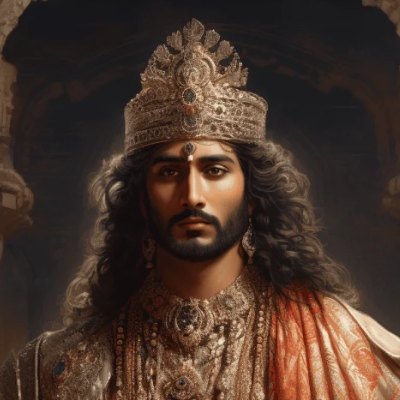
About
Nabhaga — Son of Dishta and Progenitor of the Vaishya Sub-Line
Nabhaga · Nabhanedishta · Nabhagarishta · Nabhagadishta · Nedishtha · Suryavanshi
Nabhaga, known in the tradition as Nabhanedishta to distinguish him from his uncle of the same name, is a figure of the solar dynasty recorded in the Bhagavata Purana as the son of Dishta and the grandson of Vaivasvata Manu, the seventh Manu and progenitor of the current human race. Dishta was one of the ten sons born to Vaivasvata Manu — also known as Shraddhadeva and Satyavrata, son of Vivasvan the sun-god — following a century of austerities performed on the bank of the Yamuna and subsequent worship of Vishnu. Nabhaga is notable within the Puranic genealogical tradition primarily for two reasons: first, for the naming confusion his existence creates with his uncle Nabhaga, a separate direct son of Vaivasvata Manu, which the Bhagavata Purana itself explicitly acknowledges and addresses; and second, for the varna transition recorded at his generation, he having adopted the occupational duties of a vaishya rather than continuing in the kshatriya royal tradition of his father Dishta. He appears principally in the Bhagavata Purana at Skandha IX, Chapter 2, and is the progenitor of a line continuing through Bhalandana, Vatsapriti, Pramshu, Pramati, Khanitra, Cakshusha, and Vivimshati.
✦ The Names
The personal name Nabhaga is of Sanskrit origin and is generally understood to derive from a root relating to the navel or centre, nabha, with the compound conveying a sense of centrality, eminence, or one who is of the innermost. The name was borne by at least two distinct figures in connection with Vaivasvata Manu — this Nabhaga who is the son of Dishta, and a separate Nabhaga who is a direct son of Manu — and the Puranic tradition developed several disambiguating designations to keep the two apart. The most widely used of these is Nabhanedishta, a compound encoding the paternal connection directly: it means the Nabhaga born of Dishta, with the Dishta element anchoring the compound and identifying this figure as the grandson of Manu through the Dishta line rather than a son of Manu in his own right. The form Nabhagarishta appears in certain manuscript traditions and carries a similar disambiguating function. The Vishnu Purana uses the form Nedishtha in related passages. The compound name Nabhagadishta, meaning the Nabhaga of Dishta, is yet another variant of the same identifying tradition. All of these forms refer to the same individual and serve the same purpose of resolving the homonymic overlap created when Dishta named his son after his own brother.
✦ Lineage
- Paternal grandfather: Vaivasvata Manu — the seventh Manu, also called Shraddhadeva and Satyavrata, son of Vivasvan the sun-god and his wife Saranyu; progenitor of the current human race and founding ancestor of all solar dynastic lines of the present age.
- Father: Dishta — one of the ten sons of Vaivasvata Manu, a king of the solar dynasty and the progenitor of this sub-branch of the Manu lineage. Dishta is recorded in the Bhagavata Purana, Vishnu Purana, Shiva Purana, and Markandeya Purana as a son of Manu, though no primary source assigns him any independent narrative episode beyond his position in the succession.
- Paternal uncle: Nabhaga — a separate direct son of Vaivasvata Manu who bore the same personal name as this figure and founded his own distinct royal sub-line. The Bhagavata Purana explicitly distinguishes the two at Skandha IX, Chapter 2, verse 23, noting that the Nabhaga son of Dishta is different from the Nabhaga described elsewhere in the same text as a son of Manu.
- Son: Bhalandana — the immediate successor of Nabhaga in the Dishta sub-line, confirmed at Bhagavata Purana IX.2.23–24 as the son of this Nabhaga and the next link in the descent toward Vivimshati.
- Descendants in succession: Bhalandana → Vatsapriti → Pramshu → Pramati → Khanitra → Cakshusha → Vivimshati. The Bhagavata Purana records no independent narrative episode, named spouse, or personal achievement for any of these six kings beyond their position in the succession.
✦ The Varna Transition
The Bhagavata Purana records at Skandha IX, Chapter 2, verse 23 that Nabhaga, son of Dishta, adopted the occupational duties of a vaishya rather than those of a kshatriya. This is presented not as a fall or transgression but as a natural consequence of the principle that varna is determined by quality and conduct rather than by the accident of birth. The commentary tradition associated with this passage, drawing on the principle stated by Narada Muni at Bhagavata Purana VII.11.35, uses the example of Nabhaga explicitly to illustrate that even within the same family, born of a kshatriya father who was himself the son of Manu, different offspring may properly belong to different varnas according to their innate qualities and chosen ways of life. Nabhaga's adoption of vaishya duties is thus presented as a legitimate and religiously sanctioned transition, placing the Dishta sub-line alongside the line of Manu's son Dhrishta — whose kshatriya descendants became brahmanas — and the line of Narishyanta — whose terminal figure Agniveshya founded a brahminical dynasty — as examples of varna transition within Manu's extended family in the Puranic record.
✦ Textual Variants and Inconsistencies
The primary textual complexity surrounding this figure is the homonymic overlap with his uncle, and the variety of disambiguating compound names deployed across manuscript traditions to resolve it. The Bhagavata Purana itself is the clearest primary source on the distinction, marking the two figures explicitly within the same chapter. The Vishnu Purana refers to the son of Dishta under the form Nedishtha, which conflates the disambiguating function into a shortened compound. Certain later Puranic son-lists of Vaivasvata Manu include Nabhanedishta or Nabhagarishta as a name in the list of Manu's own sons, which creates the appearance of a third Nabhaga figure but is most plausibly understood as a scribal or editorial conflation of the grandson with the generation of sons, prompted by the prominence of the disambiguating name. The Bhagavata Purana's own internal note at IX.2.23 is the most authoritative primary resolution of this complexity and is the basis on which this profile treats Nabhaga as the son of Dishta and the grandson of Manu.
✦ Connection to the Wider Genealogy
Nabhaga occupies the second generation of the Dishta sub-line and the third generation of the solar dynasty as constituted in the present age, counting from Vivasvan. Through his son Bhalandana the line continued for six further generations to Vivimshati, at which point the Bhagavata Purana closes its account without extending it further. His line is one of several sub-branches of the solar dynasty established through the sons of Manu, running parallel to the principal Ikshvaku line of Ayodhya, the Narishyanta line ending in Agniveshya, the Nriga line, the Dhrishta line, and the lines of Sharyati, Karusha, and the other sons of Manu. The varna transition recorded at Nabhaga's generation means that his line, unlike the Ikshvaku royal succession, did not continue as a kshatriya dynasty, though the Bhagavata Purana records no point at which the line ceased entirely — it simply closes the account at Vivimshati without further comment.
✦ References
- Bhagavata Purana, Skandha IX, Chapter 2, verses 23–24: Primary source for Nabhaga as the son of Dishta; records the varna transition to vaishya occupational duty, names Bhalandana as his son, and explicitly distinguishes this Nabhaga from the Nabhaga who is a direct son of Manu.
- Bhagavata Purana, Skandha VII, Chapter 11, verse 35: Records the principle attributed to Narada Muni that varna is determined by innate quality and occupation; cited in commentary on Nabhaga's vaishya transition as the doctrinal basis for understanding it as legitimate.
- Vishnu Purana, Book IV, Chapter I: Refers to the son of Dishta under the variant form Nedishtha; consulted to confirm the identification across both primary Puranic sources.
- Bhagavata Purana, Skandha VIII, Chapter 13, verses 2–3: Contains a separate reference to a Nabhaga among the sons of Manu; consulted to confirm that this is the distinct paternal-uncle figure and not the son of Dishta.
- Vettam Mani, Puranic Encyclopaedia: Secondary reference compiling entries on both figures named Nabhaga with citations to the relevant Puranic passages; useful for navigating the homonymic overlap and the variant disambiguating name-forms across sources.
- V. S. Agrawala, Matsya Purana — A Study: Modern secondary work on solar dynasty genealogies; consulted for contextualisation of Nabhaga's position within the Dishta sub-line and the broader pattern of varna transitions among Manu's descendants.