
About
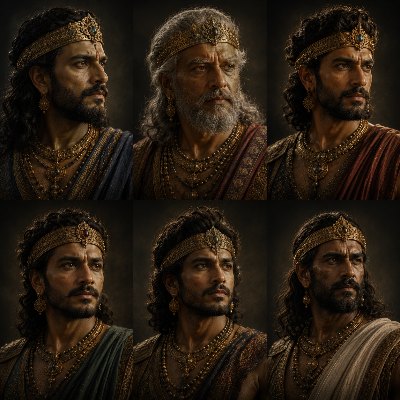
The Kings of Vaishali — Hemachandra to Sumati
Hemachandra · Suchandra · Dhumraksha · Srinjaya · Sahadeva · Krishasva · Somadatta · Janamejaya · Pramati · Sumati
This profile covers ten successive kings of the Solar dynasty (Suryavamsha), belonging to the Dishta branch of the line descending from Vaivasvata Manu, the progenitor of the present age. These kings ruled the city of Vaishali, founded by their ancestor Vishala — son of Trinabindu, himself a celebrated Solar king who married Alambusha the Apsara — and form the continuation of the Dishta Solar line from Vishala's son Hemachandra through to Sumati, the last prominently named king of this dynastic block in the primary sources. The majority of these kings are recorded only as names in the genealogical sequences of the Vishnu Purana, the Bhagavata Purana, and the Harivamsa, with no individual narrative episodes preserved. One king in this sequence — Somadatta — is distinguished by a specific act of religious observance attested in the primary sources and is treated in greater detail within this profile.
✦ The Dynastic Sequence
- Hemachandra: Son of Vishala, the founder of Vaishali, and his immediate successor as ruler of the city. His name means golden moon — hema meaning gold and chandra meaning moon. No narrative episodes are recorded for him in any primary source beyond his position in the dynastic sequence. He was succeeded by his son Suchandra.
- Suchandra: Son of Hemachandra. His name carries the meaning of beautiful moon or auspicious moon — su meaning good or beautiful and chandra meaning moon. No individual episodes are recorded in the primary sources. He was succeeded by his son Dhumraksha.
- Dhumraksha: Son of Suchandra. His name means smoke-eyed or grey-eyed — dhumra meaning smoke or grey and aksha meaning eye. The same name is borne by a rakshasa commander in the Valmiki Ramayana who fought against Rama's forces at Lanka, but that figure is entirely distinct from this Solar king of Vaishali and the two should not be conflated. No narrative material specific to this king is recorded in the primary sources. He was succeeded by his son Srinjaya.
- Srinjaya: Son of Dhumraksha. His name is associated with victory in battle. No individual narrative episodes are recorded beyond his position in the dynastic sequence. He was succeeded by his son Sahadeva.
- Sahadeva: Son of Srinjaya. His name means one who conquers along with the gods — saha meaning together or along with and deva meaning god or divine being. The same name is borne by the youngest of the five Pandava brothers in the Mahabharata, but that figure belongs to an entirely different lineage and tradition and should not be confused with this king of Vaishali. No narrative episodes are recorded for this king. He was succeeded by his son Krishasva.
- Krishasva: Son of Sahadeva. His name means black horse or lean horse — krisha meaning lean or black and ashva meaning horse. No individual narrative material is recorded in the primary sources beyond his position in the sequence. He was succeeded by his son Somadatta.
✦ Somadatta — The Ashvamedha King
Somadatta, son of Krishasva, is the most distinctly attested king in this sequence. His name means one given by Soma — soma being the sacred ritual drink of the Vedic tradition associated with the moon, and datta meaning given or gifted. He is recorded in the primary sources as a king of exceptional religious dedication who performed numerous Ashvamedha sacrifices during his reign.
The Ashvamedha — the horse sacrifice — was the most prestigious of all Vedic royal rituals, reserved exclusively for kings of supreme power and universal ambition. Its performance required not only vast material resources but the uncontested sovereignty of the sponsoring king over a wide territory, since the sacrificial horse was released to wander freely for a full year and any kingdom that failed to honour its passage was considered to have challenged the sponsoring king's supremacy. A king who performed the Ashvamedha even once was elevated in Puranic estimation to the highest rank of royal sanctity; a king credited with performing it numerous times occupied an exceptional position in the tradition's record of righteous rulers.
The primary sources do not elaborate the specific details of Somadatta's Ashvamedha performances — the number of sacrifices, the sages who officiated, or the territories through which the sacrificial horse passed — but the specific attribution of multiple Ashvamedha performances to this king distinguishes him clearly from the other unnamed and unepisoded rulers of Vaishali in this sequence. He was succeeded by his son Janamejaya.
✦ The Concluding Kings
- Janamejaya: Son of Somadatta. His name means one who conquers by birth or one whose victory is born — jana meaning birth or people and jaya meaning victory. The same name is borne by the Kuru king who performed the great snake sacrifice in the Mahabharata, but that figure belongs to an entirely different lineage and should not be confused with this king of Vaishali. No narrative episodes are recorded for this king of the Vaishali line. He was succeeded by his son Pramati.
- Pramati: Son of Janamejaya. His name means one of great wisdom or great intelligence — pra being an intensifying prefix and mati meaning mind, wisdom, or thought. No individual narrative material is recorded in the primary sources. He was succeeded by his son Sumati.
- Sumati: Son of Pramati. His name means one of good or excellent mind — su meaning good or excellent and mati meaning mind or wisdom. He is recorded as the last prominently named king of this dynastic block in the primary sources. The Vishnu Purana and Bhagavata Purana do not elaborate further on his reign or deeds beyond recording his position in the sequence as son of Pramati.
✦ Textual Variants and Recension Differences
The genealogical lists of the Vishnu Purana, Bhagavata Purana, and Harivamsa are broadly consistent in recording this sequence of Vaishali kings, though minor variations in name spelling and occasional differences in the ordering of one or two kings appear across recensions. The sequence as presented in this profile follows the most complete and internally consistent attested list. The attribution of Ashvamedha sacrifices to Somadatta is consistent across sources and is not subject to recension dispute. The names Dhumraksha, Sahadeva, and Janamejaya — shared with figures in other Puranic and epic contexts — are confirmed in the primary sources as distinct individuals belonging specifically to the Vaishali Solar line and should be treated accordingly.
✦ Dynastic Significance
These ten kings represent the full flowering and gradual conclusion of the Vaishali branch of the Dishta Solar line as recorded in the primary Puranic sources. They ruled the city established by their ancestor Vishala and maintained the Solar dynastic tradition through ten successive generations after him. The city of Vaishali, situated in the region corresponding to modern northern Bihar, carried the name and legacy of the Solar line's founder throughout this period. With Sumati, the primary sources bring this specific dynastic sequence to a close, and the Dishta branch of the Solar line recedes from the major genealogical narratives of the Puranic corpus.
✦ Connection to the Wider Genealogy
The full dynastic chain running through these ten kings connects upward through Vishala, Trinabindu, Budha, Vegavat, Bandhumat, Kevala, Nara, Sudhriti, Rajyavardhana, Dama, Narishyanta, Marutta, Avikshit, Karandhama, Khaninetra, Rambha, Vivimshati, Cakshusha, Khanitra, Pramati, Pramshu, Vatsapriti, Bhalandana, Nabhanedishta, Dishta, and Vaivasvata Manu — the progenitor of the present age. The same ancestor Trinabindu whose son Vishala founded Vaishali also had a daughter, Manini, whose marriage to the sage Pulastya produced the sage Vishrava, drawing this Solar royal line into genealogical connection with the lineage of Kubera and the principal figures of the Ramayana tradition.
✦ References
- Primary Sources
- Bhagavata Purana, Skandha 9 — principal genealogical source for the complete sequence from Hemachandra through Sumati; records each king by name as son of the preceding king and attributes Ashvamedha performances to Somadatta
- Vishnu Purana, Book 4 — parallel genealogical list for the same sequence; minor recension variants in name spellings noted against this source
- Harivamsa — supplementary Solar dynastic genealogy providing a third recension of this sequence for cross-referencing
- Valmiki Ramayana, Bala Kanda — establishes the foundational context of Vaishali as a Solar royal capital, providing the narrative framework within which these kings ruled
- Secondary Sources
- Vettam Mani, Puranic Encyclopaedia (1975), Motilal Banarsidass — reference entries for individual kings and cross-referencing of name duplications across the Puranic and epic traditions
- Wisdomlib — genealogical concept entries for the Vaishali Solar line — secondary reference aggregating Puranic textual material on this dynastic sequence and the significance of the Ashvamedha attribution to Somadatta