
About
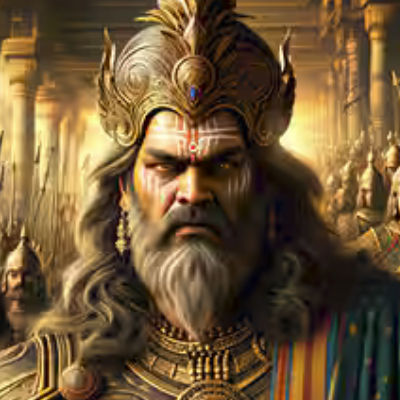
Ugrasena — Son of Ahuka, King of Mathura
Ugrasena · Ugrasena of Mathura · Ugrasena of the Kukura line · Augrasenि
Ugrasena is recorded in the Puranic and epic tradition as the younger son of Ahuka — tenth generation of the Kukura sub-clan and son of Punarvasu — and thus represents the eleventh generation of the Kukura line within the genealogical tree of the Yadu dynasty. The Yadu dynasty belongs to the lunar line (Chandravamsha) of Indian epic and Puranic tradition, descending through Chandra, Budha, Pururavas, Ayus, Nahusha, Yayati, and Yadu, from whom all Yadava clans derive their collective identity. Ugrasena was the king of Mathura, one of the most important cities in the Yadava political world, and his reign is defined in the Puranic narrative by three momentous events: his violent deposition and imprisonment by his own son Kamsa, his restoration to the throne by Krishna after Kamsa's death, and his reign over the Yadavas during the period of Jarasandha's invasions and the subsequent migration to Dwaraka. He appears extensively in the Bhagavata Purana, the Vishnu Purana, the Harivamsa, and the Mahabharata.
✦ The Name
Ugrasena is a Sanskrit compound formed from ugra, meaning fierce, powerful, or terrible, and sena, meaning army or host. The compound thus means one who commands a fierce or powerful army, a name of martial character appropriate to a king. The name carries no ironic or diminishing connotation in the primary sources despite Ugrasena's deposition by his own son — the texts treat the name as a straightforward royal epithet befitting his status as a legitimate king of Mathura. His descendants are sometimes referred to by the patronymic Augrasenि, meaning son or descendant of Ugrasena, applied most notably to Kamsa in some passages of the epic and Puranic literature.
✦ Lineage
- Father: Ahuka — tenth generation of the Kukura clan, son of Punarvasu, described in the Harivamsa as a figure of exceptional wealth and military stature who never travelled without a guard of ten thousand gold-adorned chariots. Ahuka is the common ancestor of both the line producing Devaki and the line producing Kamsa.
- Mother: A princess of Kashi — named in the Vishnu Purana and the Bhagavata Purana as the wife of Ahuka and mother of both Devaka and Ugrasena.
- Brother: Devaka — elder son of Ahuka, father of seven daughters including Devaki, the mother of Krishna. Devaka's line thus produces the divine birth while Ugrasena's line produces the principal adversary of that birth.
- Wife: The Harivamsa records that Ugrasena's wife was approached by a Gandharva named Drumila who took the form of Ugrasena and fathered Kamsa upon her. This account, specific to the Harivamsa, provides a supernatural explanation for Kamsa's exceptional ferocity and his estrangement from the dharmic qualities of his nominal father Ugrasena. The Bhagavata Purana does not include this episode and treats Kamsa straightforwardly as Ugrasena's son.
- Sons: The Bhagavata Purana records that Ugrasena fathered nine sons. The eldest was Kamsa, who became the king of Mathura after deposing Ugrasena, and who is the principal adversary of Krishna in the Puranic narrative. The remaining eight sons are named in the Bhagavata Purana at chapter 24, verses 24 and 25.
- Daughters: The Bhagavata Purana also records that Ugrasena had daughters, including Kamsavati and others named in the same passage, who were given in marriage to members of other Yadava families.
- Notable grandson: Kamsa's death at the hands of Krishna, and Ugrasena's subsequent restoration, place Ugrasena in the unusual position of outliving his eldest son and being reinstated to the throne he had been forcibly removed from.
✦ The Deposition and Imprisonment by Kamsa
The Bhagavata Purana and the Vishnu Purana record that Ugrasena's eldest son Kamsa, driven by arrogance and a celestial prophecy foretelling that the eighth child of Devaki — Ugrasena's niece through his brother Devaka — would bring about his death, seized power in Mathura through a palace coup. Kamsa imprisoned his own father Ugrasena, removed him from the throne, and declared himself the absolute ruler of Mathura. The Bhagavata Purana treats this act as a defining expression of Kamsa's adharmic nature — the violent overthrow of a rightful king and the imprisonment of one's own father being among the gravest transgressions within the Puranic ethical framework. Ugrasena remained imprisoned throughout the period of Kamsa's reign, which was marked by tyranny, the persecution of the Yadavas, and the repeated imprisonment of Devaki and Vasudeva as Kamsa sought to destroy Devaki's children before they could fulfil the prophecy.
✦ Restoration to the Throne by Krishna
The Bhagavata Purana records at chapter 45, verses 12 through 15 of the tenth skanda that after Krishna killed Kamsa in the wrestling arena of Mathura, he declined to assume the kingship himself and instead liberated Ugrasena from imprisonment and reinstated him as the rightful king of the Yadavas. The Bhagavata Purana presents Krishna's decision to restore Ugrasena rather than take the throne personally as an act of deference to the legitimate dynastic order and to the elder of his family, consistent with the dharmic principle that kingship belongs to the rightful hereditary ruler. Under Ugrasena's restored reign, Krishna and Balarama remained in Mathura as the effective military protectors of the Yadava people while Ugrasena held the formal royal authority.
✦ The Invasions of Jarasandha and the Migration to Dwaraka
Following Kamsa's death, Mathura faced repeated and devastating military invasions by Jarasandha, the king of Magadha and Kamsa's father-in-law, who sought vengeance for his son-in-law's killing. The Bhagavata Purana records at chapter 50, verses 40 through 44 of the tenth skanda that these invasions placed the Yadava population under severe and sustained military pressure. In response to this threat, Krishna arranged for the construction of the fortified island city of Dwaraka on the western coast and led the Yadava population in a mass migration from Mathura to this new stronghold. Ugrasena, as the restored king of the Yadavas, was part of this migration and continued to hold royal authority within the Yadava community at Dwaraka, where the Yadava confederation resettled and where the remaining narrative of the Bhagavata Purana's tenth skanda is largely set.
✦ Ugrasena in the Mahabharata
Ugrasena appears in the Mahabharata in several contexts connected to the Yadava political world and the events surrounding Krishna's life. The Sabha Parva of the Mahabharata, in its account of the Rajasuya sacrifice of Yudhishthira, references Ugrasena among the Yadava kings present at the assembly, acknowledging his status as the senior king of the Yadava confederation at Dwaraka. The Mahabharata's references to Ugrasena are generally consistent with the Puranic account of his restoration and his role as the nominal royal head of the Yadavas under Krishna's effective protection.
✦ The Harivamsa Account of Kamsa's Birth
The Harivamsa contains an episode, absent from the Bhagavata Purana, in which a Gandharva named Drumila assumed the form of Ugrasena and approached Ugrasena's wife, fathering Kamsa upon her. This account is offered in the Harivamsa as an explanation for why Kamsa possessed a nature so utterly opposed to the dharmic character of his nominal father Ugrasena, and why Kamsa showed none of the restraint or legitimacy expected of a king born into the Yadava royal line. This episode is specific to the Harivamsa tradition and is not corroborated by the Bhagavata Purana or the Vishnu Purana, which treat Kamsa without qualification as Ugrasena's biological son. The two accounts represent a genuine textual divergence in the treatment of Kamsa's origins.
✦ Textual Variants and Inconsistencies
Beyond the Harivamsa's supernatural account of Kamsa's birth, the primary textual variant affecting Ugrasena's genealogical position is the Harivamsa's insertion of Abhijit between Punarvasu and Ahuka in the preceding generation — a variant noted in the profiles of Punarvasu and Ahuka. In the Harivamsa's account, Ugrasena is therefore the grandson of Abhijit rather than the grandson of Punarvasu directly, a carried consequence of that earlier generational variant rather than a fresh inconsistency specific to Ugrasena. The Bhagavata Purana and Vishnu Purana are broadly consistent with each other in their treatment of Ugrasena's parentage, his children, and the major narrative events of his reign.
✦ Connection to the Wider Genealogy
Ugrasena represents the culminating political figure of the Kukura genealogical chain, standing as the king of Mathura and later of the Yadava community at Dwaraka through whom the long line from Kukura achieves its greatest historical and narrative prominence. Through his son Kamsa the line connects to the central conflict of the Bhagavata Purana's tenth skanda, and through his brother Devaka's daughter Devaki the same generation produces the mother of Krishna. The Kukura sub-clan, which began as one of several Yadava branch lineages tracing descent from the founding ancestor Kukura ten generations before Ugrasena, thus reaches its narrative apex in Ugrasena's generation through the intertwined stories of divine birth, tyranny, liberation, and restoration that define the Krishna narrative across the Puranic tradition.
✦ References
- Bhagavata Purana, Ninth Skanda, Chapter 24, verses 21–25: Names Ugrasena as the younger son of Ahuka and enumerates his nine sons including Kamsa and his daughters including Kamsavati.
- Bhagavata Purana, Tenth Skanda, Chapter 1, verses 30–35: Records Kamsa's deposition and imprisonment of Ugrasena following the celestial prophecy regarding Devaki's eighth child.
- Bhagavata Purana, Tenth Skanda, Chapter 45, verses 12–15: Records Krishna's liberation of Ugrasena from imprisonment and his reinstatement as the rightful king of the Yadavas following Kamsa's death.
- Bhagavata Purana, Tenth Skanda, Chapter 50, verses 40–44: Records the invasions of Jarasandha and the context of the Yadava migration from Mathura to Dwaraka during Ugrasena's restored reign.
- Vishnu Purana, Book Five, Chapter 1, verses 12–15: A supporting source for the account of Kamsa's usurpation and Ugrasena's imprisonment, broadly consistent with the Bhagavata Purana's version.
- Harivamsa, Harivamsha Parva, genealogical and narrative chapters: Contains the variant account of Kamsa's birth through the Gandharva Drumila's deception of Ugrasena's wife, absent from the Bhagavata and Vishnu Purana accounts, and provides additional narrative material on Ugrasena's political and military context.
- Mahabharata, Sabha Parva: References Ugrasena among the Yadava kings present at Yudhishthira's Rajasuya sacrifice, acknowledging his status as the senior royal figure of the Yadava confederation at Dwaraka.
- Puranic Encyclopaedia by Vettam Mani (1975): A modern reference work summarising Puranic and epic entries on Ugrasena, Kamsa, and their family, relevant for cross-checking names, the enumeration of Ugrasena's children, and the textual variants affecting his narrative.