
About
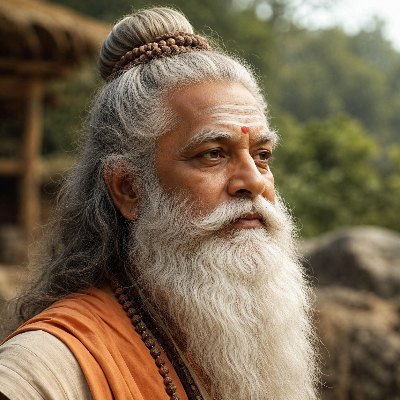
Valmiki — Sage, Author of the Ramayana, Protector of Sita and Guru of Lava and Kusha
Valmiki · Ratnakara (in later legend) · Adikavi ("First Poet") · Maharshi Valmiki · Prachetasa
Valmiki is the sage credited within the tradition as the composer of the Ramayana, the epic narrating the life of Rama, and is honoured as Adikavi, the first poet, for having given the world its first metrical shloka and its first mahakavya. Within the narrative of his own epic he also appears as a character: he shelters the exiled and repudiated Sita in his forest hermitage, raises her twin sons Lava and Kusha, teaches them the Ramayana as a recitation, and later testifies to Sita's purity before Rama's court in Ayodhya. He is discussed principally in the Bala Kanda and Uttara Kanda of the Valmiki Ramayana, with an extensive devotional and hagiographic biography developed in later texts such as the Adhyatma Ramayana, the Ananda Ramayana, and the Skanda Purana.
✦ The Name
The name Valmiki is derived from valmika, meaning an anthill or termite mound. The name commemorates the legend, recorded in later hagiographic sources rather than in the Valmiki Ramayana itself, that the sage remained motionless in meditation for so long that an anthill grew up and encased his body, after which he emerged and took this name. The title Adikavi, "the first poet," refers to his traditional standing as the originator of shloka metre and of the mahakavya form of Sanskrit poetry. The patronymic Prachetasa, "son of Prachetas," is used of him in some textual traditions, identifying his father as the sage Prachetas, though this affiliation is not uniform across all sources that discuss him.
✦ The Origin of the Shloka: The Kraunca-vadha Episode
The Bala Kanda of the Valmiki Ramayana narrates that the sage, while walking near the river Tamasa, witnessed a hunter kill one of a pair of krauncha birds (a type of curlew or crane) in the act of mating. Moved by grief at the surviving bird's lament, Valmiki spontaneously uttered a curse upon the hunter in a balanced, metrical utterance of equal quarters, which he recognised afterward as a new form of verse. This utterance is presented within the epic as the origin of the shloka metre. Shortly after, the god Brahma is said to have appeared to Valmiki and commissioned him to compose the full narrative of Rama's life in this new metre, providing him with the power to perceive events not directly witnessed. This commissioning frames the entire epic as composed at divine instruction, using the very metre born from Valmiki's spontaneous grief.
✦ Shelter of Sita and the Birth of Lava and Kusha
According to the Uttara Kanda, after Rama, yielding to public suspicion in Ayodhya regarding Sita's chastity during her captivity in Lanka, orders her abandonment despite her pregnancy, it is Valmiki who receives her into his forest hermitage on the banks of the Tamasa or Ganga. There Sita gives birth to twin sons, Lava and Kusha. Valmiki raises the boys within his ashram, and it is here that he composes and teaches them the Ramayana itself as an oral recitation, making the twins the first reciters of the epic that narrates their own parents' story, unknown to them at first as their own history.
✦ The Ashwamedha and Testimony Before Rama's Court
The Uttara Kanda further narrates that when Rama performs the Ashwamedha (horse sacrifice) at Ayodhya, Lava and Kusha are brought by Valmiki to recite the Ramayana before the assembled court, and Rama recognises the boys as his own sons through their resemblance and the content of the narrative. Valmiki then presents Sita before the court and vouches for her chastity during her period of separation from Rama. In response to continued public doubt, Sita calls upon the earth to receive her if her fidelity has been true, and the earth opens to take her in, ending the narrative of her life. Valmiki's testimony in this episode is presented as authoritative precisely because of his sagely standing and his direct knowledge as Sita's protector during her years of exile.
✦ Textual Variants and the Ratnakara Legend
A widely known devotional legend, absent from the Valmiki Ramayana itself, holds that Valmiki was originally a highway robber named Ratnakara who preyed on travellers to support his family. In this account, found in later texts such as the Adhyatma Ramayana and the Ananda Ramayana and elaborated further in regional devotional literature, the sage Narada encounters Ratnakara and questions whether his family, for whose sake he commits his crimes, will share the burden of his sin. On learning they will not, Ratnakara is stricken with remorse, abandons his former life, and undertakes prolonged meditation on the name of Rama, during which the anthill (valmika) forms over his body, giving him his new name and identity as Valmiki. Because this narrative does not appear within the Valmiki Ramayana's own text, it should be understood as a later hagiographic tradition built around the figure of the epic's author rather than as a claim made by the epic about itself. The two layers, the epic's own account of Valmiki as sage-poet commissioned by Brahma, and the later legend of his transformation from robber to sage, belong to distinct textual strata and are presented here as such.
✦ Theological and Literary Significance
Valmiki occupies a unique double position in the tradition, as both the composer of a scripture and a character acting within it, since the Ramayana itself narrates his sheltering of Sita and his role in the reunion of Rama with his sons. His title Adikavi marks him as the fountainhead of classical Sanskrit poetic tradition, and the krauncha episode is treated in later poetics and commentarial literature as the paradigmatic account of how aesthetic emotion, specifically grief, gives rise to formal poetic expression. His role as Sita's protector and character witness also places him within the epic as a figure of moral authority whose word is treated as sufficient to settle a matter of public doubt at the highest level of the kingdom.
✦ Connection to the Wider Genealogy
Valmiki is directly linked to the Ikshvaku solar line through his role as protector and guardian of Sita, wife of Rama of Ayodhya, and as the foster-guru of their twin sons Lava and Kusha, who succeed to portions of the Kosala kingdom and continue the Ikshvaku line through their own descendants. Though not himself a blood member of any royal dynasty, his hermitage functions as the site where the succession of Rama's line is preserved and publicly re-established after Sita's exile.
✦ References
- Valmiki Ramayana, Bala Kanda (Sarga 2): narrates the krauncha-vadha episode and the origin of the shloka metre, and Brahma's commissioning of the epic.
- Valmiki Ramayana, Uttara Kanda: narrates Sita's abandonment and shelter in Valmiki's ashram, the birth and upbringing of Lava and Kusha, their recitation of the Ramayana at the Ashwamedha, and Valmiki's testimony before Rama's court.
- Adhyatma Ramayana: a later devotional retelling that contributes elements of Valmiki's spiritual characterisation within the Rama-bhakti tradition.
- Ananda Ramayana: a later Puranic-style Ramayana text that contains an elaborated version of the Ratnakara-to-Valmiki transformation legend.
- Vettam Mani, Puranic Encyclopaedia: consulted for cross-referencing the Ratnakara legend and Valmiki's traditional biographical details against multiple source texts.
- Wisdomlib: consulted for etymological confirmation of the name Valmiki and its derivation from valmika.