
About
Padmavati — Queen of Mathura, Wife of Ugrasena, Mother of Kamsa
Padmavati · Padmāvatī · daughter of Satyaketu · queen consort of Mathura · mother of Kamsa
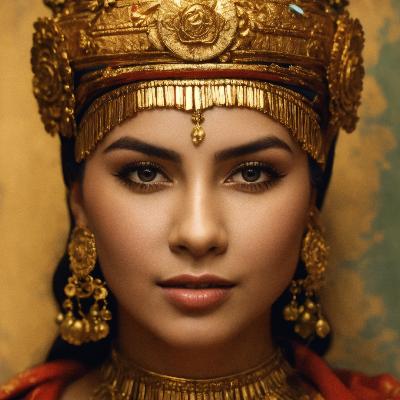
Padmavati is a figure in the Hindu Puranic tradition, identified in the Padma Purana's Srishti Khanda as the daughter of Satyaketu — the righteous king of the Vidarbha kingdom — and as the principal queen consort of Ugrasena, king of Mathura and ruler of the Kukura-Bhoja branch of the Yadava dynasty. She is identified across the Padma Purana as the mother of Kamsa — the tyrant king of Mathura and principal antagonist of Krishna's early life — whose demonic nature despite his royal Yadava birth is explained in the Padma Purana through a detailed and theologically significant narrative of deception on Mount Pushpavan, in which a shape-shifting demonic entity assumed Ugrasena's form and deceived Padmavati during her visit to her father's kingdom. Her narrative is attested principally in the Padma Purana Srishti Khanda Chapters 48 through 51, which constitute the most detailed primary source treatment of her life, her parentage, and the circumstances of Kamsa's conception. The Bhagavata Purana and the Harivamsha identify Kamsa as Ugrasena's son but handle the theological question of his demonic nature differently, making the Padma Purana account a significant cross-source variant to be noted. Padmavati herself is presented in the Padma Purana as a woman of great virtue, beauty, and righteous conduct whose life was transformed by an act of deception entirely beyond her agency.
✦ The Name
The name Padmavati is a Sanskrit feminine compound of padma — meaning lotus — and vati, the suffix indicating possession or association, giving the sense of "she who is of the lotus" or "the lotus-bearing one." The lotus in the Sanskrit and Puranic tradition is the supreme symbol of beauty, purity, and auspicious radiance — it rises from muddy water while remaining unstained, an image consistently applied to figures of exceptional virtue and grace. The Padma Purana Srishti Khanda Chapter 48 reinforces the lotus imagery directly in its description of Padmavati at birth — describing her as having eyes like lotuses and a face like a lotus, and as devoted to truthful behaviour — encoding her name's meaning into the very description of her person. The name is shared by several figures across the Puranic and regional tradition and requires source-specific identification in any genealogical reference.
✦ Lineage
- Father: Satyaketu — identified in the Padma Purana Srishti Khanda Chapter 48 verses 2 through 7 as a righteous and dignified king ruling in the holy country of Vidarbha; the Sanskrit text names him explicitly as satyaketura-dharmikaḥ — Satyaketu the righteous — and records that his longing to see his daughter after a long separation was the immediate cause of Padmavati's fateful visit to Vidarbha, during which the Pushpavan deception occurred.
- Husband: Ugrasena — king of Mathura and ruler of the Kukura-Bhoja branch of the Yadava dynasty of the Chandravamsha lunar lineage; father of Kamsa in the principal Puranic accounts; later imprisoned by his own son Kamsa when the latter staged a coup and seized the Mathura throne; subsequently liberated by Krishna after Kamsa's death and restored to his kingdom.
- Son: Kamsa — king of Mathura and the principal antagonist of Krishna's early life; identified in the Bhagavata Purana as the mortal incarnation of Kalanemi, a powerful Asura slain by Vishnu in a previous age; in the Padma Purana's account his demonic nature is explained through the circumstances of his conception by the demon Godila who deceived Padmavati by assuming Ugrasena's form; a tyrant of immense physical strength who imprisoned his sister Devaki and her husband Vasudeva and sought to destroy their children, having been warned by a divine voice that Devaki's eighth son would slay him; ultimately killed by Krishna — the eighth son of Devaki and Vasudeva and the eighth avatar of Vishnu — fulfilling the prophecy.
✦ The Deception on Mount Pushpavan
The defining narrative of Padmavati's life is recorded in the Padma Purana Srishti Khanda Chapters 48 through 51. After her marriage to Ugrasena and her establishment as queen of Mathura, Padmavati's father Satyaketu of Vidarbha, having not seen his daughter for a long time, sent word requesting her visit. Padmavati traveled to her father's kingdom in Vidarbha and was received with great joy. During her stay she went walking in a forest region near the capital known as Mount Pushpavan — a lush and beautiful mountain forest described in the text as a place of great natural splendour.
In this forest she encountered a powerful demonic entity identified in the Padma Purana as Godila — described across different recensions also as Dramila or Gobhila — a shape-shifting being of great magical power. The Padma Purana identifies Godila variously as a demonic follower of Kubera, the deity of wealth, or as an Asura king depending on the recension consulted. Struck by Padmavati's extraordinary beauty, Godila employed his powers of illusion — the faculty of maya — to assume the precise physical form, voice, manner, and appearance of Ugrasena, her husband, in every detail. Padmavati, completely deceived by the perfect imitation and believing her husband had traveled unexpectedly from Mathura to join her at her father's home, willingly embraced the figure she believed to be Ugrasena. The union that followed was entirely the result of this deception — Padmavati had no knowledge that the figure before her was not her husband.
After the encounter Godila abandoned his assumed form and revealed his true identity. The Padma Purana records Padmavati's response as one of profound shock, grief, and burning rage at the violation of her chastity through deception. She is described as fiercely cursing the demon — invoking destruction upon him for his act — while simultaneously being confronted with the reality that she had already conceived a child from the forced union. The text presents her response not as passive acceptance but as active moral condemnation of what had been done to her, her curse functioning as the assertion of her own righteousness against the demonic agency that had violated it.
The child conceived in these circumstances was Kamsa. The Padma Purana uses this origin narrative to explain the theological problem that occupied the tradition regarding Kamsa — why a figure of such extreme demonic violence and cruelty should have been born to righteous Yadava royalty. The answer the Padma Purana provides is that Kamsa's demonic nature derived not from Ugrasena's lineage but from his true biological father Godila, a being of Asura nature whose qualities were transmitted to the child. Padmavati's own virtue and righteousness are thereby preserved in the text — she is presented as a victim of deception rather than as the willing mother of a demon — while the narrative simultaneously accounts for Kamsa's character through his actual paternal origin.
✦ Padmavati and Kamsa
The Padma Purana records that Padmavati harboured deep awareness of the troubled circumstances of Kamsa's conception and his true paternal origin. As Kamsa grew and his violent, tyrannical nature became increasingly apparent, the disconnect between the righteous household of Ugrasena and the character of their acknowledged son was felt acutely. Regional and secondary traditions record that Padmavati predicted the destruction that Kamsa would bring upon the family and foresaw that he would ultimately be destroyed by a righteous member of the lineage — a prediction consistent with the divine voice prophecy that later warned Kamsa himself that Devaki's eighth son would slay him.
When Kamsa staged his coup against Ugrasena, imprisoning his father and seizing the Mathura throne, Padmavati's position as queen mother was rendered powerless. The Padma Purana presents her throughout as a figure of personal virtue caught within a chain of events initiated by an act of demonic deception over which she had no control and from which she could not escape, her tragedy being the particular Puranic tragedy of a righteous person whose life is redirected by the agency of a malevolent other.
✦ Textual Variants and Inconsistencies
The most significant textual inconsistency surrounding Padmavati is the divergence between the Padma Purana's account of Kamsa's conception and the accounts given in the Bhagavata Purana and the Harivamsha. The Bhagavata Purana — in its seventh canto's account of the Jaya-Vijaya cycle and in its tenth canto's Krishna narrative — identifies Kamsa as the mortal incarnation of Kalanemi, a powerful Asura who was slain by Vishnu and reborn as Kamsa to fulfil the cosmic cycle of Vishnu's engagement with his adversaries. In this theological framework Kamsa's demonic nature is explained through the reincarnation mechanism — the soul of Kalanemi entering Kamsa's body at birth — without any reference to a deceptive demonic conception. The Bhagavata Purana treats Kamsa as the biological son of Ugrasena without qualification. The Harivamsha similarly presents Kamsa as Ugrasena's son in its genealogical lists without the Pushpavan episode.
The Padma Purana and the Bhagavata Purana are therefore offering two distinct and irreconcilable explanations for the same theological problem — why Kamsa was demonic — through different mechanisms: biological paternity by a demon in the Padma Purana, and soul-reincarnation of a demon in the Bhagavata Purana. Both texts are Mahapuranas of the Hindu canonical tradition and both accounts carry primary source standing within their respective recensions. The two accounts cannot be harmonised without suppressing one, and both must be recorded as legitimate textual variants. Padmavati as a named figure with biographical detail belongs strictly to the Padma Purana tradition — the Bhagavata Purana does not name Ugrasena's wife in the contexts relevant to this profile.
Within the Padma Purana's own account, the name of the demonic deceiver varies across recensions — Godila, Dramila, and Gobhila all appear in different manuscript traditions as the name of the entity who assumed Ugrasena's form on Mount Pushpavan. This internal variant does not affect the substance of the narrative but should be noted as a recension-level difference within the Padma Purana tradition itself.
✦ Theological Significance
Padmavati's theological significance within the Padma Purana's framework is that of the righteous human vessel through whom a demonic force enters the royal lineage — not through any fault of her own but through the operation of demonic deception against which her personal virtue was no protection. The narrative encodes a specific theological understanding: that demonic forces can penetrate even the most righteous households through maya — the power of illusion — and that the results of such penetration, however unjust to the innocent party, produce consequences that must be worked out through the subsequent operation of divine providence. In the Padma Purana's account it is precisely because of Kamsa's tainted origin that the divine intervention of Krishna becomes necessary — the demonic intrusion into the Yadava royal house through Padmavati's deception creates the conditions that require Vishnu's eighth avatar to descend and restore order. Padmavati's tragedy is thus simultaneously a personal injustice and a cosmological occasion.
✦ Connection to the Wider Genealogy
Padmavati's genealogical position connects the Vidarbha royal house of her father Satyaketu to the Mathura Yadava royal complex through her marriage to Ugrasena. Through Ugrasena she is placed within the Kukura-Bhoja branch of the Yadava dynasty — the branch that rules Mathura and within whose political world the early episodes of Krishna's life unfold. Through her acknowledged son Kamsa she is the queen mother of the Mathura tyranny that imprisons Devaki — Kamsa's sister and Krishna's mother — and Vasudeva, and that provides the immediate context for Krishna's miraculous birth and eventual liberation of Mathura. Through the Padma Purana's account of the Pushpavan deception she is connected to the demonic lineage of Godila — a connection entirely involuntary and forced — through which Kamsa's Asura nature is genealogically grounded in the text's own terms. Her father Satyaketu's Vidarbha kingdom places her within the broader network of central Indian Kshatriya royal alliances that the Puranic tradition traces through the Yadava dynastic complex.
✦ References
- Padma Purana, Srishti Khanda, Chapter 48, verses 2–7: The foundational primary source for Padmavati's identity; names her father explicitly as Satyaketu the righteous king of Vidarbha; describes Padmavati at birth as lotus-eyed, lotus-faced, and devoted to truthful behaviour; records the circumstances of her marriage to Ugrasena and the beginning of the Vidarbha visit narrative.
- Padma Purana, Srishti Khanda, Chapters 48–51: The complete primary source narrative for the Pushpavan episode; records Godila's assumption of Ugrasena's form, the deception of Padmavati, her discovery of the truth, her curse upon the demon, and the conception of Kamsa from this forced union; the most detailed treatment of Padmavati's life in the primary corpus.
- Bhagavata Purana, Canto 10, Krishna narrative sections: Identifies Kamsa as the son of Ugrasena and as the mortal incarnation of the Asura Kalanemi through the reincarnation mechanism; does not name Ugrasena's wife or record the Pushpavan deception; recorded here as a primary source presenting an irreconcilable alternative account of Kamsa's demonic nature.
- Harivamsha Purana, genealogical sections on the Yadava lineage: Lists Kamsa as a son of Ugrasena in the dynastic genealogy without the conception-by-deception narrative; contributes the parallel genealogical framework within which Padmavati's position as Ugrasena's queen is situated.
- Wisdomlib, Padma Purana Srishti Khanda entries: Secondary reference providing the translated text and verse-level data for the Padmavati narrative across Chapters 48 through 51 of the Srishti Khanda; used to verify the Sanskrit verse content and the name of Satyaketu as attested in the primary text.
- Vettam Mani, Puranic Encyclopaedia (1975): Secondary reference consolidating Puranic data on Ugrasena, Kamsa, and the Mathura royal house; contributes supporting genealogical context for Padmavati's position within the Kukura-Bhoja Yadava lineage.