
About
The Eight Sons of Ugrasena — Brothers of Kamsa, Terminal Branch of the Kukura Clan
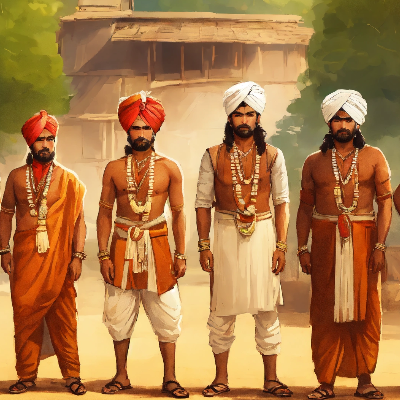
Nyagrodha · Sunama · Kanka · Shanku · Subhumi · Rashtrapala · Yuddhamusti · Tushtiman
The eight sons of Ugrasena listed here are the younger brothers of Kamsa — the eldest son of Ugrasena, king of Mathura, and the principal antagonist of the early narrative of Krishna's life. Together with Kamsa, these eight constitute the nine sons of Ugrasena enumerated in the Bhagavata Purana at chapter 24, verses 24 and 25 of the ninth skanda, and in the Vishnu Purana at chapter 14, verse 5 of the fourth book. Ugrasena himself was the younger son of Ahuka, tenth generation of the Kukura sub-clan of the Yadava confederation, which traces its ancestry through the lunar dynasty to Yadu, eldest son of the king Yayati. These eight brothers thus represent the twelfth generation of the Kukura line alongside their eldest brother Kamsa. Unlike Kamsa, who receives extensive individual narrative treatment across multiple Puranas and the Mahabharata, the eight younger brothers are recorded primarily as a collective group within the genealogical lists and in the single narrative episode in which they appear — the events immediately following Kamsa's death in the wrestling arena of Mathura.
✦ Parentage and Clan Position
- Father: Ugrasena — eleventh generation of the Kukura clan, younger son of Ahuka, and the rightful king of Mathura who was deposed and imprisoned by his eldest son Kamsa and later restored to the throne by Krishna following Kamsa's death in the wrestling arena.
- Paternal grandfather: Ahuka — tenth generation of the Kukura clan, son of Punarvasu, described in the Harivamsa as a figure of exceptional wealth and military stature who never travelled without a guard of ten thousand gold-adorned chariots.
- Elder brother: Kamsa — eldest son of Ugrasena, de facto ruler of Mathura following his violent usurpation of the throne, and the principal adversary of Krishna whose death in the wrestling arena of Mathura precipitates the episode in which these eight brothers meet their end.
- Paternal uncle: Devaka — elder son of Ahuka and brother of Ugrasena, whose youngest daughter Devaki became the mother of Krishna. These eight brothers were thus first cousins of Devaki and, through the Puranic framework of the narrative, members of the same extended family as the deity whose instrument brought about both their brother's death and their own.
✦ The Eight Brothers: Names and Attestation
The Bhagavata Purana enumerates all nine sons of Ugrasena at chapter 24, verse 24 of the ninth skanda. The eight younger brothers, in the order in which they appear in that enumeration, are as follows.
- Nyagrodha: The name is a Sanskrit word denoting the banyan tree, known for its expansive aerial roots and wide canopy. As a personal name it carries associations of broad reach and rootedness. Nyagrodha is named in the Bhagavata Purana's genealogical list and is among those killed by Balarama in the arena following Kamsa's death.
- Sunama: The name is a Sanskrit compound from su, meaning good or auspicious, and nama, meaning name. The compound thus means one of good name or well-named. Sunama is listed among the sons of Ugrasena in the Bhagavata Purana's genealogical enumeration.
- Kanka: The name denotes a heron or a type of arrow in Sanskrit, and also appears as a name borne by other figures in the epic tradition — most notably as one of the assumed names of Yudhishthira during the Pandavas' year of incognito in the Mahabharata, an entirely distinct figure. This Kanka is the son of Ugrasena and younger brother of Kamsa, listed in the Bhagavata Purana's enumeration.
- Shanku: The name is a Sanskrit word meaning a stake, peg, or conical object, and also refers to a type of shell. As a personal name it carries no specific narrative elaboration in the primary sources beyond the genealogical listing in the Bhagavata Purana.
- Subhumi: The name is a Sanskrit compound from su, meaning good or auspicious, and bhumi, meaning earth or ground. The compound may be interpreted as one of good earth or one with auspicious ground. Subhumi is listed among the sons of Ugrasena in the Bhagavata Purana without further individual narrative treatment.
- Rashtrapala: The name is a Sanskrit compound from rashtra, meaning kingdom or realm, and pala, meaning protector or guardian. The compound thus means protector of the realm, a name of evident royal and administrative significance. Rashtrapala is listed among the sons of Ugrasena in the Bhagavata Purana's genealogical enumeration.
- Yuddhamusti: The name is a Sanskrit compound from yuddha, meaning battle or combat, and musti, meaning fist or a clenched hand. The compound carries the sense of one with a battle-fist or a fighter's grip, a name of martial character. Some regional recensions of parallel texts render this name in variant forms, though the Bhagavata Purana's primary enumeration gives Yuddhamusti as the standard form.
- Tushtiman: The name is a Sanskrit compound from tushti, meaning satisfaction or contentment, and man, a suffix indicating one who possesses the quality. The compound thus means one who is satisfied or endowed with contentment. Tushtiman is identified in the genealogical tradition as the youngest of Ugrasena's recorded sons and is listed last in the Bhagavata Purana's enumeration of the nine brothers.
✦ The Collective Fate in the Wrestling Arena of Mathura
The only narrative episode in which these eight brothers appear as active participants is recorded in the Bhagavata Purana at chapter 44, verses 40 through 43 of the tenth skanda. The account describes that immediately after Krishna slew Kamsa in the wrestling arena of Mathura, Kamsa's younger brothers — moved by grief and anger at the death of their eldest sibling — rushed into the arena to attack Krishna and Balarama. The Bhagavata Purana records that Balarama, wielding his club, killed these brothers as they charged into the arena. The text treats their collective assault and collective death as a single episode without assigning distinct individual actions to specific named brothers within the group. Their fate sealed the end of Kamsa's regime within the arena itself, completing the narrative sequence that had begun with the celestial prophecy at Devaki's wedding and continued through the years of persecution, imprisonment, and the final confrontation.
✦ Terminal Branch Status in the Kukura Genealogy
The Bhagavata Purana records that the sons of Ugrasena who fell in the arena did not leave surviving descendants who established continuing sub-lineages. Together with Kamsa — whose own sons are recorded in the Bhagavata Purana as having perished with the collapse of his regime — these eight brothers thus constitute terminal branches of the Kukura genealogical tree at the twelfth generation. The long chain from Kukura through twelve generations, which had produced the royal house of Mathura and the immediate family of Krishna's adversary, ends with this generation without issue in the line of Ugrasena's sons. The continuing narrative of the Yadava confederation passes through Ugrasena's own restoration and the subsequent history of the community at Dwaraka rather than through any of Kamsa's brothers.
✦ Textual Variants and Inconsistencies
The names of Ugrasena's nine sons are given in the Bhagavata Purana and in the Vishnu Purana, with the two sources broadly consistent in their enumeration. Minor variation in the spelling and form of individual names occurs between manuscript recensions, as is common in Puranic genealogical lists of this type. The name Yuddhamusti in particular shows variation across recensions, with some manuscripts giving alternate phonetic forms of the same name. The Harivamsa contains parallel genealogical material on the Kukura line and the family of Ugrasena, and while it is broadly consistent with the Bhagavata account in listing multiple sons of Ugrasena, the precise enumeration and ordering of the eight younger brothers may show variation between the Harivamsa and Bhagavata traditions. No primary source assigns distinct individual roles, political positions, or separate narrative episodes to any of the eight brothers beyond their collective appearance in the arena episode.
✦ References
- Bhagavata Purana, Ninth Skanda, Chapter 24, verses 24–25: The primary genealogical source enumerating all nine sons of Ugrasena including the eight brothers profiled here, situating them within the Kukura lineage as the twelfth generation of the sub-clan.
- Bhagavata Purana, Tenth Skanda, Chapter 44, verses 40–43: The narrative source recording the collective assault of Kamsa's younger brothers on Krishna and Balarama immediately after Kamsa's death in the wrestling arena, and their killing by Balarama.
- Vishnu Purana, Book Four, Chapter 14, verse 5: A supporting genealogical source listing the sons of Ugrasena, consistent with the Bhagavata Purana's enumeration.
- Harivamsa, Harivamsha Parva, genealogical and narrative chapters: Contains parallel material on the family of Ugrasena and the events in the wrestling arena of Mathura, providing a further textual witness to the collective fate of Kamsa's brothers.
- Puranic Encyclopaedia by Vettam Mani (1975): A modern reference work summarising Puranic genealogical lists and entries on the sons of Ugrasena, relevant for cross-checking the names, their order, and the manuscript variants affecting individual name-forms within the enumeration.