
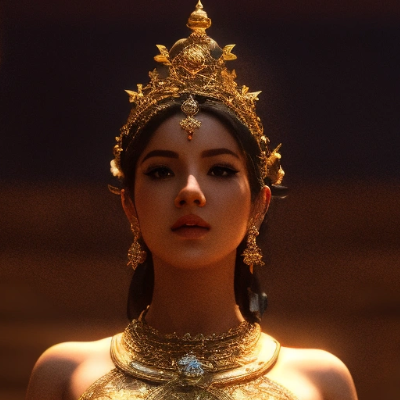
About
Sutanu — Yadava Princess of the Andhaka-Kukura Line
Sutanu · Ugraseni
Sutanu is a princess of the Yadava confederacy, belonging to the Andhaka-Kukura lineage, whose genealogical position is attested across several Puranic texts though with notable divergence between them. She is principally recorded as the wife of Akrura, a celebrated Yadava prince and devotee of Krishna who was the son of Shvaphalka and Gandini. Through this marriage she became the mother of two sons whose names vary across textual recensions. Sutanu appears in the Vishnu Purana as a daughter of Ugrasena, a Yadava king of Mathura, and a sister of Kamsa. The Puranic genealogical studies of F. E. Pargiter, drawing on the data of the Vayu Purana and Matsya Purana, record her instead as the daughter of Ahuka, who was Ugrasena's own father and the paramount chief of the Kukura-Andhaka line. These two attributions place Sutanu either as the daughter or the granddaughter of Ahuka, depending on the recension consulted, and represent a genuine textual divergence that cannot be resolved by choosing one account over the other.
✦ The Name
The name Sutanu is a Sanskrit compound formed from su (good, beautiful, excellent) and tanu (body, form, person). It conveys the sense of one possessed of a beautiful or excellent form. The name Ugraseni, which appears in the Harivamsha as the name of Akrura's wife, means "she who belongs to, or is born of, Ugrasena," functioning as a patronymic rather than a personal name and indicating daughter of the king Ugrasena.
✦ Lineage
- Father (Pargiter / Vayu-Matsya Purana tradition): Ahuka — a Kukura-Andhaka Yadava king, son of Abhijit and twin brother of Ahuki, celebrated in the Harivamsha as a mighty and generous monarch who was the patriarch of the entire line that produced both Devaka and Ugrasena.
- Father (Vishnu Purana tradition): Ugrasena — Yadava king of Mathura, son of Ahuka, and father of Kamsa, Nyagrodha, Sunaman, Kanka, Shanku, Subhumi, Rashtrapala, Yuddhamushthi, and Tushtimat among his sons; and of Kamsa, Kamsavati, Sutanu, Rashtrapali, and Kanki among his daughters.
- Paternal uncle (in the Vishnu Purana genealogy): Devaka — son of Ahuka, brother of Ugrasena, father of Devaki (the mother of Krishna) and several other daughters all given in marriage to Vasudeva.
- Husband: Akrura — Yadava prince, son of Shvaphalka (of the Vrishni line) and Gandini (daughter of the king of Kashi); a foremost commander of the Yadava forces, celebrated devotee of Krishna, and bearer of the Syamantaka jewel.
- Sons (Pargiter / Bhagavata commentary tradition): Devaka and Upadevaka — born of Sutanu and Akrura.
✦ Textual Variants and Inconsistencies
Three distinct textual positions must be recorded honestly. First, the Vishnu Purana (Book IV, Chapter XIV) names Sutanu explicitly as one of five daughters of Ugrasena, sister of Kamsa. Second, the raw Sanskrit text of the Harivamsha (Harivamsha Parva, Chapter 34) names Akrura's wife as Ugraseni, a daughter of Ugrasena, and gives their sons as Prasena and Upadeva — neither son matching the name Devaka. Third, the genealogical synthesis of F. E. Pargiter, working from the Vayu and Matsya Puranas, records Sutanu as the daughter of Ahuka (Ugrasena's father, one generation higher) and the sons as Devaka and Upadevaka.
These three accounts may represent: (a) confusion between a daughter and a granddaughter of Ahuka across recensions; (b) Ugraseni being a patronymic for Sutanu rather than a separate personal name; or (c) genuine divergence between the Harivamsha and Bhagavata-aligned traditions regarding both the wife's identity and the sons' names. It should be noted additionally that a figure named Sutanu appears in the Harivamsha (Vishnu Parva, Chapter 35) as one of the fourteen wives of Vasudeva — a distinct individual, not to be confused with the Sutanu who is the wife of Akrura.
✦ Connection to the Wider Genealogy
If Sutanu is the daughter of Ugrasena (as the Vishnu Purana records), she is the sister of Kamsa and thus the maternal aunt by lineage of those Yadavas most closely associated with the events at Mathura leading to Krishna's birth. Her marriage to Akrura — a prince of the Vrishni branch — would constitute a dynastic alliance between two major sub-lineages of the Yadava confederacy: the Kukura-Andhaka branch of Ahuka's line, and the Vrishni branch through Shvaphalka. If Sutanu is instead placed one generation higher as Ahuka's own daughter (as Pargiter records), she would be the sister of both Ugrasena and Devaka, making her the paternal aunt of Kamsa and the paternal aunt of Devaki.
✦ References
- Vishnu Purana, Book IV, Chapter XIV (trans. H. H. Wilson, 1840) — names Sutanu as one of five daughters of Ugrasena, alongside Kamsa, Kamsavati, Rashtrapali, and Kanki; primary source for the Ugrasena-daughter identification.
- Harivamsha, Harivamsha Parva, Chapter 34 (Sanskrit text, Chitrashala Press edition) — records Akrura's wife as Ugraseni, daughter of Ugrasena, and names their sons as Prasena and Upadeva; primary source for the Harivamsha recension of this marriage.
- Harivamsha, Harivamsha Parva, Chapter 37 (trans. M. N. Dutt) — records the family of Ugrasena and Ahuka, listing Sutanu among Ugrasena's daughters; confirms Sutanu as a name within Ugrasena's family.
- Harivamsha, Vishnu Parva, Chapter 35 (trans. M. N. Dutt, Wisdomlib) — lists a Sutanu as one of the fourteen wives of Vasudeva; establishes her as a distinct figure from the wife of Akrura.
- Pargiter, F. E. — Puranic genealogical studies synthesizing data from the Vayu Purana and Matsya Purana; cited in secondary scholarship (including the Wikipedia article on Akrura) as the source for the identification of Sutanu as daughter of Ahuka and mother of Devaka and Upadevaka.
- Wisdomlib, "Akrura" entry — secondary reference drawing on Vettam Mani's Puranic Encyclopaedia and Bhagavata Purana Navama Skandha sources; records the marriage of Akrura and Sutanu with sons Devaka and Upadevaka.
- Wikipedia, "Akrura" — secondary reference summarising both the Harivamsha and Pargiter accounts of Akrura's wife and sons; useful for identifying the textual divergence.