
About
Bhagadatta — King of Pragjyotisha and Warrior of the Mahabharata
Bhagadatta · Pragjyotishapura-pati · Naraka-putra · Narakasura-ja
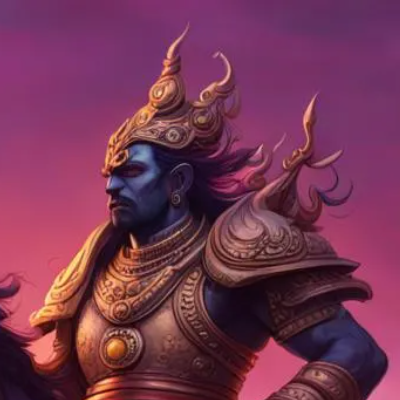
Bhagadatta was the sovereign of Pragjyotisha, the ancient kingdom identified with the region of present-day Assam in the far northeast of the Indian subcontinent. He was the son of Narakasura — the powerful Asura-king of Pragjyotisha who was slain by Krishna, the avatar of Vishnu, in an episode recounted across the Mahabharata and the Bhagavata Purana. Bhagadatta is principally remembered in the Mahabharata as one of the great warrior-kings who sided with the Kauravas in the Kurukshetra War, bringing with him a formidable force of troops from the eastern and northern frontier regions, including soldiers described as belonging to the Kiratas, Chinas, and other martial peoples of the Himalayan and trans-Himalayan borderlands. He was celebrated above all as a supreme master of elephant warfare, riding into battle upon his great war elephant Supratika. His death at the hands of Arjuna, one of the five Pandava brothers and the preeminent archer-hero of the Mahabharata, forms one of the most dramatic episodes of the Drona Parva. Bhagadatta appears most extensively in the Mahabharata, particularly in the Sabha Parva, the Udyoga Parva, and the Drona Parva, and is referenced in the Bhagavata Purana in connection with his father Narakasura.
✦ The Name
The name Bhagadatta is a Sanskrit compound formed from two elements. The first element, bhaga, carries a range of interconnected meanings in Sanskrit: fortune, prosperity, glory, divine favour, and sovereignty. The word is related to bhagavan, the exalted epithet applied to Vishnu and Krishna meaning "one who possesses all divine excellences." The second element, datta, is the past passive participle of the verbal root da, meaning "given" or "bestowed." The compound as a whole therefore signifies "one upon whom fortune has been bestowed" or "given by divine grace," suggesting a name that marks the bearer as a ruler endowed with heaven-granted prosperity and power. The epithet Pragjyotishapura-pati means "lord of Pragjyotishapura," Pragjyotisha itself meaning "the city of eastern lights" or "the eastern abode of luminaries," a name that reflects both the geographic position of the kingdom in the far east and its ancient reputation as a seat of power. The patronymic Naraka-putra or Narakasura-ja means "son of Narakasura," identifying his descent from the demon-king of the same realm.
✦ Lineage
- Father: Narakasura (also called Naraka or Bhauma), the Asura-king of Pragjyotisha and a figure of enormous power in the Puranic tradition. Narakasura was himself the son of Bhumi, the earth goddess, and is variously described in different sources as having been fathered by Vishnu in his Varaha (boar) avatar or by the god Brahma upon the earth. He was slain by Krishna, the eighth avatar of Vishnu, at the request of Satyabhama, one of Krishna's principal wives, who accompanied Krishna into battle. Following Narakasura's death, Krishna freed the sixteen thousand and one hundred women the demon had held captive and subsequently married them all.
- Mother: The primary sources do not record the name of Bhagadatta's mother with consistency. The Bhagavata Purana and related texts focus on Narakasura's defeat and the freeing of captive women without naming Bhagadatta's mother specifically.
- Kingdom inherited: Upon the death of Narakasura, Bhagadatta was installed as the rightful king of Pragjyotisha by Krishna himself, an act of grace that underscores the unusual relationship between Bhagadatta's lineage and the Vaishnava tradition even as Bhagadatta later aligned himself with the enemies of the Pandavas, who were Krishna's close allies.
- Son: Vajradatta is named in later Puranic tradition as the son of Bhagadatta, who after his father's death at Kurukshetra sought to avenge him. The account of Vajradatta appears in texts such as the Vishnu Purana in supplementary genealogical material, though his narrative is far less elaborated than his father's.
✦ Ancestry of the Pragjyotisha Line
The kingdom of Pragjyotisha and its ruling line occupy a distinctive position in Puranic cosmology. Narakasura, Bhagadatta's father, was born of the union between Bhumi — the personified earth, also called Prithvi or Vasundhara — and the divine principle that took the form of the great boar Varaha to rescue her from the cosmic waters. Despite this semi-divine origin, Narakasura became a being of destructive power whose reign was marked by oppression of gods, sages, and mortals alike. The tradition thus presents Bhagadatta as a king of mixed cosmic heritage: descended from the earth goddess and from a divine source, yet ruling a kingdom founded by a figure ultimately characterised as demonic. This ancestry helps explain why, even after Krishna spared Bhagadatta and established him as a legitimate sovereign, the king retained an identity independent of — and ultimately opposed to — the Pandava-Krishna alliance.
✦ Friendship with Indra and the Pre-War Context
One of the most significant relationships attributed to Bhagadatta in the Mahabharata is his deep and longstanding friendship with Indra, the king of the gods and the father of Arjuna, the great Pandava archer. The Sabha Parva of the Mahabharata records this connection when Bhagadatta is encountered during the digvijaya — the campaign of conquest — undertaken by Arjuna on behalf of the Pandavas in preparation for the Rajasuya sacrifice of Yudhishthira, the eldest of the five Pandava brothers and the rightful claimant to the imperial throne of Hastinapura. When Arjuna's forces reached the northeast and approached Pragjyotisha, Bhagadatta initially resisted with great ferocity. The battle between Arjuna and Bhagadatta on this occasion was prolonged and fierce, lasting several days by the epic's account. It was ultimately resolved not by the defeat of Bhagadatta but by a negotiated submission: Bhagadatta, out of his affection for Indra and recognising Arjuna as Indra's own son, agreed to acknowledge Yudhishthira's suzerainty and pay tribute, thereby allowing the digvijaya to proceed. This episode is important because it establishes that the personal relationship between Bhagadatta and the Pandavas was complex even before the war — neither pure enmity nor genuine alliance.
✦ Role in the Kurukshetra War — Alignment with the Kauravas
When the Kurukshetra War finally erupted between the Pandavas and the Kauravas — the two branches of the Bharata royal family contending for the throne of Hastinapura — Bhagadatta chose to side with Duryodhana, the eldest of the hundred Kaurava princes and the principal antagonist of the Pandavas. The reasons the epic text provides for this choice are not elaborated in explicit political terms, but the alignment is consistent with the larger pattern of many eastern and northern frontier kings joining the Kaurava side. Bhagadatta brought to the Kaurava army a formidable contingent drawn from the peoples of the northeast and the Himalayan borderlands. The Udyoga Parva and the Bhishma Parva describe his forces as including Kiratas — the mountain peoples of the Himalayan region — as well as soldiers variously described as Chinas and other groups from beyond the conventional boundaries of Aryavarta. Bhagadatta's personal contribution to the Kaurava military strength was centred on his mastery of elephant warfare and on his great war elephant, a beast described in the epic as immensely powerful and battle-trained.
✦ The War Elephant Supratika
Bhagadatta's war elephant is named Supratika in the Mahabharata. The name Supratika in Sanskrit means "well-formed" or "of beautiful appearance," and the animal is described in the epic as one of the foremost war elephants of the age, enormous in size and trained to the highest degree of battle discipline. The relationship between Bhagadatta and Supratika is presented as one of complete mastery and coordination: the king controlled the elephant with subtle commands, and together they constituted a single devastating unit on the battlefield. The Drona Parva, which narrates the events of the later days of the Kurukshetra War under the command of Drona — the revered martial preceptor who took over supreme command of the Kaurava forces after the fall of Bhishma — provides the most detailed accounts of Bhagadatta and Supratika in combat. During the fighting described in the Drona Parva, Bhagadatta on Supratika wrought great destruction on the Pandava forces, and numerous Pandava warriors are described as unable to withstand the combined assault of the king and his elephant. Some later Puranic sources, particularly traditions associated with the Bhagavata Purana's extended cosmological material, identify Supratika as belonging to a lineage of divine elephants connected to the dikpalas — the elephants of the eight directions — though the epic text itself does not make this identification explicit.
✦ Bhagadatta's Combat in the Drona Parva
The Drona Parva of the Mahabharata contains the most sustained and detailed account of Bhagadatta's fighting during the Kurukshetra War. He is portrayed as one of the most dangerous warriors on the Kaurava side during this phase of the battle, described as being in the vanguard of the fighting and causing enormous casualties among the Pandava infantry, cavalry, and elephant corps. Several of the Pandava commanders attempted to engage and neutralise Bhagadatta and Supratika, and the epic describes these attempts as largely unsuccessful. Bhima, the second of the five Pandava brothers and one of the mightiest warriors of the age, is among those who fought Bhagadatta during this period; despite Bhima's renowned physical strength, the encounter is not presented as resulting in Bhagadatta's defeat. Satyaki, the Yadava warrior and close ally of Krishna who fought on the Pandava side, also engaged Bhagadatta. The epic's descriptions of these combats serve to establish Bhagadatta's credentials as a warrior of the highest tier before the climactic encounter with Arjuna.
✦ The Death of Bhagadatta — Encounter with Arjuna
The death of Bhagadatta at the hands of Arjuna is one of the pivotal moments of the Drona Parva and is narrated with considerable epic detail. When Arjuna finally confronted Bhagadatta on the battlefield, the encounter was between two warriors of supreme calibre. Bhagadatta, directing Supratika against Arjuna's chariot, launched an array of weapons including the Vaishnavastra — a divine weapon of extraordinary power associated with Vishnu — at Arjuna. The Vaishnavastra, in the epic's account, was a weapon of such potency that it could not be countered by ordinary means and was directed straight at Arjuna with the intent to destroy him. At this critical moment, Krishna — who served as Arjuna's charioteer throughout the Kurukshetra War — intervened directly. Krishna stood up in the chariot and allowed the Vaishnavastra to strike his own chest, where it transformed into a garland of flowers rather than dealing its lethal blow. The text explains this through the logic that the Vaishnavastra, being Vishnu's own weapon, could not harm Vishnu himself, and Krishna, as the avatar of Vishnu, absorbed its force harmlessly. Having thus neutralised the most dangerous weapon at Bhagadatta's disposal, Arjuna then struck Bhagadatta with a shaft that pierced the goad — the instrument the king used to control Supratika — and then with a further arrow that struck Bhagadatta in the forehead, killing him. The description of Bhagadatta's death notes that he was old and that his eyes, weakened by age, were described as requiring a band or cloth tied around his head to keep them from drooping and obscuring his vision during battle. This detail of the aged king fighting with impaired eyesight yet still commanding one of the most feared military units on the field is presented with a degree of pathos in the epic narrative.
✦ The Vaishnavastra Episode — Significance
The episode of the Vaishnavastra is theologically and narratively one of the most striking in the entire account of Bhagadatta. It raises the question of how a king of Pragjyotisha — the son of Narakasura, a demon destroyed by Krishna — came to possess a weapon sacred to Vishnu. The Mahabharata does not explicitly explain the origin of the Vaishnavastra in Bhagadatta's possession, though commentators have speculated that it may have come to him through his father's lineage, given that Narakasura himself was born of divine and earthly parentage and may have received or seized divine weapons during his reign. The transformation of the weapon into a garland upon striking Krishna's chest is consistent with the epic's broader theological framing, in which Krishna's divinity is revealed progressively throughout the text — most famously in the Bhagavad Gita section of the Bhishma Parva — and the Bhagadatta episode functions as another demonstration of that divinity in a martial context. For the reader familiar with the larger tradition, it is also notable that the Vaishnavastra that Bhagadatta fired was, by the logic of the narrative, always destined to be absorbed by Krishna: a weapon of Vishnu returning to its source.
✦ Narakasura — Father of Bhagadatta
To understand Bhagadatta's position fully, the figure of his father Narakasura requires identification within this profile. Narakasura, also called Naraka or Bhauma (meaning "son of the earth"), was the ruler of Pragjyotisha before Bhagadatta and is counted among the great demonic antagonists of the Puranic tradition. His mother was Bhumi, the earth goddess, and his origin story connects him to the Varaha avatar episode of Vishnu, in which the boar form of the god rescued the earth from cosmic submersion. Despite his semi-divine origin, Narakasura became a source of oppression and disorder, accumulating power to the point of threatening the cosmic order maintained by the gods. His defeat came at the hands of Krishna, who attacked Pragjyotisha and killed him. Following his death, Krishna freed the thousands of women Narakasura had held captive and, at the dying demon's own request according to some accounts, spared Bhagadatta and installed him as the legitimate ruler of Pragjyotisha. This act of succession — a Pandava-allied divinity establishing the future Kaurava-allied king — gives Bhagadatta's narrative a particular irony that the Mahabharata's construction seems to acknowledge through its detailed treatment of the Vaishnavastra episode.
✦ Textual Variants and Inconsistencies
The primary textual tradition concerning Bhagadatta is reasonably consistent across the different parvans of the Mahabharata, but several points of variation or ambiguity exist across sources.
The identity of Narakasura's father — and therefore Bhagadatta's paternal grandfather — is a point of genuine variance across texts. The Bhagavata Purana identifies Vishnu in his Varaha form as the progenitor of Narakasura through Bhumi. The Mahabharata itself, in certain passages, associates Narakasura's parentage with Brahma or describes his origin in terms that are less clearly Vaishnava in emphasis. These two accounts reflect the broader tension in Puranic literature between Vaishnava-centred and Brahma-centred cosmological frameworks.
The nature of the elephant Supratika is also treated differently in different parts of the tradition. The epic text presents Supratika primarily as Bhagadatta's personal war elephant of exceptional quality and training. Some Puranic traditions, drawing on the mythology of the eight directional elephants (the Ashtadik-gajas), connect Supratika to that cosmic framework, but the Mahabharata's own war narrative does not make this connection explicit, and the identification should be treated as a later or parallel tradition rather than a reading that is unambiguously supported by the core epic text.
The Harivamsa — a text appended to the Mahabharata and devoted to the life of Krishna — provides additional material on the defeat of Narakasura and the establishment of Bhagadatta as king, with some differences in detail compared to what can be reconstructed from the epic's own internal references. Scholars have noted that the Harivamsa and the Bhagavata Purana tenth skandha represent the most elaborated versions of the Narakasura narrative, while the Mahabharata's own treatment of that backstory is comparatively brief.
✦ Connection to the Wider Genealogy
Bhagadatta stands at the intersection of several major genealogical lines of the Puranic and epic tradition. Through his father Narakasura, he is connected to the lineage of Bhumi, the earth goddess, and through her to the primordial cosmological narratives of the Varaha avatar. His kingdom of Pragjyotisha was understood in the epic geography as the eastern anchor of the known world, and the peoples who served him — the Kiratas and others — represented the frontier zones beyond the heartland of Aryavarta. His submission to Arjuna during the digvijaya formally made him a tributary of the Pandava imperial order, yet his subsequent alignment with Duryodhana placed him among those who died fighting against that same order in the war. His son Vajradatta, named in later genealogical tradition as his successor, continued the Pragjyotisha line and is associated in some texts with a later attempt to avenge his father's death, connecting Bhagadatta's story to the post-war genealogical narratives of the Puranas. Through the Vaishnavastra episode, Bhagadatta is also linked directly to the theological lineage of Vishnu-Krishna, as the possessor of a Vaishnava weapon and as the figure whose death most dramatically displayed Krishna's divine nature in the martial register of the Drona Parva.
✦ Theological and Philosophical Significance
Bhagadatta's story carries several layers of theological meaning within the Mahabharata's overall framework. His lineage from Narakasura — a being who was simultaneously of divine parentage and destructive orientation — illustrates the Puranic concept that birth and cosmic origin do not automatically determine the path an individual will take. His submission to Arjuna during the digvijaya, motivated by friendship for Arjuna's father Indra, and his subsequent choice to fight on the side opposing that same Arjuna at Kurukshetra, present a narrative of loyalty divided between personal bonds and political alignment. The episode of the Vaishnavastra serves the epic's larger theological argument about the nature of Krishna's divinity: in the moment of greatest danger, when a weapon of supreme power was directed against Arjuna, it was Krishna rather than Arjuna's own skill who provided the decisive protection — a demonstration of the relationship between human effort and divine grace that is one of the Mahabharata's central preoccupations. Bhagadatta is thus not merely a military antagonist but a figure whose narrative arc and death are structured to serve the text's theological purposes.
✦ References
Primary Sources
- Mahabharata, Sabha Parva: Contains the account of Arjuna's digvijaya to the northeast, his prolonged encounter with Bhagadatta, and Bhagadatta's eventual submission as a tributary of Yudhishthira's imperial order.
- Mahabharata, Udyoga Parva: Lists Bhagadatta among the kings who declared their allegiance to the Kaurava side in preparation for the Kurukshetra War, and describes the composition of his forces from the northeastern frontier peoples.
- Mahabharata, Bhishma Parva: Mentions Bhagadatta as an active combatant in the early days of the Kurukshetra War under Bhishma's overall command of the Kaurava forces.
- Mahabharata, Drona Parva: Provides the most detailed accounts of Bhagadatta's fighting under Drona's command, his mastery of elephant warfare on Supratika, his encounters with Bhima and Satyaki, and the climactic duel with Arjuna in which he deployed the Vaishnavastra, was protected against by Krishna, and was ultimately slain by Arjuna's arrows.
- Harivamsa: The appendix text to the Mahabharata devoted to Krishna's biography, which elaborates the narrative of Narakasura's defeat and the establishment of Bhagadatta as successor king of Pragjyotisha, providing important context for Bhagadatta's origin and legitimacy.
- Bhagavata Purana, Tenth Skandha: Contains the most fully elaborated account of Narakasura's birth from Bhumi, his reign over Pragjyotisha, his defeat by Krishna with Satyabhama, and the freeing of the captive women — all of which form the essential backstory of Bhagadatta's succession to the Pragjyotisha throne.
- Vishnu Purana: Includes genealogical material on the Pragjyotisha line and references to Vajradatta as Bhagadatta's son and successor, contributing to the post-Kurukshetra genealogical tradition of the dynasty.
Modern Reference Works
- Vettam Mani, Puranic Encyclopaedia (1975): Provides a consolidated summary of Bhagadatta's appearances across the Mahabharata parvans and cross-references his lineage to the Narakasura narrative in the Bhagavata Purana.
- Alf Hiltebeitel, The Ritual of Battle: Krishna in the Mahabharata (1976): Offers scholarly analysis of the theological significance of episodes in the Drona Parva including Krishna's interventions, relevant to understanding the Vaishnavastra episode involving Bhagadatta.
- Wisdomlib (wisdomlib.org), entries on Bhagadatta and Pragjyotisha: Aggregates Sanskrit textual references to Bhagadatta from multiple Puranic and epic sources, useful for cross-referencing verse locations across different recensions.