
About
Vajradatta — Prince of Pragjyotisha and Avenger of Bhagadatta
Vajradatta · Bhagadatta-putra · Pragjyotishapura-pati
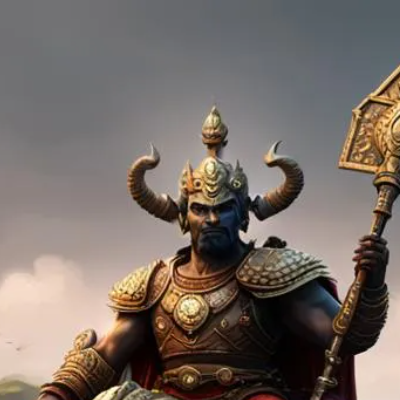
Vajradatta was the son of Bhagadatta, the king of Pragjyotisha — the ancient kingdom identified with the region of present-day Assam in the far northeast of the Indian subcontinent — and the grandson of Narakasura, the powerful Asura-king of that same realm who was slain by Krishna, the avatar of Vishnu. Vajradatta succeeded his father Bhagadatta as ruler of Pragjyotisha following Bhagadatta's death at the hands of Arjuna, the great Pandava archer-hero, during the Kurukshetra War. He is most prominently recorded in the context of Arjuna's second great campaign of conquest — the Ashvamedha digvijaya undertaken after the conclusion of the Kurukshetra War — during which Vajradatta confronted Arjuna in battle, seeking to avenge his father's death. His narrative appears in the Ashvamedha Parva of the Mahabharata and is referenced in genealogical material preserved in the Vishnu Purana and related texts. Vajradatta is a figure of comparatively limited textual elaboration, appearing principally in the post-war portion of the Mahabharata rather than in its main war narrative, and the primary sources treat him with far less detail than they devote to his father.
✦ The Name
The name Vajradatta is a Sanskrit compound of two elements. The first, vajra, is one of the most semantically rich words in the Sanskrit lexicon: it denotes the thunderbolt weapon wielded by Indra, king of the gods, and by extension carries meanings of hardness, invincibility, brilliance, and indestructibility — the diamond is also called vajra in Sanskrit on account of its extreme hardness. The second element, datta, is the past passive participle of the verbal root da, meaning "given" or "bestowed." The compound thus signifies "one upon whom the thunderbolt has been bestowed" or "given by Vajra," suggesting a name that marks its bearer as one endowed with the indestructible, lightning-like quality of Indra's own weapon. The name is structurally parallel to his father's name Bhagadatta — "one upon whom fortune has been bestowed" — and this parallel in naming convention suggests a deliberate continuity in the royal tradition of the Pragjyotisha dynasty. The patronymic Bhagadatta-putra means "son of Bhagadatta," and the epithet Pragjyotishapura-pati means "lord of Pragjyotishapura," the city of eastern lights, identifying his inherited sovereignty over the northeastern kingdom.
✦ Lineage
- Paternal grandfather: Narakasura (also called Naraka or Bhauma), the Asura-king of Pragjyotisha, born of Bhumi, the earth goddess. Narakasura was a ruler of immense power whose reign was marked by the oppression of gods, sages, and mortals alike. He was slain by Krishna, the eighth avatar of Vishnu, in a battle at Pragjyotisha during which Krishna's wife Satyabhama also participated. Following Narakasura's death, Krishna freed the thousands of women the demon-king had held captive and installed Bhagadatta as the legitimate ruler of the kingdom.
- Father: Bhagadatta, king of Pragjyotisha and one of the foremost warrior-kings of the Kurukshetra War, who fought on the side of Duryodhana and the Kauravas. Bhagadatta was celebrated as a supreme master of elephant warfare, commanding the great war elephant Supratika on the battlefield. He was slain by Arjuna in the Drona Parva of the Mahabharata after deploying the Vaishnavastra — a divine weapon sacred to Vishnu — which was absorbed by Krishna before Arjuna delivered the killing blow.
- Kingdom inherited: Pragjyotisha, the ancient northeastern kingdom, which Vajradatta ruled as his father's successor following the conclusion of the Kurukshetra War.
✦ The Ashvamedha Campaign and Confrontation with Arjuna
The principal episode in which Vajradatta figures is the Ashvamedha digvijaya — the campaign of conquest that followed the Pandava victory at Kurukshetra. After the war's conclusion, Yudhishthira, the eldest of the five Pandava brothers and the now-unchallenged emperor of Hastinapura, undertook the Ashvamedha sacrifice — the horse sacrifice that served in the tradition as the supreme assertion of imperial sovereignty. As was customary in this rite, a consecrated horse was released to roam freely across the land for a year, accompanied by an armed escort. Any king on whose territory the horse entered was required either to submit to Yudhishthira's imperial authority or to capture the horse and face the Pandava army in battle. Arjuna, the preeminent Pandava warrior and the same hero who had slain Bhagadatta during the Kurukshetra War, was appointed to lead the armed escort following the sacrificial horse.
When the horse and Arjuna's forces reached the northeast and entered the territory of Pragjyotisha, Vajradatta confronted them. The Ashvamedha Parva of the Mahabharata records that Vajradatta engaged Arjuna in battle with the explicit motivation of avenging the death of his father Bhagadatta. The combat between Vajradatta and Arjuna is described as fierce, with Vajradatta fighting with considerable skill and determination. The text records that Vajradatta deployed an elephant force in the tradition of his father's renowned mastery of that arm of warfare, maintaining the military character that had defined the Pragjyotisha dynasty's reputation. Despite the vigour of his resistance, Vajradatta was ultimately defeated by Arjuna in this encounter. The Ashvamedha Parva does not describe Vajradatta's death in this battle; the implication of the narrative is that he was overcome and submitted, allowing the sacrificial horse to proceed, though the text's treatment of the episode is considerably less elaborate than the detailed narration devoted to his father's combat and death in the Drona Parva.
✦ Textual Variants and the Limits of the Evidence
The textual record for Vajradatta is significantly thinner than for his father Bhagadatta, and several aspects of his narrative are either briefly treated or inconsistently rendered across the sources that mention him.
The Ashvamedha Parva of the Mahabharata, which is the primary source for Vajradatta's confrontation with Arjuna, is itself a section of the epic that has been regarded by some scholars as containing a higher proportion of later interpolated material than the more central war parvans. This means that the details of Vajradatta's episode should be read with awareness that the textual history of this parva is somewhat more complex than that of, for example, the Drona Parva or the Bhishma Parva.
The Vishnu Purana includes Vajradatta in its genealogical lists of the Pragjyotisha line, confirming his position as Bhagadatta's son and successor, but does not provide narrative elaboration beyond that dynastic placement. The genealogical material in the Vishnu Purana is primarily concerned with establishing dynastic continuity rather than narrating individual episodes, and Vajradatta's entry in that framework is accordingly brief.
Some regional traditions of Assam and the northeast, drawing on local historical memory and on texts such as the Kalika Purana — which devotes considerable attention to the sacred geography and royal history of Pragjyotisha — preserve accounts of the Pragjyotisha dynasty that may include material relevant to the post-Bhagadatta line. However, the Kalika Purana's treatment of this dynasty is oriented toward the religious and ritual significance of the Kamakhya temple and the goddess Kamakhya rather than toward the genealogical narrative of individual kings, and direct identification of Vajradatta within that text's framework requires careful source-critical attention that the primary Mahabharata account does not itself provide.
✦ Connection to the Wider Genealogy
Vajradatta occupies the third generation of the Pragjyotisha royal line as it is recorded in the epic and Puranic tradition. His grandfather Narakasura, born of Bhumi the earth goddess and connected through her to the Varaha avatar episode of Vishnu, founded the dynastic tradition of Pragjyotisha as it is remembered in these texts. His father Bhagadatta brought the kingdom to its greatest moment of epic prominence as one of the supreme warrior-kings of the Kurukshetra War, dying in that conflict at the height of his military power. Vajradatta, inheriting both the kingdom and the memory of his father's death, represents the generation that faced the consequences of the Kurukshetra War's outcome — a pattern repeated across numerous royal lines in the Ashvamedha Parva, in which the sons of warriors slain at Kurukshetra confronted Arjuna during the sacrificial horse's journey and were in turn defeated by him. In this structural sense, Vajradatta's episode belongs to a broader narrative pattern of the post-war Mahabharata in which Arjuna's supremacy is reasserted dynasty by dynasty across the subcontinent.
Through his grandfather Narakasura, Vajradatta is also genealogically connected to the broader Puranic tradition of the Asura kings and to the theology of the Vishnu avatar cycle — the same cycle of divine descents that produced Krishna, who both established Bhagadatta's kingship by sparing him after Narakasura's death and contributed to that kingship's end by absorbing the Vaishnavastra during Bhagadatta's final battle. Vajradatta thus stands at the terminus of a dynastic arc that begins with a divine act of grace and concludes with the irreversible military supremacy of the Pandava order.
✦ References
Primary Sources
- Mahabharata, Ashvamedha Parva: The principal source for Vajradatta's narrative, recording his confrontation with Arjuna during the post-war horse sacrifice campaign, his motivation to avenge his father Bhagadatta, and the outcome of their encounter.
- Mahabharata, Drona Parva: Does not concern Vajradatta directly but provides the essential context of Bhagadatta's death at Arjuna's hands — the event that motivates Vajradatta's later confrontation — and describes Bhagadatta's military character and the elephant warfare tradition of Pragjyotisha that Vajradatta inherited.
- Vishnu Purana: Includes Vajradatta in the genealogical lists of the Pragjyotisha dynasty, confirming his position as Bhagadatta's son and the dynastic successor to the northeastern kingdom, without providing narrative elaboration.
- Bhagavata Purana, Tenth Skandha: Does not treat Vajradatta directly but provides the foundational account of Narakasura's defeat and Bhagadatta's installation as king of Pragjyotisha, establishing the dynastic and theological context within which Vajradatta's lineage must be understood.
- Kalika Purana: A text devoted substantially to the sacred geography and religious traditions of Pragjyotisha and the Kamakhya goddess, which preserves material on the royal history of the northeastern kingdom relevant to understanding the broader dynastic tradition within which the Pragjyotisha line including Vajradatta is situated, though its orientation is devotional and geographical rather than genealogical in the strict sense.
Modern Reference Works
- Vettam Mani, Puranic Encyclopaedia (1975): Provides a concise entry on Vajradatta identifying his parentage, kingdom, and role in the Ashvamedha Parva, and situating him within the Pragjyotisha dynastic sequence.
- Wisdomlib (wisdomlib.org), entries on Vajradatta and Pragjyotisha: Aggregates Sanskrit textual references to Vajradatta from the Mahabharata and Puranic sources, useful for cross-referencing his appearances across different recensions and secondary genealogical lists.