
About
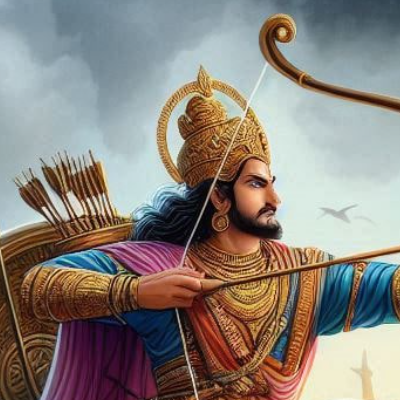
Pushpadatta — Prince of Pragjyotisha and Kaurava Warrior
Pushpadatta · Bhagadatta-putra · Pragjyotisha-raja-putra
Pushpadatta was a prince of Pragjyotisha, the ancient kingdom identified with the region of present-day Assam in the far northeast of the Indian subcontinent. He was a son of Bhagadatta, the celebrated king of Pragjyotisha and one of the foremost warrior-kings of the Kurukshetra War, who fought on the Kaurava side and was slain by the Pandava archer Arjuna during the Drona Parva. Pushpadatta fought alongside his father in the Kurukshetra War on the side of Duryodhana and the Kauravas, and was killed in battle by Nakula, the fourth of the five Pandava brothers. His death is recorded in the Drona Parva and retrospectively confirmed in the Karna Parva of the Mahabharata. The Kalika Purana, an Upapurana with particular authority on the genealogy of the Pragjyotisha royal house and the lineage of Narakasura, identifies Pushpadatta alongside Vajradatta — another son of Bhagadatta who survived the war and later ruled Pragjyotisha — as the two sons of Bhagadatta. The Harshacharita, the biographical work on Emperor Harsha composed by the Sanskrit author Banabhatta, also references the Pragjyotisha dynastic line in the context of establishing the ancestry of Bhaskaravarman, an ally of Harsha, and includes Pushpadatta within that lineage. Pushpadatta is a figure of limited but clearly attested textual presence, known principally through his death in the Kurukshetra War and his position within the Pragjyotisha royal genealogy.
✦ The Name
The name Pushpadatta is a Sanskrit compound of two elements. The first, pushpa, means "flower" or "blossom" and carries connotations of beauty, abundance, and auspiciousness in the Sanskrit literary tradition. The second element, datta, is the past passive participle of the verbal root da, meaning "given" or "bestowed." The compound as a whole therefore signifies "one upon whom flowers have been bestowed" or "given by blossoms," a name with a quality of grace and divine favour. The naming convention of Pushpadatta follows a pattern visible across the Pragjyotisha royal line: his father was named Bhagadatta — "one upon whom fortune has been bestowed" — and his brother Vajradatta — "one upon whom the thunderbolt has been bestowed." All three names share the suffix datta, suggesting a deliberate dynastic naming tradition within the Pragjyotisha royal house in which the element of divine bestowal is consistently emphasised. The patronymic Bhagadatta-putra means "son of Bhagadatta," and the epithet Pragjyotisha-raja-putra means "prince of the king of Pragjyotisha," identifying his royal status within the northeastern kingdom.
✦ Lineage
- Paternal grandfather: Narakasura (also called Naraka or Bhauma), the Asura-king of Pragjyotisha, born of Bhumi the earth goddess. Narakasura was a ruler of immense power whose oppression of gods, sages, and mortals culminated in his defeat and death at the hands of Krishna, the eighth avatar of Vishnu. Following Narakasura's death, Krishna installed Bhagadatta as the legitimate ruler of Pragjyotisha.
- Father: Bhagadatta, king of Pragjyotisha and one of the supreme warrior-kings of the Kurukshetra War, who fought on the side of Duryodhana and the Kauravas. Bhagadatta was celebrated as a master of elephant warfare, riding the great war elephant Supratika into battle. He was slain by Arjuna in the Drona Parva of the Mahabharata after deploying the Vaishnavastra — a divine weapon sacred to Vishnu — which was absorbed by Krishna before Arjuna delivered the killing blow.
- Brother: Vajradatta, the other son of Bhagadatta named in the Kalika Purana. Vajradatta survived the Kurukshetra War — being a child at the time of the conflict according to the tradition that reconciles the two brothers' fates — and subsequently succeeded his father as king of Pragjyotisha. He is recorded in the Ashvamedha Parva of the Mahabharata as having confronted Arjuna during the post-war horse sacrifice campaign, seeking to avenge his father's death, and was defeated though not killed in that encounter.
- Kingdom: Pragjyotisha, the ancient northeastern kingdom, over which Bhagadatta ruled and from which both Pushpadatta and Vajradatta derived their royal identity.
✦ The Pragjyotisha Dynasty — Ancestral Context
The kingdom of Pragjyotisha — whose name means "the city of eastern lights" or "the eastern abode of luminaries" — occupied a position of considerable significance in the epic and Puranic geographic imagination as the far northeastern anchor of the known world. Its ruling line, as preserved in the Kalika Purana and the genealogical sections of the Vishnu Purana, traced its origin to Narakasura, a figure of mixed divine and demonic character born of Bhumi, the earth goddess, and connected through her to the Varaha avatar episode of Vishnu. Despite this semi-divine ancestry, Narakasura's reign became a source of cosmic disorder, and his defeat at the hands of Krishna marked both the end of his line's demonic orientation and the beginning of its reconstitution as a legitimate royal dynasty. Bhagadatta, installed by Krishna himself as the rightful successor, represented this reconstituted legitimacy — a sovereignty granted by the same divine power that had destroyed its founder. Pushpadatta was born into this royal house at a generation removed from its most dramatic transformation, inheriting both the martial tradition of Pragjyotisha and the complex theological legacy of a dynasty whose origin story was inseparable from the Vaishnava avatar cycle.
✦ Role in the Kurukshetra War
Pushpadatta fought on the side of the Kauravas in the Kurukshetra War, aligned with his father Bhagadatta in support of Duryodhana, the eldest of the hundred Kaurava princes and the principal antagonist of the Pandavas in the epic's central conflict. The Drona Parva of the Mahabharata — the seventh book of the epic, which narrates the battles conducted under the supreme command of Dronacharya, the revered martial preceptor who led the Kaurava forces after the fall of the patriarch Bhishma — records Pushpadatta's participation in the fighting and his death at the hands of Nakula.
Nakula, who killed Pushpadatta, was the fourth of the five Pandava brothers, the twin of Sahadeva, and a son of Madri — the second wife of Pandu — by the divine Ashvins, the celestial twin physicians of the gods. Nakula was renowned in the Mahabharata tradition as a warrior of great beauty, swiftness, and skill with the sword and bow, and the epithet applied to him in the Karna Parva's retrospective passage — likening his battle movement to the swiftness of a hawk — is consistent with how the epic characterises his fighting style elsewhere. The Drona Parva does not elaborate Pushpadatta's individual combat in the manner reserved for the great warrior-kings of the conflict; his death belongs to the category of battlefield deaths that the epic records as significant enough to name but does not narrate with extended description. This is consistent with his status as a prince of Pragjyotisha fighting in his father's retinue rather than as an independent commander of one of the great divisions of the Kaurava army.
✦ The Karna Parva Retrospective
The eighth book of the Mahabharata, the Karna Parva, contains in its fifth section a retrospective passage in which Sanjaya — the divinely gifted narrator who reported the events of the Kurukshetra War to the blind king Dhritarashtra, father of the Kauravas — enumerates the warriors who have fallen in the course of the fighting. It is in this passage that Pushpadatta receives his most explicit textual acknowledgement. Sanjaya's statement to Dhritarashtra identifies the fallen prince as a son of Bhagadatta, characterises him as a warrior of great wisdom and great strength, and attributes his death to Nakula, whose battlefield swiftness is compared to that of a hawk. This retrospective mode of reference — in which a fallen warrior is named and briefly characterised in a summary passage rather than having his death narrated in real time — is a well-established convention of the Mahabharata's narrative technique, used for numerous warriors whose deaths occur within the main battle narrative but whose individual episodes are not given extended treatment. The Karna Parva passage thus confirms and summarises what the Drona Parva's battle narrative had recorded, providing Pushpadatta with a named epitaphic acknowledgement within the epic's own internal memorial of the war's fallen.
✦ The Kalika Purana — Genealogical Authority
The Kalika Purana is an Upapurana of particular significance for the history and mythology of Pragjyotisha. Unlike the Mahapuranas, whose geographical and genealogical focus tends toward the broader pan-Indian tradition, the Kalika Purana is oriented specifically toward the sacred geography of the northeast, the theology of the goddess Kamakhya whose principal shrine is located at Pragjyotisha, and the royal lineage of the Naraka dynasty that ruled that kingdom. Its genealogical statements about the Pragjyotisha royal house therefore carry a degree of regional authority that is difficult to find in texts whose concern with Pragjyotisha is more incidental. The Kalika Purana's identification of both Vajradatta and Pushpadatta as sons of Bhagadatta is significant because it establishes a two-son account of Bhagadatta's immediate succession that is consistent with the distinction the tradition draws between the brother who died in the war and the brother who survived to rule the kingdom. This dual identification also helps explain how the Pragjyotisha dynastic line continued after both the death of Bhagadatta at Kurukshetra and the death of Pushpadatta in the same conflict — through Vajradatta, the surviving son, who is independently attested in the Ashvamedha Parva of the Mahabharata as the post-war king of Pragjyotisha.
✦ The Harshacharita Reference
The Harshacharita, composed by the Sanskrit poet and scholar Banabhatta in the seventh century CE as a biographical account of the Emperor Harsha of Kanauj, contains genealogical material relevant to Bhaskaravarman, the king of Kamarupa — the historical successor state to the ancient kingdom of Pragjyotisha — who was a significant political ally of Harsha. In establishing Bhaskaravarman's royal credentials and ancestral prestige, Banabhatta traces the Kamarupa royal line back through its legendary and mythological antecedents, including the Pragjyotisha dynasty of the Mahabharata period. Within this genealogical passage, the Harshacharita records the order of succession in the Pragjyotisha kingdom as running through Bhagadatta and then Vajradatta, and includes Pushpadatta as a member of this royal lineage. The Harshacharita occupies a somewhat different category of source authority than the Mahabharata or the Kalika Purana: it is a work of Sanskrit court biography and literary prose rather than a Purana or epic, and its genealogical claims about the legendary past of Kamarupa serve the immediate political purpose of glorifying Bhaskaravarman's ancestry. Nevertheless, the text's inclusion of Pushpadatta within the Pragjyotisha dynastic sequence — written by a scholar of Banabhatta's learning and in a context where genealogical accuracy carried political weight — constitutes a meaningful corroborating reference that supports the broader tradition of Pushpadatta's place in the Pragjyotisha royal house.
✦ Textual Variants and Source-Critical Notes
The textual record for Pushpadatta, while sufficient to establish his existence within the tradition, is thin enough to require some source-critical honesty about what can and cannot be stated with confidence.
The Karna Parva retrospective passage is the most directly informative primary textual reference, providing Pushpadatta's parentage, a characterisation of his qualities, and the identity of his killer in a single attributed statement. This passage, being part of Sanjaya's narration to Dhritarashtra — a narrative frame that the Mahabharata uses for its most authoritative battle reporting — carries considerable internal textual weight.
The Drona Parva reference to Pushpadatta's actual combat and death, while identified as the parva within which the events occurred, is not elaborated in the manner of the great individual duels of the epic. This is consistent with the Drona Parva's narrative structure, in which the deaths of hundreds of warriors are recorded in varying degrees of detail, with the majority receiving brief notice rather than extended narration.
The relationship between the Kalika Purana's genealogical account and the Mahabharata's war narrative is one of complementarity rather than contradiction: the Kalika Purana establishes the dynastic position of Pushpadatta within the Pragjyotisha royal house, while the Mahabharata records the fact and circumstances of his death. Neither text's account conflicts with the other, and together they provide a coherent if slender picture of the figure.
The Harshacharita reference, as noted above, should be read with awareness of its literary and political context. It is a corroborating source rather than a primary narrative one, and its value lies in demonstrating that the Pragjyotisha dynastic tradition including Pushpadatta was known and considered authoritative in the seventh-century CE court literary tradition of northern India.
✦ Connection to the Wider Genealogy
Pushpadatta stands in the third generation of the Pragjyotisha royal line as it is recorded across the epic, Upapuranic, and classical literary sources. His great-grandmother in the maternal cosmic sense was Bhumi, the earth goddess, through whom the entire Pragjyotisha dynasty derived its semi-divine origin. His grandfather Narakasura, born of Bhumi and connected to the Varaha avatar of Vishnu, founded the legendary dimension of the Pragjyotisha dynasty before his defeat by Krishna reconstituted it under Bhagadatta's rule. His father Bhagadatta brought the kingdom to its greatest moment of epic prominence, and his own death at Kurukshetra — together with Pushpadatta's — meant that the dynasty's continuation fell entirely to his brother Vajradatta.
Within the structural logic of the Kurukshetra War's genealogical consequences, Pushpadatta belongs to the large category of princes and warriors who died in the conflict without issue, their lines extinguished by the war's violence. His death at Nakula's hands, and his brother's survival as a child too young to fight, together produce the dynastic situation that the Ashvamedha Parva addresses when Vajradatta later confronts Arjuna — a king ruling as the sole surviving male of a line that the war had otherwise devastated. The Pragjyotisha dynasty's subsequent history, as traced in the Harshacharita through the Kamarupa kings down to Bhaskaravarman, runs entirely through Vajradatta's branch, and Pushpadatta's place in that tradition is that of the prince whose death closed one branch of the royal house at Kurukshetra.
✦ References
Primary Sources
- Mahabharata, Drona Parva (Book 7): Records Pushpadatta's participation in the Kurukshetra War on the Kaurava side and his death at the hands of the Pandava Nakula during the battles conducted under Dronacharya's supreme command.
- Mahabharata, Karna Parva (Book 8), Section 5: Contains a retrospective passage in which Sanjaya, narrating the war's events to the blind king Dhritarashtra, explicitly identifies Pushpadatta as a son of Bhagadatta, characterises him as a warrior of great wisdom and strength, and attributes his death to Nakula, whose battlefield swiftness is compared to that of a hawk.
- Kalika Purana: An Upapurana with particular authority on the genealogy of the Naraka dynasty and the sacred geography of Pragjyotisha; identifies both Vajradatta and Pushpadatta as the two sons of Bhagadatta, establishing Pushpadatta's place within the Pragjyotisha royal house and providing the most explicit genealogical confirmation of his dynastic position.
- Harshacharita (Banabhatta, seventh century CE): A Sanskrit biographical work on Emperor Harsha that includes genealogical material on the Pragjyotisha-Kamarupa royal line in connection with Bhaskaravarman, Harsha's ally; references Pushpadatta as a member of the Pragjyotisha dynastic lineage descending from Bhagadatta, providing a classical literary corroboration of the tradition.
- Bhagavata Purana, Tenth Skandha: Does not treat Pushpadatta directly but provides the foundational account of Narakasura's birth, reign, and defeat by Krishna, and the installation of Bhagadatta as king of Pragjyotisha — the essential dynastic backstory within which Pushpadatta's lineage must be situated.
- Vishnu Purana: Includes genealogical material on the Pragjyotisha dynasty relevant to understanding the dynastic sequence of which Pushpadatta formed a part, though it does not name him explicitly in the portions most commonly cited.
Modern Reference Works
- Vettam Mani, Puranic Encyclopaedia (1975): Provides consolidated entries on Bhagadatta and the Pragjyotisha royal line useful for situating Pushpadatta within the broader genealogical tradition recorded across Puranic and epic sources.
- Wisdomlib (wisdomlib.org), entries on Pushpadatta and Pragjyotisha: Aggregates Sanskrit textual references relevant to the Pragjyotisha dynastic line and its members across Puranic and epic sources, useful for cross-referencing appearances in different recensions.