
About
Mangala — The Red Planet Deity, Son of Varaha and Bhudevi
Mangala · Bhauma · Angaraka · Kuja · Lohitanga · Raktavarna · Bhumija · Bhaumeya · Mahisuta · Skanda · Kumara · Dharanisuta
Mangala is the presiding deity of the planet Mars in the Hindu astrological and Puranic tradition, identified as the son of Bhudevi — the earth goddess, also known as Bhumi or Prithvi — and of Vishnu in his Varaha avatara form, the great boar manifestation in which Vishnu descended into the cosmic ocean to rescue the earth from the demon Hiranyaksha. Mangala is one of the Navagrahas — the nine planetary deities who govern the celestial influences understood in the Jyotisha tradition to shape human life and cosmic events. He is associated with the qualities of energy, courage, strength, martial prowess, and ambition, and his influence in astrological thought is regarded as fierce and powerful, capable of both great benefit and significant harm depending upon his placement and the dispositions of other planetary bodies. His name Bhauma — meaning born of Bhumi, the earth — is the most theologically precise of his appellations, identifying him directly through his divine parentage. Mangala appears across a wide range of primary sources including the Skanda Purana, the Brahma Purana, the Matsya Purana, the Varaha Purana, the Agni Purana, the Brihat Parashara Hora Shastra, and various other Puranic and astrological texts, though the depth and consistency of his narrative treatment varies considerably across these sources.
✦ The Name
Mangala is derived from a Sanskrit root associated with auspiciousness, welfare, and good fortune — mangala in Sanskrit denoting that which is auspicious or propitious. The name is somewhat ironic in the astrological tradition, where Mangala's influence is regarded as fierce and potentially malefic rather than straightforwardly benevolent, and some commentators have understood the name as apotropaic — naming the deity of an intense and dangerous planet with an auspicious name to propitiate rather than describe him.
Bhauma is the most genealogically precise of his names, deriving from Bhumi meaning earth and the suffix indicating birth from or belonging to, thus meaning the earth-born one or son of the earth. This name appears consistently across Puranic and astrological texts as the standard designation for the Mars deity specifically in his capacity as the son of the earth goddess. Bhaumeya and Mahisuta carry the same meaning through slight variations — Mahisuta combining mahi, another name for the earth, with suta meaning son.
Angaraka derives from angara meaning burning coal or ember, and refers to the red or fiery colour of the planet Mars as observed in the night sky — a blazing reddish body whose colour suggested heat, fire, and intensity to the astronomical observers of the tradition. Lohitanga compounds lohita meaning red with anga meaning body or limb, yielding the red-bodied one, again referencing the planet's characteristic colour. Raktavarna similarly means red-coloured — rakta meaning red and varna meaning colour or form. Kuja is a compound of ku meaning earth and ja meaning born, carrying the same sense as Bhauma — the earth-born one — and is one of the most commonly used names for Mars in Sanskrit astrological literature. Dharanisuta compounds dharani, yet another name for the earth, with suta meaning son, and is used in devotional and hymnic contexts.
The identification of Mangala with Skanda and Kumara — the war god and son of Shiva in the Shaiva tradition — appears in certain textual contexts and iconographic traditions, particularly in South India, where the two figures share martial associations and red colouration. This identification is not universal across all Puranic traditions and represents a regional or sectarian conflation rather than a consistent pan-Puranic equation.
✦ Lineage
- Father: Varaha — the boar avatara of Vishnu, the preserver deity of the Hindu tradition, who manifested in the form of a great cosmic boar to rescue Bhudevi from the demon Hiranyaksha, who had dragged the earth to the floor of the cosmic ocean. Varaha is a direct transcendent manifestation of Vishnu and not a being born of parents in the conventional sense.
- Mother: Bhudevi — the earth goddess, also known as Bhumi, Prithvi, Dharani, and Mahi, one of the two principal consorts of Vishnu alongside the goddess Lakshmi. Bhudevi represents the earth as a divine being and is venerated as the mother of all living creatures who depend upon the earth for sustenance and existence.
- Consort: Jwalini — the consort of Mangala recorded in certain Puranic texts. Her identity and background are discussed separately in the profile dedicated to her.
✦ Birth Narrative
The birth of Mangala is connected directly to the Varaha avatara narrative. Vishnu, in the form of the great boar Varaha, had descended into the primordial cosmic ocean where the demon Hiranyaksha — a Daitya and the elder brother of Hiranyakashipu, both being sons of the sage Kashyapa and Diti — had seized the earth and dragged her to the ocean floor. Varaha located Bhudevi in the depths, slew Hiranyaksha after a prolonged battle, and carried Bhudevi back to her proper place supported upon the cosmic waters. The Skanda Purana and the Brahma Purana record that from the intimate union of Varaha and Bhudevi following this rescue, Mangala was born. The texts present his birth as a natural consequence of the relationship between the divine rescuer and the earth goddess, whose gratitude and devotion toward Varaha are described as the emotional context of their union.
The Matsya Purana similarly identifies Bhauma as born of Bhudevi following her rescue, confirming the parentage across multiple Puranic sources. The Varaha Purana, which frames its entire contents as a discourse delivered by Varaha to Bhudevi, provides the theological background of their relationship that underpins the birth narrative, though the specific account of Mangala's birth is handled with varying degrees of explicitness across different recensions of that text.
The birth of Mangala from the earth goddess accounts directly for his red colour as understood in the tradition — the red soil of the earth is reflected in the red planet — and for his fierce martial energy, understood as deriving from his father Varaha's immense power and the cosmic intensity of the battle in which his parents' union was forged.
✦ Textual Variants and Inconsistencies
The parentage of Mangala presents the most significant textual inconsistency in his profile, and a genealogical reference system must record both accounts clearly and identify which textual tradition supports each.
The Vaishnava Puranic tradition — represented by the Skanda Purana, the Brahma Purana, the Matsya Purana, and the Varaha Purana — consistently identifies Mangala as the son of Vishnu in the Varaha form and Bhudevi. This is the most widely attested account and the one embedded in the nomenclature of the deity through the names Bhauma, Kuja, and Bhaumeya.
The Shiva Purana presents a distinct and incompatible account in which Mangala originates from drops of sweat or blood from Shiva falling upon the earth, rather than from any union between Vishnu-Varaha and Bhudevi. In this Shaiva account Bhudevi may still be involved as the receiving ground but Shiva rather than Vishnu is the originating divine force. This variant reflects the Shaiva tradition's tendency to assimilate important deity-birth narratives into a Shiva-centred framework, and it is not accepted within the Vaishnava tradition as authoritative.
A further complexity arises from the equation of Mangala with Skanda-Kumara in certain South Indian regional traditions and in some iconographic programmes. Skanda, the war god, is in the standard Shaiva accounts the son of Shiva and the goddess Parvati — or in some accounts born of Shiva's seed falling into the Ganga river or into the Saravana reed forest without direct involvement of Parvati. The martial qualities shared by Mangala and Skanda — both associated with warfare, red colour, and fierce energy — led some traditions to treat them as identical or closely related, but this equation is not supported by the principal genealogical accounts of either figure in their respective primary texts and should be treated as a regional conflation rather than a pan-Puranic identification.
✦ Mangala as a Navagraha
Mangala's primary role in the Hindu theological and ritual tradition is as one of the nine Navagrahas — the planetary deities whose positions and movements in the heavens are understood in Jyotisha to exert direct influence upon the lives of individuals and the unfolding of events in the world. The nine Navagrahas are Surya the sun, Chandra the moon, Mangala the planet Mars, Budha the planet Mercury, Brihaspati the planet Jupiter, Shukra the planet Venus, Shani the planet Saturn, Rahu the ascending lunar node, and Ketu the descending lunar node. Of these nine, Mangala is regarded in the Jyotisha tradition as a natural malefic — a planetary deity whose influence, when afflicted or badly placed in a horoscope, tends toward aggression, accidents, injury, conflict, and disruption, but whose influence when well-placed confers courage, energy, leadership, and the capacity for sustained effort.
The Brihat Parashara Hora Shastra, the foundational text of the Parashari school of Jyotisha attributed to the sage Parashara — himself a significant figure in the Puranic genealogical tradition as the father of Vyasa, the compiler of the Mahabharata and the Puranas — identifies the presiding deity of Mangala as Bhauma, son of Bhumi, and assigns him specific characteristics, colouration, governance of particular signs of the zodiac, and relationships with other planetary deities. Mangala is understood to govern the zodiac signs Aries and Scorpio, to be exalted in the sign Capricorn, and to be debilitated in Cancer. He is associated with the element fire, with the colour red, with the day Tuesday — which in Sanskrit is Mangalavara, the day of Mangala — and with qualities of energy, ambition, and martial force.
✦ Iconography and Worship
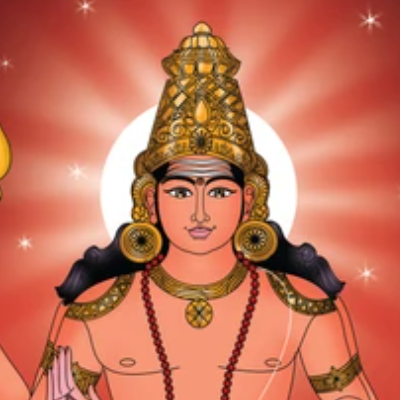
The iconographic conventions for Mangala as a Navagraha deity are well established across the temple tradition. He is depicted with a red body and red garments — the colour directly referencing both the red planet and his earth-born origin through the red soil association. He is shown with four arms, typically holding a trident or spear, a mace, a lotus, and making the gesture of granting boons. He is mounted upon a ram — the ram being his standard vehicle in the iconographic tradition — or in some depictions upon a chariot drawn by rams or horses. His overall appearance is that of a powerful warrior deity, consistent with his martial associations.
In the Navagraha panels that appear in virtually all major Hindu temples across South India and in many North Indian temples as well, Mangala is positioned according to the spatial conventions of Navagraha worship, typically facing south — the direction associated with Yama, the god of death, and with intensity and power — though the precise directional assignments vary somewhat across regional traditions. Dedicated temples to Mangala as a Navagraha deity exist across India, with the Mangalanatha temple at Ujjain in Madhya Pradesh being among the most significant, Ujjain being one of the seven sacred cities of the Hindu tradition and a major centre of astronomical and astrological learning. In South India, the Navagraha temple complex at Tirunallar in Tamil Nadu includes a shrine to Mangala, and numerous other Navagraha shrine complexes maintain dedicated Mangala shrines. Tuesday — Mangalavara — is the day on which worship of Mangala is particularly prescribed, and devotees seeking relief from astrological afflictions associated with Mars observe fasts and perform specific rituals on Tuesdays.
✦ Connection to the Wider Genealogy
Mangala occupies a structurally distinctive position in the Itihasa-Puranic genealogical tree. Through his mother Bhudevi he is connected to the earth goddess lineage — Bhudevi being one of the two principal consorts of Vishnu, the other being Lakshmi, and her identification with the earth making her a figure present across the entire breadth of the Puranic tradition as the divine ground of physical existence. Through his father Varaha he is the son of a transcendent avatara of Vishnu, which places him in a unique genealogical position as an offspring of a divine manifestation rather than of a conventionally embodied parent.
Among the Navagraha deities, Mangala is one of several who have recorded divine parentage in the Puranic tradition. Budha — the deity of the planet Mercury — is the son of Chandra, the moon deity, and Tara, the wife of the sage Brihaspati, born of their union during the episode known as the Tarakamaya war, making Budha the grandson of Atri and Anasuya through Chandra's lineage. Shani — the deity of the planet Saturn — is the son of Surya, the sun deity, and Chhaya, the shadow-form of Surya's wife Sangya. These genealogical connections among the Navagraha deities form a distinct sub-network within the wider Puranic genealogical tree, intersecting with the Kashyapa lineage, the Atri lineage, and the Varaha avatara cluster at different points.
✦ References
- Primary Sources:
- Skanda Purana — records the birth of Mangala as the son of Varaha and Bhudevi following the rescue of the earth from Hiranyaksha; one of the principal Puranic sources for this parentage.
- Brahma Purana — confirms the birth of Mangala from Bhudevi after her rescue by Varaha; contributes to the multi-textual attestation of this parentage.
- Matsya Purana — identifies Bhauma as born of Bhudevi following her rescue, confirming the Varaha-Bhudevi parentage in a third major Puranic source.
- Varaha Purana — frames its contents as a discourse of Varaha to Bhudevi and provides the theological background of their relationship underpinning the birth narrative of Mangala.
- Agni Purana — references Mangala among the Navagraha deities and contributes to the systematic Puranic treatment of the planetary deities.
- Shiva Purana — presents the variant account of Mangala's origin from Shiva rather than from Varaha and Bhudevi; this account is specific to the Shaiva tradition and is not consistent with the Vaishnava Puranic accounts.
- Brihat Parashara Hora Shastra — the foundational text of Parashari Jyotisha attributed to the sage Parashara; identifies the presiding deity of the planet Mars as Bhauma son of Bhumi; assigns Mangala specific astrological characteristics, sign lordships, exaltation, and debilitation positions; is the primary astrological textual source for Mangala's role among the Navagrahas.
- Secondary Sources:
- Vettam Mani, Puranic Encyclopaedia (Motilal Banarsidass, 1975) — provides a consolidated entry on Mangala with cross-references to relevant Puranic passages and a summary of the principal birth narrative.
- David Frawley, Planets in the Vedic Astrology — provides context for Mangala's role and characteristics within the Jyotisha tradition and his identification as Bhauma son of Bhumi.
- Wisdomlib (wisdomlib.org) — provides indexed references to Mangala and Bhauma across multiple Puranic texts with verse-level citations useful for cross-referencing the birth narrative and the Navagraha context.