
About
Jwalini — Consort of Mangala
Jwalini · Jwala · Shakti of Mangala
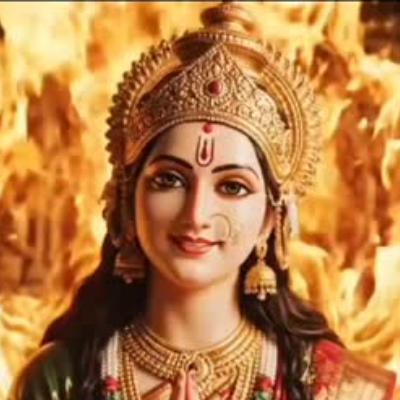
Jwalini is identified in certain Puranic texts as the consort of Mangala, the red planet deity and son of Varaha and Bhudevi. Her name derives from the Sanskrit root jwal meaning to blaze or burn, and she is understood as a being of fiery nature consistent with Mangala's own associations with fire, red colour, and intense energy. Jwalini is a figure of limited textual attestation — she appears in connection with Mangala in a small number of Puranic and astrological sources and is not the subject of independent narrative episodes in any major text. The profile that can be constructed for her from the primary sources is accordingly brief, and this brevity reflects the actual state of the textual evidence rather than any gap in research.
✦ The Name
Jwalini is a feminine form derived from the Sanskrit root jwal, meaning to blaze, burn, or flame. The name denotes one who blazes or one who is characterised by flame and burning light. It is consistent with the fiery associations of her consort Mangala, whose planet is associated with the element fire, whose body is described as red like burning coal, and whose names Angaraka and Lohitanga similarly evoke fire and redness. The name Jwala — the shorter form — is used in some texts as a variant designation. As the consort of a Navagraha deity, Jwalini is also understood in the broader Shakta theological framework as the Shakti — the feminine divine power — of Mangala, the active energy that complements and enables the planetary deity's cosmic function.
✦ Lineage
- Consort: Mangala — also known as Bhauma, Kuja, and Angaraka, the presiding deity of the planet Mars, son of the earth goddess Bhudevi and of Vishnu in his Varaha avatara form; one of the nine Navagraha planetary deities of the Hindu tradition.
✦ Textual Attestation and Its Limits
Jwalini is named as the consort of Mangala in texts within the Navagraha worship tradition, where the consorts of the planetary deities are listed alongside the deities themselves as part of the complete iconographic and ritual programme of Navagraha veneration. These listings appear in certain Puranic and Agamic texts that codify the forms, attributes, vehicles, consorts, and directional assignments of the nine planetary deities for the purposes of temple installation and ritual worship. In this context Jwalini functions as a ritual and iconographic complement to Mangala rather than as a figure with her own independent narrative.
No independent birth narrative, genealogical lineage, or narrative episode is recorded for Jwalini in any primary text currently available to this reference. Her parentage is not stated in the sources that name her as Mangala's consort, and no children of Jwalini and Mangala are recorded in the primary Puranic literature. The profile that the primary sources support for this figure is therefore limited to her identity as Mangala's consort and the meaning of her name, and any elaboration beyond these points would go beyond what the textual evidence sustains.
✦ Iconography
Where Jwalini is depicted in the iconographic tradition of Navagraha worship, she appears alongside Mangala in the context of the complete Navagraha panel or shrine complex. Her depiction follows the general convention for the consorts of planetary deities — seated beside or near the primary deity, with attributes and colouration consistent with those of her consort. Given the fiery and red associations of Mangala, Jwalini's iconographic form where it appears reflects these qualities. The specific details of her iconographic conventions are not elaborated upon with the same degree of canonical precision as those of Mangala himself in the primary Agamic texts consulted.
✦ Connection to the Wider Genealogy
Jwalini's connection to the wider Itihasa-Puranic genealogical tree is solely through her consort relationship with Mangala. Mangala himself is the son of Bhudevi, the earth goddess and principal consort of Vishnu, and of Varaha, the boar avatara of Vishnu, placing Mangala within the Vaishnava divine lineage. Jwalini enters the genealogical tree as Mangala's consort and does not connect to any other established lineage through her own parentage, as that parentage is not recorded in the available primary sources. In a genealogical reference system she is appropriately represented as a spouse node linked to Mangala, with a clear notation that her own lineage is not recorded in the primary texts.
✦ References
- Primary Sources:
- Puranic and Agamic Navagraha texts — certain Puranic and Agamic texts codifying the iconographic and ritual programme of Navagraha worship list Jwalini as the consort of Mangala alongside listings of the consorts of the other eight planetary deities; these texts provide the name and the consort identification but do not elaborate upon her independent narrative or genealogy.
- Secondary Sources:
- Vettam Mani, Puranic Encyclopaedia (Motilal Banarsidass, 1975) — consulted for cross-references to Mangala and his consort; the entry on Mangala provides the principal genealogical context within which Jwalini appears.
- Wisdomlib (wisdomlib.org) — consulted for indexed references to Jwalini and Mangala across Puranic texts; confirms the limited textual footprint of Jwalini as an independently attested figure beyond her identification as Mangala's consort.