
About
Utkaca — Daitya Son of Hiranyaksha, Previous Life of Sakatasura
Utkaca · Utkaca Daitya · Sakata · Sakatasura · Shatakasura
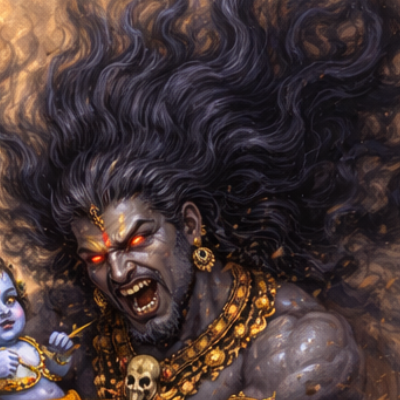
Utkaca is a Daitya — a member of the race of powerful demonic beings descended from the sage Kashyapa and his wife Diti — who appears principally in the Garga Samhita, a Vaishnava text devoted to the glorification of Krishna and the narration of his childhood and youth. Utkaca is identified in that text as a direct son of Hiranyaksha, the mighty Daitya lord born of Kashyapa and Diti who conquered the three worlds and was slain by Vishnu in his Varaha avatara. Utkaca's own story is one of arrogance, divine punishment, prolonged ghostly existence, and ultimate spiritual liberation — a narrative arc that the Garga Samhita presents as culminating in the Dvapara Yuga when the infant Krishna, by the touch of his foot, destroys the cart-demon Sakatasura, who is identified as Utkaca reborn in that ghostly form. The Utkaca-Sakatasura episode is thus a story of two connected lives: a powerful Daitya cursed into disembodiment, and the redemption of that cursed soul through contact with the divine.
✦ The Name
The name Utkaca is formed from Sanskrit elements suggesting something that is raised, prominent, or lifted — carrying connotations of pride, elevation, and distinction. As an Asura designation it may reflect his status as the son of one of the most powerful Daitya lords of the tradition. The name Sakata, which he assumes in his reborn ghostly form, means cart or wagon in Sanskrit, referring to the form he takes to attack the infant Krishna. The compound Sakatasura combines sakata with asura, meaning the cart-demon. The variant Shatakasura, appearing in some texts, is a phonological variation of the same name. The name Videha — meaning bodyless — is applied to Utkaca's condition following the curse of Lomasha, describing his state as a being stripped of his physical form and existing as an invisible entity composed of air.
✦ Lineage
- Father: Hiranyaksha, a Daitya of immense power, son of the sage Kashyapa and his wife Diti, daughter of the patriarch Daksha. Hiranyaksha conquered the three worlds, dragged the earth to the bottom of the cosmic ocean, and was ultimately slain by Vishnu in his Varaha — divine boar — avatara. He is celebrated as one of the mightiest of all Daitya lords in the Bhagavata Purana and other Puranic texts.
- Paternal uncle: Hiranyakashipu, the elder or prominent brother of Hiranyaksha, likewise a son of Kashyapa and Diti. Hiranyakashipu was a supreme Daitya sovereign who performed extraordinary austerities, obtained near-invincibility from Brahma, and ruled the three worlds until he was destroyed by Vishnu in his Narasimha — man-lion — avatara. He is the father of the great devotee Prahlada.
- Ancestral lineage: The Daitya race, originating with Kashyapa and Diti. The Daityas are the elder demonic cousins of the Devas, sharing the same father Kashyapa but born of the different mother Diti rather than Aditi.
✦ Character and Early Life
The Garga Samhita presents Utkaca as a Daitya of exceptional physical power who took great pride in the might and status of his father Hiranyaksha and his uncle Hiranyakashipu — two of the most feared and celebrated figures in the demonic tradition. This pride, rooted in his birth into one of the most powerful Daitya families, manifested as arrogance and a disregard for the boundaries and sanctities observed by others. His character in youth is thus defined by the combination of genuine power and the spiritual defect of pride that the Puranic tradition consistently identifies as the primary vulnerability of the Asura class — the quality that leads them, despite their formidable strength, into acts that bring about their downfall.
✦ The Curse of Sage Lomasha
The pivotal event of Utkaca's first life is his encounter with the sage Lomasha. While wandering, Utkaca entered the hermitage of Lomasha — an ascetic sage whose ashram represented a space of sacred calm and disciplined spiritual practice. Acting out of pure arrogance and with no purpose beyond the assertion of his own power, Utkaca began breaking and trampling the trees within the hermitage, destroying the carefully tended natural environment of the ashram.
It should be noted that the Lomasha who appears in the Garga Samhita is to be distinguished from the sage Lomasha of the Mahabharata, who serves as the guide of the Pandavas during their forest exile. The name Lomasha is borne by more than one sage in the tradition, and the Garga Samhita's Lomasha belongs to a separate narrative context.
Enraged by the senseless destruction of his hermitage, Lomasha pronounced a curse upon Utkaca. The curse was that Utkaca would become videha — bodyless. Immediately upon the pronouncement of the curse, Utkaca's immense physical body disintegrated, and he was reduced to a ghostly existence as an invisible being composed of air, deprived of the physical form that had been the source of his pride and power. The loss of the body was thus a punishment that struck directly at the quality — physical strength and pride in that strength — that had led to the offence.
When Utkaca, now in his disembodied state, begged Lomasha for mercy, the sage was pacified. He modified the curse with a prophecy of redemption: in the Dvapara Yuga, the supreme Lord Krishna would touch Utkaca with his foot, and through that divine contact Utkaca would be liberated from the curse and attain spiritual redemption. This prophecy established the framework for the second part of Utkaca's story — his existence as the ghostly cart-demon Sakatasura and his eventual liberation at the hands of the infant Krishna.
✦ Existence as a Ghostly Being
Following the curse, Utkaca existed for an extended period — across cosmic time, until the Dvapara Yuga — as a disembodied ghostly entity. In this form he retained his demonic consciousness and his capacity for malevolent action, but was deprived of the physical body that had defined him as a Daitya. This intermediate state — between the full embodied existence of a Daitya and the liberation that Lomasha had prophesied — is characteristic of a class of beings in the Puranic tradition who exist in ghostly or subtle-body form as a consequence of curses or unresolved karma, awaiting the specific condition that will dissolve their bondage.
✦ Alignment with Kamsa and the Attack on Krishna
In the Dvapara Yuga, the ghostly Utkaca aligned himself with King Kamsa — the tyrannical ruler of Mathura and the maternal uncle of Krishna, who had received a prophecy that the eighth son of his cousin Devaki would bring about his death. Kamsa, in his campaign to destroy Krishna, employed various demonic agents to kill the divine child. Utkaca, in his ghostly disembodied state, presented himself as a suitable instrument for this purpose.
The strategy Utkaca adopted was to take the form of a heavy wooden cart — a sakata — and position himself near the infant Krishna in Gokula, the settlement of cowherds where Krishna's foster parents Nanda and Yashoda lived. Krishna at this time was approximately three months old. The infant was placed beneath the cart to rest in its shade, a common practice in the pastoral setting of Gokula. Utkaca, inhabiting the form of the cart and using his ghostly power to invest it with demonic force, intended to crush the divine child beneath its weight.
✦ Liberation by the Infant Krishna
As the infant Krishna lay beneath the cart, he stirred and kicked upward with his small foot — an act described in the Garga Samhita and related texts as a playful and apparently effortless movement of a three-month-old child. The kick, though outwardly the gesture of an infant, carried the full divine power of the Supreme Lord. The cart shattered instantly and completely, its pieces flying in all directions with tremendous force. The ghostly being inhabiting the cart — Utkaca-as-Sakatasura — was destroyed in the same moment.
The destruction of the cart-demon fulfilled precisely the prophecy that Lomasha had made at the moment he modified his curse: that Utkaca would be liberated when touched by the foot of the Supreme Lord Krishna in the Dvapara Yuga. The touch of Krishna's foot — even the touch of an infant's kick — constituted the divine contact that dissolved the curse and freed the soul of Utkaca from its long disembodied bondage. Following this liberation, Utkaca's soul attained spiritual redemption.
✦ Textual Variants and Inconsistencies
The Bhagavata Purana, one of the most authoritative texts of the Vaishnava tradition, narrates the episode of the cart-demon's destruction by the infant Krishna in considerable detail. However, the Bhagavata Purana's account does not identify the cart-demon as the reincarnation of a Daitya named Utkaca, nor does it provide the backstory of the curse of Lomasha. In the Bhagavata Purana the cart-demon episode stands as a self-contained miracle of Krishna's infancy, without the prior-life narrative that the Garga Samhita supplies. The identification of Sakatasura as Utkaca reborn, and the full narrative of the curse and its redemption, is thus specific to the Garga Samhita and the textual tradition that follows it.
Some versions of the cart-demon episode attribute the attack to a demon sent by Kamsa who takes the form of a cart, while others describe the cart itself as being animated by a ghostly or demonic presence without specifying the identity of that presence. The Garga Samhita's identification of this presence as Utkaca, son of Hiranyaksha, represents the most genealogically detailed account of the episode available in the primary sources.
✦ Theological and Philosophical Significance
The Utkaca-Sakatasura narrative is theologically significant within the Vaishnava tradition on several levels. First, it exemplifies the Puranic principle that even beings of demonic birth and demonic conduct are not permanently excluded from divine grace and liberation. Utkaca's liberation comes not through his own spiritual effort or repentance but through divine contact — the touch of Krishna's foot — which the tradition presents as sufficient in itself to dissolve even the most deeply embedded karmic bondage.
Second, the episode participates in the broader Vaishnava theological pattern in which the enemies of the Lord are granted liberation precisely through their opposition to him — a principle sometimes called shatrubhava mukti, liberation through the attitude of enmity toward the divine. Utkaca aligns himself with Kamsa and attacks the infant Krishna, but the attack itself becomes the instrument of his liberation when Krishna's divine power, expressed even through the apparently casual kick of an infant, dissolves both the demonic threat and the karmic condition sustaining it.
Third, the episode illustrates the Puranic understanding of curses as instruments of cosmic justice that carry within themselves the seed of their own resolution. Lomasha's curse is not merely punitive — it includes, at Utkaca's entreaty, a redemptive clause that ensures the punishment serves a larger soteriological purpose. The curse thus functions as a mechanism that holds Utkaca in a condition of readiness for the divine encounter that will ultimately free him.
✦ Connection to the Wider Genealogy
Utkaca stands within the Daitya dynastic tradition that originates with Kashyapa and Diti and produces the most powerful demonic sovereigns of the Puranic world. As a direct son of Hiranyaksha — the Daitya who dragged the earth to the cosmic ocean's depths and was destroyed by Vishnu as Varaha — Utkaca belongs to the first generation of Hiranyaksha's offspring. His paternal uncle Hiranyakashipu, likewise a son of Kashyapa and Diti, was the father of the celebrated devotee Prahlada and was destroyed by Vishnu as Narasimha. The family thus spans two of the most celebrated Vishnu avatara episodes in the Puranic tradition. Utkaca's own story adds a third divine encounter to this family's history: where his father was destroyed by Varaha and his uncle by Narasimha, Utkaca-as-Sakatasura is destroyed and liberated by the infant Krishna — Vishnu's complete divine descent in human form — in the Dvapara Yuga.
✦ References
- Garga Samhita: The principal primary source for the complete narrative of Utkaca — his identity as a son of Hiranyaksha, the curse of Lomasha, his existence as a ghostly being, his alignment with Kamsa, his attack on Krishna as Sakatasura, and his liberation. This text provides the most genealogically and narratively detailed account of the figure.
- Bhagavata Purana, Book X (Bala Lila section): Narrates the episode of the cart-demon's destruction by the infant Krishna without identifying the demon as Utkaca or providing the prior-life narrative; represents a significant textual variant in which the Sakatasura episode is self-contained and the Utkaca connection is absent.
- Bhagavata Purana, Book III: The principal source for the biography and lineage of Hiranyaksha, Utkaca's father, providing the account of his conquest of the three worlds and his destruction by Vishnu in the Varaha avatara.
- Vishnu Purana, Book I: Provides genealogical information on the Daitya race descending from Kashyapa and Diti, and on the figures of Hiranyaksha and Hiranyakashipu, within whose family Utkaca is situated.
- Wisdomlib — Concept of Utkaca Daitya: A modern reference resource consulted for the identification of Utkaca within the Garga Samhita and for cross-referencing the narrative details of the curse and liberation episodes.
- Vettam Mani, Puranic Encyclopaedia (1975): A modern reference work consulted for cross-checking the identification of Daitya figures and the Sakatasura episode across Puranic texts.