
About
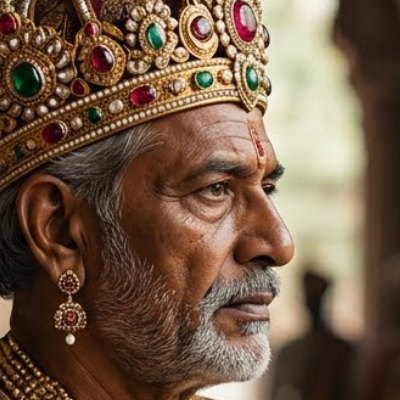
Brahmadatta — King of Kampilya, Husband of the Hundred Daughters of Kushanabha
Brahmadatta · Saumadeya (son of Somada)
Brahmadatta is a king of Kampilya recorded in the Balakanda of the Valmiki Ramayana, born to the sage Chuli through his ascetic power and to the gandharva woman Somada, who desired a son of his own glory and righteousness while remaining unmarried. He is best known for his marriage to the hundred daughters of King Kushanabha of Kanyakubja, an act through which a curse placed on the sisters by the wind god Vayu was lifted. The episode is narrated by the sage Vishvamitra to Rama at Girivraja, as part of Vishvamitra's account of his own ancestry. This Brahmadatta is to be distinguished from another king of the same name and city found elsewhere in the tradition, described as a descendant of Anuha in the Bharata line of the Solar dynasty; the two figures have entirely separate parentage and belong to different genealogical contexts.
✦ The Name
The name Brahmadatta is a Sanskrit compound of brahma, here referring to the sage Chuli's attainment of the knowledge of Brahman through his austerities, and datta, meaning "given" or "granted." The name thus signifies "given through Brahman" or "granted by the power of Brahman," reflecting the manner of his birth: Chuli produced him through the will of his mind alone, as a fruit of his ascetic power, rather than through ordinary union. The Ramayana also refers to him by the patronymic Saumadeya, "son of Somada," identifying him through his mother rather than his father, since his conception did not follow the conventional pattern of paternity.
✦ Lineage
- Father: Chuli, a brahmarshi devoted to celibate austerity in pursuit of the knowledge of Brahman, who produced Brahmadatta through the power of his mind in answer to Somada's request.
- Mother: Somada, a gandharva woman and daughter of the apsara Urmila, who served Chuli devotedly during his austerities and was granted a son by him while remaining unmarried herself.
- Wives: the hundred daughters of King Kushanabha of Kanyakubja and the apsara Ghritachi, all given to Brahmadatta in a single collective marriage ceremony.
✦ The Unusual Birth from Chuli and Somada
The Ramayana recounts that Somada, a gandharva woman and daughter of the apsara Urmila, served the sage Chuli with great devotion throughout his long austerities directed toward attaining the knowledge of Brahman. Pleased with her service, Chuli offered to grant her any wish. Somada explained that she wished to remain unmarried, yet desired a son who would possess Chuli's own glory and righteousness, and asked that such a son be given to her through the fruit of his mental power rather than through ordinary contact. Chuli consented, and by his will alone produced a son, who became known as Brahmadatta. Brahmadatta grew to rule the city of Kampilya with a splendour that the text compares to Indra's rule of heaven.
✦ Marriage to the Hundred Daughters of Kushanabha
King Kushanabha of Kanyakubja had a hundred daughters by the apsara Ghritachi, all of whom were cursed and disfigured into hunchbacks by the wind god Vayu after they refused his proposal of marriage. Seeking a means of restoring them, Kushanabha resolved to give all hundred in marriage to Brahmadatta. Brahmadatta accepted the proposal, and the marriage of all hundred sisters to him was solemnised together in a single ceremony, attended by priests and by Kushanabha's queens. As Brahmadatta took each sister's hand in turn during the rites, the curse lifted from her, and she regained her former beauty. Somada, present as Brahmadatta's mother, rejoiced at the marriage and praised her son's righteous conduct in the matter.
✦ Textual Variants and Disambiguation
A separate king named Brahmadatta of Kampilya appears in other strands of the tradition, including the Puranic Encyclopaedia's account drawn from the Puranas and a closely related genealogy in the Harivamsha's Adi Parva. That Brahmadatta is recorded as the son of Anuha and his wife Kritvi, daughter of the sage Shukra, within a Solar-dynasty lineage descending through Brihatkshatra, Suhotra, Hasti, and Ajamidha; he is also known by the name Pitridatta and is associated with a separate narrative involving a sparrow named Pujani who long dwelt in his household. The two figures share a name and a city but have entirely distinct parentage, and the primary sources do not identify them with one another.
✦ Connection to the Wider Genealogy
Through his marriage to the hundred daughters of Kushanabha, Brahmadatta becomes linked by marriage to the Amavasu branch of the Chandravamsha, the lineage of his wives' father. His own birth, however, places him outside ordinary lines of paternal descent, since he was produced by the sage Chuli's ascetic power rather than born of a union between two parents in the conventional sense. His mother Somada was herself a gandharva woman, daughter of the apsara Urmila, connecting Brahmadatta to the wider company of celestial beings who intermarry and produce offspring with sages and kings throughout the tradition.
✦ References
- Valmiki Ramayana, Balakanda, Sarga 33 (verses 1.33.1–1.33.26): primary attestation of Brahmadatta's birth to Chuli and Somada, his rule of Kampilya, and his marriage to the hundred daughters of Kushanabha.
- Valmiki Ramayana, Balakanda, Sarga 32 (verses 1.32.7–1.32.20): primary attestation of the curse placed on Kushanabha's hundred daughters by Vayu, providing the narrative context for Brahmadatta's marriage to them.
- Vettam Mani, Puranic Encyclopaedia (1975), entry on Brahmadatta: confirms the parentage from Chuli and Somada and distinguishes this Brahmadatta from the separate king of the same name descended from Anuha.
- Wisdomlib (Puranic glossary), entry on Brahmadatta: corroborates the episode's location in Balakanda Sargas 32 and 33 and the identification of his parents.