
About
Lavanasura — Asura Tyrant of Madhupuri, Slain by Shatrughna
Lavanasura · Lavana · Lavaṇasura · Lavaṇa · lord of Madhuvana
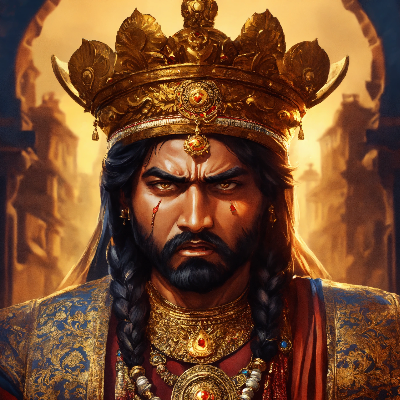
Lavanasura is an asura whose narrative occupies Sargas 60 through 70 of the Uttara Kanda of the Valmiki Ramayana. He is the son of Madhu, a pious daitya king of Madhupuri on the Yamuna river, and of Kumbhinasi, a rakshasi who stood in virtual sisterhood to Ravana, king of Lanka. Lavanasura is depicted as a figure of savage and depraved character whose cruelty stood in stark contrast to his father's renowned piety, and whose terror over the sages of the Madhuvana region provided Rama's youngest brother Shatrughna with his defining military episode in the post-war period of the epic. His death at Shatrughna's hands and the subsequent founding of Mathura on the site of Madhupuri represent the final act of armed conquest in the Ramayana tradition. The name Lavanasura is also shared by a separate figure in certain Puranas — a demon associated with the Lonar Crater in the Skanda Purana and Padma Purana — who is unrelated to the present figure.
✦ The Name
The name Lavanasura is a Sanskrit compound of lavana and asura. The element lavana means salt, and is also used in Sanskrit to mean saline, saltish, or — in a different application — elegant or charming. The Grokipedia account of regional folk tradition notes that Lavanasura's association with salt is reflected in northern Indian lore around Mathura, where he is characterised as a salt-associated demon. The suffix asura denotes a powerful supernatural being of antagonistic disposition. The figure is also referred to simply as Lavana throughout the Uttara Kanda text, with the full compound Lavanasura functioning as an epithet emphasising his demonic status. A source from The Viral Express notes a tradition in which the name Lavana was originally his given name and Lavanasura was appended on account of his evil deeds, though this interpretation of the name as earned rather than given is not confirmed in the primary text.
✦ Lineage
- Father: Madhu — a daitya king of Madhupuri on the banks of the Yamuna, renowned for his compassion toward brahmanas and his personal friendships with the devas. Shiva granted Madhu a portion of his own divine trident as a gift. Madhu surrendered all his possessions including the trident to Lavanasura and drowned himself in the ocean in shame at his son's wickedness.
- Mother: Kumbhinasi — a rakshasi, daughter of the gandharva Vishvavasu and Anala, who was abducted by Madhu and became his wife. Kumbhinasi stood in virtual sisterhood with Ravana through the collateral line of Malyavan, being the granddaughter of Malyavan through Anala. In the Brahmanda Purana and Vayu Purana variants she is assigned as a daughter of Vishrava and Pushpotkata, which would make her a direct half-sister of Ravana.
- Paternal grandfather: Lola — identified in the Vayu Purana tradition as the father of Madhu. No further information about Lola is available in the primary or secondary sources consulted.
- Maternal grandfather: Vishvavasu — a gandharva, father of Kumbhinasi by Anala, according to the Uttara Kanda account.
- Relationship to Ravana: Lavanasura was the virtual nephew of Ravana through Kumbhinasi's collateral kinship with him. In the Puranic variant assigning Kumbhinasi as Vishrava's daughter, Lavanasura would be a direct nephew of Ravana by blood.
✦ Character and Reign of Terror
Lavanasura's character is presented in the Uttara Kanda as the inverse of his father's in every respect. Where Madhu was kind to brahmanas, maintained peace between asuras and devas, and was beloved of the gods, Lavanasura is described as violent and depraved from childhood — beating his playmates, killing them, and eating them. He inherited the divine trident along with all his father's possessions and used it to establish a reign of total terror over the Madhuvana region. The Grokipedia account of the Uttara Kanda describes his daily activities as including the devouring of sages and ascetics, the destruction of their hermitages, the disruption of sacred yajnas, and daily hunting expeditions in which he slaughtered lions, tigers, deer, and elephants by the thousands. The sages of the region were unable to perform their rites or maintain their establishments because of his continuous predations.
The trident Lavanasura wielded was the central source of his invincibility. It had been given to his father Madhu by Shiva personally, and as long as Lavanasura held it, no being — human, divine, or demonic — could overcome him. This is illustrated most dramatically by his defeat of the great solar dynasty king Mandhata. Mandhata, a descendant of the Ikshvaku line and ancestor of Rama himself, had dominated the entire earth and was sufficiently proud of his conquest to challenge Indra for dominion over the heavens. Indra responded that if Mandhata could defeat every being on earth he would concede his realm. The challenge led Mandhata to march against Lavanasura. Lavanasura wielded the trident against Mandhata's forces and reduced them to ashes. The scale of this defeat — of a chakravarti emperor who had conquered the known world — underscored the absolute invincibility conferred by the weapon.
✦ The Petition to Rama and the Choice of Shatrughna
Following Rama's return to Ayodhya and his coronation, a delegation of sages led by Chyavana — a descendant of the sage Bhrigu — came before Rama to petition him for protection from Lavanasura's continued depredations. Rama received their complaint and undertook to protect the sages and the kingdom of Madhupuri. When the question arose of which of the four brothers would be sent on this campaign, Bharata — Rama's second brother — volunteered first. Shatrughna, the youngest, then pressed his own claim, arguing that Bharata had already served Rama with great distinction during the fourteen years of exile, when Bharata had governed Ayodhya in Rama's name with sandals placed on the throne as a symbol of Rama's authority. Shatrughna argued that he had had no comparable opportunity to serve his elder brother. His appeal was accepted and all four brothers agreed that he should go.
Rama gave Shatrughna a divine arrow — the same celestial weapon originally created by Vishnu for the slaying of the primordial asuras Madhu and Kaitabha at the beginning of creation — and briefed him on the critical weakness in Lavanasura's invincibility. Lavanasura's power depended entirely on the trident; when he left his residence for his daily hunt, he left the trident behind. Rama instructed Shatrughna that he must challenge and engage Lavanasura before the demon returned home and could retrieve the weapon. Rama also had Shatrughna crowned as the designated king of Madhupuri before departure, indicating the intention to establish legitimate governance on the site after the demon's destruction.
✦ The Journey and the Night at Valmiki's Hermitage
The Uttara Kanda records that on his march toward Madhupuri, Shatrughna halted at the hermitage of the sage Valmiki. It was at this hermitage, on the very night of Shatrughna's arrival, that Sita — who had been banished by Rama from Ayodhya and had taken refuge with Valmiki after his rejection of her — gave birth to her twin sons Lava and Kusha. Shatrughna encountered the newborn sons and gifted them new garments before continuing his march. This juxtaposition within the Uttara Kanda of the birth of Rama's heirs with the departure of his youngest brother on a mission of conquest is one of the most structurally significant moments of the post-war narrative sequence.
✦ The Battle and Death of Lavanasura
Shatrughna arrived at Madhupuri with a large army but positioned himself alone at the gate of Lavanasura's residence when the demon was away on his daily hunt. When Lavanasura returned — described as returning with animals for his meal — he encountered Shatrughna's challenge. The demon, accustomed to easy victories, was reportedly pleased by the prospect of combat, viewing it as an opportunity for sport combined with sustenance. He engaged Shatrughna immediately. The battle was fierce and Lavanasura is described as uprooting trees and hurling them at Shatrughna. At the decisive moment, when Lavanasura attempted to retrieve his trident, Shatrughna prevented him from doing so. Without the weapon, Lavanasura was vulnerable. Shatrughna then deployed the divine arrow given to him by Rama — the weapon of Vaishnava potency — and struck Lavanasura through the heart, killing him. One secondary account notes that Shatrughna was briefly rendered unconscious during the combat, regaining his strength through the efficacy of the divine weapon.
Following the death of Lavanasura, the assembled devas congratulated Shatrughna on his victory and the restoration of cosmic order in the region. Shatrughna requested possession of the city and its territory, which the celestials granted. He cleared and embellished the edifices of the former demon's domain and established his base in the city during the month of Shravana. He ruled the kingdom, which came to be known as Mathura, for fourteen years before returning to Ayodhya.
✦ Connection to the Founding of Mathura
The Wikipedia article on Mathura records that the city's traditional foundation is attributed to Shatrughna's conquest of the Madhuvana site following Lavanasura's death. The site is described as having been called Madhuvan on account of its dense forest, then Madhupuri as a city, and eventually Mathura. The Jatland wiki article records the city's alternate names as Lavanapura, reflecting the association with Lavanasura's occupation of the site. The Archaeological Survey of India plaque at the Mathura Museum also records that Shatrughna's slaying of Lavanasura and his claiming of the land is attested in the Ramayana, making Mathura one of the few Indian cities whose legendary foundation is traceable to a specific episode in an ancient primary text. The Varaha deity given to Shatrughna by Rama — which had been brought to Ayodhya after Rama's defeat of Ravana — was installed at Mathura by Shatrughna and continues to be worshipped there.
✦ Textual Variants
The mainstream account of the Uttara Kanda is consistent across the secondary sources in attributing the trident to Madhu as its original recipient from Shiva, and Lavanasura as the one who inherited it. However, one secondary account from The Viral Express states that Lavanasura himself performed intense penance and obtained Shiva's invincible trident directly — a variant that conflicts with the standard Uttara Kanda account but may reflect a divergent regional or Puranic tradition. This variant is noted here without endorsement, as the primary text tradition is clear that the trident belonged originally to Madhu.
The Grokipedia account notes that a separate demon named Lavanasura — with entirely different parentage and context — appears in variants of the Skanda Purana and Padma Purana in connection with the Lonar Crater, where Vishnu manifests as Daityasudana to defeat him. This is a distinct figure and should not be conflated with the Uttara Kanda Lavanasura. The Kamba Ramayana contains a further variant according to which Madhu himself was killed by Shatrughna rather than having drowned voluntarily — conflating the fates of Madhu and Lavanasura in that recension.
✦ Cultural Tradition
The Grokipedia entry notes that Lavanasura features in Kathakali performance traditions through the play Lavanasuravadham, composed by Palakkattu Shersri Amritha Sastrikal, in which he is enacted as a trident-wielding tyrant whose ferocity and inevitable destruction are rendered through the classical mudra and abhinaya vocabulary of that tradition. Regional folk tradition in the Mathura area preserves memory of Lavanasura as the demonic occupant of Madhuvan whose presence gave the locality its more sinister pre-urban character before Shatrughna's conquest and the city's establishment.
✦ References
Primary Sources
- Valmiki Ramayana, Uttara Kanda, Sargas 60–70 — the primary source for the entire Lavanasura narrative: the petition of the sages led by Chyavana, the selection of Shatrughna, the journey via Valmiki's hermitage, the strategy of catching Lavanasura without his trident, the battle, and the founding of Mathura.
- Valmiki Ramayana, Uttara Kanda, Sarga 25 — establishes the genealogical background through the account of Kumbhinasi's intercession with Ravana for Madhu's life, and thus Lavanasura's virtual kinship with Ravana's clan.
- Kalidasa, Raghuvansha, 15.15 — cites Lavanasura as the son born of Kumbhinasi's womb, attesting his presence in classical Sanskrit literature outside the Valmiki corpus.
- Kamba Ramayana (Tamil) — contains a variant in which Shatrughna slays Madhu himself rather than Lavanasura being treated as a figure distinct from his father, collapsing the two generations.
- Skanda Purana and Padma Purana — contain a separate demon named Lavanasura associated with the Lonar Crater who is unrelated to the Uttara Kanda figure; noted for the purposes of disambiguation only.
Modern Reference Works
- Wikipedia, "Lavanasura" — provides the standard summary of the Uttara Kanda narrative drawing directly from the Valmiki text; records the key details of Madhu's character, Lavanasura's inheritance of the trident, Mandhata's defeat, the strategy of Shatrughna, and the slaying.
- Wikipedia, "Shatrughna" — records Shatrughna's role in killing Lavanasura as his chief exploit and notes his subsequent reign as king of Madhupura, with his sons Subahu and Shatrughati as his successors.
- Wikipedia, "Mathura" — records the traditional founding of Mathura by Shatrughna after the defeat of Lavanasura, citing the ASI plaque at the Mathura Museum.
- Wikipedia, "King Mandhata" — records Lavanasura's defeat of Mandhata's army with the divine trident, providing context for the demon's supremacy before Shatrughna's campaign.
- Grokipedia, "Lavanasura" — the most detailed secondary account; covers the genealogy, the tyranny over Madhuvana, the Mandhata episode, the strategy of Shatrughna, the post-battle founding of the city, and the Kathakali performance tradition; notes the separate Puranic Lavanasura of the Lonar Crater.
- Wisdomlib, "Lavanasura: 2 definitions" — provides the Sanskrit dictionary entry and the Puranic encyclopaedia entry for Lavanasura as an asura associated with the Yamuna region and Shatrughna's campaign.
- Kamakoti.org, Essence of Valmiki Uttara Ramayana — provides chapter-by-chapter summary of the Uttara Kanda confirming the sarga-level structure of the Lavanasura episode (Sargas 60–69) and the subsequent establishment of Shatrughna's rule.