
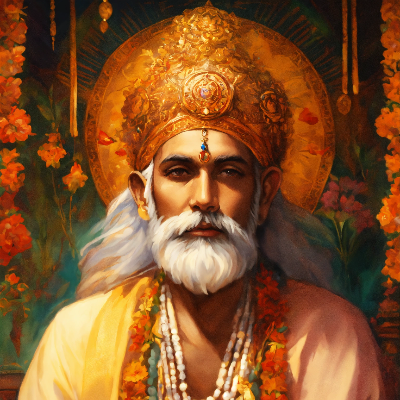
About
Vishvakarma Prajapati — Divine Craftsman, Architect of the Gods, Father of Samjna, Barhishmati, and Surupa
Vishvakarma · Vishvakarman · Vishvakarmaprajapati · Vishvakarma Bhauvana · Tvashtr (in partial identification)
Vishvakarma is the divine craftsman and architect of the gods in the Hindu tradition, one of the most consistently attested creative and technical deities across the Vedic, Puranic, and epic literature. He is credited with fashioning the celestial weapons, chariots, palaces, and cities of the divine order, and with the architectural construction of the great mythological cities of Lanka, Dvaraka, and Indraprastha. He is the father of Samjna — wife of Vivasvat the sun-god and mother of Manu Vaivasvata, Yama, and the Ashvins — and of Barhishmati and Surupa, both of whom became wives of Priyavrata, the eldest son of Svayambhuva Manu. His parentage, identity, and relationship to other divine craftsman figures varies significantly across the primary sources, making him one of the most genealogically complex figures in the tradition. The Bhagavata Purana, Canto 5, calls him Vishvakarma Prajapati when naming him as the father of Barhishmati; the Puranic Encyclopaedia of Vettam Mani places him as the son of Prabhasa, the eighth Vasu, and his wife Yogasiddha; while in the oldest Vedic usage the name Vishvakarman functions as an epithet of the universal creative deity identified with Prajapati and not with the craftsman Tvashtr. All of these layers are present in the tradition and are addressed below.
✦ The Name
The name Vishvakarma or Vishvakarman is a compound of vishva, meaning all or universal, and karma or karman, meaning work, action, or making, yielding the meaning of the all-maker, the universal creator, or the one who performs all works. In the Rigveda, the name appears in two late hymns — Rigveda 10.81 and 10.82 — where it designates a universal divine figure identified with the creative principle itself, described as the all-seeing deity with eyes, faces, arms, and feet on every side who fashioned heaven and earth and who is the universal Father and Generator. This Rigvedic Vishvakarman is explicitly associated with Prajapati — the lord of creatures — rather than with the craftsman deity Tvashtr, who is separately named in the Vedic texts as the fashioner of specific divine implements. The Brahmanas call this figure Vishvakarma Bhauvana, identifying him as a son of Bhuvana. In the later Puranic tradition, the Prajapati identification and the craftsman function gradually merged, producing the figure of Vishvakarma as both the divine architect and a creative progenitor simultaneously.
✦ Lineage
- Father (Puranic account): Prabhasa — the eighth of the eight Vasus, a class of elemental divine beings; according to the Vishnu Purana, Mahabharata, and the Puranic Encyclopaedia, Vishvakarma is the son of Prabhasa and his wife Yogasiddha. This is the most detailed genealogical statement in the primary Puranic sources.
- Father (alternative Puranic account): Vastu — identified as his father in some Puranic texts, where Vastu is a deity of architecture and dwelling; this account does not specify Vastu's own parentage consistently.
- Father (Vedic account): Bhuvana — named as his father in the Brahmana literature, where he is called Vishvakarma Bhauvana.
- Mother: Yogasiddha — named in the Vishnu Purana and the Puranic Encyclopaedia as the wife of Prabhasa Vasu and the mother of Vishvakarma; she is described as the sister of Brihaspati, the divine preceptor, and as one who had attained Yogasiddhi — union with the universal soul — and who travelled throughout the world.
- Wife: Ghritachi — a celestial Apsara named as the wife of Vishvakarma in the Vamana Purana; her parentage is not specified in the sources consulted.
- Daughters: Samjna — wife of Vivasvat the sun-god, mother of Manu Vaivasvata, Yama, and Yami, and indirectly through Chaya her shadow also the mother of Shani; Barhishmati — wife of Priyavrata, mother of his ten sons who became island-kings and his daughter Urjasvati; Surupa — second wife of Priyavrata, mother of his three sons Uttama, Tamasa, and Raivata who became lords of the third, fourth, and fifth Manvantaras; and Chitrangada — named in several sources as a fourth daughter, though her narrative is not elaborated in the primary sources consulted.
- Sons (in the tradition that gives him sons): The Vishvakarma community tradition names five sons — Manu, Maya, Tvashtr, Shilpi, and Vishvajna — each understood as the progenitor of one of the five craft lineages. This tradition is more developed in community and devotional literature than in the principal Mahapuranas.
✦ Vishvakarma in the Vedic Tradition
The two Rigvedic hymns dedicated to Vishvakarman — 10.81 and 10.82 — present a figure of cosmic scale: the all-seeing, all-forming divine being who created heaven and earth, who is the universal Father, and who is identified with Prajapati as the generative creative principle. This Rigvedic Vishvakarman is not primarily a craftsman in the technical sense but a universal divine maker — the creative intelligence behind all form and all existence. His identification with Prajapati in this early layer of the tradition is the basis for the designation Vishvakarma Prajapati that appears in later texts such as the Bhagavata Purana. In the Brahmanas, this figure is further identified as Vishvakarma Bhauvana and is treated as the revealer of certain Vedic hymns.
Separately from this universal creative figure, the Rigveda names Tvashtr as the divine craftsman who fashions specific divine implements — Indra's thunderbolt, the cup of divine drink, the forms of living beings. In the Yajurveda's Purusha Sukta, Vishvakarman is mentioned in the context of the divine smith who originated from the cosmic being. The gradual coalescence of the cosmic Vishvakarman with the craftsman Tvashtr is a development traceable through the Brahmana and later Puranic literature.
✦ Vishvakarma's Creative Works in the Epic and Puranic Tradition
The Mahabharata, Ramayana, and Puranic literature attribute an extraordinary range of creative works to Vishvakarma. He is named as the builder of Lanka — the golden city of the Rakshasas, later ruled by Ravana — before it was given to Kubera and then seized by Ravana. He built Dvaraka, the divine city raised from the sea for Krishna and the Yadavas. He constructed Indraprastha, the capital of the Pandavas. He fashioned the Pushpaka Vimana, the aerial chariot of Kubera later taken by Ravana and used throughout the Ramayana. He crafted Indra's Vajra from the bones of the sage Dadhichi after the sage sacrificed himself for this purpose. He is credited with the Sudarshana Chakra of Vishnu and the Trishula of Shiva, both fashioned from the excess radiance trimmed from the solar disc of Vivasvat when Samjna could no longer bear his brightness. He is named as the father of the monkey architect Nala, who built the bridge to Lanka for Rama in the Ramayana.
✦ The Samjna Episode
The most narratively significant episode involving Vishvakarma in the primary sources is the story of his daughter Samjna and her marriage to Vivasvat the sun-god. The Vishnu Purana and Bhagavata Purana narrate that Samjna, unable to bear the overwhelming radiance of her husband Vivasvat, secretly created a shadow duplicate of herself — Chaya — to remain in her place, and fled to her father's house and then to the northern wilderness in the form of a mare. When Vivasvat eventually discovered the deception, he went to Vishvakarma in anger. Vishvakarma, taking responsibility for the situation as the one who had given his daughter to so radiant a husband, placed Vivasvat's solar disc on his lathe and trimmed away one eighth of his excessive radiance. From the trimmed solar material Vishvakarma fashioned several divine weapons and objects, including Vishnu's Sudarshana Chakra and Shiva's Trishula. Samjna then returned to her husband. This episode establishes Vishvakarma directly as the father-in-law of Vivasvat the sun-god and the maternal grandfather of Manu Vaivasvata, Yama, Yami, and the Ashvins.
✦ Textual Variants and Inconsistencies
The parentage of Vishvakarma is the most significant inconsistency across the primary sources. The Mahabharata and Harivamsha name him as the son of Prabhasa Vasu and Yogasiddha. The Vishnu Purana concurs with this identification. The Puranas in general name his father variously as Vastu or Brahma. The Brahmana literature calls him Vishvakarma Bhauvana, son of Bhuvana. These are not reconcilable as a single consistent genealogy, and they reflect the coalescence of several distinct divine figures — the Rigvedic cosmic Vishvakarman, the Brahmanic Vishvakarma Bhauvana, and the Puranic craftsman Vishvakarma — into a single named deity over the course of the tradition's development.
The relationship between Vishvakarma and Tvashtr is the second major inconsistency. In the oldest Vedic sources they are distinct figures with different functions and different genealogical positions. In later texts — particularly the Vamana Purana — they are partially or fully identified, with Tvashtr's son Vishvarupa and daughter Saranyu sometimes attributed to Vishvakarma when the identification is operative. Your tree correctly maintains them as separate figures, which is the more rigorous position.
The number and names of his daughters also varies: the Puranic Encyclopaedia names four — Samjna, Chitrangada, Surupa, and Barhishmati; the Wikipedia article on Vishvakarma names three — Barhishmati, Samjna, and Chitrangada — omitting Surupa; and the Bhagavata Purana Canto 5 mentions only Barhishmati by name in the context of Priyavrata's marriage. No single primary source provides the complete list of four daughters together.
✦ Note on the Placement Under Brahma in This Lineage Tree
The placement of this node under Brahma in the lineage tree reflects the Prajapati identity that the Bhagavata Purana assigns when calling him Vishvakarma Prajapati in Canto 5 — a designation that in Puranic usage consistently implies a figure operating as a direct agent of Brahma's creative order. The Rigvedic identification of Vishvakarman with Prajapati further supports this placement at the level of Brahma's creative emanations. It should be noted honestly that the Vishnu Purana and the Puranic Encyclopaedia place his biological parentage through Prabhasa Vasu and Yogasiddha, which would situate him genealogically under the Vasu lineage rather than directly under Brahma. Both placements have primary source support; the Brahma placement is adopted here on the basis of his Prajapati designation and his functional role as a progenitor at the cosmogonic level.
✦ Connection to the Wider Genealogy
Through his daughter Samjna's marriage to Vivasvat, Vishvakarma is the maternal grandfather of Manu Vaivasvata — progenitor of humanity in the present Manvantara — and of Yama, the lord of death. Through Manu Vaivasvata he is an ancestor of all the royal dynasties of the Solar lineage recorded in the Puranas. Through his daughters Barhishmati and Surupa's marriages to Priyavrata, he is connected to the cosmographic act by which the seven islands of the earth were established and to the lineages of the Manvantaradhipatis — Uttama, Tamasa, and Raivata — who governed three of the fourteen Manvantaras. Through Surupa's daughter Urjasvati's marriage to Shukracharya, he is connected to the lineage of the Asura preceptor. Vishvakarma thus sits at the intersection of the solar divine lineage and the first-generation human cosmographic tradition, making him one of the most genealogically consequential figures in the Puranic system.
✦ References
- Rigveda, hymns 10.81 and 10.82: The oldest primary sources for the cosmic Vishvakarman as universal maker and Prajapati; establish the Vedic theological identity from which the later figure develops.
- Bhagavata Purana, Canto 5, Chapter 1, verse 24: Names Vishvakarma as Prajapati and father of Barhishmati, the wife of Priyavrata; the principal source for his Prajapati designation in the genealogical context.
- Vishnu Purana, Book III, Chapter 2: Narrates the Samjna episode and identifies Vishvakarma as Samjna's father and as the craftsman who trimmed Vivasvat's radiance; names him as son of Prabhasa Vasu in the genealogical scheme.
- Mahabharata, various Parvas including Adi Parva and Shanti Parva: Names Vishvakarma as chief architect of the gods, son of Prabhasa Vasu, and credits him with building the divine cities and fashioning divine weapons.
- Valmiki Ramayana, Sundara Kanda and Yuddha Kanda: Credits Vishvakarma with the construction of Lanka and names Nala as his son who built the bridge to Lanka for Rama.
- Vamana Purana: The source for Vishvakarma's wife Ghritachi and for the partial identification of Vishvakarma with Tvashtr.
- Vettam Mani, Puranic Encyclopaedia (1975), Vishvakarma entry: The most comprehensive secondary source consolidating references to Vishvakarma's daughters across Puranic sources, naming Samjna, Chitrangada, Surupa, and Barhishmati as his four daughters.
- Wikipedia, Vishvakarma article: Secondary source consolidating parentage variants across primary texts.