
About
Tumburu — Foremost of the Gandharvas, Cursed to Rakshasa Form and Freed by Rama
Tumburu · Tumbaru · Tumbura · Tumvuru · Viradha (cursed form) · lord of gandharvas · king of songs
Tumburu is the foremost musician among the gandharvas, described across the Valmiki Ramayana, the Mahabharata, the Bhagavata Purana, the Adbhuta Ramayana, the Kathasaritsagara, and numerous other texts as the supreme singer of the celestial realm. He is the son of the sage Kashyapa and his wife Pradha, and the brother of the gandharvas Bahu, Haha, and Huhu. He serves as a courtier in the courts of both Indra, king of the gods, and Kubera, god of wealth, and is regarded alongside Narada as one of the two supreme authorities on divine music. His most significant narrative episode is his transformation into the rakshasa Viradha as a consequence of Kubera's curse, and his liberation when Rama slew the rakshasa in the Aranya Kanda of the Valmiki Ramayana — making Tumburu the first figure in the epic to be liberated by Rama's intervention. He is also credited in the Kathasaritsagara with causing the separation of the king Pururavas from the apsara Urvashi through a curse. The Puranic Encyclopaedia of Vettam Mani cites him as a deva gandharva who was the best musician among all gandharvas.
✦ The Name
The name Tumburu is of Sanskrit origin and is associated in Indian musical tradition with the tumbura or tanpura — the stringed instrument fundamental to Hindustani and Carnatic classical music as a drone. The connection between the gandharva's name and the instrument is recorded in secondary commentary and in South Indian iconographic tradition, where Tumburu is typically depicted holding a veena or tumbura. The Puranic Encyclopaedia traces his name to his parentage from Kashyapa, son of Marici and grandson of Brahma. Tumburu is also referred to in some texts as a muni rather than strictly as a gandharva, indicating a degree of cross-category identification in certain recensions. He is styled king of songs alongside Narada and Gopa in various sources, and is described in the Mahabharata as leading the gandharvas in their singing.
✦ Lineage
- Father: Kashyapa — the great sage, son of Marici and grandson of Brahma, regarded as the progenitor of all living beings through his multiple wives. The Puranic Encyclopaedia specifies Tumburu's lineage as Brahma-Marici-Kashyapa, placing him three generations from the creator.
- Mother: Pradha — one of Kashyapa's wives, named specifically in the Puranic Encyclopaedia and the Tumburu Wikipedia article as the mother of the four gandharva sons Tumburu, Bahu, Haha, and Huhu. The general Puranic class genealogy names Arishta rather than Pradha as the mother of the gandharvas collectively; the Puranic Encyclopaedia's specific assignment of individual named gandharvas to Pradha represents a more granular level of genealogical specificity within the same tradition.
- Brothers: Bahu, Haha, and Huhu — the four sons of Kashyapa and Pradha collectively renowned in the Puranic Encyclopaedia for their sweet and pleasant conversation.
- Daughters: Manovati and Sukesha — described in the Tumburu Wikipedia article as two daughters of Tumburu called collectively the Pancacudas, who are said to ride the sun's chariot in the months of Chaitra and Madhu. No further details about their mothers or narratives are given in the sources available.
✦ Musical Preeminence and the Rivalry with Narada
Tumburu's reputation as the supreme musician of the divine realm is established across multiple texts. The Mahabharata places him as a courtier of both Indra at Sabha Parva 7.14 and Kubera at Sabha Parva 10.26. His songs are described in the Vana Parva as being heard from the Gandhamadana mountain on full-moon days, where he performed as a devotee and worshipper of Kubera. The Adbhuta Ramayana records that Tumburu was identified by Vishnu as dearer to him than Narada because Tumburu loved songs of praise, whereas Narada was more oriented toward austerities. This assertion provoked Narada's jealousy. In seeking to surpass Tumburu, Narada was sent by Vishnu to learn from an owl named Ganabandhu. When he finally arrived at Tumburu's house to challenge him, he found Tumburu surrounded by wounded figures — the musical Ragas and Raginis, who had been injured by Narada's own inadequate renditions. Narada eventually surpassed Tumburu only after learning the seven svaras from Krishna's wives Jambavati, Satyabhama, and Rukmini.
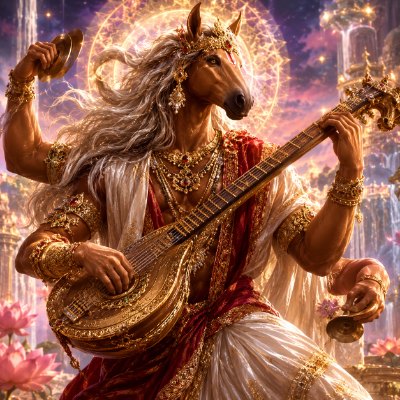
A South Indian tradition preserved in the Wikipedia article records that Tumburu once performed severe austerities in honour of Shiva, who blessed him with the ability to travel the universe, skill in music, and the privilege of residing permanently with Shiva. In South Indian iconographic representations Tumburu is typically shown as horse-faced, holding a veena in one hand and wooden cymbals in the other — the cymbals providing the rhythmic foundation for his singing.
✦ The Curse of Kubera and the Incarnation as Viradha
The Aranya Kanda of the Valmiki Ramayana, Sargas 2 through 4, records that Tumburu served in Kubera's city and was sent by Kubera to bring the apsara Rambha at a stipulated time. Tumburu failed to produce Rambha within the appointed time — the Bhagavanbhakthi secondary account adds that in some retellings he had formed an intimate relationship with an apsara, which constituted his transgression. Kubera, enraged, cursed Tumburu to be reborn as a rakshasa. When Tumburu pleaded for mercy, Kubera could not reverse the curse but granted that his liberation would come when Rama, the son of Dasharatha, slew him in the Treta Yuga.
In accordance with the curse, Tumburu was reborn as Viradha, the son of the giant Jaya and his wife Shatahrada. Viradha grew to monstrous size with two enormous arms and terrible appearance. When Rama, Sita, and Lakshmana entered the Dandaka forest during their exile, Viradha encountered them, seized Sita, and carried her on his shoulders while running. Rama and Lakshmana followed and struck off both his arms. The severing of his arms did not kill him, and the brothers consulted on how to destroy him. They chose to bury him alive, digging a deep pit into which they cast him. From within the pit, Viradha revealed to Rama his former identity as Tumburu and expressed his gratitude. Immediately upon being buried, the curse was broken: Viradha resumed the form and nature of Tumburu, emerged in celestial brilliance, and departed for Gandharvaloka.
✦ The Curse on Pururavas and Urvashi
The Kathasaritsagara records a separate episode of Tumburu's role as a curser of mortals. The lunar dynasty king Pururavas, having married the apsara Urvashi, was invited to Devaloka by Indra to assist in a battle against the asuras. During a celebratory occasion following the defeat of the demon Mayadhara, Rambha danced before her preceptor Tumburu. Pururavas found fault with her performance. Rambha, offended, challenged him to explain what he knew of divine dance. Pururavas responded that his wife Urvashi had taught him more about divine dance than Tumburu himself knew. Tumburu, angered at this disparagement, cursed Pururavas that he would live separated from Urvashi until he performed penance to Vishnu. The gandharvas then abducted Urvashi, fulfilling the curse. This episode is one of the explanations given for the Pururavas-Urvashi separation legend, which also appears in the Rigveda and the Vikramorvasiya of Kalidasa.
✦ Role in the Mahabharata
The Puranic Encyclopaedia cites five specific Mahabharata passages involving Tumburu. He attended Arjuna's birth celebrations at Adi Parva 122.54. He gifted Yudhishthira a hundred horses at Sabha Parva 52.24. He welcomed Arjuna when the latter visited Svarga to meet his father Indra at Vana Parva 43.14. He watched with keen interest Arjuna's disguised battle against the Kauravas during the Virata kingdom episode at Virata Parva 56.12. He was present at Yudhishthira's Ashvamedha yajna at Ashvamedha Parva 88.39. The Bhagavata Purana notes that Tumburu accompanied Narada on a visit to Yudhishthira's court. He also granted Arjuna his gandharva weapon and gifted war-horses to Shikhandi, the Pandava ally.
✦ Theological Significance
In the Vaishnavite devotional tradition, Tumburu's liberation through Rama's intervention at the beginning of the Aranya Kanda serves as the paradigmatic demonstration that Rama's purpose in incarnating includes the liberation of cursed celestial beings alongside the destruction of demonic forces. Tumburu is the first such liberation in the epic, preceding those of Ahalya, Kabandha, and others. In the Shaiva tradition, Tumburu's receipt of boons from Shiva following severe austerities reflects a different alignment, and his horse-faced South Indian iconographic form connects him to a class of divine musicians who are also associated with Shiva's realm. The Adbhuta Ramayana's assertion that Tumburu was dearer to Vishnu than Narada is a significant devotional claim elevating the musical mode of worship above the ascetic mode, a position consistent with the bhakti orientation of that text.
✦ References
Primary Sources
- Valmiki Ramayana, Aranya Kanda, Sargas 2–4 — the primary source for the Viradha episode; records Tumburu's curse by Kubera, his rebirth as Viradha, the encounter with Rama and Lakshmana, the severing of his arms and burial, his self-identification, and his liberation and return to Gandharvaloka.
- Mahabharata, Sabha Parva, Chapters 7 and 10 — records Tumburu as a courtier of both Indra and Kubera.
- Mahabharata, Vana Parva, Chapter 159 — records that Tumburu's songs were heard from Gandhamadana mountain on full-moon days as a worshipper of Kubera.
- Mahabharata, Adi Parva, Chapter 122; Sabha Parva, Chapter 52; Vana Parva, Chapter 43; Virata Parva, Chapter 56; Ashvamedha Parva, Chapter 88 — the five specific Mahabharata passages citing Tumburu's interactions with the Pandavas.
- Adbhuta Ramayana — records Tumburu as the best of all singers, rewarded by Vishnu, and the subject of Narada's jealousy; presents the comparison of Tumburu's song-praise with Narada's austerities.
- Kathasaritsagara — records the episode in which Tumburu cursed Pururavas to be separated from Urvashi.
- Bhagavata Purana — records Narada as Tumburu's teacher; notes Tumburu's accompaniment of Narada to Yudhishthira's court.
- Vishnu Purana — records the class genealogy of gandharvas from Kashyapa and Arishta.
Modern Reference Works
- Wikipedia, "Tumburu" — the most comprehensive modern summary; covers his parentage, musical preeminence, the Viradha episode, the Pururavas-Urvashi episode, his Mahabharata appearances, his daughters Manovati and Sukesha, and his South Indian iconography.
- Wisdomlib, "Story of Tumburu" (Puranic Encyclopaedia, Vettam Mani) — provides the Puranic Encyclopaedia account with specific chapter and shloka references for all five Mahabharata passages and the genealogical statement identifying him as the son of Kashyapa and Pradha and brother of Bahu, Haha, and Huhu.
- AncientVoice Wikidot, "Gandharva" — cites the Mahabharata Sabha Parva list of gandharva chiefs in Kubera's court, placing Haha, Huhu, Tumburu, and Sailusha together as named members of the divine musical community.