
About
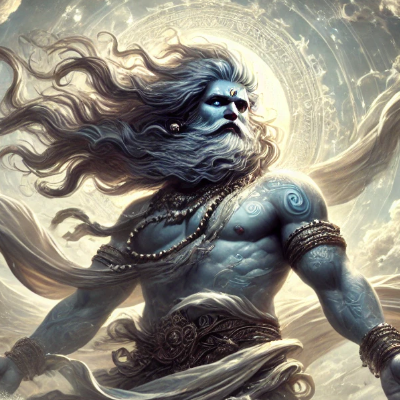
Vayu — God of Wind, Lord of Breath, Foremost of Divine Servants
Vayu · Vata · Pavana · Anila · Prana · Mukhyaprana · Tanuna · Matharishva · Maruta · Vayuvega · Gandha-vaha · Sadagati
Vayu is the god of wind and breath in the Vedic and Puranic tradition — one of the most ancient of the divine powers, attested from the earliest layers of the Rigveda and sustained as a figure of theological significance across the entire span of Hindu literature. He is simultaneously the physical wind that moves through the world, the vital breath (prana) that sustains all living beings, and a personal deity of formidable power, beauty, and devotion to Vishnu. In the Vedic cosmogony of the Purusha Sukta (Rigveda 10.90), Vayu arises from the breath of the cosmic Purusha — the primordial person whose sacrifice generates the universe — making him among the most immediate cosmic emanations in the Vedic creation framework. In the Puranic genealogical system to which this profile belongs, Vayu is placed as a son of Brahma, one of the primordial divine beings who emerge at the beginning of each cosmic cycle. His consort is Svasti (also known as Bharati or Vayupriya), identified in the Devi Bhagavata Purana as his wife and a goddess of fortune and auspiciousness. Through Svasti he is the father of Ila, the wife of Dhruva Maharaja and mother of Utkala. He is also the divine father of Hanuman (through Anjana) and of Bhima the Pandava (through Kunti) — though in this genealogical system Hanuman is placed under Anjana and Bhima under Kunti, reflecting their biological mothers' nodes. In the Madhva Vaishnava tradition, Vayu occupies a uniquely elevated theological position as Mukhyaprana — the chief vital force, the foremost of all individual souls, and the eternal intermediary through whom the grace of Vishnu reaches all other beings. His principal sources include the Rigveda, the Atharvaveda, the Shatapatha Brahmana, the Brihadaranyaka Upanishad, the Prashna Upanishad, the Mahabharata, the Ramayana, the Vayu Purana, the Bhagavata Purana, the Devi Bhagavata Purana, and the Markandeya Purana.
✦ The Name
The name Vayu derives from the Sanskrit root va, meaning to blow, and designates the blowing one or the wind itself — the name is as ancient as the Vedic language and appears in cognate forms across the Indo-European family, including in the Avestan Vayu of the Zoroastrian tradition. Vata is a closely related name from the same root, meaning the blown or the blowing, used frequently in the Rigveda as an alternative designation. Pavana — the purifier — is among his most widely used epithets, expressing his function of cleansing and purifying: the wind disperses impurities, carries away stagnation, and renews the atmosphere. It is the source of the Vaishnava devotional names Pavanaputra (son of the purifier) and Pavanasuta applied to Hanuman. Anila means the windless one or the one who is all-pervading air, used particularly in poetic and epic literature. Prana — breath or vital force — is the name that most directly connects the physical wind to the biological principle of life: the same word that denotes the wind outside the body denotes the breath within it, and Vayu as the deity of both connects cosmic and bodily vitality into a single principle. Mukhyaprana — chief vital breath or foremost of the pranas — is the specific title used in the Madhva Vaishnava tradition to designate Vayu's unique position as the supreme individual soul (jiva). Matharishva is a Vedic name of uncertain etymology, appearing in the Rigveda as a name or epithet of Vayu connected with the bringing of fire; some scholars connect it to the idea of one who grew in the mother or one connected with the cosmic womb. Gandha-vaha — carrier of fragrance — names his role in carrying the scents of flowers and earth through the world. Sadagati — ever moving — expresses his ceaseless motion as the defining characteristic of wind.
✦ Vedic Identity
Vayu is one of the most frequently invoked deities of the Rigveda, appearing in the very first hymn of the first mandala alongside Indra as a joint recipient of praise. The opening hymn of the Rigveda (1.1) praises Agni; the second hymn (1.2) is addressed to Vayu, establishing him as the first deity invoked after the fire in the Vedic liturgical order — a position of considerable theological significance. He is described in the Rigveda as swift, beautiful, and roaring; his chariot is drawn by a team of horses ranging in number from two to a thousand across different hymns, expressing his boundless speed and power. He is closely paired with Indra as an ally and companion, and several hymns are addressed jointly to the Vayu-Indra pair, reflecting a Vedic ritual custom in which Vayu drinks the soma first before Indra.
The Purusha Sukta (Rigveda 10.90, verse 13) provides the most significant cosmogonic statement about Vayu's origin: from the breath (prana) of the sacrificed cosmic Purusha, Vayu was born. This places him as the direct embodiment of the cosmic breath — the first and most fundamental of the life-sustaining forces that emerge from the primordial creative sacrifice. The same verse places the moon as born from the cosmic mind, the sun from the cosmic eye, and Indra and Agni from the cosmic mouth — situating Vayu among the most fundamental of all cosmic emanations.
In the Upanishadic literature, Vayu-as-Prana is the subject of one of the most important philosophical arguments in the tradition. The Brihadaranyaka Upanishad and the Prashna Upanishad both narrate contests in which the five pranas (vital breaths — prana, apana, vyana, udana, samana) debate which among them is supreme. Each vital breath leaves the body in turn, and it is discovered that when prana (identified with Vayu as the chief vital force) departs, all the others are compelled to depart as well — establishing prana as the foremost among vital forces and by extension Vayu as supreme among the elemental powers. This Upanishadic argument directly informs the Madhva theological elevation of Vayu as Mukhyaprana.
✦ Lineage
- Cosmic Origin (Vedic): Born from the breath of the cosmic Purusha at the primordial sacrifice — the most direct Vedic cosmogonic account of his origin, as stated in Rigveda 10.90.13. In this framework Vayu is not a created being with parents but an elemental cosmic principle that arises at the moment of the universe's differentiation from the primordial unity.
- Father (Puranic): Brahma — in the Puranic genealogical framework, Vayu is placed among the beings who arise at the beginning of each cosmic cycle through Brahma's creative activity. This genealogical placement under Brahma is the structural position adopted in this genealogical system and is consistent with the Puranic tendency to integrate cosmogonic figures into the Brahma-derived creation sequence.
- Father (Madhva tradition): Vishnu — in the Dvaita Vedanta theology of Madhvacharya, Vayu is identified as the son of Vishnu and Lakshmi, reflecting the Madhva tradition's theological assertion of Vayu's unique proximity and derivation from the supreme deity. This position is specific to the Madhva sampradaya and is noted here as a significant sectarian variant.
- Consort (primary): Svasti — also known as Swasti Devi, Bharati, and Vayupriya — identified in the Devi Bhagavata Purana as Vayu's consort and a goddess of fortune, auspiciousness, and abundance. She is described in some traditions as the daughter of Vishvakarma, the divine architect of the gods. She resides with Vayu in Vayu Loka and is described as sharing his devotion to Vishnu. In the Madhva tradition, Vayu's consort is specifically named Bharati, who is identified as a form of Saraswati and the consort of Vayu-Mukhyaprana in the cosmic hierarchy.
- Consort (Vedic): The Rigveda refers to Vayu as the son-in-law of Tvashta (Vishvakarma) — naming his wife as a daughter of the divine craftsman, which is consistent with the later Puranic identification of Svasti as Vishvakarma's daughter.
- Daughter (through Svasti): Ila — wife of Dhruva Maharaja, the celebrated royal devotee of Vishnu who was elevated to the position of the pole star (Dhruva-loka); mother of Utkala and an unnamed daughter. Identified as Vayu's daughter in Bhagavata Purana, Canto 4, Chapter 10, Verse 2. This Ila is a distinct figure from the Ila of the Lunar Dynasty — the child of Vaivasvata Manu who underwent a gender transformation and became the ancestor of the entire lunar royal line through union with Budha.
- Divine Father (through Anjana): Hanuman — the great monkey deity, foremost devotee of Rama and the most celebrated of Vayu's offspring. Born of the Apsara Anjana through Vayu's divine bestowal of his power, Hanuman is the spiritual son of Vayu and inherits his father's strength, speed, and devotion. In this genealogical system Hanuman is placed under Anjana's node. Hanuman is identified in the Madhva tradition as the first of Vayu's three great incarnations.
- Divine Father (through Kunti): Bhima — the second Pandava, son of Queen Kunti of the Kuru dynasty through Vayu's divine bestowal in response to her invocation of the mantra given to her by the sage Durvasa. Bhima inherits Vayu's prodigious physical strength and is the most powerful of the five Pandava brothers in bodily terms. In this genealogical system Bhima is placed under Kunti's node. Bhima is identified in the Madhva tradition as the second of Vayu's three great incarnations.
✦ Cosmic Role and Functions
Vayu's cosmic functions are multiple and operate at several levels simultaneously. At the physical-elemental level, he is Vayu as one of the five Panchamahabhuta — the five great elements (earth, water, fire, wind, and space) that constitute all material existence. As the wind element, he governs movement, change, and the dynamic energy that prevents the material universe from stagnating. At the biological level, he is Prana — the vital breath that animates all living beings. Without Vayu-as-Prana, no living creature can exist, which is why the Upanishadic arguments establish him as the foremost of the elemental powers: he is not merely important but foundational to all life. At the ritual level, he receives the first drink of soma in Vedic sacrifice, ahead even of Indra, establishing his ritual primacy. At the divine level, he is one of the Ashtadikpalas — the eight guardians of the eight directions — presiding over the northwest quarter, governing and protecting that portion of cosmic space.
The Vayu Purana — one of the eighteen Mahapuranas and among the oldest of the Puranas, dated by scholars to the third or fourth century CE — is narrated by Vayu himself. According to the Vayu Purana and the Markandeya Purana, a group of sages gathered at Naimisharanya (one of the most sacred forests in the Puranic tradition) and requested Vayu to answer their questions about cosmology, genealogy, and dharma. Vayu's reply constitutes the Vayu Purana — making him not merely the subject of a Purana but its divine author and narrator. This gives Vayu a unique position among the gods: while other deities are subjects of Puranas named in their honour, Vayu is the active narrator of his own Purana, delivering its cosmological and genealogical content directly to the assembled sages.
✦ Major Narrative Episodes
The Withdrawal of Breath: One of the most significant narrative episodes associated with Vayu occurs in connection with the childhood of Hanuman. When the young Hanuman, mistaking the sun for a fruit, leaps toward it and Indra strikes him down with his thunderbolt (vajra), Vayu — enraged at the injury to his son — withdraws from the universe, carrying away all breath with him. All living beings, from gods to humans to animals, begin to suffocate and die. The universe faces extinction. Brahma, Indra, and all the gods rush to Vayu, offer him honour and apologies, and Brahma himself heals and resuscitates Hanuman. Vayu then allows breath to return to the universe. This episode demonstrates both Vayu's supreme power — he alone can deprive all of life by withdrawing — and his deep paternal love for Hanuman. It also serves as the occasion for the gods to bestow upon Hanuman his many extraordinary powers and boons, making it narratively foundational for Hanuman's divine capabilities.
Vayu and the Summit of Mount Meru: The Mahabharata narrates an episode in which Vayu and Indra engage in a contest concerning the summit of Mount Meru — the cosmic mountain at the centre of the universe. Vayu applies his full force to break off the summit of Meru, but Indra's vajra prevents him. Eventually Vayu succeeds in dislodging a fragment of the summit, which flies into the ocean and becomes the island of Lanka. This episode, narrated in the Adi Parva, establishes the origin of Lanka — the island that later becomes the kingdom of Ravana and the setting of the Ramayana's climactic conflict — as the product of a cosmic contest between the wind god and the king of the gods.
Vayu in the Mahabharata War: Vayu's presence in the Mahabharata is primarily through his son Bhima, who embodies his father's wind-like speed and irresistible force throughout the Kurukshetra war. The Mahabharata repeatedly characterises Bhima as Vayu's son specifically to explain his superhuman strength and his role as the primary physical destroyer of the Kaurava forces. Through Bhima, Vayu participates in the establishment of dharma through the war's outcome.
✦ Iconography and Worship
Vayu is described in the iconographic texts as an extremely handsome deity, fair or white in complexion, with flowing garments that billow perpetually in the wind he generates. He carries a white flag or banner and a goad (ankusha) as his primary attributes in his Dikpala (directional guardian) form. In his Mukhyaprana form, worshipped in the Madhva tradition, he is depicted with a mace (gada). His vehicle in different textual descriptions is either a chariot drawn by swift horses or a deer (gazelle), the latter symbolising his speed and the graceful swiftness of the wind. He is said to reside in Vayu Loka, his divine realm, with his consort Svasti and his family.
Independent temples dedicated to Vayu are rare in the broader Hindu tradition, reflecting his status as a cosmic elemental force rather than a sectarian deity with a developed temple cult. The most prominent temple dedicated to him as Mukhyaprana is at Udupi in Karnataka — the seat of the Madhva tradition established by Madhvacharya in the thirteenth century — where Vayu is venerated in his theologically elevated Dvaita form as the foremost jiva and the mediator of Vishnu's grace. Vayu is also worshipped daily by Brahmin practitioners through the Sandhyavandanam ritual, in which Agni and Vayu are invoked three times daily as part of the foundational Vedic liturgical practice.
✦ Theological Significance — Mukhyaprana in Dvaita Vedanta
In the Dvaita Vedanta philosophy of Madhvacharya (1238–1317 CE), Vayu occupies a position of unique theological importance not found in any other major school of Hindu philosophy. Madhva identifies Vayu as Mukhyaprana — the chief of all vital forces and the foremost among all individual souls (jivas) — and places him immediately below Vishnu and Lakshmi in the cosmic hierarchy, above Brahma and all other gods. In this theological framework, Vayu is the indispensable intermediary between the supreme deity Vishnu and all other beings: Vishnu's grace cannot reach souls directly but flows through Vayu, making Vayu the necessary channel of liberation for all beings in every cosmic age. Madhva further identifies Vayu as the deity who incarnates alongside Vishnu in each cosmic age to assist in the preservation of dharma: as Hanuman in the Treta Yuga alongside Rama, as Bhima in the Dvapara Yuga alongside Krishna, and as Madhvacharya himself in the Kali Yuga. This tri-incarnation theology is specific to the Madhva sampradaya and gives Vayu a narrative and theological significance in that tradition comparable to that of Ananta Shesha in the broader Vaishnava tradition.
✦ Textual Variants and Inconsistencies
The principal textual variant concerning Vayu is his parentage. The Rigveda's Purusha Sukta presents him as arising from the breath of the cosmic Purusha — a cosmogonic emanation rather than a genealogical birth. The Puranic tradition, which tends to embed all divine figures within a genealogical framework, places him as a son of Brahma. The Madhva tradition specifically identifies his parents as Vishnu and Lakshmi, asserting his unique origin from the supreme deity as theological justification for his position as the foremost jiva. These three accounts are not reconcilable as literal genealogical statements and reflect the different theological frameworks — cosmogonic, Brahma-centred, and Vaishnava-Dvaita — in which Vayu's origin is understood.
A further variant concerns his consort. The Rigveda names Vayu as the son-in-law of Tvashta (Vishvakarma), implying a wife who is Vishvakarma's daughter but not naming her. The Devi Bhagavata Purana names this consort as Svasti. The Madhva tradition names her as Bharati, identified as a form of Saraswati. Some secondary sources treat Svasti and Bharati as the same figure under different names; others treat them as distinct. The primary sources do not definitively resolve this question.
✦ Connection to the Wider Genealogy
Vayu's genealogical connections extend across multiple traditions and lineages. Placed under Brahma in this genealogical system, he connects the primordial divine generation to the specific lineages he generates through his children. Through his daughter Ila and her marriage to Dhruva Maharaja — the great devotee of Vishnu elevated to the pole star — he connects to the line of Svayambhuva Manu, the first Manu and cosmic progenitor of humanity. Through his divine fatherhood of Hanuman, he connects to the Ramayana's divine narrative and the tradition of Vaishnava devotional service. Through his divine fatherhood of Bhima, he connects to the Pandava line of the Mahabharata and to the Kuru-Panchala genealogical world of the epic tradition. In the Madhva theological framework, Vayu's three incarnations link him structurally to both the Treta and Dvapara Yugas' avatara narratives, making him the consistent divine companion of Vishnu's descents across cosmic ages.
✦ References
Primary Sources
- Rigveda, Mandala 1, Hymn 2; Mandala 10, Hymn 90 (Purusha Sukta): The earliest and most authoritative Vedic sources for Vayu — Hymn 1.2 is the first hymn of the Rigveda addressed to Vayu and establishes his liturgical primacy; the Purusha Sukta (10.90.13) states Vayu's origin from the breath of the cosmic Purusha.
- Atharvaveda, various hymns: Contains material on Vayu as Prana and his identification with the vital breath sustaining all life; supplements the Rigvedic treatment.
- Shatapatha Brahmana: Develops the cosmological role of Vayu-as-Prana and his relationship to the sacrificial order; contributes to the theological elevation of breath as the foremost cosmic principle.
- Brihadaranyaka Upanishad and Prashna Upanishad: The primary Upanishadic sources for the philosophical argument establishing Prana-Vayu as the supreme vital force through the contest of the pranas; foundational for the Mukhyaprana theology of the Madhva tradition.
- Valmiki Ramayana, Bala Kanda and Sundara Kanda: Narrates Vayu's role in Hanuman's birth and the episode of Indra's strike upon the infant Hanuman, Vayu's withdrawal of breath from the universe, and the divine bestowal of powers on Hanuman; the primary source for Vayu's paternal relationship with Hanuman.
- Mahabharata, Adi Parva and throughout: Contains the Mount Meru episode, the account of Bhima's divine birth through Kunti and Vayu's bestowal, and the consistent characterisation of Bhima as Vayuputra throughout the epic narrative.
- Vayu Purana: One of the eighteen Mahapuranas, narrated by Vayu himself to the sages at Naimisharanya; provides cosmological, genealogical, and theological material in Vayu's own voice; one of the oldest surviving Mahapuranas.
- Bhagavata Purana, Canto 4, Chapter 10, Verse 2: The definitive source for Ila as Vayu's daughter and her identification as Dhruva's wife and Utkala's mother.
- Devi Bhagavata Purana: Identifies Svasti as Vayu's consort and provides material on her identity as a goddess of fortune and auspiciousness; the primary source for Svasti's relationship to Vayu.
- Markandeya Purana: Contains additional material on Vayu's cosmic functions and his role as narrator of the Vayu Purana tradition to the sages.
Secondary Sources
- Vettam Mani, Puranic Encyclopaedia (1975): Cross-references Vayu's appearances across epics and Puranas; useful for locating the Mount Meru episode, the genealogical material, and the variant accounts of his consort.
- Wisdomlib (wisdomlib.org), entries on Vayu, Svasti, Mukhyaprana: Provides verse-level identifications for the Bhagavata Purana and Devi Bhagavata Purana passages referenced in this profile.
- A. A. Macdonell, Vedic Mythology (1897): Provides the foundational philological analysis of Vayu's Vedic hymns, his relationship with Indra, and his position in the Vedic pantheon.
- B. N. K. Sharma, Philosophy of Sri Madhvacharya (1962): The standard scholarly treatment of Madhva's Dvaita Vedanta, including the Mukhyaprana theology and the tri-incarnation doctrine of Vayu as Hanuman, Bhima, and Madhvacharya.