
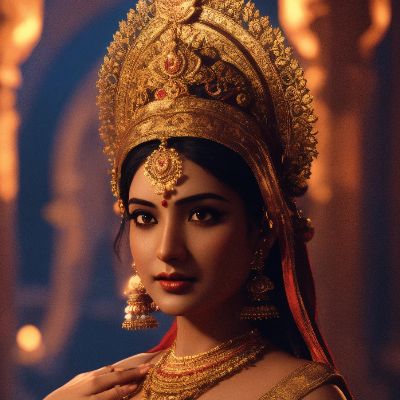
About
Ila — Daughter of Vayu and Wife of Dhruva Maharaja
Ila · Vayu-putri · Dhruva-patni · Utkala-mata
Ila was a daughter of Vayu, the Vedic and Puranic god of wind and breath, and his consort Svasti. She is identified in the Bhagavata Purana at Canto 4, Chapter 10, Verse 2 as the wife of Dhruva Maharaja — the celebrated royal devotee of Vishnu who, through the intensity of his childhood austerities performed in the forest of Madhuvana, was elevated by the grace of Vishnu to the position of Dhruva-loka, the pole star, the fixed celestial point around which the entire stellar sphere revolves. Through her marriage to Dhruva, Ila became the mother of Utkala, named in the same Bhagavata Purana verse, and of a daughter whose name is not recorded in that passage. This Ila — daughter of Vayu, wife of Dhruva, mother of Utkala — is a distinct figure from the far more extensively discussed Ila of the Lunar Dynasty tradition, who was the child of Vaivasvata Manu and underwent a celebrated gender transformation, eventually becoming the progenitor of the Lunar royal line through her union with Budha, the planet Mercury. The two figures share only a name; their parentage, narratives, and genealogical positions are entirely separate, and this profile concerns solely the Vayu-born Ila of the Dhruva narrative.
✦ The Name
The name Ila is of ancient Sanskrit origin with a range of interrelated meanings. In the Vedic tradition ila or ida denotes refreshment, food, libation, and the earth as a nourishing power — the word appears in Vedic ritual contexts as a term for the oblation offered to the gods and for the earth's life-sustaining abundance. As a divine or semi-divine name it carries connotations of fertility, nourishment, and the productive capacity of the earth. In the broader Puranic tradition the name is shared by several figures, which creates potential for confusion in genealogical analysis; careful attention to parentage and narrative context is necessary to distinguish between them. The patronymic Vayu-putri means "daughter of Vayu," the epithet Dhruva-patni means "wife of Dhruva," and Utkala-mata means "mother of Utkala" — together these relational identifiers constitute the primary coordinates through which this particular Ila is distinguished from other bearers of the same name in the tradition.
✦ Distinction from Ila of the Lunar Dynasty
Because the name Ila is shared by two significant but entirely distinct figures in the Puranic tradition, a clear statement of their differences is essential for any genealogical reference system. The Ila of the Lunar Dynasty — the more extensively treated of the two in the primary sources — was the child of Vaivasvata Manu, the progenitor of the current human race and the seventh Manu of the present cosmic cycle. That Ila's narrative involves a celebrated gender transformation: born as a son or daughter depending on the textual version, this Ila entered a forest sacred to Shiva and Parvati and was transformed into the opposite gender, subsequently living alternately as male and female through a divine arrangement. In her female form this Ila united with Budha — the planet Mercury and the son of the moon god Chandra — and from that union was born Pururavas, the first king of the Lunar Dynasty from whom the entire lunar royal line of the Mahabharata — including the Pandavas and Kauravas themselves — ultimately descends. This Ila's story is narrated in the Vishnu Purana, the Bhagavata Purana, the Mahabharata, and the Harivamsa with considerable elaboration.
The Ila of this profile shares none of these narrative elements. She is the daughter of Vayu and Svasti, the wife of Dhruva Maharaja, and the mother of Utkala. Her parentage, her husband, her offspring, and her narrative context are entirely different from those of the Manu-born Ila. The two figures are connected only by the common Sanskrit name they bear, and no genealogical or narrative relationship between them is attested or implied in the primary sources.
✦ Lineage
- Father: Vayu, the god of wind and breath, one of the most ancient Vedic divine powers and one of the Ashtadikpalas — the guardians of the eight directions — presiding over the northwest. Vayu is the animating life-force of all living beings, the divine sovereign of the breath that sustains existence. He is the father of Hanuman through his union with Anjana, the father of Bhima — the second Pandava — through his divine bestowal upon Kunti, and the father of Ila through his union with Svasti.
- Mother: Svasti, also known as Swasti Devi, Bharati, and Vayupriya, identified in the Devi Bhagavata Purana as the consort of Vayu and a goddess of fortune, good luck, and abundance. Some traditions identify her as a daughter of Vishvakarma, the divine architect of the gods.
- Husband: Dhruva Maharaja, the son of King Uttanapada — himself a son of Svayambhuva Manu, the first Manu and the progenitor of the human race in the current cosmic cycle — and his queen Suniti. Dhruva's story is among the most celebrated devotional narratives of the Bhagavata Purana: spurned by his father in childhood at the instigation of his stepmother Suruchi, Dhruva retired to the forest of Madhuvana at the age of five and performed fierce austerities in devotion to Vishnu. Vishnu appeared before him and granted him a position of cosmic permanence — the pole star, Dhruva-loka — around which the entire stellar and planetary system revolves for the duration of the cosmic cycle. Dhruva had two wives: Shambhu, the daughter of the Prajapati Shishumara, and Ila, the daughter of Vayu.
- Son: Utkala, named in the Bhagavata Purana at Canto 4, Chapter 10, Verse 2 as the son born of Dhruva and Ila. Utkala appears in the Bhagavata Purana's genealogical material as a figure of renunciant disposition — the text describes him as one who from birth showed no interest in kingship or worldly affairs, being absorbed in a condition of spiritual detachment. Because of Utkala's renunciant nature, the royal succession of Dhruva's line did not pass through him but through Dhruva's son by his other wife Shambhu.
- Daughter: A daughter of Dhruva and Ila is mentioned in the same Bhagavata Purana verse as Utkala, described as very beautiful, but her name is not recorded in that passage.
✦ Ila in the Narrative of Dhruva
The narrative of Dhruva Maharaja is told most fully in the fourth canto of the Bhagavata Purana, and it is within that canto's account of Dhruva's later life and royal career that Ila appears. The Bhagavata Purana's treatment of Dhruva distinguishes between two phases of his story: the celebrated childhood episode of his austerities and Vishnu's grace, which constitutes the devotional core of the narrative and is among the most frequently retold episodes of the Puranic tradition, and the subsequent account of Dhruva's adult life as a king, his wars, his marriages, and the births of his children. It is in this second phase — less celebrated but genealogically significant — that Ila appears as Dhruva's wife and the mother of Utkala.
The choice of Ila — a daughter of Vayu — as one of Dhruva's wives carries a certain theological resonance within the Bhagavata Purana's framework. Dhruva was a supreme devotee of Vishnu, elevated to cosmic permanence through divine grace. Vayu, in the Puranic tradition and especially in the Vaishnava devotional framework, occupies a position of particular closeness to Vishnu as the foremost of the divine servants. A marriage alliance between Dhruva's royal line and Vayu's divine family thus represents a connection between two figures and lineages that are both defined by their exceptional relationship to Vishnu — the devoted human king and the devoted divine servant — giving the union a coherence within the text's broader theological architecture.
✦ Utkala — Son of Ila and Dhruva
Utkala, the son born of Ila and Dhruva, is described in the Bhagavata Purana as a figure of natural spiritual detachment. From birth he displayed the qualities of a renunciant — indifference to the world, absorption in inner states, and the absence of the desires and ambitions that ordinarily motivate royal conduct. The text presents this not as a defect but as a mark of innate spiritual elevation, consistent with the Bhagavata Purana's broader celebration of detachment and devotion as the highest human attainments. Because of Utkala's renunciant nature, he did not assume the kingship of Dhruva's realm, and the royal succession passed instead through Dhruva's son Vatsara, born of his other wife Shambhu. Utkala thus represents a figure whose significance in the tradition is devotional and genealogical rather than political — he is the son through whom Ila's maternal identity is confirmed and located within the Puranic genealogical system, but he is not a figure whose own narrative is elaborated beyond the brief characterisation the Bhagavata Purana provides.
✦ Connection to the Wider Genealogy
Ila's genealogical position connects two significant lineages of the Puranic tradition. Through her father Vayu she is connected to the ancient Vedic divine order and to the remarkable line of Vayu's heroic and devoted offspring — Hanuman, Bhima, and herself among them — each of whom in different ways embodies the qualities of strength, loyalty, and devotion that are Vayu's divine attributes. Through her mother Svasti she is connected to the lineage of Vishvakarma if that tradition is credited, placing her within the family of the divine craftsman as well as the family of the wind god. Through her husband Dhruva she is connected to the line of Svayambhuva Manu — the first Manu and cosmic progenitor — and to the royal tradition of the earliest human generations as the Bhagavata Purana constructs them. Through her son Utkala she is the mother of a figure whose renunciant nature, while removing him from the line of royal succession, marks him as a figure of spiritual distinction within the fourth canto's genealogical and devotional narrative. Ila thus occupies a position at the intersection of the divine natural order represented by Vayu, the devotional royal order represented by Dhruva, and the spiritual ideal represented by Utkala — a genealogical node whose connections extend in multiple significant directions even as her own individual narrative remains briefly treated in the primary sources.
✦ References
Primary Sources
- Bhagavata Purana, Canto 4, Chapter 10, Verse 2: The definitive primary source for this profile, naming Ila explicitly as the daughter of Vayu, identifying her as a wife of Dhruva Maharaja, and recording the birth of her son Utkala and a beautiful unnamed daughter from that union.
- Bhagavata Purana, Canto 4, Chapters 8 and 9: The celebrated account of Dhruva's childhood austerities and Vishnu's grace, providing the essential narrative and theological context for understanding Dhruva as Ila's husband and the significance of his lineage within the Puranic devotional tradition.
- Devi Bhagavata Purana: Identifies Svasti as the consort of Vayu, thereby establishing the maternal identity of Ila as a daughter of both Vayu and Svasti and providing the parental context within which Ila's divine lineage is situated.
- Vishnu Purana: Contains genealogical material on the line of Svayambhuva Manu and the descendants of Dhruva relevant to situating Ila's son Utkala within the broader Puranic dynastic sequence descending from the first Manu.
Modern Reference Works
- Vettam Mani, Puranic Encyclopaedia (1975): Provides consolidated entries on Dhruva and his wives and offspring, useful for situating Ila within the genealogical sequence of Dhruva's family and for distinguishing her from the Manu-born Ila of the Lunar Dynasty tradition.
- Wisdomlib (wisdomlib.org), entries on Ila, Dhruva, and Utkala: Aggregates Sanskrit textual references to these figures across Puranic sources, useful for cross-referencing the Bhagavata Purana account against parallel genealogical material in other texts and for clarifying the distinction between the two Puranic figures named Ila.