
About
Utkala — Jivanmukta Son of Dhruva Maharaja and Ila, Renouncer of the Royal Throne
Utkala · Utkaladeva
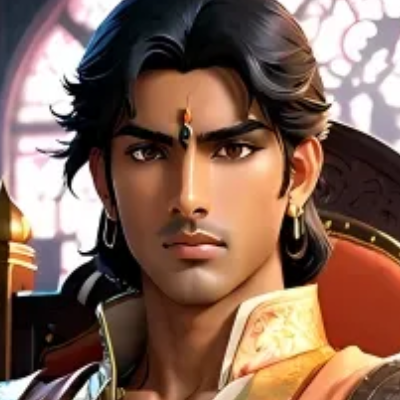
Utkala is recorded in the Bhagavata Purana's fourth Skandha as the son of the celebrated royal ascetic Dhruva Maharaja and his wife Ila, daughter of the demigod Vayu, the lord of wind. He is the eldest son in the lineage of Dhruva and the rightful heir to his father's throne, yet the Bhagavata Purana presents him as a figure of singular spiritual distinction who, from birth, was entirely absorbed in the realisation of Brahman. Upon his father's departure for the forest after a long reign, Utkala refused the kingdom, and his younger half-brother Vatsara — son of Dhruva's other wife Bhrami — was installed in his place by the elders and ministers of state. Utkala is characterised in the Bhagavata Purana as a jivanmukta — one who has attained liberation while still alive — and his outward appearance of apparent stupor, deafness, blindness, and madness is explained by the text as the natural condition of a soul so deeply absorbed in Brahman that it no longer responds to the external world. His episode is the opening narrative of the Bhagavata Purana's fourth Skandha, Chapter 13, and it is one of the text's most concentrated portraits of a liberated being in human form.
✦ The Name
The Sanskrit name Utkala is formed from the prefix ut meaning upward, elevated, or distinguished, and kala meaning art, skill, part, or portion. The compound may thus carry the sense of one of elevated artistry or distinguished excellence. The name is also that of an ancient kingdom and people — the Utkalas — corresponding to the region of Odisha, as attested in the Mahabharata (Drona Parva, Chapter 4, Verse 8), where Utkala is named as a country conquered by Karna. The Brihat Samhita of Varahamihira places the Utkala country in the eastern division of the subcontinent. Whether the kingdom's name derives from the figure in the Dhruva lineage or from a separate eponymous tradition is not clarified by the primary sources. The Wisdomlib entry on Utkala records multiple figures of this name — including a son of Sudyumna who is a different person — and notes the kingdom as identified with modern Odisha.
✦ Lineage
- Father: Dhruva Maharaja — son of Uttanapada and his queen Suniti; grandson of Svayambhuva Manu, the first Manu; the celebrated royal ascetic who, as a child of five, performed intense penance in the forest at Madhuvana on the banks of the Yamuna and was granted by Vishnu the imperishable station of the Pole Star — Dhruva Nakshatra. After a long and just reign on earth, Dhruva departed for the forest, and thereafter ascended to Vaikunthaloka in his own body.
- Mother: Ila — second wife of Dhruva Maharaja; daughter of Vayu, the demigod who is the lord and controller of wind; described in the Bhagavata Purana (4.10.2) as a jewel among women. Her own broader lineage beyond her father Vayu is not recorded in the available sources. She is distinct from the more widely known figure of Ila or Ida — son of Vaivasvata Manu who became a woman — who belongs to a separate lineage entirely.
- Paternal grandmother: Suniti — first queen of Uttanapada; daughter of Dharma according to some Puranic accounts; the gentle and pious queen whose guidance sent the young Dhruva to the forest to propitiate Vishnu.
- Paternal grandfather: Uttanapada — son of Svayambhuva Manu; king whose neglect of Dhruva at the instigation of his second queen Suruchi set in motion the events that led to Dhruva's celebrated penance and elevation.
- Half-brothers (by Bhrami): Kalpa and Vatsara — sons of Dhruva by his first wife Bhrami, daughter of the Prajapati Shishumara. Vatsara was installed on the throne in Utkala's place and became the father of Pushparna, Tigmaketu, Isha, Urja, Vasu, and Jaya.
- Unnamed sister: The Bhagavata Purana (4.10.2) records that Dhruva also fathered by Ila a very beautiful daughter alongside Utkala; her name is not given in any primary or secondary source examined.
- Paternal uncle: Uttama — the younger son of Uttanapada by his second queen Suruchi; Dhruva's half-brother who died unmarried, killed by a powerful Yaksha while hunting in the Himalayan mountains; his death prompted Dhruva's war against the Yakshas.
✦ Utkala's Renunciation of the Throne
The Bhagavata Purana's fourth Skandha, Chapter 13, opens with the sage Maitreya narrating to the royal devotee Vidura the account of what happened in the Dhruva lineage after Dhruva's ascent to Vaikunthaloka. Maitreya states that Utkala, the son of Dhruva, after his father's departure for the forest, did not desire the royal seat — the throne of the emperor, with all its lands, wealth, and attendant magnificence. The text presents this not as a failure of political ambition but as the natural expression of a nature that, from the very day of his birth, was entirely absorbed in the realisation of the Supersoul. The Bhagavata Purana states that Utkala perceived the Supersoul as spread everywhere throughout the world and all the world as resting within the Supersoul — a formulation that describes the condition of non-dual realisation in which the distinction between self, world, and supreme reality dissolves.
✦ The Description of Utkala as Jivanmukta
The Bhagavata Purana provides a detailed characterisation of Utkala's inner state and outer appearance. By the fire of uninterrupted yoga practice, the text states, Utkala had consumed all the accumulated impurities of past karma in his mind. He realised that the individual self is identical with the tranquil Brahman in which all distinctions dissolve — the embodiment of pure knowledge and absolute bliss, existing without differentiation throughout all existence. Having realised his own true nature in this way, he ceased to perceive anything as separate or different from it.
Outwardly, the Bhagavata Purana records, Utkala appeared to those who encountered him on the road to be a fool — blind, deaf, dumb, and mad. The text is careful to distinguish appearance from reality: he was not actually any of these things. His inner awareness was described as being like a fire that had ceased to send out flames — its heat and power fully present but no longer manifesting outwardly in the form of engagement with the world. The comparison to a covered or quiescent fire is a classical Vedantic image for a liberated consciousness that continues to exist but no longer projects karma-generating action onto the world.
The Wisdomlib Puranic Encyclopaedia entry on Utkala uses the term jivanmukta — literally one who is liberated while still alive — to describe his state, and adds that he did not desire the throne or the kingdom but gave himself up entirely to penance. The Bhagavata Purana's own chapter commentary, as rendered by G.V. Tagare, describes Utkala as having realised the individual self as identical with Brahman, the absolute consciousness characterised by knowledge and bliss.
✦ The Installation of Vatsara in His Place
The elders of the royal family and the ministers of state, observing Utkala's condition and taking it for vacancy of mind and madness rather than recognising it as the absorption of a liberated soul, concluded that he was unfit to rule. They accordingly passed over him and installed his younger half-brother Vatsara — the son of Dhruva by his first wife Bhrami, daughter of Shishumara — as king and ruler of the earth. The Bhagavata Purana presents this decision without editorial censure of the elders; their misreading of Utkala's state is presented as the natural failure of ordinary perception when confronted with a jivanmukta whose inner reality is entirely invisible to those without spiritual discernment. The narrative thus sets up a structural contrast: the outward world interprets liberation as madness, and crowns the engaged ruler in the liberated one's place, while the liberated one remains entirely unmoved.
✦ Theological and Philosophical Significance
Utkala's portrait in the Bhagavata Purana is one of the text's most developed illustrations of the concept of jivanmukti — liberation in life — as understood within the Vedantic and Vaishnava traditions. Several classical features of jivanmukta behaviour are present in his description: the cessation of ordinary social engagement, the appearance of inertia or dullness to observers, the absence of desire for worldly objects including political power, and the inner realisation of non-difference between the individual self and the universal consciousness. The comparison of his awareness to a fire without visible flames draws on the Upanishadic metaphor of the Self as a fire whose combustion continues without outward manifestation. His renunciation of a throne to which he was fully entitled, without conflict or drama, is presented as the natural consequence of a realisation in which the value of worldly sovereignty has been entirely dissolved. The commentator Bhavarartha Dipika is cited in the Tagare translation in connection with several interpretive points in this chapter, indicating that classical Bhagavata exegesis paid close attention to the doctrinal implications of Utkala's characterisation.
✦ Textual Variants and the Name Ila
The Bhagavata Purana (4.10.2) gives Utkala's mother as Ila, identified in that verse as the daughter of Vayu. The Wikipedia article on Dhruva names the same figure among Dhruva's wives as Ila. This is consistent across all sources examined. However, the Wisdomlib Puranic Encyclopaedia entry on Utkala — drawing on the Puranic Encyclopaedia of Vettam Mani — identifies Utkala simply as a son of Dhruva by Ila without further specification of Ila's parentage; it does not contradict the Bhagavata's account. A separate Utkala is mentioned in the Bhagavata Purana as a son of Sudyumna-Ila — a completely different lineage, belonging to the Vaivasvata Manu's line — and care must be taken not to conflate this second Utkala with the son of Dhruva. The Wisdomlib entry on Utkala lists both without conflation. The name Ila as Dhruva's wife must also be distinguished from the figure of Ila or Ida — the child of Vaivasvata Manu who alternated between male and female form — who belongs to an entirely separate narrative and genealogical tradition.
✦ References
Primary Sources
- Bhagavata Purana, Skandha 4, Chapter 10, verse 2 (4.10.2): The Sanskrit verse directly naming Ila as Dhruva's wife and daughter of Vayu, and Utkala as the son born from her; also records the unnamed beautiful daughter born alongside Utkala.
- Bhagavata Purana, Skandha 4, Chapter 13, verses 6–11: The principal narrative account of Utkala's spiritual state from birth, his realisation of Brahman, his appearance as a fool or madman to observers, his renunciation of the throne, and the installation of Vatsara in his place.
- Vishnu Purana, Book I, Chapter XIII: Records the Dhruva lineage in its own account; does not specifically mention Utkala, as it gives an entirely different genealogy for Dhruva's descendants that does not include the allegorical time-personifications of the Bhagavata.
Secondary Sources
- Wisdomlib.org, entry on Utkala: Confirms Utkala as a son of Dhruva by Ila and characterises him as a jivanmukta who gave himself entirely to penance; also lists the distinct Utkala who is a son of Sudyumna, preventing conflation.
- Wisdomlib.org, Puranic Encyclopaedia entry on Dhruva (Story of Dhruva): Records both marriages of Dhruva — to Bhrami and to Ila — and the sons born from each, confirming Utkala's parentage and Vatsara's installation as king.
- Vedabase.io, Srimad Bhagavatam 4.10.2: Provides the full Sanskrit text, word-by-word synonyms, and English translation of the verse naming Utkala and his mother Ila as daughter of Vayu, confirming the primary source directly.
- Bhagavata.org, Canto 4, Chapter 13: Provides a further translation of the chapter narrating Utkala's renunciation and the description of his liberated state.
- Wikipedia, article on Dhruva: Lists Ila as one of Dhruva's wives and Utkala among his children, consistent with the Bhagavata Purana's account.