
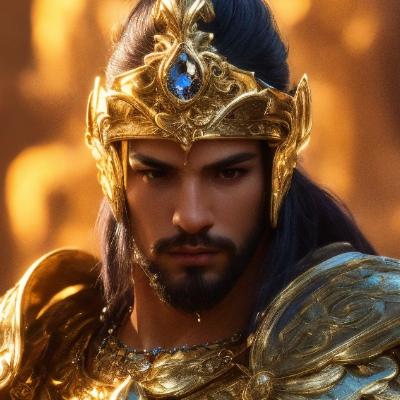
About
Vijitashva (Antardhana) — Eldest Son of Prithu, Emperor of the World, Bearer of the Gift of Invisibility
Vijitashva · Antardhana · Antarddhi · Vijitaswa · Vijitashva Prithuja
Vijitashva, also known by his second name Antardhana, is identified across the Bhagavata Purana, the Vishnu Purana, the Vayu Purana, the Brahmanda Purana, and the Harivamsha as the eldest son of Prithu — the celebrated first consecrated king, regarded as a partial avatar of Vishnu, who was born from the churned arm of the wicked king Vena and who gave the earth her Sanskrit name Prithvi. Vijitashva succeeded his father as emperor of the world and appointed his four younger brothers as governors of the four directions. His second name Antardhana — meaning disappearance or the one who vanishes — was bestowed upon him by Indra in recognition of his restraint during the episode of Indra's theft of Prithu's sacrificial horse: Vijitashva, having witnessed Indra's act, refrained from attacking Indra out of respect, and Indra rewarded this magnanimity by granting him the supernatural power of appearing and disappearing at will. He had two wives — Shikhandini and Nabhasvati — through whom he begot several sons, the most genealogically consequential of whom is Havirdhana, the ancestor of the Prachetasas and ultimately of Daksha.
✦ The Names
The name Vijitashva is a compound of vijita, meaning conquered or victorious, and ashva, meaning horse, yielding the meaning of one who has conquered the horse or victor of horses. In the Vedic and Puranic context, the horse is the supreme symbol of royal sovereignty — the Ashvamedha or horse sacrifice is the highest expression of imperial power — and the name thus carries the connotation of one who has mastered the royal prerogative. The name is directly connected to the episode of Indra's theft of Prithu's sacrificial horse, during which Vijitashva played a pivotal role.
The name Antardhana derives from antara, meaning within or between, and dhana or dhana from the root dha meaning to place or to hold, but in the compound it carries the verbal sense of disappearance or vanishing — from antardha, to disappear or to become invisible. The name thus means the one who disappears or the one endowed with the power of invisibility, directly reflecting the boon granted to him by Indra. The Vishnu Purana uses the form Antarddhi interchangeably with Antardhana for the same figure, and these are orthographic variants of the same name.
✦ Lineage
- Father: Prithu — the first consecrated king, regarded as a partial avatar of Vishnu, born from the churned arm of King Vena by the sages; the king who tamed the earth-goddess Prithvi in the form of a cow and extracted from her the world's grain and vegetation, earning her her name; a great devotee and the first sovereign to bear the title chakravartin.
- Mother: Archi — the wife of Prithu, born alongside him from the churning of Vena's arms, regarded as a partial manifestation of Lakshmi; she accompanied Prithu into the forest in his final years and went Sati on his funeral pyre.
- Brothers (Bhagavata Purana account): Four younger brothers — Haryaksha, Dhumrakesa, Vrika, and Dravina — whom Vijitashva appointed as governors of the four directions upon becoming emperor. The Vishnu Purana gives a different and shorter account of Prithu's sons, naming only Antardhana and Pali, without the additional three brothers of the Bhagavata Purana.
- First wife: Shikhandini — named in the Bhagavata Purana as the first wife of Vijitashva; through her he begot three sons — Pavaka, Pavamana, and Shuchi — who were in a former existence fire-gods cursed by the sage Vasishtha to take birth as human beings. After attaining perfection in mystic yoga, these three sons were reinstated in their original divine positions as fire-gods.
- Second wife: Nabhasvati — named in the Bhagavata Purana as the second wife of Vijitashva; through her he begot Havirdhana.
- Son (principal genealogical heir): Havirdhana — the son of Vijitashva and Nabhasvati; his wife Havirdhani bore him six sons — Barhisat, Gaya, Shukla, Krishna, Satya, and Jitavrata according to the Bhagavata Purana; the Vishnu Purana names these six as Prachinvarhi, Shukra, Gaya, Krishna, Vraja, and Ajina. The lineage through Havirdhana leads to the Prachetasas and thence to Daksha.
- Paternal grandfather: Anga — king of the Chakshusa Manvantara lineage descended from Dhruva through Vatsara, Pushparna, Ulmuka, and Anga. Anga's wife Sunitha daughter of Mrityu bore Vena, the wicked king from whose churned arm Prithu was produced.
✦ The Episode of Indra and the Sacrificial Horse
The primary narrative episode involving Vijitashva is embedded within the larger story of Prithu's hundred Ashvamedha sacrifices. The Bhagavata Purana, Canto 4, narrates that Prithu performed ninety-nine horse sacrifices in sequence, each confirming his imperial sovereignty over the earth. Before the hundredth and final sacrifice could be completed, Indra — the king of the gods — grew alarmed that Prithu's completion of a hundred Ashvamedhas would give him a status equal to or surpassing Indra's own position in the cosmic order. Indra therefore repeatedly disguised himself and stole the sacrificial horse, frustrating the completion of the hundredth sacrifice.
During one of these thefts, Vijitashva — who was present at the sacrifice and serving his father — witnessed Indra making off with the horse while disguised as an ascetic. He recognised Indra despite the disguise and gave chase. However, when he caught up with Indra and was on the verge of attacking, he held back. His restraint arose not from weakness but from a deliberate act of respect: Indra was carrying the emblems of a holy man, and attacking a figure bearing the symbols of renunciation would have been a transgression of dharma, regardless of Indra's actual identity or motive. Vijitashva therefore chose not to strike.
Indra was profoundly moved by this restraint. Recognising that Vijitashva had sacrificed the satisfaction of righteous retaliation out of respect for religious observance, Indra willingly granted him a remarkable boon — the mystic power of appearing and disappearing at will, of becoming invisible whenever he chose. It was this boon, and the quality of character it honoured, that gave Vijitashva his second name Antardhana — the one who can vanish.
✦ Vijitashva's Reign and Spiritual Practice
After Prithu's retirement to the forest and eventual liberation, Vijitashva succeeded to the imperial throne and appointed his four younger brothers as administrators of the four quarters of the earth. The Bhagavata Purana records that Vijitashva, while outwardly discharging the duties of kingship, was inwardly devoted to spiritual practice. Using the pretext of performing a long sacrifice, he eventually gave up the conventional duties of a king — the collection of taxes and the imposition of punishments and fines — on the grounds that such activities caused suffering to his subjects. During his sacrifice he meditated upon the supreme Lord in the form called Hamsa — the divine swan, a form associated with transcendent wisdom — and through that sustained meditation he attained the realm of the Lord. The Bhagavata Purana thus presents Vijitashva as a king who combined the external fulfillment of royal duty with the internal practice of devotion, eventually attaining liberation through meditation while nominally engaged in a sacrificial rite.
✦ The Three Fire-God Sons by Shikhandini
The Bhagavata Purana records an unusual detail about the three sons born of Vijitashva and his wife Shikhandini — Pavaka, Pavamana, and Shuchi. These three, though born as the sons of a human king, were in their prior existence fire-gods — specific manifestations or aspects of the divine fire Agni. They had been cursed by the sage Vasishtha and forced to take human birth as a consequence of that curse. After their birth as Vijitashva's sons, they attained perfection in mystic yoga and, through the power of that yoga, were released from the human condition and reinstated in their original positions as fire-gods. The Bhagavata Purana treats this episode as an illustration of the principle that divine beings temporarily displaced into human birth by a curse can regain their original status through spiritual practice — a theme common across the tradition.
✦ Textual Variants and Inconsistencies
The most significant inconsistency concerns the number of Prithu's sons. The Bhagavata Purana names five sons — Vijitashva, Haryaksha, Dhumrakesa, Vrika, and Dravina — with Vijitashva as the eldest and the one who also bears the name Antardhana. The Vishnu Purana names only two sons of Prithu — Antardhana and Pali — and the lineage through Antardhana to Havirdhana and thence to the Prachetasas is consistent between the two traditions even though the number of brothers differs. The Vayu Purana and Brahma Purana follow the shorter account of the Vishnu Purana in naming only Antardhana as the son of Prithu relevant to the genealogical continuation, without the additional four brothers of the Bhagavata Purana account.
A further minor variant concerns the sons of Havirdhana. The Bhagavata Purana names them Barhisat, Gaya, Shukla, Krishna, Satya, and Jitavrata, while the Vishnu Purana names them Prachinvarhi, Shukra, Gaya, Krishna, Vraja, and Ajina. The first name in each list — Barhisat in the Bhagavata Purana and Prachinvarhi in the Vishnu Purana — refers to the same figure, with Prachinvarhi being an epithet meaning one whose sacrificial grass points eastward, which is directly related to the name Barhisat also meaning one associated with the sacred grass. The other names show variation across the two lists.
✦ Theological Significance
Vijitashva's narrative illustrates two important Puranic themes. The first is the virtue of restraint in the exercise of power: he possessed both the ability to attack Indra and the righteous cause to do so, yet he held back out of respect for the symbolic sanctity of the disguise Indra wore, and this restraint was rewarded with a supernatural gift surpassing any victory he might have achieved in combat. The Bhagavata Purana presents this as a model of the quality by which a king's power is made truly sovereign — not by the exercise of force but by the wisdom to know when force would violate a higher principle.
The second theme is the compatibility of royal duty and spiritual liberation. Like his father Prithu and his grandfather-lineage back through Dhruva, Vijitashva is a king who discharges the full duties of governance while maintaining an inner orientation toward the divine — and who ultimately attains liberation not by abandoning his royal role but by transforming the performance of a royal rite into an occasion for sustained meditation on the supreme Lord.
✦ Connection to the Wider Genealogy
Vijitashva stands in one of the most consequential positions in the Puranic dynastic tradition. Upward through his father Prithu and grandfather Vena and great-grandfather Anga, he connects to the lineage of the Chakshusa Manvantara descending from Dhruva, Uttanapada, and Svayambhuva Manu. Downward through his son Havirdhana and Havirdhana's son Prachinvarhi and Prachinvarhi's wife Savarna, daughter of the ocean, the lineage reaches the ten Prachetasas — who after their austerities in the depths of the sea married Marisha and begot Daksha, the great Prajapati whose daughters became the mothers of all the gods, demons, sages, serpents, and living beings of the Puranic universe. The genealogical chain that runs from Svayambhuva Manu through Dhruva, Anga, Vena, Prithu, Vijitashva, Havirdhana, Prachinvarhi, and the Prachetasas to Daksha is one of the most important dynastic sequences in all the Puranas, connecting the first Manu's lineage to the progenitor of the entire divine and demonic order.
✦ References
- Bhagavata Purana, Canto 4, Chapters 13–24: The most detailed primary source for the Prithu narrative including the episode of Indra's theft of the sacrificial horse witnessed by Vijitashva; Canto 4, Chapter 24 records Vijitashva's two wives Shikhandini and Nabhasvati, his three fire-god sons, his son Havirdhana, and his own attainment of liberation through meditation on the Hamsa form of the Lord.
- Vishnu Purana, Book I, Chapter 14: Names Antardhana as the principal son of Prithu through whom the lineage continues, records his son Havirdhana and Havirdhana's six sons including Prachinvarhi; gives the shorter account with only two sons of Prithu.
- Vayu Purana: Corroborating source for the lineage from Prithu through Antardhana to Havirdhana and the Prachetasas.
- Brahmanda Purana: Parallel genealogical account of Prithu's descendants through Antardhana.
- Harivamsha: Additional corroborating source for the lineage of Prithu's descendants and the name variants for Antardhana.
- Vettam Mani, Puranic Encyclopaedia (1975): Consolidates the narrative of Vijitashva-Antardhana across primary sources, recording both his names, the episode with Indra, his wives, his sons, and his attainment of liberation.