
About
Prachinabarhisat — Son of Havirdhana, Patriarch and Father of the Ten Prachetasas
Prachinabarhisat · Prachinabarhis · Prachinvarhi · Barhisat · Barhishad · Prachinavarhi · Prachinabarhisat Priyavrateya
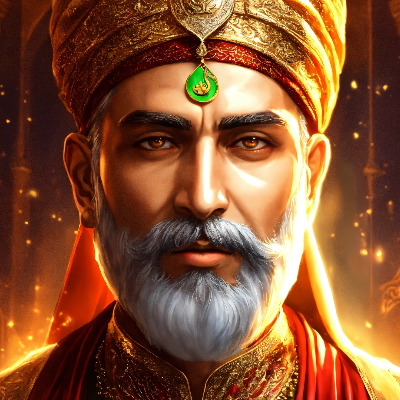
Prachinabarhisat is a king and patriarch of great Puranic significance, identified across the Bhagavata Purana, the Vishnu Purana, the Vayu Purana, the Brahmanda Purana, the Matsya Purana, and the Harivamsha as the eldest son of Havirdhana — himself a son of Vijitashva and grandson of King Prithu — and as the father of the ten Prachetasas who feature in one of the most theologically and cosmogonically important episodes of the Bhagavata Purana's fourth Skandha. He is described as a king of extraordinary power in the performance of Vedic sacrifices, so devoted to yajna that as he conducted sacrifice after sacrifice across the whole of the earth, the kusa grass spread eastward over the entire terrestrial surface — an act of cosmic ritual coverage that earned him the epithet Prachinabarhisat, meaning he of the eastward-pointing sacrificial grass. Despite this prodigious sacrificial activity, the Bhagavata Purana presents him as a king immersed in the fruitive dimension of dharma who required the instruction of the divine sage Narada to turn toward the path of liberation. Narada addressed him with an elaborate allegorical narrative — the story of King Puranjana — which constitutes one of the longest and most philosophically sophisticated passages in the entire fourth Skandha and forms the immediate context within which Prachinabarhisat appears as the royal audience for whom that teaching was composed.
✦ The Names
The name Prachinabarhisat is a compound of prachina, meaning eastern or turned toward the east, and barhis, the sacred kusa grass used in Vedic sacrifice, with the suffix -at forming an adjective. The compound thus means one whose barhis or sacrificial grass is turned eastward — a reference to the correct placement of kusa grass in Vedic ritual, where it should be laid with its tips pointing east as a seat for the gods. The name commemorates the extraordinary scope of his sacrificial practice: as he performed sacrifice after sacrifice across the surface of the earth, the barhis grass spread eastward as if the whole earth had become his sacrificial ground. The shorter epithet Barhisat or Barhishad is a contraction of the same root meaning. The Vishnu Purana uses the form Prachinvarhi or Prachinavarhi, and the Bhagavata Purana uses Barhisat interchangeably with Prachinabarhisat — all referring to the same figure. The Puranic Index entry from the Brahmanda Purana also uses the designation Ekarat meaning sole sovereign, reflecting his imperial standing.
✦ Lineage
- Father: Havirdhana — son of Vijitashva and Nabhasvati; grandson of King Prithu; his wife in the Bhagavata Purana is Havirdhani, and in the Vishnu Purana is Dhishana daughter of the race of Agni.
- Paternal grandfather: Vijitashva (Antardhana) — eldest son of Prithu; emperor of the world granted the power of invisibility by Indra; attained liberation through devotion to the Hamsa form of the Lord.
- Paternal great-grandfather: Prithu — the first consecrated king, partial avatar of Vishnu, born from the churned arm of Vena; the sovereign who gave the earth her name Prithvi.
- Wife: Savarna — named in the Vishnu Purana and the Vayu Purana as the daughter of Samudra, the ocean; in the Bhagavata Purana she is named Shatadruti and described as so beautiful that when she entered the marriage arena and circumambulated the sacrificial fire, the god Agni — and indeed all the assembled gods, demons, and sages present — were captivated simply by the sound of her ankle bells. The Puranic Index entry uses the name Samudri as a variant for Savarna, both meaning she of the ocean or ocean's daughter.
- Sons: Ten — collectively known as the Prachetasas — all born of Savarna and all described as equal to one another in character, disposition, and spiritual standing; all skilled in the military science of Dhanurvidya; all of whom descended into the depths of the sea and performed tapas for ten thousand years dedicated to Vishnu.
✦ Prachinabarhisat as Prajapati and Sovereign
The Bhagavata Purana presents Prachinabarhisat as a figure of immense royal and ritual power. He is designated a Prajapati — one of the creative progenitors commissioned to multiply living beings in the world — by virtue of the scope and intensity of his sacrificial activity. He is also identified as an Ekarat, meaning sole or supreme sovereign, indicating that his royal authority extended over the entirety of the earth without challenge. His sacrificial practice was such that it is described as covering the whole earth with eastward-pointing kusa grass — a hyperbolic expression for the sheer volume and geographical spread of his yajnas, which the Bhagavata Purana treats as both a mark of his extraordinary devotion to Vedic ritual and as a marker of his limitation: his devotion was to the karma-kanda, the ritualistic dimension of the Vedas, rather than to the knowledge and devotion that lead directly to liberation.
The Bhagavata Purana records that Brahma, who had directed Prachinabarhisat to multiply the world through his offspring, instructed him to commission his ten sons the Prachetasas to undertake this task. Prachinabarhisat in turn instructed the Prachetasas to perform austerities so that they would be empowered to fulfill this creative mandate. When the Prachetasas asked how they should proceed, Prachinabarhisat told them that worship of Vishnu was the essential prerequisite for all desired results — that it was through Vishnu's grace that Brahma had created the universe at the beginning of creation, and that the Prachetasas should similarly proceed by propitiating the Lord. The Prachetasas accordingly descended into the sea and performed tapas for ten thousand years.
✦ Narada's Instruction and the Puranjana Allegory
The most significant narrative episode associated with Prachinabarhisat in the Bhagavata Purana is not a military or political episode but a philosophical and spiritual one. While the Prachetasas were performing their underwater tapas, Prachinabarhisat himself was absorbed in the performance of yajnas and the governance of his kingdom. The divine sage Narada arrived at his court and, observing that the king was entirely devoted to fruitive sacrificial activity without the spiritual knowledge that transcends it, resolved to instruct him. However, rather than delivering direct philosophical discourse, Narada composed and narrated an elaborate allegorical story — the tale of King Puranjana.
The story of King Puranjana, which occupies Bhagavata Purana Canto 4, Chapters 25 through 28, describes a king who seeks a suitable place to enjoy and discovers a magnificent city with nine gates — representing the human body with its nine openings — and becomes utterly captivated by a beautiful woman named Puranjani, representing the material intelligence or mind, with whom he enjoys for a hundred years. The story proceeds through episodes of hunting, the king's attachment to his wife, an attack on the city by the forces of time and old age, the destruction of the city, and the king's rebirth as a woman — the result of dying with his mind absorbed in thoughts of his wife. The old brahmana friend who appears at the end to reveal the truth is Avijnata, representing the unknowable Supreme Lord who is always present as the soul's companion but forgotten in the pursuit of material enjoyment.
Prachinabarhisat, having listened to the story, honestly confessed to Narada that he could not fully grasp its meaning — that those devoted to karma might not penetrate the depth of such teaching as easily as those advanced in spiritual knowledge. Narada then, in Canto 4, Chapter 29, provided the full allegorical explanation of the story element by element, revealing the cosmological and philosophical significance of each character, city, gate, enemy, and episode in terms of the soul's condition in material existence. This dialogue between Narada and Prachinabarhisat is regarded in the Vaishnava tradition as one of the most profound philosophical passages in the Bhagavata Purana, and Prachinabarhisat's honest acknowledgment of his incomprehension is presented as itself a mark of spiritual sincerity.
✦ The Marriage to Shatadruti and the Birth of the Prachetasas
The Bhagavata Purana narrates the marriage of Prachinabarhisat to Shatadruti — the daughter of the ocean — in terms that emphasise her extraordinary beauty. When she entered the marriage arena to circumambulate the sacrificial fire, the assembled gods, demons, sages, and indeed the fire-god Agni himself were so overwhelmed by her loveliness — and particularly by the musical tinkling of her ankle bells — that they were captivated by it. The Bhagavata Purana compares Agni's attraction to Shatadruti with his earlier desire for Suki, the wife of the sage Shandilya, in the fire's characteristic inability to refrain from consuming whatever beautiful thing comes before it. Through this marriage Prachinabarhisat begot the ten Prachetasas.
✦ Textual Variants and Inconsistencies
The name of Prachinabarhisat's wife varies between the Bhagavata Purana — where she is called Shatadruti — and the Vishnu Purana and Vayu Purana — where she is called Savarna, the daughter of Samudra. Both names connect her to the ocean: Shatadruti meaning she of the hundred streams or the hundred-channelled one, and Savarna meaning one of the same caste or lineage as the ocean. The Puranic Index entry uses Samudri as an additional variant. These appear to be different epithets or names for the same figure rather than genuinely different wives. The Mahabharata's Mokshadharma section gives a variant tradition identifying Prachinabarhisat as belonging to the lineage of Atri rather than of Dhruva — a tradition noted in the commentary on the Vishnu Purana by H. H. Wilson — but this minority view conflicts with the principal Puranic tradition and is not adopted in the primary sources that form the basis of this series.
✦ Theological Significance
Prachinabarhisat exemplifies a recurrent Puranic theme: the king or patriarch who fulfils the external obligations of dharma — including the most demanding and prestigious forms of sacrificial practice — with great power and dedication, yet remains confined within the karma-kanda orientation that leads to repeated birth and the continuation of samsara rather than to liberation. The Bhagavata Purana does not condemn him for this: his sacrificial devotion is presented as genuinely worthy and his royal administration as righteous. But the tradition uses his example to make the distinction between the path of karma, which leads to temporary heavenly enjoyment and eventual return to the cycle, and the path of jnana and bhakti combined, which leads to the permanent transcendence of that cycle. Narada's choice to address him with the sophisticated allegory of Puranjana rather than with direct philosophical statement reflects the Bhagavata Purana's pedagogical sophistication: the king is brought to philosophical inquiry through a narrative that engages his imagination before revealing the metaphysical truth embedded within it.
✦ Connection to the Wider Genealogy
Prachinabarhisat stands at one of the most cosmogonically significant genealogical positions in the Puranic tradition. Upward through Havirdhana, Vijitashva, Prithu, Vena, Anga, and the lineage of Dhruva, he traces to Uttanapada, Svayambhuva Manu, and Brahma. Downward through his ten sons the Prachetasas, the lineage reaches the pivotal creative event of the Prachetasas' marriage to Marisha and the birth of Daksha — the great Prajapati whose daughters became the mothers of the Adityas, Daityas, Danavas, Nagas, and all other categories of being in the Puranic universe. Through his wife Shatadruti's identity as daughter of the ocean, Prachinabarhisat is also connected to the cosmic waters and to the tradition of the ocean as a source of divine lineages. The entire subsequent structure of Puranic cosmogony — from Daksha's daughters through Kashyapa and Aditi to the Adityas, through Diti to the Daityas, and so on through all the divine and demonic lineages — thus traces back through Prachinabarhisat's sons, making him one of the most consequential genealogical figures in the tradition despite his relatively modest narrative profile compared to figures such as Prithu or Dhruva.
✦ References
- Bhagavata Purana, Canto 4, Chapters 24–31: The primary and most detailed source for Prachinabarhisat; records his parentage as son of Havirdhana, his title of Prajapati and Ekarat, the marriage to Shatadruti daughter of the ocean, the birth of the ten Prachetasas, his instruction to the Prachetasas to worship Vishnu, and the extended Puranjana allegory delivered by Narada to instruct the king in the path transcending karma.
- Bhagavata Purana, Canto 6, Chapter 4, verse 4: Cross-reference confirming Prachinabarhisat as a Prajapati figure in the context of Daksha's genealogy.
- Vishnu Purana, Book I, Chapter 14: Names Prachinvarhi as the eldest son of Havirdhana and Dhishana, records his marriage to Savarna daughter of the ocean, and the birth of the ten Prachetasas; narrates Prachinabarhisat's instruction to the Prachetasas to worship Vishnu.
- Vayu Purana: Records the lineage from Prithu through Antardhana, Havirdhana, and Prachinvarhi to the Prachetasas and Savarna as their mother.
- Brahmanda Purana, Book II, Chapters 13 and 30: Corroborating sources for Prachinabarhisat's identity, designating him Prajapati and Ekarat and recording the Prachetasas as his sons through Savarna.
- Matsya Purana: Additional primary source for the genealogy of Prachinabarhisat and the Prachetasas.
- Vishnu Purana, Wilson translation commentary: Notes the variant tradition in the Mahabharata Mokshadharma placing Prachinabarhisat in the lineage of Atri, establishing this as a minority account that conflicts with the principal Puranic tradition.
- Vettam Mani, Puranic Encyclopaedia (1975), Prachinabarhisat entry: Modern consolidation of the genealogical and narrative data for Prachinabarhisat across primary sources; records his identification as Barhishad, his wife Samudri or Savarna, the ten Prachetasas, and the Puranjana allegory context.