
About
The Ten Prachetasas — Sons of Prachinabarhisat and Shatadruti, Fathers of Daksha
Prachetasas · Prachetas · Dasha Prachetasas · Pracetasas · Prachinabarhisatputra
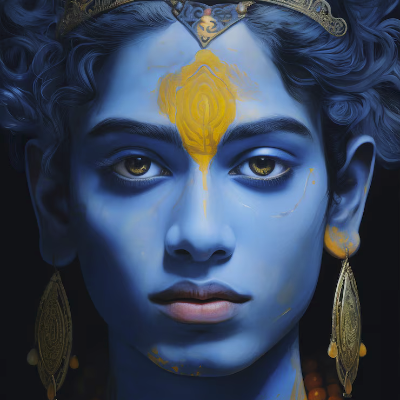
The ten Prachetasas are a collective of princes — all sons of Prachinabarhisat and his wife Shatadruti, daughter of the ocean — who occupy one of the most cosmogonically significant positions in the Puranic genealogical tradition. Their narrative spans the Bhagavata Purana Canto 4, Chapters 24 through 31, and is paralleled in the Vishnu Purana, the Vayu Purana, the Brahmanda Purana, the Matsya Purana, the Agni Purana, the Padma Purana, and the Harivamsha. The ten brothers are described throughout the primary sources as equal to one another in nature, disposition, austerity, and spiritual standing — they are in every meaningful sense a single collective figure rather than ten distinct individuals, and none of the primary sources gives individual names to any of them. Their narrative moves through four great episodes: the encounter with Shiva and the receiving of the Rudra Gita; the ten-thousand-year tapas in the depths of the ocean; the furious burning of the world's overgrown forests upon emerging; and the marriage to Marisha through the pacifying intervention of Soma, resulting in the birth of Daksha — the great Prajapati whose daughters became the mothers of the gods, demons, serpents, and all other living beings of the Puranic cosmos.
✦ The Name
The name Prachetasa derives from the Sanskrit root chet meaning to perceive, know, or be conscious, with the prefix pra indicating intensification, yielding the meaning of the greatly knowing ones, the deeply conscious ones, or those of keen perception and intelligence. The name is sometimes applied as a title to Varuna — the ancient Vedic deity of cosmic order and the ocean — as an epithet meaning the supremely wise or all-perceiving one, and in some textual traditions the Prachetasas are described as being of Varunic lineage through their mother Shatadruti who is identified as the daughter of the ocean-god Varuna or simply of the ocean as a cosmic being. This Varunic connection is consistent with the primary episode of their tapas — performed in the depths of the sea — which is the natural domain of Varuna. The name carries connotations of profound inner knowledge consistent with the extraordinary depth of their meditation.
✦ Lineage
- Father: Prachinabarhisat — eldest son of Havirdhana; great-great-grandson of King Prithu; a powerful king and Prajapati whose sacrificial practice was so extensive that eastward-pointing kusa grass spread across the entire earth; described in the Bhagavata Purana as deeply devoted to karma-kanda Vedic ritual; instructed by the sage Narada through the allegory of King Puranjana.
- Mother: Shatadruti — daughter of Samudra the ocean-god; named in the Bhagavata Purana as so beautiful that at the marriage ceremony, when she circumambulated the sacred fire with ankle bells tinkling, even the fire-god Agni and all the assembled gods and sages were captivated. In the Vishnu Purana and Vayu Purana she is called Savarna, and in the Puranic Index she is also referred to as Samudri.
- Individual names: No primary source consulted names any of the ten brothers individually. They are consistently treated as a collective — all ten identical in nature and described as a single spiritual unit.
- Wife: Marisha — shared collectively by all ten brothers as a common wife; her origin is elaborated extensively in the Vishnu Purana as follows. A sage named Kandu had been performing austerities on the banks of the Gomati river when the god Indra, threatened by his tapas, sent the celestial nymph Pramloca to disturb him. Kandu, overcome by her beauty, lived with Pramloca for what seemed to him many years but which was in reality only a brief moment of divine time. When he dismissed her and she departed, she shed moisture from her body as she flew through the trees. This moisture — the sweat and dew of her passage — collected among the branches and leaves and coalesced into a female child named Marisha, who was raised by the trees. Soma the moon-god, who had nourished her with moonbeams from his fingertips, brought her before the Prachetasas and offered her to them as a wife who would bear them a son of great power and glory. All ten Prachetasas accepted her jointly.
- Son: Daksha — the great Prajapati born of all ten Prachetasas and Marisha jointly; whose daughters — given in marriage to the god Dharma, to the sage Kashyapa, and to others — became the mothers of the Adityas, the Daityas, the Danavas, the Nagas, the birds, the cattle, and all other classes of living beings in the Puranic universe.
✦ The Father's Commission and the Departure for Tapas
The Bhagavata Purana records that Prachinabarhisat, acting on the instruction of Brahma to multiply creation, directed his ten sons the Prachetasas to undertake the task of propagating human beings and filling the earth with progeny. The Prachetasas, earnest in their obedience but uncertain how to proceed, asked their father what preparation was required for the fulfillment of such a cosmic task. Prachinabarhisat replied that the worship of Vishnu was the essential foundation for all creative capacity — that it was through Vishnu's grace that Brahma himself had created the universe at the beginning of cosmic time, and that the Prachetasas should proceed first by propitiating the Lord. The ten brothers accepted this instruction and departed the palace together to perform austerities.
✦ The Encounter with Shiva and the Rudra Gita
On the way to the ocean, the Prachetasas encountered Lord Shiva emerging from a vast and pure lake — described in the Bhagavata Purana as luminous and effulgent, surrounded by his attendants. This encounter is treated in the tradition as an act of extraordinary divine grace: Shiva, moved with compassion for the ten brothers who had set out on the path of devotion and creation, chose to impart to them the body of teaching known as the Rudra Gita — a hymn of prayers to Vishnu that Shiva had himself received from Brahma. The Bhagavata Purana, Canto 4, Chapter 24, contains the full text of these prayers, which comprise thirty-seven or more verses of profound Vaishnava theology. The Rudra Gita first describes the all-pervading nature of Vishnu as the supreme soul present in all beings, then offers a detailed contemplation of Vishnu's divine form, and then emphasises the supreme excellence of devotional service above all other spiritual paths.
In the course of delivering this teaching, Shiva made a statement that became one of the most frequently cited passages in the tradition regarding the spiritual hierarchy: he told the Prachetasas that one who follows his occupational duty perfectly for a hundred births becomes qualified for Brahmaloka, and one still more qualified may approach Shiva himself — but one who takes direct refuge in Vishnu is immediately elevated to the spiritual world without passing through these intermediate stages. Shiva explicitly described himself as the greatest Vaishnava — the supreme devotee of Vishnu — and this declaration within the Rudra Gita is treated in Vaishnava commentarial tradition as among the most authoritative statements of Shiva's own position relative to Vishnu. The Prachetasas received the Rudra Gita with devotion and recited it throughout their subsequent austerities in the ocean.
✦ The Ten Thousand Years of Tapas in the Ocean
Having received the Rudra Gita from Shiva, the ten Prachetasas descended into the ocean — or, in some accounts, into a great inland lake of vast depth — and there performed tapas for ten thousand years. Throughout this duration they meditated upon Vishnu with sustained concentration, reciting the Rudra Gita prayers and dedicating every act of renunciation, study, service, austerity, and fasting to the Lord alone. The Bhagavata Purana presents their practice as of exemplary purity — all ten brothers equal in devotion, all ten sustaining the same meditation without variation or diminishment over the full span of the ten thousand years.
At the end of this period, the primary sources record that Vishnu appeared before them — the Bhagavata Purana describes him as riding on Garuda, his eagle vehicle, appearing in a form of eight arms, with a form of such radiant beauty that the assembled devotees were filled with supreme satisfaction and their long labour of austerity was made fully worthwhile. Vishnu blessed them and directed them toward the fulfillment of their creative mission.
✦ The Burning of the Forests and the Intervention of Soma
When the Prachetasas emerged from the ocean after their ten thousand years of tapas, they found the earth in a state of crisis. During their entire period of underwater meditation, no governance had been exercised over the earth, and the forests had spread without check across the whole of the land — so dense that the wind could not blow and the light of the sky was entirely shut out by the canopy of trees. Human beings and other living creatures had perished or suffered for the full ten thousand years. The news of this devastation reached the Prachetasas and roused their fury.
Filled with indignation, the ten brothers began to release fire and wind from their mouths — a manifestation of their accumulated ascetic power — and started to burn down the forests. The strong wind that issued from their mouths tore up the trees by the roots and left them dried and withered, and the fire that followed consumed them. The burning was proceeding toward the total destruction of all plant life on earth when Soma — the moon-god, who is the lord of all vegetation — intervened.
Soma came to the Prachetasas and entreated them to restrain their wrath. He pointed out that a remnant of the trees had survived and that in the tradition's understanding trees were not the cause of the earth's neglect but innocent beings. More practically, he brought them a proposal: he had nourished with moonbeams a maiden raised among the trees, the daughter of the sage Kandu and the apsara Pramloca, named Marisha, who had been raised by the trees themselves after her supernatural birth from the moisture shed by Pramloca as she flew through the forest. Soma offered Marisha to the Prachetasas as a common wife, promising them that from the union of their collective vigour with his own nourishing power and Marisha's substance, a son would be born who would be a great patriarch and would multiply the human race and fill the universe with progeny.
The Prachetasas, hearing Soma's words, relented from their fury, accepted Marisha in accordance with his counsel, and refrained from destroying the remaining trees. This pacification — the extinguishing of the brothers' collective wrath through the acceptance of a wife and the promise of creative purpose — marks the transition in their narrative from agents of destruction to agents of creation.
✦ The Birth of Daksha
The Prachetasas took Marisha as their joint wife and through her begot Daksha — described in the Vishnu Purana as an eminent patriarch who had in a prior existence been born as a mind-born son of Brahma. The Vishnu Purana's commentary notes the two distinct traditions regarding Daksha: in one tradition he is a mind-born Prajapati of the Svayambhuva Manvantara, begotten directly by Brahma; in the other — which is the tradition placed in the Chakshusa Manvantara — he is the son of the Prachetasas and Marisha. The incompatibility of these two accounts is acknowledged in the Vishnu Purana commentary, which attempts to reconcile them by assigning the two Dakshas to different Manvantaras, though this reconciliation is not unanimously accepted across the primary sources.
Daksha, born of the union of all ten Prachetasas and Marisha, grew into the great Prajapati who multiplied all life on earth. He made movable and immovable things, bipeds and quadrupeds, and gave birth to daughters — ten of whom he gave to Dharma, twenty-seven to the moon-god Chandra, thirteen to the sage Kashyapa, and others to various sages. From the daughters married to Kashyapa came the Adityas through Aditi, the Daityas through Diti, the Danavas through Danu, the Nagas through Kadru, the birds through Vinata, and all other classes of divine, demonic, and natural beings that populate the Puranic universe. The entire subsequent cosmological order therefore traces back to the creative act of the Prachetasas and Marisha.
✦ Narada's Final Instruction and Liberation
The Bhagavata Purana, Canto 4, Chapter 30 and 31 records that after the Prachetasas had completed their mission and fulfilled their creative mandate, the sage Narada appeared before them and delivered final instructions on the path of liberation — extending to them the same philosophical teaching he had provided to their father Prachinabarhisat through the Puranjana allegory, now in direct form. Narada instructed them that the bonds of home, family, and creative duty — even the most righteous bonds — ultimately keep the soul in the cycle of birth and death, and that the highest attainment lies in unalloyed devotion to Vishnu. The Bhagavata Purana records that the Prachetasas received Narada's teaching with complete acceptance and ultimately attained liberation.
✦ Textual Variants and Inconsistencies
The name of the Prachetasas' mother varies — Shatadruti in the Bhagavata Purana and Savarna in the Vishnu Purana and Vayu Purana — as discussed in the profile of Prachinabarhisat. More significantly, the parentage and nature of Marisha varies considerably. The Vishnu Purana provides the most detailed account of Marisha's origins — as the daughter of Kandu and Pramloca raised by the trees — which the commentary notes is peculiar to that text and not paralleled as fully in the other Puranas that merely allude to her birth. The Bhagavata Purana's treatment of Marisha's origin is briefer. The tradition of the ten Prachetasas sharing a single wife is itself unusual and is noted in the primary sources without explanation, being treated as a cosmogonically necessary arrangement rather than a socially normative one.
The question of which Manvantara the Prachetasas belong to is also textually complicated. As great-great-grandsons of Prithu who is descended from Anga who is descended from the lineage of Chakshusa Manu, they belong genealogically to the Chakshusa Manvantara's lineage. Yet as the fathers of Daksha who in another tradition is the mind-born son of Brahma in the Svayambhuva Manvantara, their temporal placement within the Puranic cosmological scheme is acknowledged even in the primary sources as an area of confusion.
✦ Theological Significance
The Prachetasas serve multiple theological functions in the Bhagavata Purana. They are the occasion for the Rudra Gita — one of the principal Vaishnava theological compositions attributed to Shiva himself within the fourth Skandha — establishing through their encounter with Shiva the subordinate devotional status of even the greatest cosmic administrator relative to Vishnu. They model the ideal of tapas conducted with unswerving devotion over an impossibly long duration. Their burning of the forests illustrates the destructive potential of unregulated ascetic power when it lacks the wisdom of renunciation, and their pacification by Soma demonstrates how the creative mandate of the cosmos requires that even righteous fury be tempered by larger cosmic purpose. Their shared marriage to Marisha and the birth of Daksha through the combined potency of all ten brothers represents a cosmogonic act of collective creation — the fathering of the ancestor of all living beings through a unity of purpose and spiritual power that transcends individual agency. The tradition presents them not as ten separate characters but as a single unified creative force divided into ten bodies.
✦ References
- Bhagavata Purana, Canto 4, Chapters 24–31: The primary source for the full narrative of the Prachetasas — their father's commission, the encounter with Shiva and the Rudra Gita (Chapter 24), the ten thousand years of tapas in the ocean, the appearance of Vishnu, the emergence and burning of the forests, Soma's intervention and the marriage to Marisha, the birth of Daksha, and Narada's final instruction leading to liberation.
- Vishnu Purana, Book I, Chapter 15: Records the burning of the forests by the Prachetasas, Soma's intervention, the full account of Marisha's origin from Kandu, Pramloca, and the trees, and the birth of Daksha; notes the two-Daksha problem and the attempt to reconcile the two traditions by assigning them to different Manvantaras.
- Vayu Purana: Records the Prachetasas as sons of Prachinavarhi (Prachinabarhisat) and Savarna daughter of the ocean; narrates the forest episode and the birth of Daksha.
- Brahmanda Purana: Corroborating source for the Prachetasas, their parentage, and their cosmogonic role as fathers of Daksha.
- Matsya Purana: Additional primary source for the Prachetasas' genealogy, their wife Marisha, and the birth of Daksha.
- Agni Purana and Padma Purana: Sources that allude to the austerities of the Prachetasas and the birth of Marisha, though without the full detail of the Vishnu Purana account.
- Varaha Purana, Chapters 70–72: Contains the Rudra Gita in a parallel version to the Bhagavata Purana's account.
- Vettam Mani, Puranic Encyclopaedia (1975), Prachetasas entry: Modern consolidation of the Prachetasas' genealogy, the forest episode, Marisha's origin, and the birth of Daksha across primary sources.