
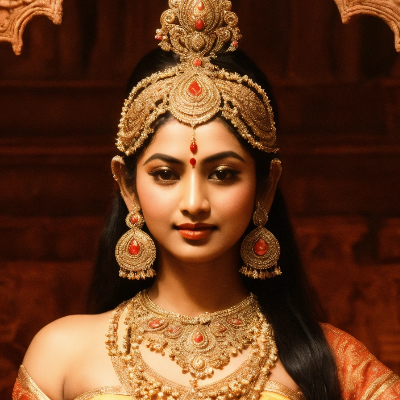
About
Marisha — Forest-Born Daughter of Pramlocha, Wife of the Ten Prachetas
Marisha · Marisa · daughter of Kandu · daughter of Pramlocha
Marisha is a figure of unusual origin and significant genealogical position who appears in the Vishnu Purana and related Puranic texts. She was not born through conventional gestation but arose from the drops of perspiration shed by the Apsara Pramlocha — a celestial nymph who had lived for many centuries at the hermitage of the sage Kandu before departing. As Pramlocha flew through the forest on her departure, her perspiration fell upon the trees and the earth, and from it Marisha was formed and nurtured among the vegetation of the forest. She grew up in the forest without a conventional mother in attendance, raised in effect by the trees themselves. In adult life she became the wife of the ten Prachetas, a group of royal brothers who are sons of King Prachinabarhis, and from their union Daksha — the great progenitor in the Puranic cosmogony — was born. Marisha is thus positioned at a pivotal node in the Puranic genealogy of creation.
✦ The Name
The name Marisha is recorded in the Puranic texts as a proper name without extended etymological commentary within those passages. Vettam Mani and other secondary compilers treat it as a received name. Some scholars have noted a possible connection to Sanskrit roots meaning worthy or praiseworthy, though this derivation is not confirmed within the primary texts. The name Marisa appears as an orthographic variant in some recensions and modern reference works, reflecting differences in transcription rather than a distinct tradition.
✦ Lineage
- Father: Kandu — a Brahmin sage of great ascetic power who performed austerities at the hermitage of Mandara. The Vishnu Purana identifies Marisha as his daughter through the episode with Pramlocha.
- Mother: Pramlocha — an Apsara, a celestial nymph, who had been sent by Indra to interrupt Kandu's austerities and who resided at his hermitage for several hundred years. Marisha was not born from Pramlocha's womb but from the perspiration shed by Pramlocha's body as she departed the hermitage and passed through the forest canopy.
- Husbands: The ten Prachetas — a group of royal brothers, sons of King Prachinabarhis, a descendant of the primordial king Uttanapada who was himself a son of Manu Svayambhuva, the first Manu. The Prachetas had spent ten thousand years performing austerities at the bottom of the ocean at the command of their father. Upon their emergence, they found the earth so densely overgrown with trees planted during their absence that sunlight no longer reached it. In their anger they began to destroy the trees with fire and wind. The god Soma — the Moon — intervened and brokered a resolution in which Marisha was given to the Prachetas as their joint wife. All ten brothers shared her as a single wife.
- Son: Daksha — born from the union of Marisha and the ten Prachetas. Daksha is one of the foremost progenitors in the Puranic cosmogony, a Prajapati responsible for generating vast numbers of beings. He is the father of many daughters, including Sati, who became the wife of Shiva, and Aditi, Diti, Danu, and others who became the mothers of gods, demons, and other classes of supernatural beings.
✦ Birth and Childhood in the Forest
The Vishnu Purana describes Marisha's origin as arising entirely from the physical substance of Pramlocha. As the Apsara flew upward through the forest on her departure from Kandu's hermitage — whether in distress from his anger, from a curse he had pronounced, or simply in the agitation of her leave-taking — perspiration poured from her limbs. Some accounts specify that the branches of the trees wiped the moisture from her body as she passed through the canopy. These drops of perspiration fell among the trees and the undergrowth, and from them Marisha took shape. She was, in the technical Puranic classification of origins, sveda-ja — born of sweat — a category of non-womb birth distinct from egg-born, womb-born, and spore-born origins that the Puranas enumerate.
Having been formed in the forest, Marisha was in effect nurtured by the trees. The Vishnu Purana indicates that she grew up there, tended by the forest itself, until she reached adulthood. No human or divine guardian is named as her caretaker during this period. This upbringing in the forest without conventional parentage sets her apart from most figures in the Puranic genealogical tradition and resonates with the later narrative in which the trees become her advocates.
✦ Marriage to the Ten Prachetas
The Vishnu Purana narrates that the ten Prachetas — royal brothers who had collectively performed ten thousand years of penance at the command of their father Prachinabarhis, submerged in the depths of the ocean — emerged to find the earth entirely overwhelmed by forests. During the immense period of their underwater austerities, the trees had multiplied without restraint, filling the sky and preventing rain from reaching the ground. Furious, the Prachetas began to incinerate the trees and to tear them apart with storms of wind.
Soma, the Moon god — who is described in this context as the lord and protector of plant life — intervened to save the remaining trees from total destruction. He appeared before the Prachetas and offered a resolution: the trees would acknowledge their fault, and in return for sparing them, Soma would give the Prachetas a wife of extraordinary merit. That wife was Marisha, who had been raised by the trees of the forest and whom the trees now gave over as a gift to the brothers who threatened them, in gratitude for their intercession and as the price of their survival.
Soma's presentation of Marisha to the Prachetas includes a substantial account of her spiritual credentials. The Vishnu Purana gives Soma's speech in which he describes Marisha's previous lives — she had been a woman of great virtue and devotion who, through successive births, had performed good deeds and accumulated merit sufficient to earn this extraordinary birth and this remarkable destiny. The detail of her past lives is specific to this text and represents one of the more extended accounts of metempsychosis attached to any female figure in the Vishnu Purana. Through this account Soma establishes that Marisha, despite her unusual origin, is a fitting and honourable wife for the ten royal brothers.
All ten Prachetas took Marisha as their joint wife. From this union Daksha was born.
✦ Textual Variants and Inconsistencies
The Vishnu Purana is the primary and most detailed source for Marisha. The Brahma Purana treats the same genealogical sequence but with reduced detail regarding Soma's speech and Marisha's past lives. A significant variant concerns the identity of Daksha's parents in different Puranic traditions. The Vishnu Purana is explicit that Daksha is the son of Marisha and the ten Prachetas. However, other Puranic texts — notably the Bhagavata Purana — identify Daksha instead as a mind-born son of Brahma, the creator deity, without reference to Marisha or the Prachetas in that lineage. The Mahabharata contains yet further genealogical accounts that differ from both of these. These are genuine textual inconsistencies reflecting the multiple, sometimes irreconcilable genealogical traditions preserved in the Puranic corpus. The Vishnu Purana's account in which Marisha is Daksha's mother is internally consistent and fully developed within that text, but should not be treated as a universally agreed genealogical fact across all sources.
A further variant concerns the account of Marisha's past lives as related by Soma. This speech, which provides spiritual and moral justification for her unusual destiny, appears in the Vishnu Purana but is not replicated in the briefer parallel passages of the Brahma Purana. It is therefore a feature of the Vishnu Purana's particular editorial tradition rather than a universally attested element of her narrative.
✦ Theological Significance
Marisha's narrative carries several theological concerns. Her birth from perspiration rather than a womb illustrates the Puranic doctrine that consciousness and form can arise through multiple modalities and that conventional biological parentage is not the only mechanism of birth. Her childhood among the trees and her subsequent gift by the trees to the Prachetas links her to the reciprocal relationship between human beings and the natural world that runs through Puranic cosmology. Her marriage to ten brothers simultaneously is unusual but is presented in the text without moral censure; rather, it is framed as a divinely arranged resolution to a crisis threatening the natural world.
Soma's account of Marisha's past lives in the Vishnu Purana serves as a vehicle for teaching on the cumulative effects of moral action across successive births. Her story demonstrates that extraordinary circumstances of birth and destiny are the result of karma accumulated over multiple lifetimes, and that virtue — even in obscure or humble circumstances — generates merit that eventually flowers into a significant role in the cosmic order.
✦ Connection to the Wider Genealogy
Marisha occupies a critical position in the Puranic lineage of creation as recorded in the Vishnu Purana. Her parents are the sage Kandu — a Brahmin ascetic of great but volatile spiritual power — and the Apsara Pramlocha — a celestial nymph sent by Indra from the heavenly realms. Her husbands are the ten Prachetas, royal brothers descended from Manu Svayambhuva, the first Manu and progenitor of humanity, through the line Manu — Uttanapada — Dhruva — Sishti — Ripu — Chakshusha — Prachinabarhis — the Prachetas. Her son Daksha, in the Vishnu Purana's account, is the Prajapati who gives rise to the mothers of gods, demons, serpents, birds, and innumerable other beings, making Marisha — through Daksha — a grandmother figure to much of the populated universe in that text's cosmogonic scheme.
✦ References
- Vishnu Purana, Book I, Chapters 14–15: Primary source for the full account of Marisha's birth from Pramlocha's perspiration, her upbringing in the forest, Soma's speech regarding her past lives, her marriage to the ten Prachetas, and the birth of Daksha.
- Brahma Purana: Parallel genealogical account of the Prachetas and their wife; provides the same lineage but with less elaboration on Marisha's past lives and Soma's speech.
- Bhagavata Purana, Book VI: Gives a divergent account in which Daksha is a mind-born son of Brahma, without reference to Marisha or the Prachetas as his parents; this represents a genuine alternative tradition in conflict with the Vishnu Purana's genealogy.
- Mahabharata, Adi Parva: Contains additional genealogical material relating to Daksha and the Prachetas which does not fully align with the Vishnu Purana account, reflecting the plurality of genealogical traditions in the Sanskrit literary corpus.
- Vettam Mani, Puranic Encyclopaedia (Motilal Banarsidass, 1975): Secondary summary of Marisha's story identifying the key Puranic sources and noting the genealogical variants regarding Daksha's parentage.
- H. H. Wilson, The Vishnu Purana: A System of Hindu Mythology and Tradition (1840): English translation with notes; the principal modern reference for the text of the Vishnu Purana passages relating to Marisha.
- Cornelia Dimmitt and J. A. B. van Buitenen, Classical Hindu Mythology: A Reader in the Sanskrit Puranas (Temple University Press, 1978): Provides translated extracts and contextual commentary on the Prachetas episode and the role of Marisha within it.